

HomeAluminiumVedanta Aluminium Growth Raises Sustainability Focus

Vedanta Aluminium Growth Raises Sustainability Focus

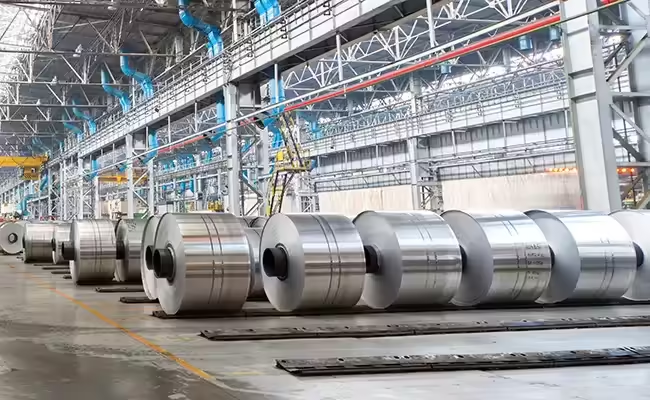
Vedanta Aluminium has outlined plans to significantly expand its production capacity over the next three years,positioning itself to meet rising domestic demand from infrastructure,transport, renewable energy and manufacturing sectors.

The company has indicated that it aims to increase annual output to around 6 million tonnes, making capacity expansion a central element of its long-term manufacturing strategy. Industry analysts view the move as part of a broader trend across India’s metals sector, where producers are investing in larger facilities to support the country’s infrastructure pipeline and strengthen its position in global manufacturing supply chains.The planned aluminium capacity expansion comes as demand for lightweight, recyclable metals continues to grow across multiple sectors. Aluminium is increasingly used in metro rail systems, electric vehicles, renewable energy equipment, transmission infrastructure, commercial buildings and modern housing because of its durability, corrosion resistance and lower weight compared with traditional materials.Market experts believe India’s infrastructure ambitions are likely to sustain long-term aluminium consumption.Government investment in logistics corridors, airports, railways, power transmission and clean energy projects has created favourable demand conditions,while manufacturing initiatives are encouraging greater domestic production of value-added metal products.However,the aluminium capacity expansion also highlights the industry’s sustainability challenge.

Aluminium production is among the most electricity-intensive industrial processes, making access to cleaner energy sources increasingly important. Environmental specialists argue that future capacity growth will need to be accompanied by greater adoption of renewable power, improved energy efficiency, responsible mining practices and enhanced recycling systems to reduce lifecycle emissions.Urban planners note that aluminium has an important role in building more resilient cities. Lightweight construction materials can improve transport efficiency, while recyclable metals support circular economy objectives by reducing dependence on virgin raw materials. Increased use of recycled aluminium in construction and manufacturing could also help lower the carbon footprint of future infrastructure projects.Industry observers add that capacity growth alone will not determine competitiveness. Companies are expected to invest simultaneously in downstream processing, advanced manufacturing technologies and supply chain integration to produce higher-value products for domestic and export markets. Such diversification can strengthen industrial resilience while creating skilled employment opportunities across manufacturing clusters.

At the same time, analysts caution that large-scale expansion projects require careful balancing of commercial objectives with environmental safeguards and community considerations. Water management, biodiversity protection and transparent environmental compliance are expected to become increasingly important as industrial projects expand across mineral-rich regions.Looking ahead, India’s aluminium industry appears well positioned to benefit from sustained infrastructure investment and the transition towards cleaner transport and energy systems. The long-term success of this growth, however, will depend on whether production increases are matched by advances in resource efficiency, renewable energy adoption and circular manufacturing practices.For India’s rapidly urbanising economy, expanding aluminium supply could strengthen the availability of critical materials needed for resilient infrastructure.Equally important will be ensuring that industrial growth contributes to lower-carbon development rather than increasing the environmental burden of future cities.

Also Read : India Aluminium Recycling Seeks Duty Reform
Vedanta Aluminium Growth Raises Sustainability Focus
RELATED ARTICLES

LEAVE A REPLY

Please enter your comment!
Please enter your name here

- Advertisment -spot_img

Most Popular

Recent Comments

India Cement Demand Lifts Limestone Market Outlook

India Cement Demand Lifts Limestone Market Outlook

India’s construction economy could face a gradual shift in the materials feeding its cement and industrial base as global limestone demand moves towards higher-quality...
Press Metal Outlook Shifts As Aluminium Supply Rises

Press Metal Outlook Shifts As Aluminium Supply Rises

Aluminium industry is heading towards a more uncertain supply cycle, with new smelting capacity in Indonesia and India expected to reshape global availability from...
India Steel Capacity Push Raises RERA Questions

India Steel Capacity Push Raises RERA Questions

India is preparing for a major expansion in steel-making capacity, with crude steel capacity projected to reach 300 million tonnes by 2030-31 and 400...
Delhi Najafgarh Land Deal Brings RERA Into Focus

Delhi Najafgarh Land Deal Brings RERA Into Focus

Max Estates is set to acquire control of nine land-owning companies holding about 84.71 acres in Sector 3, Najafgarh, marking its first residential land...
India Private Credit Shifts As RERA Shapes Real Estate

India Private Credit Shifts As RERA Shapes Real Estate

India’s private credit market deployed $3.5 billion across 102 transactions in the first half of 2026, with domestic lenders accounting for most of the...