HomeBricks & MortarChemicalIndia Chemicals Sector Targets A Bigger Global Role

India Chemicals Sector Targets A Bigger Global Role

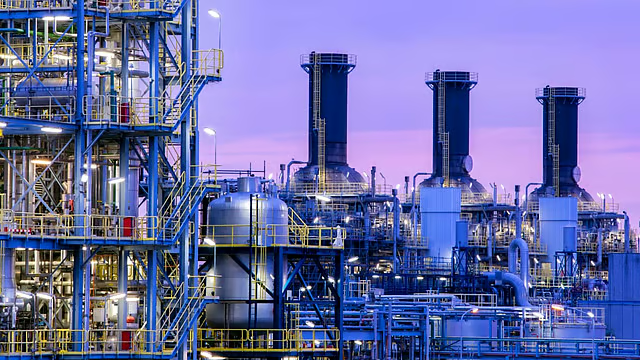
India’s chemicals industry is being positioned for a much larger role in global manufacturing, but reaching that scale will depend on closing gaps in infrastructure, technology and regulatory capacity. A recent policy assessment projects domestic chemical consumption could reach $290-310 billion by FY2030, putting pressure on producers and policymakers to expand supply while moving towards higher-value products and cleaner industrial systems.

The projected expansion would require chemical consumption to grow at roughly 10–11% annually, while production would need to rise about 14% a year. The ambition is significant because chemicals feed into construction, pharmaceuticals, agriculture, textiles, automotive manufacturing and consumer products. Growth in the sector therefore has implications far beyond chemical plants, affecting the cost and reliability of inputs used across India’s wider economy.A key opportunity lies in speciality chemicals, where India has been increasing exports to markets including the US, Brazil, Bangladesh and Japan. Yet its share of major global chemical import markets remains around 8%, suggesting substantial room to capture more value. The shift from commodity production towards speciality products could improve export earnings, but it requires stronger research capabilities, process technology and skilled labour.The policy challenge is equally important. India recorded a chemical trade deficit of about $31 billion in 2023, reflecting dependence on imported feedstock and speciality products.

NITI Aayog has also highlighted infrastructure constraints, high logistics costs, regulatory delays and comparatively low research spending as barriers to deeper participation in global value chains.Recent policy moves are aimed at some of these weaknesses. The Union Budget 2026–27 proposed support for three dedicated chemical parks, with ₹600 crore allocated in the year’s budget estimates. The planned parks are intended to provide shared infrastructure and common environmental facilities, potentially reducing the cost and time involved in establishing manufacturing capacity.For India chemical growth, however, physical expansion alone will not be enough. Chemical manufacturing can bring jobs and industrial investment to emerging regions, but poorly planned clusters can increase pressure on water, transport networks, waste systems and surrounding communities. Shared treatment infrastructure, resource efficiency and credible environmental monitoring will therefore be central to whether industrial expansion remains compatible with resilient cities.

The sector’s energy footprint adds another layer. Official data show that oil accounts for a substantial share of fuel use in India’s chemical and petrochemical industry. Greater use of renewable electricity, process efficiency and cleaner technologies could help reduce exposure to volatile energy costs while lowering industrial emissions.The next phase of India chemical growth will ultimately be measured by value captured rather than production volume alone. Stronger domestic supply chains, better technology, skilled employment and lower environmental intensity will determine whether India can expand its global position without transferring the costs of industrial growth to cities, workers and local ecosystems.

Also Read : DMCC Speciality Chemicals Sees Uneven Demand Recovery
India Chemicals Sector Targets A Bigger Global Role
RELATED ARTICLES

LEAVE A REPLY

Please enter your comment!
Please enter your name here

- Advertisment -spot_img

Most Popular

Recent Comments

India GCC Expansion Could Reshape Smaller Cities

India GCC Expansion Could Reshape Smaller Cities

India’s Global Capability Centre ecosystem is entering a broader geographic phase, with companies expected to establish nearly 1,380 new centres and generate about 1.18...
Delhi Real Estate Enters A New Density Era

Delhi Real Estate Enters A New Density Era

Delhi’s proposed Master Plan 2047 could alter the economics of land and housing by allowing greater development intensity around transit corridors, enabling redevelopment and...
India Housing Costs Rise As Valuations Change

India Housing Costs Rise As Valuations Change

India’s property market is being shaped by an administrative benchmark that rarely attracts attention until a home is bought or sold. Circle rates, the...
NCR Real Estate Seeks Consistent Project Relief

NCR Real Estate Seeks Consistent Project Relief

Delhi-NCR’s construction sector is seeking a common regulatory response to delays linked to the continuing West Asia conflict, with developers asking regulators in Delhi,...
DMCC Speciality Chemicals Sees Uneven Demand Recovery

DMCC Speciality Chemicals Sees Uneven Demand Recovery

DMCC Speciality Chemicals has entered the new financial year with a mixed operating picture, as stronger domestic demand and improving chemical realisations offset weaker...