HomeLatestMMR Housing Market Gains Ground As Demand Broadens

MMR Housing Market Gains Ground As Demand Broadens

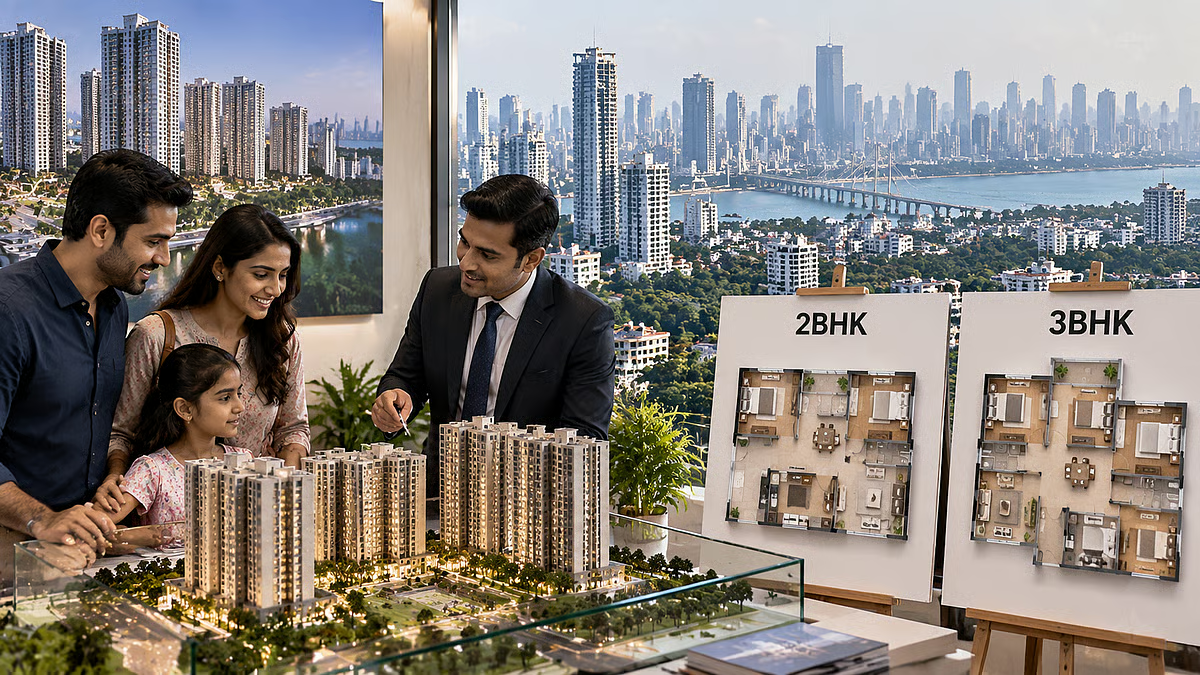
Mumbai Metropolitan Region has emerged as the largest Tier-1 housing market by primary sales value in the first half of 2026, overtaking NCR as demand expanded beyond Mumbai’s established core. The shift matters because housing growth is increasingly spreading into peripheral markets, putting transport, water, drainage and other urban systems under greater pressure.

The MMR housing market recorded about ₹93,800 crore in primary sales during H1 2026, an 8% year-on-year increase, while sales volumes rose around 9%. Its share of Tier-1 housing sales value reached 26%, compared with 19% for NCR, according to the September 2026 India Housing Report from NAR and CRE Matrix. The broader market was far less buoyant. Tier-1 cities together recorded roughly ₹3.63 lakh crore in primary housing sales, broadly matching the previous year’s record, while units sold declined about 2% to 2.58 lakh. At the same time, developers launched nearly 2.98 lakh homes, up 7%, indicating that new supply is growing faster than actual absorption.Within MMR, the pattern was not uniform. Mumbai’s sales value increased about 4% to ₹58,362 crore, while volumes stayed near 24,500 units. Its average ticket size reached ₹2.38 crore, up 4%, and homes priced at ₹5 crore or more represented roughly 40% of sales value. This shows that Mumbai continues to rely substantially on higher-value housing even as wider regional demand expands.

The stronger volume story came from Navi Mumbai and Raigad. Sales value there increased about 29% to ₹12,292 crore, with unit sales rising 20% to around 17,300. New launches climbed 29% to approximately 25,800 units. The data points to a wider geographic redistribution of housing demand rather than growth being concentrated solely within Mumbai.That expansion carries a significant urban planning question. Peripheral housing markets can offer more space and comparatively lower entry prices, but their long-term viability depends on whether employment, public transport, water networks, sewage systems, schools, healthcare and everyday services expand alongside residential construction.

NCR, meanwhile, recorded ₹68,217 crore in primary sales, down 24%, while volumes fell 9%. Gurugram’s sales value dropped about 33%, although unit sales remained broadly stable. The average ticket size there fell from ₹4.65 crore to ₹3.15 crore, alongside a reduced contribution from homes priced above ₹5 crore. For the MMR housing market, the next test is therefore not simply whether more homes can be sold. Sustained growth will increasingly depend on whether new residential districts develop as connected, service-ready communities, while supply remains aligned with genuine household demand rather than outpacing the infrastructure needed to support it.

Also Read : India’s Emerging Cities Redraw Real Estate Growth
MMR Housing Market Gains Ground As Demand Broadens
RELATED ARTICLES

LEAVE A REPLY

Please enter your comment!
Please enter your name here

- Advertisment -spot_img

Most Popular

Recent Comments

SAIL Coking Coal Project Links West Bengal Blocks

SAIL Coking Coal Project Links West Bengal Blocks

Steel Authority of India Ltd (SAIL) and Bharat Coking Coal Ltd (BCCL) have agreed to jointly develop two adjoining coking coal blocks in West...

India Steel Output Gains As Global Production Slips

India Steel Output Gains As Global Production Slips

India’s steel industry continued to expand in August even as global crude steel production contracted, highlighting the country’s growing role in the international steel...

India Orders Captive Coal Plants to Boost Grid Supply

India Orders Captive Coal Plants to Boost Grid Supply

India is turning to its industrial captive power base as electricity demand remains unusually high for September, with 112 coal-based generating stations ordered to...

Andhra Pradesh Clears Land for Cement Expansion

Andhra Pradesh Clears Land for Cement Expansion

Andhra Pradesh has approved 250 acres for the expansion of an integrated cement facility in YSR Kadapa district, enabling planned production capacity to reach...

Global White Cement Demand Shifts With Urban Design

Global White Cement Demand Shifts With Urban Design

The global white cement market is set for steady expansion through 2035 as architectural concrete, terrazzo, tile finishes and precast construction widen demand. The...