

Meghalaya Coal Sector Under Scrutiny After Arrests
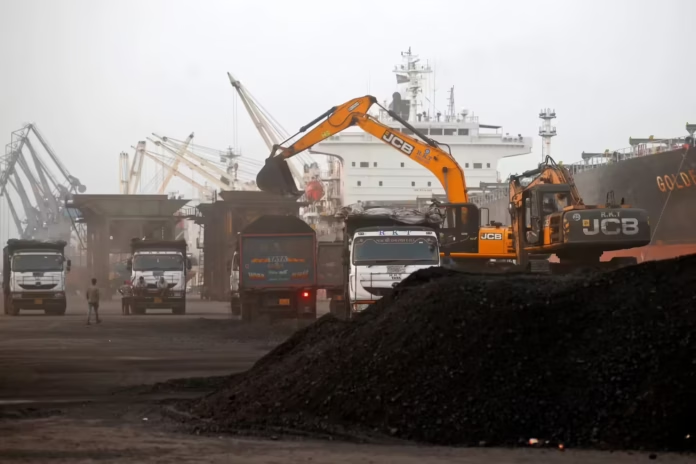
Meghalaya has collected a relatively small amount of goods and services tax (GST) from coal sales — just under ₹14 crore since 2018 — while state authorities have arrested multiple mine owners in an intensifying enforcement push against unlawful mining and transportation activities, Chief Minister Conrad K. Sangma told the state assembly on Monday. The disclosure highlights ongoing challenges in formalising mineral value chains, balancing fiscal outcomes and tackling environmental and safety risks tied to coal extraction in the state’s hilly districts.
In a written response to a legislative query, the Chief Minister said Meghalaya’s cumulative GST revenue from coal transactions stood at ₹13,87,77,996 from 2018 through early 2026, a figure drawn from registered coal traders rather than mine owners themselves. Of the 574 GST-registered coal traders in the state, only three are active mine owners with official tax registration, indicating a sharp imbalance in formal compliance across the sector.Meghalaya revised its GST rate on coal from 5 per cent to 18 per cent in September 2025, but the full revenue impact remains unclear because no auctions of coal blocks were conducted in October and November of that year, and filings for December’s returns were not yet completed at the time of the assembly session. Officials caution that comparative assessments of year-on-year revenue performance will only be possible once returns are lodged and verified.
The modest revenue figures come amid stepped-up actions against illegal mining in the East Jaintia Hills, where a February mine blast at an unauthorised site killed dozens and triggered intensified policing and judicial scrutiny. Recent operations by state police and enforcement agencies have led to the seizure of over 17,000 metric tonnes of illegally mined coal and explosive materials from abandoned sites, alongside dozens of FIRs and multiple arrests linked to unlawful extraction and transportation.Fourteen mine owners have been formally arrested since 2018 in operations targeting illicit coal activities — a development underscoring the persistence of unregulated mining despite formal auction processes and mineral resource governance frameworks. State authorities have yet to provide an official tally of all illegal mining sites, but the assembly response suggested the number of unregistered operations remains material.
Urban and environmental experts say the coal sector’s regulatory challenges resonate well beyond tax tables. In Meghalaya’s steep terrain, informal coal mining — often referred to locally as “rat-hole” mining — has long raised concerns about ecosystem degradation, watercourse disruption and disaster risks. The deadly blast earlier in February highlighted the human cost of lax oversight and the need for rigorous safety frameworks tied to mining licences, environmental approvals and community protection measures.For fiscal planners, the state’s relatively low GST yield from coal suggests a gap between the resource’s economic footprint on the ground and its contribution to public revenue. While the recent GST rate uplift aims to strengthen tax receipts, sustainable revenue growth will depend on expanded formalisation of miners and traders, improved auctioning processes and digital monitoring of extraction and sales. Analysts caution that without such structural reforms, future state revenue forecasts — especially those linked to natural resource sectors — may continue to underperform relative to potential.
Looking ahead, balancing economic, environmental and social imperatives will be key as Meghalaya’s policymakers aim to integrate mineral resource governance with broader development goals. Robust enforcement, transparent auction frameworks and community engagement could help reduce illegal mining while supporting safer, more accountable resource utilisation in the hill state.
Also Read: SECL Plans 75 Million Tonnes Coking Coal Output
Meghalaya Coal Sector Under Scrutiny After Arrests
SECL Plans 75 Million Tonnes Coking Coal Output

South Eastern Coalfields Ltd (SECL), one of India’s largest coal producers and a key subsidiary of Coal India Limited, is targeting an ambitious ramp-up of coking coal output to around 75 million tonnes in coming years, according to industry projections and officials familiar with the strategy. The focus on metallurgical coal — critical for the steel sector — reflects broader pressures on domestic energy security and industrial supply chains as the country navigates its twin goals of economic growth and sustainable transformation.
Coking coal, a high-grade variety used in steelmaking, remains in high demand in India’s growing manufacturing economy. Domestic production has historically lagged consumption for this grade, leading to significant imports and supply volatility. Government policies such as the “Mission Coking Coal” aim to boost indigenous output significantly over the medium term.SECL’s strategic focus on scaling coking coal aligns with this national objective. In the broader Coal India group, domestic coking coal output was approximately 66.47 million tonnes in the 2024-25 period, accounting for a modest share of total raw coal production. Given this backdrop, SECL’s plans signal an effort to assert more control over supply for critical downstream sectors such as steel and heavy engineering, reducing dependence on imports and enhancing price stability across value chains.
The company’s flagship Gevra open-cast mine in Korba district, already among the world’s most productive coal blocks, has received environmental clearance for expanded capacity to 70 million tonnes annually and is targeting incremental output growth over the next fiscal years. While Gevra primarily produces thermal coal, expansion investments and infrastructure enhancements — including rail connectivity and rapid loading facilities — underpin SECL’s broader ambition to serve both thermal and metallurgical coal markets more robustly.Domestic industry stakeholders have emphasised that reliable coking coal supplies are essential for India’s aspirations in steel production, which underpins infrastructure, urban construction and heavy machinery sectors. The re-orientation toward higher output supports decarbonisation pathways by enabling steelmakers to plan long-term investments in cleaner processing technologies, including coke ovens and alternative reduction processes. Observers note that a strengthened domestic coking coal base could also catalyse private sector participation in beneficiation and washery infrastructure, improving fuel quality and reducing carbon intensity in steel value chains.
However, challenges remain. Expanding coking coal extraction at scale requires sustained regulatory engagement, land acquisition, and careful environmental management, particularly in ecologically sensitive coalfield regions. The pace and scale of infrastructure upgrades — including coal handling plants, washery expansions and evacuation corridors — will be decisive factors in SECL’s ability to meet its 75 million-tonne ambition.Environmental advocates and urban planners highlight another tension: while coal will likely remain a significant energy and industrial feedstock in the near term, its environmental footprint — including greenhouse gas emissions and particulate impacts — complicates India’s broader climate commitments. This underscores the need for parallel investments in carbon mitigation technologies, cleaner processing methods and diversification of energy sources.
Looking ahead, SECL’s strategic emphasis on coking coal expansion will be closely watched by steelmakers, policymakers and infrastructure planners. Its capacity to balance industrial demand with sustainable practices will shape how effectively India can meet the needs of its urbanising economy while navigating the energy transition.
Also Read: India Brick Farmhouse Showcases Curved Patterned Walls
SECL Plans 75 Million Tonnes Coking Coal Output
India Brick Farmhouse Showcases Curved Patterned Walls

A rural residence near Indore, Madhya Pradesh, is drawing notice in design circles for its innovative use of curved brickwork that marries traditional materiality with contemporary spatial expression. The farmhouse design reflects a growing interest in regionally grounded architecture that prioritises passive performance, material honesty and contextual harmony in both rural and peri-urban settings — signalling how vernacular elements can be reinterpreted for today’s climate and lifestyle demands.
Designed by architect Manoj Patel, the single-storey structure employs locally sourced bricks laid in expressive, curvilinear patterns to create facades that balance solidity and porosity. The result is a series of sweeping walls that guide light, air and movement while grounding the building within its agricultural landscape. This approach illustrates how clay brick — a ubiquitous material across India’s built environment — can be reshaped into artful yet functional architectural expression without sacrificing constructability or environmental logic. The curved walls respond not only to aesthetics but also to climate and site conditions. In a region characterised by hot summers and intense sun, thoughtful orientation and wall articulation help reduce unwanted solar heat gain and channel prevailing breezes, contributing to passive thermal comfort. Internally, courtyards and shaded interstitial spaces create transitional zones that support cross-ventilation and encourage outdoor-indoor living, consistent with sustainable design principles common in traditional Indian architecture.
Urbanists and sustainable design advocates see such projects as important precedents for affordable, climate-responsive housing models. As India’s cities densify and peri-urban lands absorb new development, architects are increasingly looking to low-carbon materials like brick, stone and earth — combined with intelligent form-making — to reduce embodied energy and enhance building performance. In this context, the farmhouse’s curved brick walls can be read as part of a broader move toward resilient design practices that look beyond glazed facades and steel frames.While the project draws inspiration from rural modes of construction, it also adopts contemporary detailing. Exposed brick surfaces are complemented by recessed openings and deep reveals that generate shade and depth. The tactile quality of the brick — its warmth, texture and craftsmanship — brings a human scale to the residence, enhancing occupant comfort and connection to place. This blending of craftsmanship with design rigour offers insights into how small-scale residential projects can inform larger housing and community architectures.
Construction on the farmhouse showcases how brickwork can be both structural and expressive, allowing for economies in construction while unlocking visual richness. Local builders, trained in conventional masonry, were able to adapt to the design’s geometric complexity with minimal specialised tooling — a significant point for scalability in rural or resource-constrained regions.Critically, the farmhouse’s material strategy aligns with carbon-responsive building trends. Clay brick production, when sourced regionally and baked using cleaner kilns or alternative fuels, can present a lower-carbon alternative to energy-intensive concrete and steel elements. Projects like this foreground the potential of vernacular materials to contribute to India’s broader goals of sustainable, climate-resilient construction.
As rural and peri-urban India continues to evolve architecturally, this farmhouse exemplifies how deeply contextual design — rooted in local materials, climatic logic and cultural patterns — can elevate everyday buildings into enduring, environmentally attuned places.
Also Read: Hyderabad Construction Sector Faces Supplier Fraud
India Brick Farmhouse Showcases Curved Patterned Walls
Hyderabad Construction Sector Faces Supplier Fraud

An infrastructure contractor has reported a substantial financial loss exceeding ₹1 crore after being deceived by individuals posing as legitimate construction material suppliers, highlighting emerging risks in procurement practices within India’s construction supply chains. The case, now under criminal investigation, underscores the challenges infrastructure firms face in verifying vendor credentials amid rapid project expansion and complex supply networks.
Officials at the city’s Central Crime Station (CCS) confirmed that a formal complaint was filed by the director of a Hyderabad-based infrastructure firm alleging that a group of intermediaries and purported suppliers accepted multiple payments for bulk materials that were never delivered. During late 2025, the firm made five payments totalling more than ₹1 crore after receiving what appeared to be valid electronic invoices and waybills via messaging apps.Investigation records show the fraud began when an agent connected the infrastructure company with a supplier who initially fulfilled a small order, building trust before introducing additional parties and redirecting larger procurements to an entity based in another city. Subsequent communications and documentation encouraged timely payments, but deliveries never occurred and subsequent follow-ups were ignored.
As India’s construction and infrastructure sectors scale, large-value procurement of materials such as cement, steel, and aggregates has become more frequent and decentralised. Sector analysts note that while digital tools like e-invoicing and e-way bills were introduced to enhance transparency and traceability, they are not always sufficient to prevent sophisticated fraud schemes without robust vendor verification and real-time supply monitoring.The alleged scam has prompted police action under multiple sections of the Bharatiya Nyaya Sanhita, including cheating, forgery, and criminal conspiracy against the accused and unidentified collaborators. Law enforcement sources indicate that efforts to locate the main suspects — who reportedly relocated across states — are ongoing and the investigation will explore how the fraud was orchestrated and concealed.
Construction industry observers say this case reflects broader vulnerabilities in supply chain governance within India’s infrastructure ecosystem. Rapid project timelines, reliance on informal intermediaries, and limited integration between procurement and quality assurance systems can create gaps that unscrupulous actors exploit. Larger firms often manage layered vendor networks across regions, but smaller contractors and subcontractors may lack the due diligence resources needed to validate partners comprehensively.The implications are not confined to financial loss. Such incidents can delay project execution, disrupt material availability, and strain relationships with genuine suppliers. For public-sector contracts, these risks can affect compliance with delivery schedules and overall project costs, potentially diminishing infrastructure quality and fiscal efficiency.
Urban planners and procurement specialists suggest that stronger digital platforms, real-time tracking of material dispatches, and stricter supplier audits could mitigate such fraud risks. Enhanced use of blockchain-based documentation and authenticated supply-chain records are among the technological approaches being explored by larger infrastructure firms.As the investigation progresses, authorities and industry stakeholders will likely examine how procurement protocols and verification standards can be strengthened to protect companies and preserve confidence in India’s infrastructure markets.
Also Read: Vividobots Advances Smart Facade Robots For Highrise Care
Hyderabad Construction Sector Faces Supplier Fraud
Vividobots Advances Smart Facade Robots For Highrise Care

India’s boom in tall buildings and integrated urban infrastructure has catalysed a new wave of industrial automation aimed at solving complex maintenance challenges. Vividobots Pvt. Ltd., an emerging robotics startup, has developed autonomous systems designed to paint and clean the exteriors of high-rise structures — a domain traditionally dominated by manual labour and elevated safety risks. This shift highlights a broader trend toward technology-enabled, safe and efficient building upkeep within India’s expanding real estate and urban services market.
The startup’s solution portfolio includes two core products, with Wiperque already deployed in the field. These robots are engineered to navigate building facades, executing tasks such as washing, sweeping and surface maintenance with minimal human intervention. By integrating machine vision, sensors and control algorithms, the machines can adapt to complex geometries of modern high-rise exteriors — a significant step forward from the harness-dependent methods that have historically exposed workers to fall hazards and inconsistent performance.Urban planners and property developers view such innovations as strategic enablers for long-term asset management. With India’s urban population projected to account for more than half the country’s total by the mid-2030s, the demand for reliable maintenance of tall buildings and mixed-use complexes is intensifying. Robots capable of autonomously scanning and servicing facades not only improve safety outcomes but also support predictive maintenance regimes that preserve building performance over decades — aligning with sustainability and asset-resilience goals that cities increasingly prioritise.
From a business perspective, automating facade maintenance could reshape service models across the construction and real estate sectors. Traditional facade cleaning and repainting operations often require suspended platforms, safety rigging and skilled technicians, which add cost and project variability. By contrast, robotic systems offer structured data capture and repeatable quality outcomes across multiple job cycles — features that are gaining attention among institutional realty managers and facility management firms. Sector analysts suggest this could lead to new contractual frameworks tied to performance metrics, such as facade condition indices and cleaning frequency benchmarks.However, challenges remain on the path to widespread adoption. Cost considerations, integration with existing maintenance workflows, and the need for industry standards around autonomous operation in urban environments are key factors that will determine market pace. Moreover, developers and city authorities must weigh regulatory frameworks for deploying such technology in dense metropolitan areas, from safety certification to public liability considerations.
Looking ahead, innovations like those from Vividobots have the potential to influence not just how buildings are kept clean but also how urban environments are maintained sustainably and safely. As Indian cities expand vertically and horizontally, technology solutions that reduce risk, improve efficiency and enable data-driven planning will play an increasingly central role in shaping equitable and resilient urban development.
Also Read: Leotronic Scales Expands India Weighbridge Automation
Vividobots Advances Smart Facade Robots For Highrise Care
Leotronic Scales Expands India Weighbridge Automation
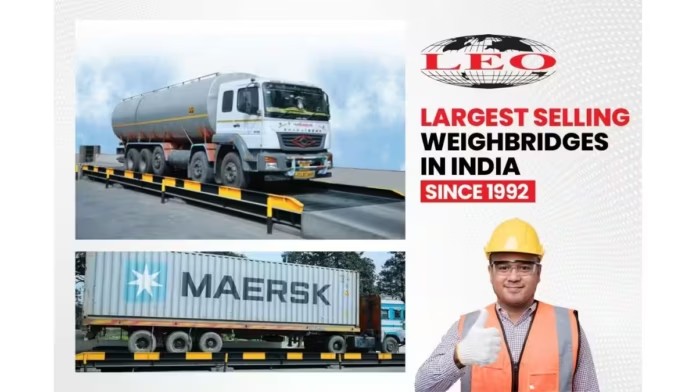
India’s industrial logistics backbone is entering a new digital phase as India weighbridge automation gathers momentum across cement, steel, mining and bulk-material sectors. The transition from manual weighbridge operations to intelligent, unmanned systems is reshaping how industries monitor material flows, control costs and ensure regulatory compliance — with companies such as Leotronic Scales Pvt Ltd emerging as key players in this transformation.
Weighbridges — heavy-duty platforms used to measure loaded trucks — are critical to industries dependent on bulk dispatch and procurement. Historically, these installations relied on manual supervision, paper-based documentation and fragmented data capture. However, as industrial supply chains grow more complex, India weighbridge automation is becoming central to improving accuracy, transparency and operational speed.Leotronic Scales has expanded its portfolio of RFID-enabled, software-integrated and unmanned weighbridge systems that automate vehicle identification, weight capture and digital reporting. These systems are designed to integrate with enterprise platforms such as ERP and SAP environments, allowing real-time synchronisation of dispatch, billing and inventory data. Industry experts note that such integration reduces revenue leakage, limits human error and enhances audit trails.
The shift is aligned with a broader digital push across India’s infrastructure-linked sectors. Cement plants, steel mills and mining operators are under pressure to improve throughput efficiency while maintaining compliance with statutory load norms and environmental reporting frameworks. Smart weighbridge systems provide continuous monitoring, automated gate control and centralised dashboards, allowing management teams to track logistics activity remotely.Urban development observers say the implications extend beyond industrial efficiency. As infrastructure construction scales across states, accurate measurement of bulk materials influences cost estimation, taxation compliance and contract execution. Transparent weight records also contribute to better road safety enforcement by discouraging overloaded freight movement — a persistent concern in high-growth corridors.
However, adoption is not without challenges. Upgrading legacy weighbridge infrastructure requires capital expenditure and digital training. Integration with older enterprise systems can be complex, and cybersecurity safeguards must be embedded as operational technology becomes increasingly connected to cloud-based platforms.Even so, analysts believe the structural direction is clear. Automation of weighing infrastructure is becoming a competitive differentiator, especially for companies operating multi-location plants or high-volume dispatch networks. As India modernises its industrial logistics systems, firms investing early in digital weighbridge solutions are likely to benefit from stronger process control and improved cost visibility.
The coming years will determine how quickly the ecosystem scales — but the trajectory suggests that India weighbridge automation will play a meaningful role in strengthening industrial productivity and supply-chain transparency nationwide.
Also Read: Faridabad Ready Mix Cement Plant Faces Enforcement Action
Leotronic Scales Expands India Weighbridge Automation
Faridabad Ready Mix Cement Plant Faces Enforcement Action

A ready-mix concrete (RMC) unit in Sector 89 of Faridabad was abruptly halted by environmental authorities after being found operating on revenue land without mandatory environmental and statutory clearances, underscoring persistent gaps in urban industrial governance and environmental safeguards in peri-urban growth corridors. The incident has resonated with residents and planners alike as rapid city expansion collides with compliance enforcement.
Joint teams from the Haryana State Pollution Control Board (HSPCB) and the state chief minister’s flying squad carried out a surprise inspection on Saturday, following repeated complaints from local villagers about dust, noise and other nuisances linked to the plant’s operations. Preliminary inquiries suggest that the facility lacked both Consent to Establish (CTE) and Consent to Operate (CTO) certifications — basic environmental licencing requirements for any concrete manufacturing or batching operation in an urban fringe setting.Officials say the plant was functioning on revenue-classified land in Bhupani village without clear land-use reclassification or environmental sanction. In rapidly urbanising districts such as Faridabad, where residential development and industrial activity share porous boundaries, such unauthorised operations can exacerbate air quality issues and place additional strain on civic services. Urban planners note that enforcing land-use plans and industrial clearances is critical not only for environmental quality but also for public health and infrastructure resilience.
During the inspection, enforcement teams observed that basic pollution control measures — such as dust suppression systems, paved haul roads and sealed storage facilities — were absent. “No effective dust mitigation or material containment measures were implemented,” a senior regulatory official said, noting the potential for fugitive emissions to impact neighbouring communities. Authorities have served a formal notice prohibiting further operations and are considering environmental compensation and other penalties pending a detailed investigation.Urban development experts say the episode highlights broader systemic challenges. Faridabad’s transition from industrial hinterland to mixed-use urban district has outpaced the capacity of monitoring agencies to enforce compliance on scattered small-scale industrial units. This gap is especially concerning given the city’s selection under national and state urban missions, which aim to balance growth with sustainability and citizen well-being. Compliance lapses in industrial land use can undermine efforts to improve air quality, align with climate resilience goals, and deliver equitable urban services.
Residents in adjacent sectors have called for clearer accountability and better integration of land records with environmental approvals, echoing wider calls in the National Capital Region for harmonised development governance. “We want growth that respects our health and environment,” said a community representative, reflecting a sentiment shared by many long-term residents.
As enforcement agencies prepare to tighten scrutiny, the plant case may serve as a bellwether for how Haryana’s urban fringes manage the intersection of industrial activity, land governance and environmental compliance. The coming weeks will be critical in determining whether regulatory action translates into systemic improvements in permitting, monitoring and enforcement.
Also Read: India Cement Industry Sees Growth On Infrastructure Push
Faridabad Ready Mix Cement Plant Faces Enforcement Action
India Cement Industry Sees Growth On Infrastructure Push

India’s cement industry is poised for a firmer growth trajectory into fiscal year 2027, underpinned by resilient demand trends, firmer price realisations and an expanded government capital expenditure envelope in the latest budget, industry analysts say. The outlook is significant for infrastructure planning and housing markets, as cement remains a core barometer of economic activity and urban expansion.
A recent sector analysis by a prominent domestic brokerage highlights that cement volumes and price indices have gained traction since late 2025, signalling strengthening absorption across key regional markets. Despite subdued investment from central public sector enterprises early this financial year, elevated state government capex has provided a meaningful offset. This shifting composition of government demand reinforces the sector’s link to diversified infrastructure execution.Industry participants underline that the allocation for capital expenditure in the FY27 national budget – higher than in the current year – should bolster pipeline activity for roads, bridges and urban utilities. In sectors such as transportation and urban water infrastructure, spill-over effects on cement consumption are typically pronounced, shaping demand beyond residential construction.
However, the sector continues to feel the drag from a softer real estate cycle. Data from late 2025 show housing launches declined on an annual basis, reflecting cautious developer sentiment amid tighter financing conditions and inventory overhangs in peripheral urban markets. This weakness in property activity tempers the overall demand outlook, even as public capex sustains momentum.Analysts point to the improving pricing environment as a key linchpin for sector profitability. After a period of downward pressure on cement prices in late 2025, gradual pricing correction has taken hold, improving revenue per tonne and aiding margins. For producers, stabilising prices help underwrite return on recent capacity additions and offset cost pressures.
Beyond fiscal support, private sector capital expenditure and manufacturing expansion plans continue to shape medium-term capacity dynamics. Cementmakers are deploying funds into upgrades and new lines to ensure proximity to demand centres, optimise logistics, and improve energy efficiency — a growing concern given the industry’s carbon intensity. These investments align with broader infrastructure goals such as the National Infrastructure Pipeline, which integrates sustainability and resilience parameters into project planning.From an urbanisation perspective, cement remains a backbone commodity. Its demand trajectory often signals how well cities and growth corridors are progressing on housing delivery and public works. As India targets a more balanced, climate-resilient urban expansion, diversified demand drivers — from rural connectivity to metropolitan mass transit — will be crucial to sustaining the sector’s recovery.
Going forward, industry stakeholders will watch closely how capex roll-outs unfold on the ground and whether private real estate investment rebounds. Those trends, combined with cost structure improvements and environmental transition strategies, will shape the cement industry’s contribution to India’s infrastructure ambitions in FY27 and beyond.
Also Read: Pune Developer Introduces Zero Cost Housing
India Cement Industry Sees Growth On Infrastructure Push
Pune Developer Introduces Zero Cost Housing
