
Mumbai Residential Pre Sales Rise Forty Four Percent In First Half FY26
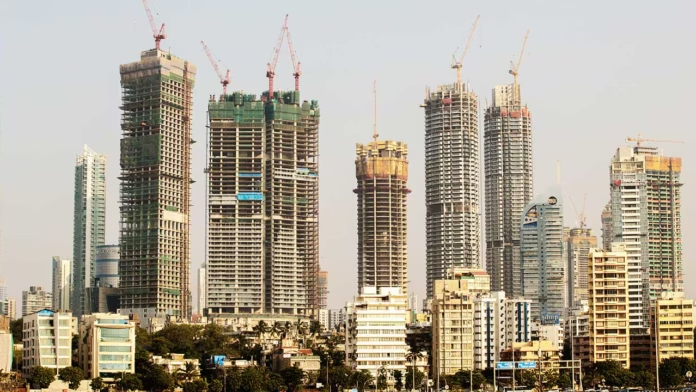
On a broader scale, Q2FY26 witnessed only an 11% year-on-year rise in pre-sales volumes, largely driven by higher prices rather than transaction volumes. Bengaluru and Hyderabad showed robust gains, whereas the Mumbai Metropolitan Region and the National Capital Region saw slight declines. Listed developers continue to pursue land acquisitions and geographic expansion to maintain long-term growth pipelines. Strong collections and earlier fund-raising have kept debt levels manageable, supporting ongoing business development.
Navi Mumbai CIDCO Launches Four Thousand Five Hundred Eight Ready Homes Scheme

The City and Industrial Development Corporation (CIDCO) has launched a First-Come-First-Serve (FCFS) scheme for 4,508 ready-to-move-in homes in Navi Mumbai, signalling a significant push in urban housing availability. The initiative, which opened for applicants on 24 November 2025, aims to provide immediate occupancy options for middle-income and working professionals, addressing both affordability and convenience in one of India’s fastest-growing urban corridors.
According to CIDCO officials, the scheme covers multiple residential complexes across key nodes of Navi Mumbai, including Vashi, Nerul, and Kharghar, which are well-integrated with public transport and city infrastructure. “The objective is to offer families ready homes that reduce lead time in relocation while encouraging sustainable urban growth,” said a senior CIDCO planner. Each unit has been constructed adhering to contemporary building standards, including efficient space utilisation, water management, and energy-conscious design practices.
Navi Mumbai has long been promoted as a satellite city designed for equitable urban development. Its connectivity through the Sion-Panvel Highway, Mumbai–Pune Expressway, and local rail links allows residents to access employment hubs in both Mumbai and Thane efficiently. Urban analysts note that ready-to-occupy schemes like this are particularly attractive to buyers seeking to avoid prolonged construction delays, while also aligning with city planning norms that prioritise mixed-use, walkable neighbourhoods.
The FCFS mechanism allows applicants to select units on a first-come-first-served basis, simplifying the allocation process and enhancing transparency. Industry experts highlight that such schemes can boost market confidence by providing immediate residential solutions, especially for professionals relocating to the city’s IT, commercial, and service sectors. Furthermore, the availability of pre-constructed homes reduces speculative demand and encourages sustainable property utilisation.CIDCO’s emphasis on readiness and accessibility aligns with broader urban policy objectives in the Mumbai Metropolitan Region, which increasingly focus on sustainable housing solutions, climate-conscious building practices, and inclusive city planning. The residential nodes under this scheme are strategically located near public amenities such as schools, healthcare facilities, and retail centres, supporting quality-of-life improvements alongside rapid urbanisation.
For prospective homebuyers, the launch represents a rare opportunity to acquire fully compliant, move-in ready units without the typical waiting periods associated with new constructions. Analysts predict strong demand for these homes, driven by Navi Mumbai’s growing appeal as a self-contained urban ecosystem offering both professional opportunities and residential convenience.As CIDCO continues to expand housing initiatives, observers emphasise the importance of integrating these developments with sustainable transport options and green urban planning. This approach not only meets immediate housing needs but also supports long-term resilience in Navi Mumbai’s rapidly evolving urban landscape.
Navi Mumbai CIDCO Launches Four Thousand Five Hundred Eight Ready Homes Scheme
Rakesh Roshan buys ₹19.7 crore of Mumbai commercial units in Andheri East

Mumbai’s commercial property market recorded another high-value transaction this month, with a prominent film industry family purchasing multiple office units in Andheri East. According to property records filed with the Maharashtra registration department, five commercial spaces within the same building were acquired for a combined consideration of nearly ₹19.7 crore. The deal underscores the continued strength of the Andheri East micro-market, a district that has evolved into one of Mumbai’s most sought-after business corridors.
The transactions were executed across November and pertain to units in Vaidya West World One Aeropolis, a commercial development located close to the Western Express Highway. Industry analysts say this cluster has gained traction over the past decade, especially among entrepreneurs, production houses, and mid-sized firms looking for a balance of accessibility and affordability compared with the city’s traditional central business districts. An official tracking Mumbai’s commercial property trends said the area’s transport integration and rising Grade A supply have pushed demand to levels comparable with Powai and the Andheri–Kurla belt.
Andheri East is strategically positioned at the intersection of major mobility networks rail, metro, and road linking it directly to business hubs such as BKC, Vile Parle, Goregaon, and Powai. The locality also benefits from its proximity to the international airport and a concentration of hotels, IT parks, and industrial estates. Urban planners note that this connectivity plays a crucial role in shaping inclusive, high-density commercial precincts where mixed-use development supports walkable access to workplaces and public services.The property documents reveal that the acquired units vary in size from around 1,089 sq. ft. to more than 2,000 sq. ft., each including two parking spaces an amenity that carries significant value in a transit-rich yet congested neighbourhood. Stamp duty charges for the deals ranged between ₹16.98 lakh and ₹31.71 lakh, in line with state regulations.
Real estate experts say such purchases reflect a broader trend of high-net-worth buyers favouring commercial assets over residential ones, particularly in well-connected Mumbai districts. They add that the shift is also fuelled by the long-term rental stability offered by offices in transit-linked corridors. With the acceleration of infrastructure projects such as the Metro Line 7, the Sahar Elevated Road, and planned airport-area upgrades, Andheri East is expected to retain its appeal for both institutional and individual investors.
The growing demand also raises questions about equitable urban development. While commercial expansion brings employment and economic dynamism, planners emphasise the need for adequate public transport capacity, pedestrian infrastructure, and climate-resilient building standards to ensure human-centred growth.As Mumbai continues to reconfigure its commercial geography, transactions of this scale highlight the emergence of decentralised business hubs that distribute economic opportunity across the city. For residents and workers, the challenge remains ensuring that rapid commercialisation is matched with inclusive and sustainable urban design.
Rakesh Roshan buys ₹19.7 crore of Mumbai commercial units in Andheri East
Mumbai Sees Tata Launch Titanium Specialised Investment Fund With Hybrid Strategy

Tata Asset Management has introduced a new hybrid investment product aimed at investors seeking more flexible tools to navigate uncertain markets. The Titanium Specialised Investment Fund (SIF), launched under Tata Mutual Fund, opens for subscription on 24 November and seeks to blend equity, debt, and derivatives exposure through a structured long–short strategy. Industry observers say the move reflects growing demand in Indian cities for sophisticated wealth products that can adapt to shifting economic cycles.
The scheme is targeted primarily at high-risk investors, requiring a minimum commitment of ₹10 lakh at the PAN level across all SIF offerings of the asset manager. According to the scheme documentation, the Titanium SIF will maintain balanced exposure across equity and debt, with each category holding at least 25 per cent allocation. Short strategies will be capped at 25 per cent of the portfolio, allowing fund managers to hedge risk while attempting to capture market rallies.An official familiar with the product structure said that the design enables participation in upturns through long positions while protecting capital during volatile periods. “Urban investors increasingly expect funds that can respond to market shifts without excessive concentration,” the official added, noting that the long–short approach also allows for more measured risk-taking in an economy where interest cycles, inflation, and sectoral reforms remain unpredictable.
The fund may also invest in Real Estate Investment Trusts (REITs) and Infrastructure Investment Trusts (InvITs), which have become important instruments for financing urban infrastructure and real estate development. Analysts say these asset classes align with the broader push for inclusive and well-governed city-building, where transparent financing models are essential to long-term sustainability.Each unit of the Titanium SIF will be offered at a face value of ₹10 during the New Fund Offer window, and additional investments can be made in multiples of ₹1 thereafter. The fund’s mandate allows exposure to domestic equities, debt, securitised instruments, money market tools, and derivatives for both hedging and non-hedging purposes. Overseas securities may also be included, subject to regulatory limits prescribed by the Securities and Exchange Board of India and the Reserve Bank of India.
Market experts note that hybrid long–short products are gradually gaining traction among investors in metropolitan areas, who face diverse financial needs ranging from housing affordability to long-term urban infrastructure transitions. The ability to smooth returns across cycles, they say, is particularly relevant as Indian cities work toward climate-resilient growth, where economic stability supports broader sustainability objectives.
While the Titanium SIF is not explicitly labelled as an ESG product, its inclusion of REITs, InvITs, and regulated debt instruments indirectly supports capital flows into urban development. For many investors, this offers a blend of potential performance and participation in the country’s evolving urban landscape. With the NFO closing on 8 December, investor response over the coming weeks will be closely watched. Analysts expect interest from affluent urban households and family offices exploring structured products that balance risk with steady, long-term outlooks.
Mumbai Sees Tata Launch Titanium Specialised Investment Fund With Hybrid Strategy
Mumbai Realty Stock Sees Sharp Open Interest Surge Amid Continuous Price Decline

Oberoi Realty witnessed a marked rise in derivatives activity this week, even as its share price continued to soften in a broader market downturn. The Mumbai-based developer saw open interest climb more than 12 per cent over recent sessions, signalling a shift in trader positioning at a time when the real estate sector is navigating softer sentiment and a recalibration of demand.
Market data shows a steady build-up of futures and options positions, with traders adding more than 2,400 contracts across the derivatives chain. Analysts tracking the counter noted that the fresh open interest, accompanied by muted rollovers, indicates new directional bets rather than routine adjustments. “This pattern is consistent with expectations of near-term volatility,” said a derivatives strategist, adding that the bias appears skewed towards short positions given the parallel decline in the underlying price.
Oberoi Realty’s stock has fallen for five consecutive sessions, slipping close to five per cent over the period. Intraday trade on the latest session saw the price drift towards the lower end of the day’s range, with the weighted average settling near the day’s low. Market experts point out that the stock has now slipped below all major moving averages, reinforcing signals of a persistent bearish trend. Delivery volumes have weakened sharply, falling more than 45 per cent below the five-day average. This, according to market watchers, points to hesitation among long-term investors who typically anchor price stability. Reduced delivery-based buying often suggests a temporary retreat in confidence, particularly when paired with high derivatives activity. Liquidity, however, remains strong enough to support moderate institutional participation, aided by consistent trade flows through the futures and options market.
While the surge in open interest may reflect caution, some traders are also positioning for a potential reversal through options-based strategies. Market participants note that the disproportionate rise in options notional value suggests higher interest in volatility plays, hedging, and selective accumulation. An equity analyst said that such behaviour is common in periods when sectoral indicators show stress but the long-term outlook remains intact.For Mumbai’s real estate ecosystem, the stock’s movement is often read as a proxy for investor sentiment in urban housing and commercial developments. With developers under pressure from financing costs, regulatory compliance, and the push towards more sustainable and resilient building practices, market volatility tends to mirror underlying structural shifts. Analysts argue that companies adapting quickly to low-carbon construction norms and equitable urban design principles may inspire more stable investor confidence.
As cities like Mumbai continue expanding vertically and rapidly, real estate counters will remain sensitive to policy cues, interest-rate changes, and broader economic momentum. For now, market participants are likely to watch Oberoi Realty’s price behaviour closely, looking for signs of consolidation or sustained weakness before revising their strategies. A clearer trend may only emerge once delivery volumes stabilise and derivatives flows show a more balanced pattern.
Mumbai Realty Stock Sees Sharp Open Interest Surge Amid Continuous Price Decline
Mumbai Homebuyers Question Premium Views As Winter Pollution Reduces Scenic Visibility Citywide

Mumbai’s mid and luxury housing market continues to witness strong demand for apartments promising scenic views from seafront homes in the city’s southern stretches to forest-facing towers near the Sanjay Gandhi National Park. Yet, an emerging counter-narrative is gaining traction on social media, where residents argue that these postcard-worthy vistas often lose their appeal during winter as poor air quality reduces visibility and turns prized views into hazy skylines.
Real estate consultants confirm that buyers routinely pay a premium for the promise of a cleaner, greener outlook. Homes overlooking mangroves, creeks, forests or the sea can cost significantly more than units in the same project facing internal roads or surrounding buildings. A consultant based in Mumbai’s eastern suburbs said that buyers may spend an additional ₹30 lakh for an apartment overlooking mangroves in certain locations. At the higher end of the market, developers in the western suburbs price forest-facing homes at ₹20–40 lakh more than comparable units with obstructed views.
This premium, consultants say, reflects a growing aspiration for openness in an increasingly dense city. For many buyers, a view represents access to light, ventilation and a sense of connection to nature qualities that enhance wellbeing and compensate for limited public green spaces. “A balcony with a view, whether of water or trees, is an emotional purchase,” a senior consultant said. “People associate it with healthier living, better mornings and a calmer home environment.”However, residents online argue that this expectation is not always met. A recurring theme across platforms is that visibility drops sharply during winter as air quality deteriorates, making sea-facing homes appear muted and forest views turn into silhouettes behind dense smog. Some users say they enjoy the view for only a few months each year, calling the premium “a seasonal luxury”.
The issue is magnified by the city’s rising pollution levels. Mumbai’s civic authorities recently announced that construction and industrial activity will be halted in any ward where the air quality index stays above 200 for three consecutive days, under the Graded Response Action Plan. Urban planners say such measures are necessary to protect public health, but they also underscore the fragility of environmental assets that developers rely on to market homes.Differences between “sea-facing” and “sea-view” homes also affect buyer expectations. Prominent stretches like Marine Drive offer direct frontage, but taller buildings behind them particularly around Churchgate provide distant views that could be obstructed by future development.
Forest views, too, vary across neighbourhoods such as Goregaon, Borivali, Vikhroli and Mulund, depending on elevation, layout and long-term zoning stability.
As Mumbai grows denser and climate challenges intensify, experts say the debate around views versus visibility highlights a deeper need for cleaner air, stronger environmental regulation and equitable access to green spaces. Without these, scenic premiums will remain vulnerable to the city’s shifting air quality and buyers may increasingly question their long-term value.
Mumbai Homebuyers Question Premium Views As Winter Pollution Reduces Scenic Visibility Citywide
Mumbai Branded Luxury Homes Command Sharp Premium As Experience Outprices Local Developers

Mumbai’s residential market is witnessing an unprecedented widening of price gaps between established developers and smaller builders, with branded projects increasingly commanding a steep premium. New registration data from major cities shows that buyers are now willing to pay significantly more for large-scale, amenity-rich developments that promise reliability, better design and a smoother long-term ownership experience.
Industry trackers observed that the difference in pricing between top developers and local builders, once around 20–30% a few years ago, has now expanded to a typical range of 50–60%. In some prime micro-markets of Mumbai, Pune and Gurugram, the gap has more than doubled. Analysts say this shift reflects both a rising aspiration for high-quality living environments and the growing role of brand assurance in a city landscape defined by density, uncertainty and long construction cycles.A senior real estate consultant explained that branded properties tend to integrate larger amenity zones, open spaces and long-term maintenance planning, features that smaller projects often struggle to provide. “Homebuyers today are effectively paying upfront for peace of mind,” the consultant said. “The value lies in the experience after possession from layout and light to safety, transparency and resale certainty.”Developers with strong national presence have seen this trend intensify. Several industry leaders said their projects achieve higher values because of consistent delivery records, robust planning and the use of experienced architects and engineers. One senior executive noted that adherence to quality standards is a defining factor, particularly in cities where construction delays and regulatory hurdles remain common concerns for buyers.
Data specialists added that branded homes not only command higher entry prices but also offer better exit liquidity. A research head at a property analytics firm said well-known developers offer “superior resale visibility,” which plays a major role in widening the pricing spread. “The entry cost is higher, but the ability to sell faster and with less negotiation is what reassures buyers,” he said.The trend is not restricted to metro cores. In Pune’s Kharadi area and parts of the National Capital Region, top developers are quoting nearly double the prices of neighbourhood projects by smaller builders. Large integrated townships and expansive gated communities, some spread across 70–130 acres, are a key reason behind these disparities.
Developers say such scale allows for more greenery, social infrastructure and energy-efficient features that are increasingly prioritised by urban families seeking healthier, more inclusive environments.Urban planners argue that the shift towards “experience-led housing” reflects broader changes in Indian cities, where sustainability, safety and accessibility are no longer optional. As metropolitan regions attempt to build more equitable urban spaces, the demand for well-managed, transparent and future-ready developments is expected to grow. For buyers, the widening premium illustrates a fundamental shift: value today lies not merely in a postal code, but in the quality of life a home can sustain.
Mumbai Branded Luxury Homes Command Sharp Premium As Experience Outprices Local Developers
Mumbai AdaniConneX JV Acquires Trade Castle Tech Park For Rs 231 Crore

An Adani Group joint venture has moved to strengthen its presence in the country’s rapidly expanding digital infrastructure landscape by acquiring Trade Castle Tech Park, an infrastructure developer with sizeable land holdings in Maharashtra. The transaction, valued at approximately ₹231 crore, is expected to support the development of large-scale utility and data infrastructure at a time when Indian cities are racing to build climate-resilient and energy-efficient digital ecosystems.
According to a recent regulatory filing, the AdaniConneX partnership formed between the Group’s flagship enterprise and global data centre operator EdgeConneX signed binding agreements to purchase the entire shareholding of Trade Castle Tech Park Private Limited. The acquisition is scheduled for completion by the end of November, subject to customary processes. A senior company representative stated that the move aligns with long-term plans to establish advanced infrastructure facilities, though further details were not disclosed.
Industry experts note that the acquisition highlights the accelerating demand for data infrastructure, especially in dense urban regions like Mumbai, where digital services have become essential to mobility, governance, healthcare, and local business continuity. With cities increasingly shifting towards cloud-enabled administration and digital public services, data centres serve as foundational assets for sustainable, inclusive, and climate-forward urban development.Trade Castle Tech Park, incorporated in late 2023, has yet to commence commercial operations. However, analysts say that acquiring a young, asset-rich entity allows AdaniConneX to fast-track expansion without navigating lengthy land procurement processes. A real estate consultant observed that the strategy mirrors a broader industry trend: large infrastructure developers are acquiring smaller firms that hold critical parcels of land suitable for high-density power and cooling infrastructure.
Urban planners argue that the growth of data infrastructure must be supported by green energy commitments, efficient water management systems, and responsible land use. They emphasise that digital growth should not exacerbate pressure on already fragile urban utilities. As one planner noted, Mumbai and other major metros need “data infrastructure that is both energy-efficient and community-conscious”, ensuring that environmental equity is preserved even amid rapid technological expansion.The acquisition also signals the strengthening of public-private investment in next-generation digital corridors. Data centres are increasingly integrated into smart city missions, offering potential benefits in real-time traffic analytics, disaster management, urban climate monitoring, and digital access for underserved communities.
As Indian cities aim for net-zero pathways, experts believe that energy-optimised data parks could become critical nodes in the sustainable urban economy of the future.While the transaction is primarily a corporate development, its urban implications are significant. If executed with strong sustainability principles, the project could support a more inclusive and resilient digital backbone for the region. For residents, this may translate into more reliable digital services, improved e-governance efficiency, and expanded employment opportunities in green tech and data operations.
Mumbai AdaniConneX JV Acquires Trade Castle Tech Park For Rs 231 Crore
Mumbai Lodha Open Interest Soars 28 Percent Despite Sharp Market Downtrend Today

Mumbai Lodha has drawn renewed attention from derivatives traders after its open interest surged sharply, even as the stock posted muted price movement and the broader realty sector showed limited momentum. The contrasting trends offer a window into how investors are positioning themselves in a market grappling with uneven sectoral performance and evolving liquidity conditions.
Fresh market data shows that open interest in the company’s derivatives contracts rose more than 21%, signalling a build-up in positions rather than simple unwinding. Analysts interpret this as a sign of active speculation or hedging, particularly in an environment where spot prices remain range-bound. The increase comes alongside trading volumes that, while healthy, did not rise proportionately, suggesting that derivative interest is being driven by strategic positioning rather than widespread participation.
The stock closed at ₹1,198, marginally lower on the day and trailing both its sector and the benchmark index. A market strategist noted that such divergence between prices and open interest often precedes bouts of volatility, adding that traders could be preparing for a directional move as the stock tests multiple technical thresholds.Technical indicators reflect a mixed setup. While Mumbai Lodha continues to trade above its 50-day moving average a level many investors consider a medium-term support it remains below several short-term and long-term moving averages, indicating pressure at the upper end of its trading band. This pattern aligns with the sentiment that the stock is navigating a transition phase rather than a clear trend.
Investor participation in the cash market has, however, weakened. Delivery volumes have fallen sharply, dropping more than 40% compared with the weekly average. Market watchers believe this suggests a tilt towards speculative interest instead of long-term holding. In a sector already contending with higher borrowing costs and cautious homebuyer sentiment, this shift emphasises the uncertainty embedded in current trading patterns.Despite these headwinds, liquidity in the counter remains robust. The stock’s average traded value supports large institutional-sized trades without distorting market price an important factor in maintaining confidence among mutual funds, pension funds and global investors who form a substantial portion of the counter’s participation.
Sectoral context is equally important. While the benchmark index posted gains, the realty sector broadly stayed flat, weighed down by concerns over delayed project launches, uneven demand and macroeconomic pressures. Mumbai Lodha, one of the largest developers in the segment, often mirrors these trends, and its derivatives activity becomes a bellwether for broader market sentiment.Urban economists say such volatility cycles highlight structural issues in India’s housing ecosystem, including affordability gaps and the need for sustainable, climate-resilient development frameworks.
As cities push towards more balanced growth, transparency and stable investment flows become critical not only for financial markets but also for long-term urban liveability.For now, the surge in open interest serves as a key signal for traders and investors. Monitoring changes in positioning, delivery volumes and price action will be crucial in understanding whether Mumbai Lodha is heading toward a breakout, a deeper correction, or an extended consolidation phase.
Mumbai Lodha Open Interest Soars 28 Percent Despite Sharp Market Downtrend Today
Chennai Oragadam Set For ₹1000 Crore Hiranandani Investment In New Growth Phase
