
CIDCO Speeds Up EduCity Work Near NMIA, Issues Rs 116.5 Crore Tender

Mumbai to Thane Signal-Free: MMRDA Starts Rs 26.8B Eastern Freeway Extension

Mumbai is advancing its urban mobility infrastructure with the launch of a Rs 26.8 billion extension of the Eastern Freeway, a key elevated corridor connecting Chheda Nagar near Chembur to Anand Nagar in Thane. Designed to improve north-south connectivity, the 13.9-kilometre corridor aims to provide a signal-free route between South Mumbai and Thane, significantly reducing travel time for daily commuters.
The six-lane elevated roadway, featuring three lanes in each direction across a 25-metre-wide superstructure, will traverse key nodes including Ramabai Nagar, Vikhroli, Kanjurmarg, JVLR, Airoli, and Mulund, before terminating at Anand Nagar. Strategic entry and exit ramps are planned at Mulund Check Naka, Airoli Junction, and Vikhroli Junction, while the corridor will connect to the proposed Anand Nagar–Saket elevated link, further integrating Mumbai’s regional transport network. “The Eastern Freeway extension is a critical component of the Mumbai in Minutes initiative, designed to make commuting seamless and efficient,” an MMRDA official said. Preliminary survey and test piling work have been completed, with geotechnical investigations, utility mapping, and pier casting underway. Approximately 5.38 per cent of civil work has been completed so far. The project will involve the removal of around 700 trees along the Eastern Express Highway, with BMC-issued public notices addressing environmental considerations. Construction is projected to span four years, including one year for design and clearances, followed by three years of civil execution.
Industry analysts note that the corridor is expected to ease congestion on arterial roads, improve travel efficiency for freight and passenger traffic, and support economic activity by linking commercial and residential hubs. The extension is anticipated to cut travel times between South Mumbai and Thane to approximately 20–25 minutes, offering a high-capacity alternative to heavily trafficked surface roads. Beyond commuting benefits, the elevated corridor is positioned to enhance the integration of Mumbai’s urban transport network. By aligning with existing and planned metro lines, the freeway extension supports a multimodal approach to mobility, reduces urban carbon emissions, and encourages more sustainable transit patterns. The project is also expected to influence real estate development along its route, enabling denser, transit-oriented growth while maintaining equitable access to mobility.
The Eastern Freeway extension reflects Mumbai’s broader vision of efficient, resilient, and sustainable urban transport infrastructure. By combining high-speed road connectivity with environmental and urban planning considerations, the MMRDA aims to deliver a corridor that not only reduces travel time but also promotes integrated regional development for the city and the surrounding metropolitan region.
Mumbai to Thane Signal-Free: MMRDA Starts Rs 26.8B Eastern Freeway Extension
MMRDA Launches Rs 16.3 Billion Wadala CBD Land Bid For Development

Mumbai is positioning Wadala as the city’s next central business district (CBD), with the Mumbai Metropolitan Region Development Authority (MMRDA) opening a premium land bid valued at ₹16.3 billion. The 10,860 sq. m parcel, offering a permissible built-up area of 108,600 sq. m and a Floor Space Index (FSI) of 10, represents a strategic step to decongest established commercial hubs like the Bandra-Kurla Complex (BKC) and create a new centre for business and mixed-use development.
The plot, offered on an 80-year lease with a reserve price of approximately ₹150,000 per sq. m, has attracted significant interest from developers and investors anticipating high returns. The bidding process closes on 7 January 2026. An MMRDA official noted, “This initiative aligns with our long-term goal of transforming Wadala into a sustainable and high-density urban centre while generating non-fare revenue to fund infrastructure across the Mumbai Metropolitan Region.” Wadala’s redevelopment has been in progress for decades. Initially leased to MMRDA in 1984 for a truck terminal to ease South Mumbai congestion, the site underwent phased planning and infrastructure upgrades. With the Special Planning Authority designation in 2005, new Development Control Regulations (DCRs) were introduced and formalised by 2010, allowing for a global FSI of 4. The relocation of the truck terminal beyond city limits paved the way for large-scale commercial and mixed-use redevelopment.
The area’s transformation accelerated with major transport infrastructure, including the Monorail, Metro Line 4, the proposed Inter-State Bus Terminal, the Anik Bus Depot, and the Eastern Freeway. These upgrades, combined with Wadala’s strategic location between the Eastern Freeway and Atal Setu, enhance multi-modal connectivity for road, rail, and metro users, making the district highly attractive for investment. Industry experts predict robust participation in the bid, citing previous transactions such as Sumitomo Corporation’s ₹22.4 billion land purchase in BKC earlier this year. The DCR 2019 earmarks the Wadala plot for mixed-use development, allowing offices, hotels, retail, healthcare, cultural spaces, and leisure facilities, fostering a self-sustaining urban ecosystem.
The project is expected to drive local economic activity, attract corporates, and stimulate residential and commercial real estate development around Wadala. By integrating business, lifestyle, and transit-oriented development principles, the MMRDA aims to create a modern CBD that not only supports Mumbai’s growing commercial demand but also promotes inclusive, sustainable urban growth.
MMRDA Launches Rs 16.3 Billion Wadala CBD Land Bid For Development
Navi Mumbai Empowers Citizens For Builder-Free Self Redevelopment With Government And CIDCO Support

Navi Mumbai is moving towards a citizen-led redevelopment model that reduces reliance on private developers. The Maharashtra Housing Self and Group Redevelopment Authority has reinforced that cooperative housing societies in the city can successfully undertake self-redevelopment, provided residents take collective ownership of the process. The message was underscored by the Authority’s chairperson during a public seminar organised by the Navi Mumbai Co-operative Housing Federation over the weekend.
The initiative seeks to place decision-making back in the hands of residents while promoting equitable urban growth. According to housing officials, self-redevelopment allows societies to rebuild older buildings without surrendering control or profit margins to developers, a shift that can also encourage more sustainable, community-centric design.Experts note that Navi Mumbai, largely a middle-class city shaped by mill and mathadi workers, represents fertile ground for this model. “A large part of the city’s housing stock is over three decades old. Self-redevelopment empowers communities that cannot attract large developers but can pool resources for their collective benefit,” said a senior housing planner.The self-redevelopment policy, initially piloted in Mumbai, is backed by state support through financing from the Mumbai District Central Co-operative Bank. Officials said that Chief Minister Devendra Fadnavis had closely monitored early projects to ensure faster approvals and smoother execution, leading to a few successful completions. The government’s approval of 16 out of 18 key proposals from housing federations has since formalised the scheme’s framework.
The initiative also enjoys strong institutional support from the City and Industrial Development Corporation (CIDCO), which manages large tracts of land across Navi Mumbai. Over 90 per cent of CIDCO officials have expressed readiness to assist in implementing the model locally, a senior authority member confirmed.Housing experts see this approach as a practical response to the region’s affordability and urban renewal challenges. “Navi Mumbai’s redevelopment has often been hindered by financing gaps and developer dependence. This model helps reduce speculative interests while ensuring that citizens gain both upgraded homes and financial transparency,” said an urban development analyst.Officials added that the Authority will guide societies through approvals, funding and construction management.
The goal is to ensure that self-redevelopment becomes a scalable urban policy tool for equitable housing renewal rather than a one-off experiment.At the close of the event, local housing bodies recognised the Authority’s leadership and reaffirmed their intent to replicate the model citywide. With the first self-redevelopment project already under construction in Sanpada, Navi Mumbai could soon serve as Maharashtra’s blueprint for citizen-driven urban regeneration.
Navi Mumbai Empowers Citizens For Builder-Free Self Redevelopment With Government And CIDCO Support
Mumbai Government Forms High-Level Panel To Record Flat Owners In Land Records

In a landmark governance move, the Maharashtra government has constituted a high-level committee to develop a uniform process for recording names of individual apartment owners directly in official land records. The initiative, aimed at improving property transparency and ease of transactions, is expected to have far-reaching implications for Mumbai’s real estate market, particularly for redevelopment projects and housing finance.
Currently, most homeowners in Mumbai’s multi-storeyed buildings are identified through cooperative housing society documents or developer-issued share certificates. Their names, however, remain absent from official land revenue records such as the 7/12 extract or the Property Register Card. This long-standing gap often complicates home loan approvals, property sales, and redevelopment procedures, according to senior officials in the state’s revenue department.
The newly formed panel, chaired by the Additional Chief Secretary (Revenue), will recommend a uniform legal and procedural framework for recognising vertical ownership — an essential reform in a city where stacked apartments dominate residential development. Members include senior officials from the departments of cooperation, law and judiciary, urban development, and rural development, as well as the settlement commissioner and inspector general of registration.
The committee’s remit is to draft guidelines that will enable each apartment in a multi-storeyed structure to be recorded as a distinct ownership unit in land records, alongside clear delineations of common areas and shared amenities. The panel has been instructed to study practices adopted by other Indian states and international jurisdictions to align Maharashtra’s system with modern urban land management norms.Legal experts and urban planners describe this as a “critical step” towards transparency in urban property ownership. “A standardised framework will not only simplify property documentation but also reduce legal disputes during redevelopment,” said a senior planning consultant involved in urban housing reform.
The move also complements the state’s ongoing efforts to introduce ‘vertical property rules’, an emerging legal framework that recognises apartment-based ownership structures instead of traditional plot-based systems. For cities like Mumbai where land scarcity has led to vertical growth the reform is seen as essential to sustainable, equitable, and inclusive urban governance.If implemented effectively, the policy could strengthen the city’s housing finance ecosystem, expedite redevelopment of ageing buildings, and reinforce citizen trust in digital land management systems. The committee has been directed to submit its report within a month, marking an important step towards modernising urban land administration in India’s financial capital.
Mumbai Government Forms High-Level Panel To Record Flat Owners In Land Records
Delhi Stadium Redevelopment Project Reinforces Ultra Premium Property Market Without Price Surge
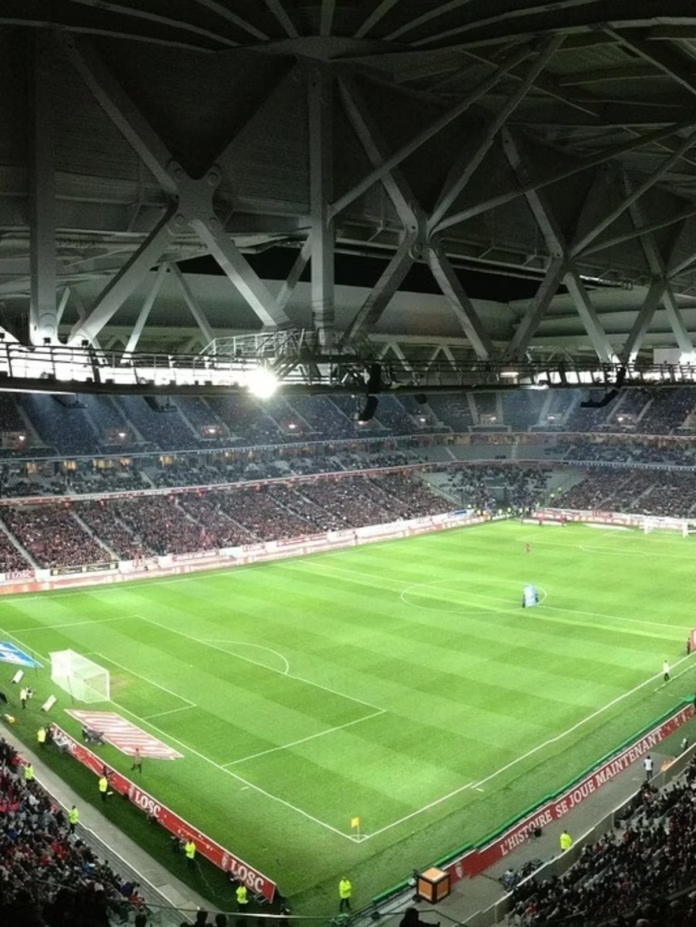
The proposed redevelopment of Delhi’s Jawaharlal Nehru (JLN) Stadium into a state-of-the-art sports city is set to reshape the capital’s urban landscape though not necessarily its property prices. Experts believe the project will enhance the prestige of Delhi’s ultra-premium neighbourhoods rather than ignite a new price surge.
Spanning 102 acres, the JLN Stadium complex originally built for the 1982 Asian Games and refurbished in 2010 is expected to be modelled on international sports hubs such as Doha’s Aspire Zone and Australia’s Docklands precinct. According to senior officials, the redevelopment aims to transform the site into a multipurpose sports and recreation district featuring training centres, residential facilities, and wellness zones.Officials familiar with the proposal said that while only 28 percent of the land is currently used, the reimagined complex will integrate advanced sporting technology and mixed-use functions.
“Global venues today serve multiple disciplines one stadium can host several sports while supporting community recreation,” an official explained.However, property analysts expect the redevelopment’s influence on Delhi’s real estate to be more reputational than financial. Localities such as Golf Links, Jor Bagh, Defence Colony, and Jangpura already commanding prices between ₹13 crore and ₹100 crore may see stable but sustained interest. “The project will reinforce, not disrupt, the capital’s high-end property hierarchy,” said a senior real estate consultant.Experts suggest that premium buyers and tenants, particularly younger Gen Z professionals, may find the upgraded infrastructure appealing for its lifestyle value rather than capital appreciation. Enhanced sports and wellness amenities could attract global tenants, lifting rentals by 15–20 percent in nearby areas such as Jor Bagh and Defence Colony once the project nears completion.The redevelopment is also being viewed as part of India’s broader ambition to host global sporting events, including the 2036 Olympics. Officials believe this is an opportunity to reimagine urban sports infrastructure through sustainable, mixed-use design.
For urban planners, the key will lie in ensuring that such projects serve both the elite and the wider community. “If integrated with accessible mobility, public greens, and shared facilities, the sports city could become a model for inclusive urban regeneration,” said an infrastructure policy expert.While its immediate impact on property prices may remain contained, the JLN Stadium redevelopment has the potential to redefine how Delhi balances heritage, sustainability, and high-value urban living in its core districts.
Delhi Stadium Redevelopment Project Reinforces Ultra Premium Property Market Without Price Surge
Mumbai Mmrda Opens Rs 16.3 Billion Land Bid To Develop Wadala Cbd

In a move that could redefine the city’s eastern growth corridor, the Mumbai Metropolitan Region Development Authority (MMRDA) has opened bids worth ₹16.3 billion for the development of a Central Business District (CBD) in Wadala. The initiative, part of Mumbai’s long-term urban expansion strategy, aims to create a new commercial hub that balances economic density with sustainable city planning.
According to officials, the proposed Wadala CBD will be developed on a large parcel of land owned by MMRDA, intended to serve as a modern business nucleus within the Mumbai Metropolitan Region (MMR). Once completed, the project is expected to decongest traditional commercial zones such as Bandra-Kurla Complex (BKC) and Nariman Point, offering state-of-the-art infrastructure for global companies, start-ups, and financial institutions.The development follows a land monetisation model, where private developers will bid for rights to develop and operate commercial and mixed-use facilities. “The project will be a benchmark in public-private partnership planning for sustainable commercial spaces,” said a senior MMRDA official.
Experts note that the Wadala CBD aligns with Mumbai’s evolving urban geography, driven by the city’s new metro lines and upcoming coastal connectivity. Wadala’s central location, combined with its proximity to major transport nodes like the Eastern Freeway and Mumbai Trans Harbour Link, makes it an ideal site for next-generation business infrastructure.Urban planners view this as more than just a real estate exercise it represents a shift toward decentralised urban growth, reducing pressure on South Mumbai and encouraging balanced regional development. The project could also generate significant employment and catalyse residential demand in adjoining precincts such as Chembur, Sion, and Dadar.
Environmental advocates have urged MMRDA to incorporate green building standards, rainwater harvesting, and low-emission mobility options into the masterplan to ensure the CBD contributes to the city’s net-zero targets.If executed responsibly, the Wadala CBD could become a model for sustainable commercial development demonstrating how India’s largest metros can combine economic expansion with climate-conscious design.
Mumbai Mmrda Opens Rs 16.3 Billion Land Bid To Develop Wadala Cbd
Thane Redevelopment Expo 2025 Attracts 2000 Visitors Empowering Housing Societies Toward Sustainable Growth

The CREDAI-MCHI Thane Redevelopment Expo 2025 has concluded with an overwhelming response, underscoring the city’s rising momentum in housing renewal and community-led urban transformation. Held at Raymond Trade Show Hall on 8 and 9 November 2025, the two-day event drew more than 2,000 visitors, including residents’ welfare associations, real estate developers, and planning professionals making it one of the largest redevelopment-focused gatherings in the Mumbai Metropolitan Region.
The expo served as a convergence point for stakeholders navigating the complexities of Thane’s growing redevelopment landscape. Industry participants said the event’s success reflects both the urgent need and strong appetite for modernising ageing housing stock across the city particularly cooperative housing societies built decades ago that now face structural and infrastructural stress. Interactive sessions covered the full redevelopment life cycle from feasibility studies, legal frameworks, and financing mechanisms to sustainable design strategies and inclusive planning. Developers showcased upcoming projects emphasising climate resilience, efficient land use, and improved living standards. Expert panels discussed evolving Maharashtra housing regulations, RERA compliance, and how urban regeneration could be aligned with low-carbon and community-centric growth models.
“The Expo empowered citizens to make informed redevelopment choices,” said a senior CREDAI-MCHI Thane official. “Thane’s potential as a model city for redevelopment lies in collaboration between societies, developers, and policymakers.”Another organiser highlighted that Thane’s redevelopment movement is not merely about building new homes but about creating resilient, equitable neighbourhoods. This aligns with the city’s long-term vision of reducing spatial inequality, improving liveability, and integrating sustainability into its real estate ecosystem.Analysts note that Thane’s strategic proximity to Mumbai, coupled with rising demand for urban infrastructure renewal, has made it a testing ground for new redevelopment frameworks. The city’s “City of Lakes” identity, alongside its evolving skyline, has positioned it as a leader in urban rejuvenation and vertical redevelopment within Maharashtra.
Organisers from CREDAI-MCHI Thane expressed gratitude to participating societies, sponsors, and industry experts, noting that the strong turnout signals growing citizen confidence in structured redevelopment. The association confirmed that future editions of the Expo will continue to promote dialogue on inclusive, transparent, and sustainable redevelopment.As Thane accelerates its transition towards a more future-ready urban form, the Expo has reaffirmed the importance of collaboration ensuring redevelopment becomes a pathway not only to economic growth but also to a greener, more equitable cityscape.
Thane Redevelopment Expo 2025 Attracts 2000 Visitors Empowering Housing Societies Toward Sustainable Growth
Mumbai Leads India Data Centre Growth Crossing 1.5 GW With 53 Percent Share

India’s fast-growing digital economy has pushed the nation’s data centre capacity past 1.5 gigawatts (GW) for the first time, with Mumbai accounting for 53 per cent of the total, according to a new report by global consultancy CBRE. The milestone marks India’s emergence as a leading global data hub, powered by rapid digitalisation, AI adoption, and favourable government policies.
The CBRE study, India’s Data Centre Market in a New Era, reveals that around 260 megawatts (MW) of new capacity was added in the first nine months of 2025. Telangana, Maharashtra, and Tamil Nadu have become the most sought-after destinations for new investments, while Mumbai’s dominance stems from its proximity to global internet exchange points and undersea cable landings vital infrastructure for global cloud connectivity.
Following Mumbai, Chennai, Delhi-NCR, and Bengaluru collectively contribute another 37 per cent of capacity, cementing a four-city network that accounts for nearly 90 per cent of the country’s operational data centres. This cluster effect, experts say, is creating regional digital corridors that could soon extend to tier-2 cities such as Pune, Ahmedabad, and Hyderabad, driven by localised demand for cloud services and AI-led applications.
CBRE estimates that total investment commitments in India’s data centre sector have reached USD 94 billion, with USD 30 billion pledged in just the first three quarters of 2025. Analysts believe that sustained policy support including incentives for renewable-powered facilities and data localisation mandates will further accelerate this growth, while aligning with India’s broader sustainability and energy efficiency goals.
An industry official noted that AI-driven demand is already reshaping facility design and energy consumption patterns. “Generative AI and automation are redefining how data centres operate. Operators are now integrating green cooling systems, energy-efficient layouts, and hybrid power sourcing to balance performance with sustainability,” the official said.
India’s competitive advantage lies not only in lower construction and electricity costs but also in its large pool of digital and AI talent nearly 16 per cent of the global AI workforce. This talent base, projected to double by 2027, positions India as a long-term destination for cloud infrastructure expansion.
As digitalisation deepens across sectors like finance, e-commerce, and manufacturing, India’s urban future will depend on how efficiently these data centres integrate with city planning ensuring resilient power, renewable energy use, and equitable data access. The country’s next challenge will be to balance scale with sustainability as it moves toward becoming one of the world’s largest data economies.
Mumbai Leads India Data Centre Growth Crossing 1.5 GW With 53 Percent Share
Mumbai Real Estate Investments Cross USD 1.2 Billion In 2025 Reclaiming Pre-Pandemic Momentum
