
Mumbai Mmrda Opens Rs 16.3 Billion Land Bid To Develop Wadala Cbd

Thane Redevelopment Expo 2025 Attracts 2000 Visitors Empowering Housing Societies Toward Sustainable Growth

The CREDAI-MCHI Thane Redevelopment Expo 2025 has concluded with an overwhelming response, underscoring the city’s rising momentum in housing renewal and community-led urban transformation. Held at Raymond Trade Show Hall on 8 and 9 November 2025, the two-day event drew more than 2,000 visitors, including residents’ welfare associations, real estate developers, and planning professionals making it one of the largest redevelopment-focused gatherings in the Mumbai Metropolitan Region.
The expo served as a convergence point for stakeholders navigating the complexities of Thane’s growing redevelopment landscape. Industry participants said the event’s success reflects both the urgent need and strong appetite for modernising ageing housing stock across the city particularly cooperative housing societies built decades ago that now face structural and infrastructural stress. Interactive sessions covered the full redevelopment life cycle from feasibility studies, legal frameworks, and financing mechanisms to sustainable design strategies and inclusive planning. Developers showcased upcoming projects emphasising climate resilience, efficient land use, and improved living standards. Expert panels discussed evolving Maharashtra housing regulations, RERA compliance, and how urban regeneration could be aligned with low-carbon and community-centric growth models.
“The Expo empowered citizens to make informed redevelopment choices,” said a senior CREDAI-MCHI Thane official. “Thane’s potential as a model city for redevelopment lies in collaboration between societies, developers, and policymakers.”Another organiser highlighted that Thane’s redevelopment movement is not merely about building new homes but about creating resilient, equitable neighbourhoods. This aligns with the city’s long-term vision of reducing spatial inequality, improving liveability, and integrating sustainability into its real estate ecosystem.Analysts note that Thane’s strategic proximity to Mumbai, coupled with rising demand for urban infrastructure renewal, has made it a testing ground for new redevelopment frameworks. The city’s “City of Lakes” identity, alongside its evolving skyline, has positioned it as a leader in urban rejuvenation and vertical redevelopment within Maharashtra.
Organisers from CREDAI-MCHI Thane expressed gratitude to participating societies, sponsors, and industry experts, noting that the strong turnout signals growing citizen confidence in structured redevelopment. The association confirmed that future editions of the Expo will continue to promote dialogue on inclusive, transparent, and sustainable redevelopment.As Thane accelerates its transition towards a more future-ready urban form, the Expo has reaffirmed the importance of collaboration ensuring redevelopment becomes a pathway not only to economic growth but also to a greener, more equitable cityscape.
Thane Redevelopment Expo 2025 Attracts 2000 Visitors Empowering Housing Societies Toward Sustainable Growth
Mumbai Leads India Data Centre Growth Crossing 1.5 GW With 53 Percent Share

India’s fast-growing digital economy has pushed the nation’s data centre capacity past 1.5 gigawatts (GW) for the first time, with Mumbai accounting for 53 per cent of the total, according to a new report by global consultancy CBRE. The milestone marks India’s emergence as a leading global data hub, powered by rapid digitalisation, AI adoption, and favourable government policies.
The CBRE study, India’s Data Centre Market in a New Era, reveals that around 260 megawatts (MW) of new capacity was added in the first nine months of 2025. Telangana, Maharashtra, and Tamil Nadu have become the most sought-after destinations for new investments, while Mumbai’s dominance stems from its proximity to global internet exchange points and undersea cable landings vital infrastructure for global cloud connectivity.
Following Mumbai, Chennai, Delhi-NCR, and Bengaluru collectively contribute another 37 per cent of capacity, cementing a four-city network that accounts for nearly 90 per cent of the country’s operational data centres. This cluster effect, experts say, is creating regional digital corridors that could soon extend to tier-2 cities such as Pune, Ahmedabad, and Hyderabad, driven by localised demand for cloud services and AI-led applications.
CBRE estimates that total investment commitments in India’s data centre sector have reached USD 94 billion, with USD 30 billion pledged in just the first three quarters of 2025. Analysts believe that sustained policy support including incentives for renewable-powered facilities and data localisation mandates will further accelerate this growth, while aligning with India’s broader sustainability and energy efficiency goals.
An industry official noted that AI-driven demand is already reshaping facility design and energy consumption patterns. “Generative AI and automation are redefining how data centres operate. Operators are now integrating green cooling systems, energy-efficient layouts, and hybrid power sourcing to balance performance with sustainability,” the official said.
India’s competitive advantage lies not only in lower construction and electricity costs but also in its large pool of digital and AI talent nearly 16 per cent of the global AI workforce. This talent base, projected to double by 2027, positions India as a long-term destination for cloud infrastructure expansion.
As digitalisation deepens across sectors like finance, e-commerce, and manufacturing, India’s urban future will depend on how efficiently these data centres integrate with city planning ensuring resilient power, renewable energy use, and equitable data access. The country’s next challenge will be to balance scale with sustainability as it moves toward becoming one of the world’s largest data economies.
Mumbai Leads India Data Centre Growth Crossing 1.5 GW With 53 Percent Share
Mumbai Real Estate Investments Cross USD 1.2 Billion In 2025 Reclaiming Pre-Pandemic Momentum

Mumbai’s property market has regained its pre-pandemic strength, attracting over USD 1.2 billion in institutional real estate investments during the first nine months of 2025. According to the latest capital markets data, the city continues to lead India’s investment landscape, driven by global confidence and a growing domestic investor base.
The milestone marks Mumbai’s fourth consecutive year of crossing the billion-dollar threshold a sign of sustained momentum in India’s largest commercial hub. Analysts say this resurgence reflects both renewed global interest and local investor maturity, underscoring Mumbai’s position as a gateway city for long-term capital.At the national level, total institutional real estate inflows including private equity and real estate investment trusts reached USD 4.7 billion by September 2025. Projections indicate that the year may close with USD 6–6.5 billion in overall inflows, positioning 2025 as the second-strongest year on record for India’s real estate sector.
What stands out this year is the rise of domestic capital, which now accounts for nearly half of total inflows. Experts note that the balance between foreign (52%) and local (48%) participation signals market stability and a reduced reliance on cross-border funding. A senior investment analyst said this evolution “marks a new phase of confidence where Indian institutions are not just following global investors but setting the pace themselves.”
Across sectors, office and residential assets remain the preferred choices, capturing more than half of Mumbai’s total inflows. Redevelopment-led residential projects attracted over USD 370 million, while the office segment followed closely, buoyed by strong leasing and sustained occupier demand. Logistics, industrial, and mixed-use assets also continued to gain traction, reflecting diversification in investor appetite.
Mumbai’s infrastructure transformation led by projects such as the Atal Setu (Mumbai Trans Harbour Link), Coastal Road, expanding Metro network, and the upcoming Navi Mumbai International Airport has played a decisive role in this rebound. Industry experts say such large-scale connectivity projects are unlocking new growth corridors, especially in peripheral zones, and supporting the city’s transition towards a more sustainable, accessible urban fabric.
Commenting on the trend, an executive from an international property consultancy observed, “Mumbai’s investment story is not just about numbers it’s about structural resilience, infrastructure-driven optimism, and a maturing investor ecosystem that is increasingly diverse and forward-looking.”As India’s financial capital continues to attract global and domestic capital, the challenge ahead will be ensuring that the city’s investment-led growth translates into inclusive, climate-resilient, and equitable urban development aligning economic expansion with the broader vision of sustainable city-building.
Mumbai Real Estate Investments Cross USD 1.2 Billion In 2025 Reclaiming Pre-Pandemic Momentum
Mumbai Developer Marathon Nextgen Realty Reports 36% Profit Jump Despite 22% Revenue Fall

Marathon NextGen Realty, a Mumbai-based listed developer, has reported a 36% year-on-year jump in consolidated net profit for the second quarter of FY2025–26, reaching ₹660 million, despite a 22% decline in total revenue to ₹1.17 billion. The company’s performance underscores how strategic cost management and operational efficiency can sustain profitability in a challenging real estate cycle.
According to financial disclosures, the rise in profit despite lower revenue highlights an improved margin structure, possibly driven by reduced project expenditure, lower financing costs, or income from joint ventures and asset monetisation. Analysts say this resilience reflects a growing trend among Mumbai-based developers, who are adopting leaner business models while diversifying into commercial, mixed-use, and redevelopment projects to maintain returns.
Industry observers noted that Marathon NextGen Realty’s prudent balance-sheet management has placed it among the more stable mid-cap developers in Mumbai’s real estate landscape. “In an environment where input costs and regulatory compliance expenses remain high, maintaining profit growth despite a revenue dip signals strong operational discipline,” said an urban property analyst.
The company’s outlook has been further strengthened by its joint venture with Adani Realty, announced recently, to develop a ₹3,400-crore premium commercial project in Mumbai. The venture is expected to create substantial office space inventory in the city’s central business district, potentially attracting multinational tenants and driving employment in the urban core.This project comes at a time when Mumbai’s commercial real estate sector is showing renewed momentum after years of subdued leasing activity.
Developers are banking on the shift toward high-quality, energy-efficient buildings as corporate tenants prioritise sustainability and employee well-being.Marathon NextGen Realty’s stock has mirrored investor optimism, gaining nearly 15% over the past six months and recording an astonishing 796% return over the last five years. The company’s consistent focus on redevelopment, mid-income housing, and premium offices has made it a key player in the evolving Mumbai real estate ecosystem.
As the city transitions toward more digitally enabled, sustainable urban infrastructure, developers like Marathon NextGen are expected to play a larger role in aligning profit goals with climate resilience and inclusive city growth.By balancing fiscal prudence with long-term investment in commercial capacity, the company exemplifies how Mumbai’s real estate sector is recalibrating for a new era of sustainable profitability.
Mumbai Developer Marathon Nextgen Realty Reports 36% Profit Jump Despite 22% Revenue Fall
Mumbai Mandates Online Rent Registration Ending Stamp Paper Deals For Legal Transparency

In a significant move towards governance transparency and tenant protection, the Maharashtra government has made online registration mandatory for all rental agreements in Mumbai and surrounding regions. The policy aims to replace the decades-old practice of paper-based rental contracts, bringing all transactions under a verified legal framework and reducing informal dealings that often lead to disputes.
According to officials, this reform intends to make renting safer for both tenants and landlords by introducing a traceable, digital record for every agreement. “The new rule ensures accountability and legal validity for all rental arrangements,” a state housing department official explained. “Stamp paper-only agreements will no longer be recognised under the law.”
Under the new framework, every rental contract must be registered digitally and contain specific details such as the rent amount, deposit value, and lease duration. The document will also carry a digital government seal, ensuring authenticity. The government has capped residential deposits at three months’ rent and commercial deposits at six months’ rent. Additionally, every agreement must have a minimum term of 11 months to qualify for registration.
Failure to comply with these norms could result in penalties of up to ₹5,000 or even a three-month jail term for property owners. The government believes these deterrents will accelerate the city’s transition to transparent, digitally recorded rental transactions.Experts say the reform is a major step in formalising Mumbai’s vast rental housing sector, which has long operated through informal cash-based agreements. A senior property consultant noted that this could “significantly reduce legal grey zones” while also helping authorities gather accurate data on rental trends and housing demand.
The digital registration platform will simplify the process for both tenants and landlords. Documents such as Aadhaar, PAN, and property details must be uploaded to the government’s official portal. Once verified, the system generates a registered e-agreement that holds the same legal status as a traditional document.For citizens, the change offers long-term benefits including legal clarity, protection from fraud, and a reliable means of resolving disputes. It also aligns with Mumbai’s broader push towards paperless governance and digital urban infrastructure. By digitising the city’s rental framework, Maharashtra is taking another step toward a transparent, equitable, and inclusive housing ecosystem.As one urban planner summarised, “This isn’t just a procedural reform it’s a structural shift in how Mumbai defines trust and accountability in its housing market.”
Mumbai Mandates Online Rent Registration Ending Stamp Paper Deals For Legal Transparency
Mumbai Parking Demand Reveals Real Estate Investor Confidence And Luxury Housing Market Trends

In India’s competitive real estate market, parking availability has evolved from a basic facility to a subtle yet powerful barometer of buyer sentiment, investor confidence, and project viability. Industry analysts suggest that the rate at which parking spaces sell or remain unsold can reveal far more about a development’s long-term prospects than traditional market metrics like price or location.
At new housing launches, swift uptake of parking slots often signals strong end-user demand and investor optimism. Conversely, projects where developers struggle to sell or must discount parking spaces tend to be dominated by short-term investors, with weaker prospects for sustained occupancy. “When a project is launched, investors quietly track what’s called ‘parking velocity’. It’s an underrated but telling measure of who’s buying residents or speculators,” explained a senior housing market analyst.
In emerging neighbourhoods, where urban infrastructure is still taking shape, fast-selling parking bays indicate investor conviction about future growth and migration. In contrast, mature micro-markets with sluggish parking sales could point to saturation or limited end-user activity.Real estate consultants note that in cities such as Mumbai, Delhi, and Bengaluru, the scarcity and cost of parking spaces have turned them into a quasi-asset class. In premium projects, one parking slot can cost anywhere between ₹10 lakh and ₹30 lakh depending on location and configuration. In ultra-luxury developments, additional parking slots are sometimes traded or leased separately, offering investors an unconventional but lucrative secondary revenue stream.
Developers typically follow what experts call the “bedroom-minus-one” rule: a 3BHK apartment includes two parking slots, a 4BHK comes with three, and so on. This ratio not only shapes project design but also influences the pricing strategy and overall marketability. “For luxury buyers, parking location and access time are deal breakers,” said a senior director at a global real estate consultancy. “A surface slot near the entryway is far more desirable than a multi-level automated system, no matter how advanced.”
Industry observers agree that parking policy remains underregulated. While open parking cannot be sold as per housing authority norms, covered parking may be priced separately. This grey area often causes disputes during possession handovers.As Indian cities face acute space shortages, developers and urban planners are exploring automated, shared, and green mobility-integrated parking systems. Experts believe that the next evolution in urban real estate will depend not just on how people live but where they park.
Mumbai Parking Demand Reveals Real Estate Investor Confidence And Luxury Housing Market Trends
Mumbai Sea-Facing Juhu Flat Linked To Harshad Mehta Set For Auction Soon
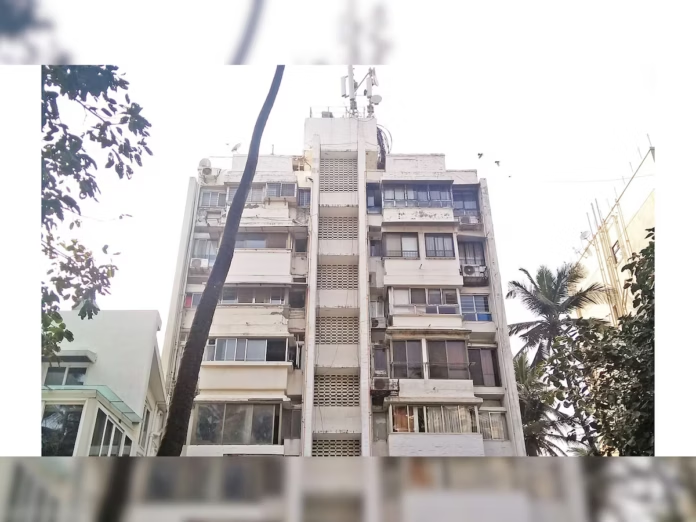
A sea-facing apartment in Juhu once associated with late stockbroker Harshad Mehta is set to be auctioned by a special court overseeing securities-related offences. The 1,150-square-foot flat, located in the Vandana Cooperative Housing Society at Janki Kutir, will be sold on an “as is, where is” basis, marking yet another attempt to liquidate assets tied to the infamous 1992 securities scam.
The property, previously owned by the late Sushila Shah a partner in Romil Exports and a judgment debtor in a case linked to Mehta’s firm, Orion Travels has a complex legal history. The special court approved its sale on 10 October, inviting potential buyers to submit offers through a public notice. Similar auctions held in 2021, 2023, and early 2025 had failed to attract bidders.
According to local brokers, unencumbered flats in the same Juhu building command prices ranging between ₹45,000 and ₹50,000 per square foot. The upcoming sale could therefore fetch over ₹5 crore if market demand remains strong. However, experts believe the property’s litigation history and association with the Mehta case might deter some buyers.
“This is a prime address, close to Prithvi Theatre and Juhu beach, yet buyers tend to be cautious when properties are burdened with legacy legal complications,” said a Mumbai-based real estate consultant.Harshad Mehta, once hailed as the “Big Bull” of Dalal Street, masterminded a ₹700-crore securities scam in the early 1990s by exploiting banking loopholes and manipulating stock prices. His actions triggered a market collapse that wiped out the savings of thousands of small investors, leading to a major overhaul of India’s financial regulations. Mehta was convicted in four criminal cases before dying of a heart attack in custody in 2001.
Over the years, authorities have auctioned several assets belonging to Mehta and his associates, including eight Worli Sea Face apartments in the Madhuli building, which were sold in 2009 for ₹32.6 crore. The latest auction continues the long process of recovering funds from properties linked to the scam.For Mumbai’s real estate market, the renewed interest in legacy properties like this one highlights both the city’s enduring demand for coastal homes and the importance of transparent asset disposal mechanisms. As experts note, each such sale reflects not only a piece of financial history but also the city’s evolving relationship with accountability and urban value recovery.
Mumbai Sea-Facing Juhu Flat Linked To Harshad Mehta Set For Auction Soon
Bengaluru MAIA Estates Secures Rs 120 Crore Funding For Seven Project

Bengaluru’s real estate sector has received a notable boost as MAIA Estates announced securing Rs 120 crore from Arnya to develop The Seven, a high-end housing project in South Bengaluru’s Basavanagudi area. Scheduled to commence in early 2026, the project will span approximately 6 lakh square feet, positioning itself as a premium residential offering targeting affluent buyers seeking spacious homes in established neighbourhoods.
Founded in 2016, MAIA Estates has steadily grown its portfolio, currently overseeing developments across 11 million square feet in Bengaluru. The company has focused on projects that combine modern design with sustainable practices, aiming to create inclusive and energy-efficient communities. Industry experts note that this funding milestone reinforces Bengaluru’s status as a resilient hub for luxury residential development.
The Seven is expected to feature a mix of large-format residences, including 4-BHK and 5-BHK apartments, designed to meet the growing demand for expansive homes in well-connected urban localities. Analysts highlight that the Basavanagudi location adds strategic value to the project, offering proximity to educational institutions, commercial centres, and established civic infrastructure, which makes it particularly appealing to long-term investors and high-net-worth individuals.
An official from MAIA Estates explained that the infusion of capital will be used to initiate construction while implementing advanced building techniques to ensure structural safety, energy efficiency, and minimal environmental impact. “We are committed to aligning our developments with sustainable urban planning principles, integrating green spaces, and utilising materials and systems that reduce carbon footprint,” the official said.
Market observers suggest that The Seven exemplifies the emerging trend of luxury redevelopment projects in central Bengaluru neighbourhoods, where legacy properties and underutilised plots are being transformed into modern residential complexes. This reflects broader shifts in urban housing demand, with a focus on quality, size, and amenities rather than mere unit quantity.The project is anticipated to reach completion by 2029, contributing to Bengaluru’s ongoing narrative of high-end residential expansion while balancing environmental sustainability and modern lifestyle expectations. MAIA Estates’ approach underscores the potential for responsible urban development that meets market demand without compromising on ecological or social considerations.
Bengaluru MAIA Estates Secures Rs 120 Crore Funding For Seven Project
Mumbai Malabar Hill Redevelopment Drives High End Luxury Large Homes Demand Rapidly
