
Delhi NCR Developers Urge Site Specific Construction Amid Severe GRAP Stage Three

Telangana Orders Construction Of 28 MW Solar Power Plant At KTPP Site

Telangana has taken a significant step towards augmenting renewable energy capacity with plans to establish a 28 MW solar power plant at the Kakatiya Thermal Power Plant (KTPP) in Chelpur, Jayashankar Bhupalpally district. Principal Secretary (Energy) Navin Mittal directed officials to initiate the necessary processes for the project, signalling the state’s commitment to integrating sustainable energy solutions alongside conventional power generation.
Mr. Mittal, accompanied by Telangana State Power Generation Corporation (TS-Genco) Chairman and Managing Director S. Harish, conducted a detailed inspection of Units 1 and 2 of KTPP on Tuesday to review operational performance and assess infrastructure readiness. “Integrating solar power within existing thermal plant frameworks represents an important step towards hybrid energy models and reduced carbon footprints,” an official said.
Following the inspection, Mr. Mittal visited the Tadicherla-I Coal Block Opencast Mine (OCP) to evaluate coal transport logistics. Officials briefed him on the proposed land acquisition for laying a dedicated conveyor belt from Tadicherla to KTPP, which aims to streamline coal movement, minimise road transport, and reduce environmental impacts from vehicular emissions.
The principal secretary emphasised the need for expeditious land acquisition while ensuring transparent and fair rehabilitation measures for affected communities. “Efficient execution of both renewable integration and coal transport infrastructure is critical to sustainable power operations and urban energy resilience,” an energy department source noted.
Experts highlight that hybridising thermal plants with solar installations not only diversifies power sources but also contributes to India’s net-zero energy goals. “Projects like KTPP’s solar integration can serve as replicable models for other states seeking to blend renewable energy with conventional plants, enhancing grid stability and long-term sustainability,” said an energy analyst.
The solar project aligns with Telangana’s broader renewable energy strategy, which targets increased solar and hybrid capacities to meet growing urban and industrial electricity demand while reducing carbon emissions. By coupling traditional coal-based generation with solar power, the state aims to maintain reliable energy supply without compromising environmental commitments.
Officials also underscored that coordinated planning of land, logistics, and rehabilitation is essential to minimise delays and maximise the efficiency of new energy projects. The initiative demonstrates how policy, governance, and technical oversight can converge to deliver environmentally responsible energy infrastructure.As Telangana expands its renewable portfolio alongside established thermal operations, projects such as the 28 MW KTPP solar plant reflect a balanced approach to energy security, economic growth, and climate-conscious urban development.
Telangana Orders Construction Of 28 MW Solar Power Plant At KTPP Site
Mumbai Government Forms Committee To Record Flat Owners Names In Land Records

The Maharashtra government has established a high-level committee in Mumbai to devise a uniform framework for recording the names of individual apartment owners in official land records. The initiative is aimed at simplifying property transactions, easing access to home loans, and accelerating redevelopment projects in the state’s densely populated urban areas.
Currently, most apartment owners hold documents such as sale deeds and housing society share certificates, but their names are not recorded in the 7/12 extract or Property Register Cards, which form the legal record of land ownership. “This gap often complicates mortgage approvals, delays redevelopment, and can trigger legal disputes,” an official said.
Under the Maharashtra Land Revenue Code, 1966, property rights are recorded under Sections 149 to 151. However, the system presently captures only the land-holding entity typically a cooperative society or developer rather than individual apartment holders. Practices vary across districts, resulting in inconsistencies for multi-storeyed properties, the government noted in a resolution issued on 30 October.
The newly formed committee is chaired by the additional chief secretary (Revenue), with members including officials from urban development, cooperation, law, rural development, registration, and land records. Its mandate is to propose clear rules for incorporating individual apartment ownership into land records while defining how common areas, amenities, and underlying land are documented. The panel has been asked to submit recommendations within one month.
Industry experts welcome the move, highlighting its potential to improve transparency and unlock stalled redevelopment projects in Mumbai’s older housing stock. “Standardising apartment ownership in land records will streamline property financing and reduce legal ambiguities,” an urban property consultant said.The committee will also examine frameworks adopted by other Indian states for registering vertical property ownership, aligning its recommendations with the forthcoming vertical property rules. These rules are particularly critical for Mumbai, where most residential units are located in stacked apartments rather than horizontal plots.
Officials emphasise that once implemented, the reform will benefit citizens by making property transactions more straightforward and secure. Banks will be able to verify ownership more efficiently, while developers and society members can resolve disputes over common areas and maintenance responsibilities.The initiative aligns with broader urban governance goals, fostering equitable and transparent property systems while supporting sustainable city redevelopment. By formalising apartment ownership in official records, Maharashtra aims to modernise its land registry, reduce procedural bottlenecks, and provide a reliable legal framework for the state’s rapidly urbanising landscape.
Mumbai Government Forms Committee To Record Flat Owners Names In Land Records
India Housing Market Value To Surge 20 Percent In FY26 Despite Flat Volumes

India’s residential real estate sector is poised for a value-led expansion in FY26, with overall market value expected to grow by nearly 20 per cent despite stagnating sales volumes. The trend signals a fundamental shift from quantity to quality as premium housing segments, larger units, and sustainable developments redefine buyer priorities.
Data from property consultancy ANAROCK reveals that housing units sold across the top seven cities Mumbai Metropolitan Region (MMR), Delhi-NCR, Bengaluru, Pune, Hyderabad, Chennai, and Kolkata were collectively valued at ₹5.59 lakh crore in FY2025. The figure is projected to exceed ₹6.65 lakh crore in FY26, marking one of the sector’s strongest years since the pandemic.
While total sales volumes are likely to remain flat with growth of less than 4 per cent, experts say rising average ticket sizes and a tilt toward high-value homes are driving the jump in sales value. “The market has entered a phase where value growth is decoupled from volume. Homebuyers are prioritising premium quality, lifestyle, and long-term appreciation potential,” said a senior researcher at ANAROCK.
In the first half of FY26 alone, housing transactions worth ₹2.98 lakh crore were recorded already accounting for more than half of the previous fiscal’s total. Delhi-NCR and Chennai have emerged as the fastest-growing markets, achieving 74 per cent and 71 per cent respectively of their FY25 sales value within six months. In contrast, MMR India’s largest housing market saw moderate growth, completing only 45 per cent of its FY25 value.
Luxury and ultra-luxury housing have become the biggest drivers of this growth cycle. Properties priced above ₹1.5 crore now account for over 40 per cent of new launches, particularly in urban hubs like Gurugram, Hyderabad, and South Bengaluru. Developers are aligning with this demand by focusing on high-ticket projects, integrated townships, and sustainability-led amenities.
Industry leaders view this shift as a sign of market maturity. “The 20 per cent rise in value, despite steady volumes, reflects stronger buyer intent and confidence,” said a senior investment fund manager. “India’s housing story is now about value creation not just volume absorption.”Analysts also note that policy support for green housing and transit-oriented development could further reinforce this sustainable, value-driven trend. The combination of infrastructure growth, financial discipline among developers, and evolving buyer aspirations is pushing Indian real estate toward a more balanced, inclusive growth model.If FY2024 marked the phase of recovery and FY2025 of consolidation, FY2026 is shaping up to be the year of value transformation signalling a maturing market ready for long-term, sustainable expansion.
India Housing Market Value To Surge 20 Percent In FY26 Despite Flat Volumes
Metro Cities Witness Double Digit Property Price Surge In Q3 2025 PropTiger

India’s major metropolitan cities witnessed a sharp rise in residential property prices during the third quarter (Q3) of 2025, driven by sustained demand, infrastructure-led development, and growing consumer confidence. Data released by real estate consultancy PropTiger indicates that property values across metro markets recorded double-digit year-on-year growth, underscoring a resilient post-pandemic recovery in the country’s housing sector.
According to PropTiger’s quarterly analysis, average housing prices across key metro regions including Mumbai, Delhi-NCR, Bengaluru, Pune, Hyderabad, Chennai, and Kolkata rose significantly between July and September 2025. This surge was supported by a steady increase in end-user demand and limited new supply in land-scarce urban zones.
Industry experts attribute this upward trend to rapid urbanisation and infrastructure expansion, particularly metro rail extensions, airport connectivity projects, and smart city upgrades. “Infrastructure remains the single largest driver of housing demand in urban India. Buyers today are prioritising accessibility, sustainability, and integrated community living,” said a senior market analyst.
Among metros, Mumbai Metropolitan Region (MMR) led the charts, with mid-segment housing prices rising by more than 20 per cent year-on-year. The city’s growing demand for well-connected townships beyond Thane and Panvel has significantly reshaped its housing geography. Bengaluru and Hyderabad followed closely, both witnessing double-digit price increases driven by IT sector expansion and growing investor participation.
Pune and Chennai also showed robust momentum, supported by new infrastructure corridors and affordable housing launches catering to first-time buyers. In Delhi-NCR, demand remained strong for ready-to-move properties and sustainable projects featuring energy-efficient design, green certifications, and water management systems.
Experts believe this trend signals a more mature, sustainability-oriented market. Developers are now rethinking project designs to align with India’s urban climate goals, focusing on energy-efficient buildings, inclusive housing layouts, and better resource management. “We are seeing a gradual shift towards climate-resilient and gender-inclusive neighbourhoods, which will define the next phase of India’s urban real estate,” noted an urban development researcher.
However, the steep rise in property values also raises concerns about affordability in high-demand metro zones. Analysts suggest that policy interventions such as interest subsidies, transit-oriented housing, and green building incentives could help maintain inclusivity while supporting sustainable urban growth.With robust economic fundamentals, rising incomes, and transformative infrastructure projects, India’s metro housing markets are poised to remain strong. Yet, the challenge will be to balance growth with accessibility ensuring cities remain equitable, affordable, and environmentally responsible for all urban residents.
Metro Cities Witness Double Digit Property Price Surge In Q3 2025 PropTiger
Mumbai 3.0 Takes Shape, Panvels Record Growth Signals Major Market Shift
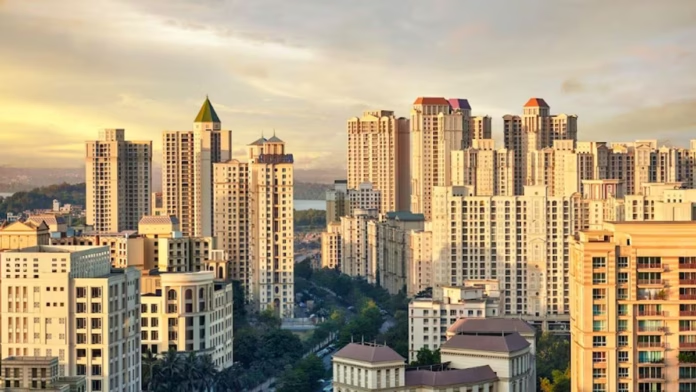
The balance of power in Mumbai’s real estate market is tilting rapidly. Once the undisputed satellite hub of the Mumbai Metropolitan Region (MMR), Thane is now losing ground to emerging corridors such as Panvel, Kalyan–Dombivli, and Ambernath. Analysts say this transformation marks a structural shift driven by affordability, infrastructure investment, and improved regional connectivity.
According to property consultancy data, Navi Mumbai including Panvel accounted for nearly 39 per cent of all new residential project launches in the July September 2025 quarter, the highest across MMR. This surge reflects the city’s growing attractiveness as a self-sustaining urban hub supported by upcoming infrastructure like the Mumbai Trans Harbour Link (MTHL), Navi Mumbai Metro, and the international airport. These projects are reshaping mobility, shortening commute times, and fuelling sustainable urban expansion.
In contrast, Thane, which long dominated as the region’s residential powerhouse, is showing signs of saturation. While its mid-segment housing prices rose around 20 per cent year-on-year, growth in new launches has slowed. Developers and homebuyers are increasingly turning their attention to less congested belts offering larger land parcels for integrated townships and affordable housing.
“Panvel and Beyond” has emerged as the most promising development frontier, where mid-segment property prices have jumped by 27 per cent over the past year the sharpest rise in MMR. Areas like Khopoli and Rasayani are also witnessing steady investor traction due to their relative affordability and improved connectivity to key employment zones.Developers are responding swiftly to this demand shift. Several major builders, including prominent Mumbai-based firms, are investing heavily in Panvel and its surrounding corridors.
Industry observers note that developer confidence has risen sharply, with a 7.1 per cent quarter-on-quarter increase in new project supply between Q2 and Q3 2025. Much of this momentum is linked to infrastructure-led urbanisation and policies promoting balanced regional growth.Experts emphasise that this trend presents an opportunity to build more sustainable and inclusive townships, avoiding the pitfalls of high-density, resource-stressed urban cores. Panvel’s planned development model and proximity to key infrastructure make it an ideal candidate for future-ready, low-carbon housing ecosystems.
As the MMR’s growth map is redrawn, Thane’s challenge will be to reinvent itself through redevelopment, green housing, and mobility improvements. For now, Panvel stands out as the new engine of real estate growth symbolising Mumbai’s gradual shift toward a more distributed, connected, and sustainable urban future.
Mumbai 3.0 Takes Shape, Panvels Record Growth Signals Major Market Shift
Pune Witnesses Inteva Products ₹50 Crore Expansion Boosting 400 Jobs And Mobility Innovation

Global automotive systems supplier Inteva Products LLC has announced a significant expansion of its India operations with the launch of a new manufacturing facility in Pune, signalling renewed confidence in the country’s rapidly evolving mobility sector. The move reinforces India’s position as a preferred hub for advanced automotive innovation and sustainable manufacturing.
The US-headquartered company, which has been active in India for over 17 years, plans to invest ₹50 crore in its second Pune plant. The new unit is expected to create more than 400 new jobs and deepen local integration across supply chains. Industry experts say this investment aligns with the government’s Make in India vision while boosting regional employment and skill development in Maharashtra’s growing auto corridor.
The new facility will focus on next-generation products tailored for Indian original equipment manufacturers (OEMs). These include frameless window regulators, small light Inteva motors, power folding and glass actuators, as well as advanced closure systems like electronic latches, frunk latches and power tailgates. Such technologies aim to make vehicles lighter, safer, and better suited for the country’s shift towards electric and smart mobility.
Executives at Inteva highlighted that the new Pune plant complements the company’s technical centre in Bengaluru, which currently employs over 320 professionals, including 180 engineers, who focus on design, validation and simulation for global projects. The centre serves as a critical engineering hub within Inteva’s international network, reflecting India’s growing importance in global automotive R&D.
Industry observers note that the expansion comes at a time when global suppliers are accelerating localisation to enhance resilience and sustainability in supply chains. “Inteva’s investment showcases the long-term confidence multinational firms have in India’s capability to deliver innovation, cost efficiency and sustainability at scale,” said a senior industry analyst.
Founded in 2008 and headquartered in Troy, Michigan, Inteva Products provides a range of environmentally responsible systems that enhance vehicle safety and performance. The company’s leadership reiterated its commitment to sustainable manufacturing and customer-centric innovation.According to Gerard Roose, President and CEO of Inteva Products, “This expansion reflects our confidence in India’s growth potential and our shared pursuit of sustainable, future-ready mobility.”
Sanjay Kataria, VP and Managing Director for India and Rest of Asia, added that the new facility would strengthen collaboration with OEMs while supporting local communities through job creation and skill enhancement.
With Pune continuing to attract major automotive and EV investments, Inteva’s expansion underscores a broader trend India’s transformation from a manufacturing base to a global innovation hub for next-generation mobility solutions.
Pune Witnesses Inteva Products ₹50 Crore Expansion Boosting 400 Jobs And Mobility Innovation
Mumbai Real Estate Attracts Over USD 1.2 Billion Investment In 2025 Boom
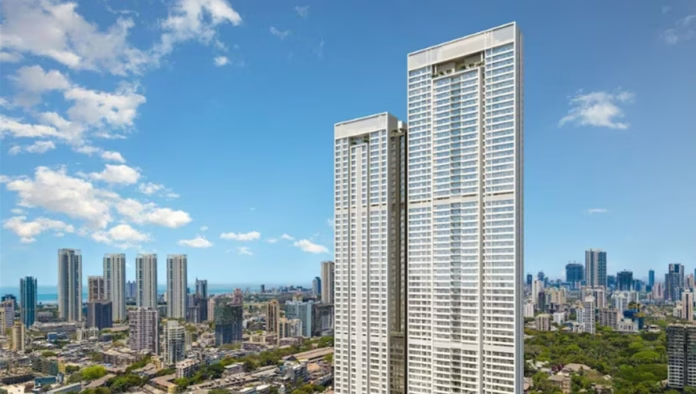
Mumbai’s property market has reaffirmed its position as India’s most preferred real estate investment hub, drawing over USD 1.2 billion in institutional inflows during the first nine months of 2025, according to a recent India Capital Markets report by Cushman & Wakefield.
The achievement marks the fourth consecutive year in which the city has crossed the billion-dollar threshold, underscoring both investor confidence and the region’s evolving infrastructure ecosystem.At a national scale, India attracted approximately USD 4.7 billion in institutional investment between January and September 2025. Analysts anticipate that the year could close with USD 6–6.5 billion in total inflows positioning 2025 as one of the most robust periods for the country’s property sector in recent times.
A senior market expert observed that Mumbai’s appeal lies in its “blend of large-scale redevelopment, expanding connectivity, and strong leasing performance.” The growth in domestic institutional participation has been especially significant, with Indian investors accounting for 48% of the total inflows, while international funds largely from the United States and Japan contributed the remaining 52%. This balance has helped stabilise market sentiment amid global macroeconomic uncertainties.
Office assets commanded the highest investor attention at 35% of total inflows, driven by resilient leasing demand in business districts. Residential projects followed at 26%, reflecting renewed end-user demand and redevelopment opportunities. Retail and logistics assets accounted for 12% and 9% respectively, while data centres continued to emerge as a new frontier for institutional capital.
Mumbai’s real estate success story is also anchored in its infrastructure upgrades. Projects such as the Mumbai Trans Harbour Link, Coastal Road, ongoing metro expansions, and the upcoming Navi Mumbai International Airport have enhanced investor confidence in long-term growth. These public investments are unlocking new corridors for residential and commercial expansion, particularly in the MMR region.
Industry observers note that sustainability considerations are also shaping investor strategy. Developers are increasingly integrating green certifications, energy-efficient materials, and transit-oriented planning to attract global funds that prioritise environmental performance. This alignment between growth and sustainability is seen as key to Mumbai’s next investment cycle.As India’s financial capital continues to strengthen its real estate fundamentals, Mumbai remains not only a symbol of investor resilience but also a testing ground for sustainable and inclusive urban development models.
Mumbai Real Estate Attracts Over USD 1.2 Billion Investment In 2025 Boom
Mumbai To Transform 319 City Ponds Into Eco Tourist And Public Spaces
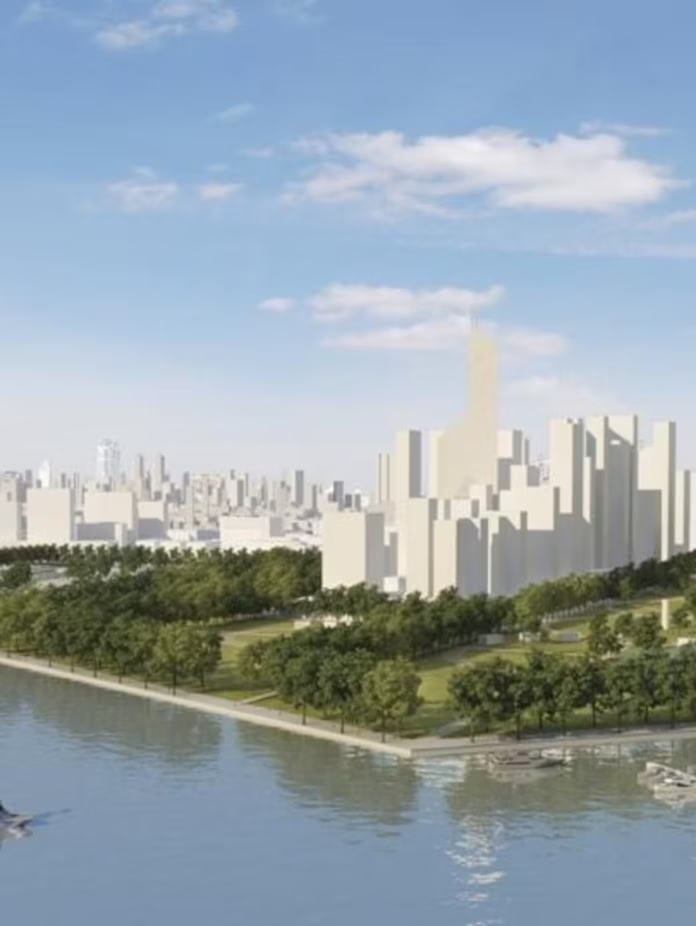
In a major step toward enhancing Mumbai’s urban ecology, the Brihanmumbai Municipal Corporation (BMC) has launched a citywide initiative to restore 319 ponds and convert them into accessible public and tourist-friendly spaces. The project aims to revive the city’s neglected water bodies while improving biodiversity, promoting heritage conservation, and expanding open recreational areas for residents.
The initiative will be implemented in phases, beginning with 30 ponds selected across different wards based on their ecological condition, location, and public access. According to civic officials, this first phase will serve as a pilot to develop restoration models before scaling up citywide. The effort forms part of a broader strategy to integrate blue-green infrastructure into Mumbai’s urban design a critical move for climate resilience and water management in a city facing rising heat and rainfall extremes.
Funding for the project will primarily come through Corporate Social Responsibility (CSR) collaborations with private companies. By adopting this partnership model, the BMC seeks to ease financial pressure on municipal budgets while engaging the private sector in sustainable urban development. “The idea is to blend ecological restoration with public benefit and cultural value,” said a senior civic planner involved in the initiative.
Of the 319 ponds identified, 309 are under BMC’s jurisdiction, while the remaining ten fall under state agencies such as the Maharashtra Housing and Area Development Authority (MHADA) and the Mumbai Metropolitan Region Development Authority (MMRDA). The civic body has begun compiling detailed surveys, documenting each pond’s depth, water quality, and surrounding land use to prepare customised rejuvenation plans.The restoration process will include de-silting, strengthening embankments, introducing natural vegetation, landscaping, improving lighting, and developing walking pathways and seating zones. Officials added that each design will balance ecological restoration with community use ensuring ponds become safe, inclusive spaces for leisure, festivals, and learning.
Special attention will be given to heritage ponds such as Banganga Tank in Walkeshwar and Bandra Talao, both of which hold significant historical and cultural value. The BMC aims to position these heritage sites as eco-tourism landmarks that celebrate Mumbai’s layered history while promoting environmental awareness.Urban experts have welcomed the plan as a step toward re-establishing the city’s “lost relationship with water”. They note that restored ponds can serve as natural carbon sinks, recharge groundwater, and act as community anchors in densely built neighbourhoods.If executed effectively, Mumbai’s pond revival could serve as a blueprint for other Indian cities grappling with rapid urbanisation and shrinking public spaces reaffirming the importance of water bodies in building resilient, inclusive, and liveable cities.
Mumbai To Transform 319 City Ponds Into Eco Tourist And Public Spaces
Mumbai Firm Woodpeckers Global Crosses One Million Square Feet Premium Design Milestone Across India
