
Pune MHADA EAuction Opens Commercial And Housing Units

Ashi Singh Buys House But Stays on Rent

Television actor Ashi Singh has reached a personal milestone by purchasing her first home in Mumbai. Yet, in an ironic twist, the actor continues to live in a rented flat—just ten minutes from her current shooting set.Singh, known for her lead roles in television dramas and admired for her grounded persona, says the decision to stay put despite owning a flat was rooted in practical thinking.
“There’s no point moving an hour away when my shoot is just ten minutes from where I currently stay,” she said, highlighting a logistical challenge familiar to millions of Mumbaikars—the city’s relentless traffic.
Her new property, though ready for possession, remains unoccupied for now. Singh explains she has always prioritised proximity to work over the prestige of living in a high-value address. “I’ve always believed that wherever my set is, that’s where my home is for the time being. Losing hours to traffic every day is not how I want to live,” she added.What makes her journey even more significant is the motivation behind buying a home. Unlike many in the entertainment industry drawn to lavish lifestyles, Singh says she had only one target—to own a house. “I never wanted a luxury car or designer bags. I just wanted a home of my own. That mattered more than anything else,” she recalled.
Her desire to buy a home was deeply personal. Having moved to Mumbai as a teenager, Singh grew up in rented accommodations. Her experience, she admits, was far from pleasant. “Even when we were paying ₹50,000 or ₹1 lakh in rent, landlords behaved as if they were doing us a favour. There’s little respect for tenants,” she said.For Singh, homeownership symbolises stability and dignity—values that resonate with many young professionals navigating the Indian urban housing ecosystem. In metros like Mumbai, where tenant rights remain weak and housing discrimination is not uncommon, owning a flat represents more than just financial security—it’s a step towards autonomy and self-respect.
Despite the delay in moving, Singh feels a quiet sense of satisfaction. The keys may not be in her pocket every day, but the sense of ownership is very real. Her story brings to light the practical compromises and emotional decisions that define modern urban life—especially for women carving out independence in cities built on inequality and aspiration.
While Singh returns to television screens after a brief hiatus, her personal milestone has inspired conversations far beyond the entertainment world. Her approach—eschewing luxury for stability—signals a shift in how success is defined in today’s India.
Also Read : R.madhavan Mumbai Apartment Leased for Rs 6.5 Lakh Monthly
Ashi Singh Buys House But Stays on Rent
R.madhavan Mumbai Apartment Leased for Rs 6.5 Lakh Monthly

Bandra Kurla Complex has been leased for ₹6.5 lakh per month under a two-year leave and licence agreement, generating a projected rental income of ₹1.6 crore over the lease period.The 4,182 sq. ft. property, located in the upscale Signia Pearl tower, was acquired in mid-2024 for ₹17.5 crore and now offers an annual rental yield between 4.5% and 4.7%—a strong performance amid tightening rental returns in Mumbai’s premium housing segment. Market experts say this is reflective of a growing appetite for luxury leasing in strategically located, high-end developments, especially in mixed-use business hubs like Bandra Kurla Complex (BKC).
The lease agreement, officially registered in June 2025, includes a security deposit of ₹39 lakh, with applicable stamp duty and registration charges adding up to around ₹48,000. The deal reinforces the trend of HNIs (High Net-worth Individuals) tapping into prime real estate investments not only for capital appreciation but also for regular passive income.
Interestingly, the lease was facilitated following the relocation of the apartment’s owners to Dubai—a shift prompted by the family’s commitment to supporting their son’s professional swimming aspirations. Large pools and sporting facilities were a decisive factor in the move, which occurred during the pandemic years when training options in India were restricted. The family continues to maintain strong ties with India, frequently returning for work and personal commitments.What stands out about this transaction is not just its scale, but the strategic timing. With Mumbai’s ultra-luxury rental segment witnessing low vacancy and growing demand from corporate executives, expatriates, and NRI investors, properties in the ₹5–7 lakh monthly rental bracket are seeing better liquidity.
Analysts observe that a return upwards of 4.5% in the first year from rental income—especially in the post-pandemic economic recovery phase—is noteworthy. Traditionally, Mumbai’s luxury real estate yields hover around 2.5–3.5%. This higher yield indicates robust tenant demand, likely supported by proximity to financial hubs, international schools, and lifestyle infrastructure in the BKC vicinity.Meanwhile, on the professional front, the apartment owner continues to remain active in the entertainment industry with recent and upcoming film projects featuring a mix of historical narratives and commercial cinema. Despite the overseas base, India remains a key work location.
This leasing transaction aligns with evolving urban living patterns where high-value asset owners diversify income streams while retaining ownership in economically resilient cities like Mumbai. It also signals the increasing formalisation of India’s luxury rental market, where tenancy agreements are now rigorously documented and structured for both regulatory and financial transparency.
As Mumbai’s luxury housing landscape matures, such transactions are expected to become more mainstream—particularly in corridors like BKC, Lower Parel, and Worli—where demand for professionally managed, high-end rental properties continues to surge.
Also Read : Mannat Property Under Coastal Zone Scrutiny
R.madhavan Mumbai Apartment Leased for Rs 6.5 Lakh Monthly
Mannat Property Under Coastal Zone Scrutiny

Mumbai’s iconic coastline is once again at the centre of regulatory attention, as state authorities investigate a proposed vertical expansion at a high-profile residential property in Bandra West. The site, which includes a six-storey modern annexe next to a 1914 colonial-era bungalow, is being scrutinised for potential violations of Coastal Regulation Zone (CRZ) norms.
On Friday, a joint inspection was conducted by officials from the forest department and the Brihanmumbai Municipal Corporation’s (BMC) H-West ward, following a complaint submitted by a citizen activist. The complaint objected to proposed structural additions atop the existing six-storey annexe, citing the property’s sensitive location along the Arabian Sea and its proximity to a demarcated hazard line.Officials confirmed that the annexe currently serves as the primary residential structure on the property and comprises two basement levels in addition to the six storeys. The total land parcel spans over 2,091 square metres, commanding sweeping sea views and lying within a tightly regulated CRZ-II zone. The neighbouring bungalow, a Grade III heritage structure, further complicates any new development on the premises.
According to official documents, an application seeking permission to construct a seventh and eighth floor was submitted to the Maharashtra Coastal Zone Management Authority (MCZMA) in November 2023. The proposed expansion, with an estimated cost of ₹25 crore, is under preliminary review, and the owners have been asked to furnish all relevant clearances and architectural plans for verification.A forest official associated with the inquiry clarified that no active construction work has begun at the site. “At this stage, we are reviewing documentation and seeking compliance records. The issue of violation will only arise if unauthorised construction proceeds without necessary approvals,” the official said.
The complaint raised multiple concerns, including environmental sensitivity, the site’s location within the hazard line mapped by the Survey of India, and the legal protections conferred by the heritage status of the original bungalow. It has also sparked broader questions about urban accountability and the enforcement of ecological safeguards along Mumbai’s increasingly contested coastline.Environmental planners and civic observers have noted that redevelopment or expansion projects along the city’s coastal belt must navigate a complex maze of approvals. In this case, the application will be judged not only against CRZ Notification 2019, but also heritage conservation guidelines and municipal building norms. Failure to adhere to any of these could result in the project being stalled or penalties being levied.
The inspection is part of a broader push by state authorities to clamp down on encroachments and unauthorised developments in ecologically fragile zones. Officials emphasised that due diligence will be followed in assessing the documentation before making a formal determination.
In a city where prime seafront land continues to be a coveted asset, the outcome of this inquiry may set a precedent for how regulations are enforced, particularly in high-profile cases involving heritage properties and CRZ compliance. For now, the matter remains under review, with further action contingent on the findings of the forest department’s report.
Also Read : Ambuja ACC First Indian Cement Firms with Net Zero Nod
Mannat Property Under Coastal Zone Scrutiny
Ambuja ACC First Indian Cement Firms with Net Zero Nod

Ambuja Cements and ACC have become the first Indian cement companies to have their net-zero emissions targets officially validated by the Science Based Targets initiative (SBTi). This recognition cements their status as sectoral pioneers in aligning with global climate standards and accelerating India’s low-carbon future.
The SBTi’s Corporate Net-Zero Standard is globally acknowledged as the most rigorous framework for validating corporate climate commitments. It demands measurable, science-aligned emissions reductions consistent with limiting global temperature rise to 1.5°C under the Paris Agreement. The endorsement places Ambuja Cements and ACC in an elite cohort of global cement players — alongside Cemex, Heidelberg, and Holcim — and distinguishes them as the first of such scale from India. The companies’ validated targets focus on deep decarbonisation strategies across Scope 1, 2, and 3 emissions. They include commitments to directly cut emissions from operations, increase reliance on renewable energy, improve thermal substitution rates through alternative fuels and raw materials (AFR), and incorporate cutting-edge green technologies. The SBTi approval highlights the firms’ readiness to not only set ambitious targets but to also operationalise them through practical, systemic action.
Officials from the cement businesses under the diversified conglomerate highlighted that this recognition reaffirms their pledge to embed sustainability at the core of industrial growth. The move is being described internally as a mandate for transformation, not a marketing milestone. Both Ambuja and ACC are accelerating a slew of initiatives to meet their net-zero ambitions. Ambuja has become the first global cement company to join the Alliance for Industry Decarbonization, a collaborative platform led by the International Renewable Energy Agency (IRENA), and is actively participating in the World Economic Forum’s Transitioning Industrial Clusters initiative. These collaborations are expected to fast-track sectoral innovation and infrastructure alignment with climate-resilient goals.
In terms of renewable energy, the two companies have outlined concrete transition plans. Ambuja alone aims to meet 60% of its power needs through green sources by FY2028. This includes deploying over 1 GW of wind and solar energy and 376 MW of Waste Heat Recovery Systems (WHRS). Of these, 299 MW of solar and 186 MW of WHRS are already commissioned. Green hydrogen also features prominently in their long-term clean energy blueprint. The larger strategic push is being backed by the parent group’s USD 100 billion green transition roadmap, which includes scaling renewable capacity to 50 GW by 2030 and establishing a robust integrated green hydrogen platform. These ecosystem synergies are designed to equip Ambuja and ACC with shared capabilities, allowing them to significantly reduce fossil fuel dependency and deliver emission reduction outcomes faster and at scale.
Experts in the field of climate policy and green infrastructure applaud the development as a strong signal to Indian industry. With cement production being one of the most carbon-intensive sectors globally, such leadership from homegrown entities is expected to set benchmarks for others to follow. Sustainability analysts note that beyond target-setting, the SBTi validation reflects a credible roadmap for implementation. It places an onus on continuous disclosure, third-party audits, and performance-linked accountability. For investors and ESG-conscious stakeholders, this endorsement reduces transition risk and aligns with international expectations around responsible business conduct.
Internally, the companies have activated cross-functional teams to ensure that climate goals are deeply integrated into everyday operations. Officials confirmed that the approach goes beyond compliance and focuses on reshaping the supply chain, product development, and plant operations to prioritise circularity, energy efficiency, and climate resilience. This milestone comes amid growing global momentum for industrial decarbonisation. The European Union’s Carbon Border Adjustment Mechanism (CBAM) and increasing investor pressure on sustainability disclosure are already reshaping how emerging market corporations define competitiveness. By aligning early with SBTi, Ambuja and ACC aim to future-proof their businesses while contributing meaningfully to India’s broader Nationally Determined Contributions (NDCs) under the Paris framework.
While the road ahead includes navigating regulatory frameworks, evolving technologies, and capital-intensive transitions, the companies are positioning themselves as catalysts for change rather than reluctant participants. Their emphasis on transparency, renewable substitution, and systemic change makes the SBTi recognition a foundational step toward long-term sustainability. The cement industry contributes roughly 7% to global CO2 emissions. As India’s urbanisation accelerates, balancing infrastructure growth with climate commitments is becoming central to policy discourse. With validated net-zero targets, Ambuja and ACC are redefining what is possible within this complex context.
The leadership demonstrated through this validation underscores that Indian industry can lead from the front in solving the climate challenge. It sends a compelling message that scale, legacy, and sustainability can co-exist when backed by intent, innovation, and institutional alignment.
Ambuja ACC First Indian Cement Firms with Net Zero Nod
Godrej Buys 16 Acre Plot in Upper Kharadi Land

Godrej Properties has bolstered its presence in Pune’s high-growth eastern corridor with the acquisition of a 16-acre land parcel in Upper Kharadi. The newly secured site, aimed at premium residential and retail development, marks the firm’s second major land deal in the Kharadi-Wagholi belt this month, positioning it firmly within one of the city’s most rapidly urbanising zones.
The transaction, estimated to yield a total revenue potential of approximately ₹31 billion, will see the development of 2.5 million square feet of mixed-use space. The project will primarily comprise high-end group housing and curated high-street retail, aligning with the developer’s strategy to focus on high-demand micro-markets with growing infrastructure and strong connectivity. According to industry insiders, the site was strategically chosen due to its location within the thriving Kharadi-Wagholi growth cluster—a region that has seen exponential appreciation in both residential and commercial capital values over the past five years. This corridor connects efficiently to key employment hubs such as Viman Nagar, Magarpatta, and Hadapsar, and is flanked by top-tier social infrastructure, including reputed educational institutions, multi-speciality hospitals, shopping destinations, and premium hospitality.
Officials associated with the acquisition highlighted that Godrej’s land-buying strategy is currently focused on unlocking high-yield opportunities in fast-developing urban pockets that are backed by supportive civic investments. The Upper Kharadi acquisition not only reflects this ambition but also builds upon the company’s recent purchase in the same corridor earlier this month, bringing the combined revenue potential of both projects to ₹73 billion. This scale-up in Pune aligns with the broader expansion plan of Godrej Properties, which aims to consolidate its portfolio in key metros by selectively acquiring land with a focus on long-term urban transformation and value creation. Experts note that Pune remains one of the most resilient real estate markets in India, with strong end-user demand, a robust IT/ITeS sector base, and supportive regulatory frameworks, making it a strategic destination for real estate investment.
The Kharadi micro-market, once a peripheral extension of the city, has emerged as a magnet for both investors and homebuyers. Civic upgrades such as widening of arterial roads, proposed metro connectivity, and the growth of Grade-A office space have added to the location’s appeal. The development of the Pune Ring Road and improved access to the airport are also catalysing new investments. Urban planners and sustainable city advocates have welcomed the structured growth in this belt but urge developers to balance density with green infrastructure. Given Pune’s growing population and ecological sensitivity, real estate projects in upcoming zones like Upper Kharadi are expected to incorporate environment-conscious planning and inclusive urban design.
From an economic perspective, Godrej’s dual acquisition in Upper Kharadi is expected to stimulate ancillary development in the region, including employment generation in construction, retail, and property management services. It may also boost local demand for public transport upgrades, utility networks, and road infrastructure, potentially nudging authorities to fast-track public service provisioning. According to real estate market observers, developers with strong balance sheets and execution capacity are increasingly looking to secure prime land parcels in growth corridors, not only for development potential but also for future-proofing their portfolios in the face of rising land prices and evolving buyer preferences.
The Upper Kharadi site acquisition underscores Godrej’s confidence in Pune’s real estate fundamentals. With a growing appetite for quality housing and branded residential experiences, Upper Kharadi is poised to evolve into a self-contained urban node over the next decade. By integrating premium residential, retail, and public realm features into one cohesive development, the project is likely to appeal to upwardly mobile professionals seeking community living with walk-to-work convenience and lifestyle amenities. This acquisition forms part of Godrej Properties’ broader mandate to champion sustainable and equitable urbanism. The company has made public commitments towards integrating low-carbon building materials, water-efficient landscaping, and inclusive open spaces in all new developments. The Upper Kharadi project is expected to be aligned with these principles.
As urbanisation intensifies in Pune, real estate developers, policymakers, and citizens alike will need to co-create blueprints for neighbourhoods that are resilient, inclusive, and future-ready. The success of projects like Godrej’s latest acquisition will depend not only on their architectural excellence but also on how well they serve the larger urban ecosystem.
Godrej Buys 16 Acre Plot in Upper Kharadi Land
Norway Net Zero Cement Plant Sells Out
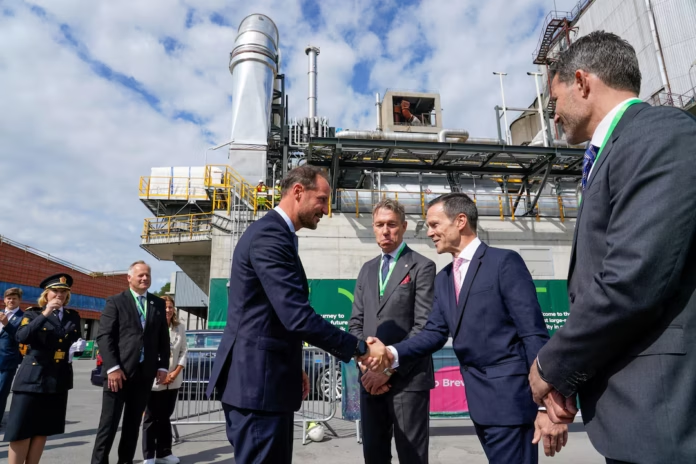
Heidelberg Materials has achieved a major climate milestone with the announcement that its zero-emissions cement production line in Brevik, southern Norway, has been completely pre-sold for the year. The landmark facility, powered by carbon capture and storage (CCS) technology, represents a breakthrough in decarbonising one of the world’s most polluting industries.
Cement manufacturing is notoriously carbon-intensive, contributing nearly 8% of global CO₂ emissions, largely due to the combustion of fossil fuels and the release of carbon during limestone conversion. The sector has long been classified as “hard to abate,” where conventional emissions reductions are both technologically and economically challenging.The Brevik plant, now operating under Heidelberg’s evoZero cement brand, is equipped with a state-of-the-art carbon capture facility that is capable of removing 400,000 metric tonnes of CO₂ annually—approximately half of the plant’s total emissions. This innovation positions Heidelberg as a global first mover in delivering net-zero cement at commercial scale.
Despite being in its ramp-up phase, the plant has already sold out production for 2025. According to Heidelberg’s chief executive, there is a strong and growing appetite for low-carbon construction materials, particularly among developers seeking to meet sustainability targets under green building certifications and climate pledges.While evoZero cement carries a premium over conventional cement, customers appear willing to pay the differential for the long-term carbon benefits. The product is viewed not merely as an environmental token but a critical lever in achieving real decarbonisation in infrastructure, real estate, and public works.
The Brevik facility is part of Norway’s Longship initiative—a €3 billion state-backed carbon capture and storage programme. The government is underwriting two-thirds of the cost to help scale the technology and reduce financial risk for early movers. Cement from the Brevik plant is made climate-neutral by capturing carbon emissions and transporting them via specially designed carriers to the Northern Lights CO₂ storage site, located deep beneath the North Sea. The site is managed jointly by energy majors Equinor, Shell, and TotalEnergies.The success of this integrated CCS supply chain is being closely watched by global policymakers and investors alike. It has already demonstrated the technical feasibility of decarbonising high-emissions industrial sectors without compromising output quality or efficiency.
However, questions remain over the long-term financial viability of CCS technologies without ongoing public support. Norwegian officials have signalled that subsidies for new CCS projects may not continue indefinitely, underscoring the need for industry players to commercialise products like net-zero cement through competitive business models.
Still, Heidelberg’s initiative signals that green transition in construction is not a distant dream. The Brevik example reinforces how a blend of public-private collaboration, advanced engineering, and targeted market incentives can deliver real-world outcomes in climate mitigation. As other regions weigh similar ventures, Brevik may well become a blueprint for decarbonising the built environment, cementing a greener future one tonne at a time.
Also Read : G Square Buys 62 Acres for Housing Project
Norway Net Zero Cement Plant Sells Out
HC Allows Slum Projects If 35 Percent of Rehab Land Must Be Park

Bombay High Court has upheld the legality of allowing slum rehabilitation schemes (SRS) on certain reserved open spaces in Mumbai. However, the court has insisted that a minimum of 35 percent of the area must be retained as usable public parks or open amenities accessible to all, not just project residents.
The verdict comes in the context of Regulation 17(3)(D)(2) of the Development Control and Promotion Regulations (DCPR), 2034, notified by the Maharashtra government in 2022. This regulation permits slum redevelopment on non-buildable plots exceeding 500 square metres, previously earmarked for public use like parks or playgrounds, provided the stipulated public open space is maintained. In a 191-page judgment, the division bench observed that the regulation promotes inclusive urban planning and strikes a delicate balance between addressing housing inequity and conserving green zones. The court reiterated the need to house marginalised communities within the city’s core, rather than displacing them to peripheral zones lacking access to jobs, education, and healthcare.
Officials noted that Mumbai’s limited geography and soaring housing demand have created pressure on land resources. The 2022 regulation aimed to unlock otherwise unusable reserved plots for the dual benefit of rehabilitation and public utility. The High Court backed this vision but added strict compliance directives to ensure green space is not completely sacrificed. As per the court’s directions, civic authorities must ensure that the earmarked 35 percent open space in any such SRS must be developed as a public amenity, such as parks, and handed over for management within 90 days of obtaining an occupation certificate. The court strictly prohibited any enclosure, fencing, or restrictions limiting access to these spaces by local residents.
Urban planning experts applauded the decision as a progressive step that aligns with international urban resilience goals. “This verdict attempts to address structural inequality by ensuring that even land-starved redevelopment projects embed public amenities into their design,” said an urban development consultant based in Mumbai. The High Court has also mandated a slew of governance and compliance measures. The Brihanmumbai Municipal Corporation (BMC) has been directed to complete GIS-based mapping and geo-tagging of all plots designated as open space under the city’s sanctioned Development Plan within four months. These datasets must be publicly published on the civic body’s official portal to promote transparency and prevent unauthorised diversions.
Moreover, the court has directed that a dedicated implementation cell be created under the Slum Rehabilitation Authority (SRA) or a designated senior officer to oversee ground-level execution. Quarterly reports on the status of all such redevelopment schemes must be submitted to the SRA and the Urban Development Department and made available in the public domain. The regulation had faced legal challenges from citizens’ groups and urban conservation NGOs, who alleged it would legitimise the encroachment of green zones and reduce Mumbai’s already precarious open space ratio. Petitioners argued that reducing the minimum plot size from 1,000 to 500 square metres in the 2022 regulation would make smaller plots vulnerable to construction activity under the pretext of welfare.
Their contention was that even under the garb of rehabilitation, no land reserved for recreational use should be converted into housing zones, as it dilutes the original purpose of urban zoning. Environmentalists also warned of the long-term consequences of green space loss on flood control, biodiversity, and mental health. Responding to these concerns, the court said that the regulation does not grant a free hand to indiscriminately reduce open space. Rather, it emphasised that the inclusion of open land in slum redevelopment must be guided by a broader urban equity lens. The court encouraged state authorities to initiate a policy review within two years to evaluate the cumulative impact of the regulation on Mumbai’s open space availability.
The judgment further stated that any violations of the 35 percent public space rule would invite disciplinary action against the developers or project officers. Projects exceeding the minimum requirement would be encouraged as model practices. The BMC has been tasked with preparing ward-wise action plans listing all reserved open spaces and conducting periodic inspections to identify unauthorised constructions or encroachments. These reports are to be forwarded to the Urban Development Department for ongoing monitoring.
From a governance standpoint, this landmark judgment reaffirms the judiciary’s role in maintaining the delicate balance between urban growth and sustainability. It sets a precedent for other Indian metros grappling with similar dilemmas of land shortage, housing backlog, and environmental degradation. For residents of Mumbai living in informal settlements, the judgment opens up new possibilities for secure, formal housing within the city fabric, without entirely giving up on the ecological or social value of open land. For city planners, the message is clear: development must be inclusive, equitable, and environmentally mindful.
HC Allows Slum Projects If 35 Percent of Rehab Land Must Be Park
G Square Buys 62 Acres for Housing Project

Real estate developer G Square has acquired 62.38 acres of land in North Chennai to create 1,091 ready-to-construct villa plots. With an estimated investment of ₹230 crore, this large-scale project spans the rapidly evolving residential micro-markets of Red Hills, Puzhal, and Karanodai — areas now emerging as key real estate destinations in the city’s northern belt.
This expansion marks a critical milestone not just for G Square, but for the future of North Chennai, a region historically viewed as industrial and underserved. However, that perception is undergoing a rapid shift, thanks to sustained investment in physical and social infrastructure. Connectivity upgrades such as the Chennai Outer Ring Road and the proposed Peripheral Ring Road are bringing new accessibility to these northern zones. Simultaneously, improved metro links, expanded educational institutions, and the growth of health and commercial services are reshaping the region into a more liveable and sought-after residential zone.
G Square’s latest projects are strategically aligned with this momentum. The acquired land parcels are located within easy reach of transformative developments including the upcoming FinTech City in Madhavaram, the MMBT logistics park, and Origins by Mahindra World City in Ponneri. These emerging nodes are fuelling demand for accessible, well-connected, and planned residential communities.
According to senior officials at G Square, the objective is clear: offer secure, legally verified, and infrastructure-ready plots in areas poised for exponential growth. “North Chennai is no longer a peripheral afterthought,” a company spokesperson noted. “It is a fast-developing corridor that presents real value to homebuyers and investors alike. Our aim is to make high-quality residential real estate accessible in every potential growth zone.”Each of the plotted developments will include key amenities such as blacktop internal roads, street lighting, 24×7 CCTV surveillance, and gated security. Buyers will also be offered one year of free maintenance support and access to post-purchase construction services — features that aim to ease the transition from land purchase to home construction. Additionally, all plots come with clear title deeds and are eligible for bank-approved financing and EMI options, enabling greater affordability for mid-income households and first-time buyers.
This development effort also ties in with a broader vision of equitable urban growth. As core areas of Chennai become saturated and increasingly unaffordable, the expansion of plotted housing options into North Chennai presents an opportunity to decentralise development while offering residents access to sustainable, secure, and better-planned neighbourhoods.With demand for independent homes rising post-pandemic and a growing number of Chennai’s working professionals looking to relocate to less congested yet well-connected localities, G Square’s strategic bet on North Chennai appears timely. The region, long known for its logistical hubs and industrial clusters, is fast becoming an aspirational address for those seeking both investment potential and a future-ready lifestyle.
As North Chennai transitions into a vital residential growth engine for the city, this project not only reflects G Square’s confidence in the region but also signals a larger movement toward planned, secure and accessible housing development in India’s emerging urban corridors.
Also Read : City Design That Makes Us Feel Healthier
G Square Buys 62 Acres for Housing Project
Govt Approves 2.35 Lakh Urban Homes Nationwide
