

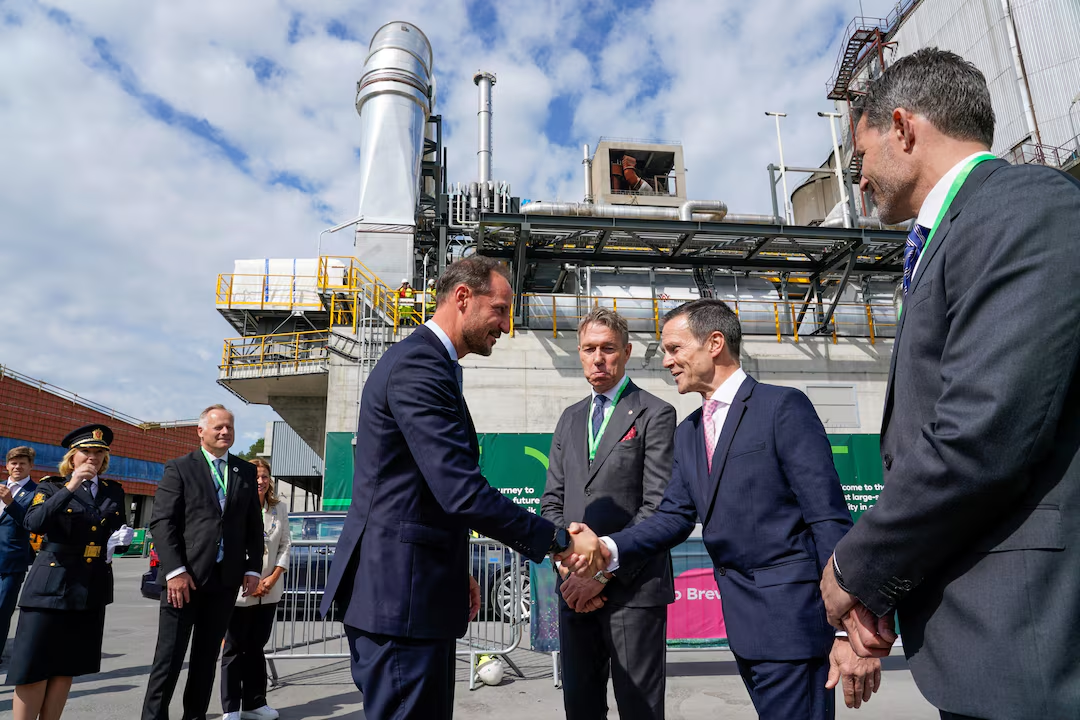
Heidelberg Materials has achieved a major climate milestone with the announcement that its zero-emissions cement production line in Brevik, southern Norway, has been completely pre-sold for the year. The landmark facility, powered by carbon capture and storage (CCS) technology, represents a breakthrough in decarbonising one of the world’s most polluting industries.
Cement manufacturing is notoriously carbon-intensive, contributing nearly 8% of global CO₂ emissions, largely due to the combustion of fossil fuels and the release of carbon during limestone conversion. The sector has long been classified as “hard to abate,” where conventional emissions reductions are both technologically and economically challenging.The Brevik plant, now operating under Heidelberg’s evoZero cement brand, is equipped with a state-of-the-art carbon capture facility that is capable of removing 400,000 metric tonnes of CO₂ annually—approximately half of the plant’s total emissions. This innovation positions Heidelberg as a global first mover in delivering net-zero cement at commercial scale.
Despite being in its ramp-up phase, the plant has already sold out production for 2025. According to Heidelberg’s chief executive, there is a strong and growing appetite for low-carbon construction materials, particularly among developers seeking to meet sustainability targets under green building certifications and climate pledges.While evoZero cement carries a premium over conventional cement, customers appear willing to pay the differential for the long-term carbon benefits. The product is viewed not merely as an environmental token but a critical lever in achieving real decarbonisation in infrastructure, real estate, and public works.
The Brevik facility is part of Norway’s Longship initiative—a €3 billion state-backed carbon capture and storage programme. The government is underwriting two-thirds of the cost to help scale the technology and reduce financial risk for early movers. Cement from the Brevik plant is made climate-neutral by capturing carbon emissions and transporting them via specially designed carriers to the Northern Lights CO₂ storage site, located deep beneath the North Sea. The site is managed jointly by energy majors Equinor, Shell, and TotalEnergies.The success of this integrated CCS supply chain is being closely watched by global policymakers and investors alike. It has already demonstrated the technical feasibility of decarbonising high-emissions industrial sectors without compromising output quality or efficiency.
However, questions remain over the long-term financial viability of CCS technologies without ongoing public support. Norwegian officials have signalled that subsidies for new CCS projects may not continue indefinitely, underscoring the need for industry players to commercialise products like net-zero cement through competitive business models.
Still, Heidelberg’s initiative signals that green transition in construction is not a distant dream. The Brevik example reinforces how a blend of public-private collaboration, advanced engineering, and targeted market incentives can deliver real-world outcomes in climate mitigation. As other regions weigh similar ventures, Brevik may well become a blueprint for decarbonising the built environment, cementing a greener future one tonne at a time.
Also Read : G Square Buys 62 Acres for Housing Project




