Home Blog Page 360

India’s Luxury Real Estate Transformation RERA and FDI Driving Change

    0
    India’s Luxury Real Estate Transformation RERA and FDI Driving Change
    India’s Luxury Real Estate Transformation RERA and FDI Driving Change

    India’s Luxury Real Estate Transformation RERA and FDI Driving Change

    India’s luxury real estate sector has seen a remarkable transformation in recent years, largely driven by the implementation of the Real Estate (Regulation and Development) Act (RERA) and the liberalisation of Foreign Direct Investment (FDI) policies. Together, these regulatory measures have not only enhanced transparency and accountability but have also fostered a robust environment for investors. For years, the luxury real estate market in India suffered from a trust deficit, where delayed projects, subpar construction quality, and lack of recourse for investors were common concerns. With RERA, however, the tides have changed, as the act mandates timely project delivery, quality assurance, and legal safeguards for buyers.

    The introduction of penalties under RERA for missed deadlines and poor quality has significantly boosted investor confidence, particularly in the luxury segment where projects often involve substantial capital. Developers are now legally bound to deliver as per their commitments, and the inclusion of escrow accounts ensures that funds are properly managed. For investors looking for safe and sound opportunities, this legal framework offers reassurance that their capital is well-protected, reducing risks that once deterred both domestic and international investors. According to recent statistics, investor confidence in the Indian real estate sector has surged by over 25% in the past three years, with luxury housing emerging as one of the most attractive segments.

    Meanwhile, FDI’s role in reshaping the Indian luxury real estate landscape cannot be overstated. The Indian government’s decision to allow 100% FDI in construction development projects has brought in global expertise, advanced technologies, and sustainable practices, which were once foreign to the domestic market. The influx of international capital has seen global real estate giants partner with Indian developers, thereby introducing world-class amenities, sustainable design practices, and cutting-edge construction technologies. For example, developers are now integrating green building solutions, with several high-end projects aiming for LEED certification, which promotes energy-efficient and environmentally friendly construction.

    From an investor’s perspective, the collaboration between RERA’s stringent regulations and FDI’s infusion of capital has created a strong synergy that ensures not only timely and high-quality deliveries but also enhances the overall buyer experience. For luxury buyers, the emphasis on transparency, sustainability, and superior construction is driving demand for homes that are not only opulent but also responsible and forward-thinking. With sustainability now at the core of luxury real estate, projects are increasingly featuring energy-efficient systems, rainwater harvesting, and green open spaces. This shift is not just about luxurious living; it’s about creating long-term value for the environment and future generations. Developers who integrate such practices stand to benefit from growing consumer awareness and demand for sustainable living options.

    The future of luxury real estate in India is poised for further evolution, with RERA and FDI continuing to drive the market toward global standards. Urban landscapes are rapidly changing, with a rising demand for luxury homes that align with both aesthetic and ethical expectations. Investors are more likely to support projects that adhere to these regulations, knowing that they not only mitigate risk but also align with a broader, more sustainable vision for India’s urban future. As the industry progresses, sustainability and transparency will continue to be at the heart of real estate development, shaping the market for years to come.

    Abhinandan Lodha Addresses Oversupply Concerns in Mumbai’s Real Estate Market

    0
    Abhinandan Lodha Addresses Oversupply Concerns in Mumbai's Real Estate Market
    Abhinandan Lodha Addresses Oversupply Concerns in Mumbai's Real Estate Market

    Abhinandan Lodha Addresses Oversupply Concerns in Mumbai’s Real Estate Market

    In the face of concerns about an oversupply of high-end residential properties in Mumbai, Abhinandan Lodha, Chairman of the House of Abhinandan Lodha, has expressed confidence in the continued growth of the city’s real estate market. Lodha’s optimism stands in stark contrast to the recent warnings issued by experts like Gulam Zia from Knight Frank, who highlighted the alarming five-year inventory in Mumbai’s ₹20-50 crore housing segment, a situation he believes could indicate emerging market stress.

    Lodha, however, attributes the inventory in this price range to a surge in newly launched projects rather than an impending market oversupply. He remains firm that these properties will find buyers over the next two to three years. “Unless FSI norms change, it’s nearly impossible to create a true oversupply situation in urban areas,” Lodha remarked, pointing out the resilience of demand in the face of expanding urbanisation. His outlook is underpinned by his belief that the demand for real estate will grow significantly in the coming years, despite regional fluctuations in pricing.

    Lodha’s views are shared by Santhosh Kumar, Vice Chairman of Anarock Group, who also weighed in on the Indian real estate sector’s positive trajectory. Kumar foresees a strong growth phase for the sector in 2025, fuelled by factors such as stable economic conditions, a growing population, and favourable government policies. Additionally, he highlighted new opportunities emerging in the real estate space, including co-living spaces, warehousing, and data centres, which are providing fresh avenues for investors to explore.


    Lodha further emphasised the enduring value of land as a key investment asset. He pointed to the success stories of areas like Gurugram and Thane, where strategic land investments over the past two decades have yielded impressive returns. Urbanisation, coupled with evolving FSI norms and infrastructure projects, is expected to continue driving land value upwards, making it a sound long-term investment. Locations such as Vrindavan, Shimla, and Ayodhya, according to Lodha, offer promising potential for long-term capital appreciation, particularly as these areas undergo significant infrastructural and demand-driven developments.

    From a sustainability perspective, Lodha’s focus on land investment aligns with a broader shift towards responsible urban planning. As cities expand, integrating sustainability into development strategies will be essential to ensure that growth does not compromise environmental well-being. While urbanisation offers vast opportunities for real estate, it also presents the challenge of balancing development with ecological preservation, a concern that will become increasingly important as India’s cities continue to grow.

    In summary, while oversupply concerns persist in Mumbai’s real estate market, experts like Abhinandan Lodha and Santhosh Kumar continue to highlight the strong growth prospects, particularly in emerging sectors and strategic land investments. As India’s urban landscape evolves, the need for sustainable, well-planned development will be pivotal in ensuring the long-term success of the real estate market.

    U.S. Steel Faces Tough Road Ahead After Nippon Steel Merger Blocked

    U.S. Steel Faces Tough Road Ahead After Nippon Steel Merger Blocked
    U.S. Steel Faces Tough Road Ahead After Nippon Steel Merger Blocked

    U.S. Steel Faces Tough Road Ahead After Nippon Steel Merger Blocked

    For over a year, U.S. Steel had hoped to solve its mounting challenges by agreeing to a $14 billion takeover by Nippon Steel, aiming to modernize its mills and stave off obsolescence. However, with the U.S. government blocking the deal on national security grounds, the company now faces a difficult road ahead.

    The merger’s collapse is a major blow to U.S. Steel, which warned that without modernization, it would be forced to shut down plants and lay off workers. Despite this setback, U.S. Steel and Nippon Steel are fighting the decision in court, claiming that politics distorted the merger review process. Without a merger partner, U.S. Steel could be forced to close its traditional steel plants, jeopardizing jobs and impacting the communities dependent on them. Attempting to merge with another competitor could spark antitrust concerns, while the company struggles to keep pace with the industry’s shift from blast furnaces to electric furnaces.

    A U.S. Steel spokesperson expressed confidence in their legal fight, emphasizing that the deal with Nippon Steel remains the best path forward to secure the company’s future. However, without that partnership, the company may be left with few viable options and may have to make drastic decisions to survive. The halted merger and its consequences mark a crucial turning point for U.S. Steel, once a dominant force in American industry but now confronting fierce challenges in a rapidly changing global steel market.

    SAIL Supplies 45,000 Tonnes of Steel for Maha Kumbh Mela 2025

    SAIL Supplies 45,000 Tonnes of Steel for Maha Kumbh Mela 2025
    SAIL Supplies 45,000 Tonnes of Steel for Maha Kumbh Mela 2025

    SAIL Supplies 45,000 Tonnes of Steel for Maha Kumbh Mela 2025

    Steel Authority of India Limited (SAIL), a Maharatna company, has supplied approximately 45,000 tonnes of steel for the upcoming Maha Kumbh Mela in Prayagraj, showcasing its ongoing commitment to national infrastructure projects. The steel supply includes chequered plates, hot strip mill plates, mild steel plates, angles, and joists, essential for the construction of various temporary structures required for the smooth conduct of the event.

    SAIL had previously supported the 2013 Maha Kumbh Mela, reinforcing its role in facilitating large-scale public events of national significance. For the 2025 Maha Kumbh Mela, the steel provided by SAIL will play a critical role in building essential structures like pontoon bridges, temporary steel bridges, flyovers, substations, and passages. Key customers benefiting from this steel supply include the Public Works Department (PWD), Uttar Pradesh State Bridges Corporation, the Electricity Board, and their suppliers. The company expressed pride in contributing to the development of infrastructure for one of the world’s largest spiritual gatherings.

    The Maha Kumbh Mela, celebrated once every twelve years, draws millions of devotees from across India and abroad, making it a global symbol of India’s cultural and spiritual heritage. The event not only serves as a major religious gathering but also as a platform to display India’s rich traditions, arts, and customs. SAIL’s ongoing involvement in national infrastructure projects highlights its commitment to supporting the country’s cultural and social well-being. As preparations for the 2025 Maha Kumbh Mela progress, the steel supplied by SAIL will be pivotal in ensuring the event’s success. The key ritual of “Shahi Snan” is set to take place on 14 January (Makar Sankranti), 29 January (Mauni Amavasya), and February 3 (Basant Panchami), marking major spiritual milestones during the event. Uttar Pradesh Chief Minister Yogi Adityanath recently reviewed the preparations for the grand event, which is expected to draw millions of devotees over the coming weeks.

    Domestic Steel Demand to Grow 8-9% in 2025

    Domestic Steel Demand to Grow 8-9% in 2025
    Domestic Steel Demand to Grow 8-9% in 2025

    Domestic Steel Demand to Grow 8-9% in 2025

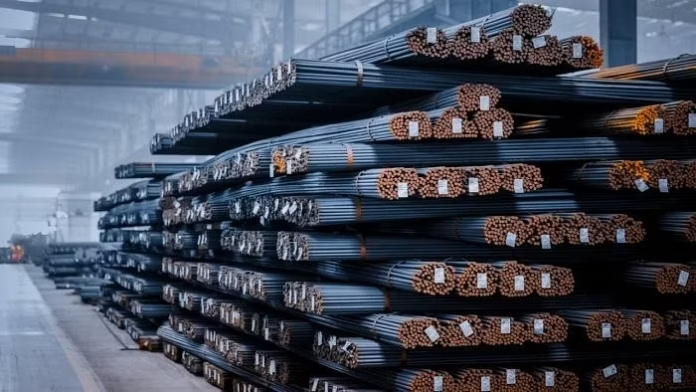
    India’s steel demand is poised for significant growth in 2025, with an anticipated increase of 8-9 percent, defying the global industry slowdown. The surge is attributed to robust demand from steel-intensive sectors such as housing, infrastructure, and engineering, coupled with growth in packaging and other segments. The introduction of a safeguard duty, as proposed by the industry, could further support steel prices and profitability, making it a critical factor to watch.

    According to Crisil Ratings, global steel demand in 2024 is estimated to have declined by 1 percent, with China, the world’s largest steel producer and consumer, seeing a 3.5 percent drop. This decrease was primarily driven by weaker demand from China’s real estate sector, despite policy changes and economic support packages. Similarly, steel demand in Europe, Japan, and the US has seen declines ranging from 2-3 percent. However, India’s steel demand grew by an impressive 11 percent, helping to offset the global dip.

    In 2025, while global steel demand is expected to see a modest increase of 0.5-1.5 percent, India will continue to be the leading force behind demand growth. The projected recovery in residential construction in developed economies, such as the EU, the US, and Korea, along with easing financing conditions, is likely to contribute to global steel demand. However, India’s market remains the most resilient and growth oriented. One of the key challenges for the Indian steel industry, however, lies in domestic supply. Crisil Ratings noted that domestic production growth remained weak in 2024, with the top seven players only achieving a marginal 0.05 percent increase in crude steel production. This was partly due to extended shutdowns and planned maintenance.

    Despite this, medium and small players reported significant production growth, with crude steel production increasing by 14 percent and finished steel production by 11.3 percent. This highlights the steady demand for long steel products, particularly from the construction sector. The surge in finished steel imports from key exporters like China, Japan, Vietnam, and South Korea also impacted the domestic market. Imports from China, especially hot-rolled coils (HRC), have increased sharply, creating price pressure on domestic producers. This has resulted in a decline in steel prices, with hot-rolled coil (HRC) prices falling by 9 percent in 2024, and cold-rolled coil (CRC) prices declining by 7 percent.

    However, a decline in coking coal prices and a reduction in volatility have provided some relief to steel manufacturers, alleviating margin pressures. Coking coal prices fell by 12 percent in 2024, while iron ore prices saw a rise of 9-10 percent. The imposition of the proposed safeguard duty is expected to provide a positive impact on steel prices in 2025, particularly in the first half. With rising production from new plants, supply is expected to increase, but steel prices are likely to remain above the average levels of 2024, offering a slight upside.

    Low-Carbon Fuel Facility Transforms Waste Into Cement Plant Energy

    Low-Carbon Fuel Facility Transforms Waste Into Cement Plant Energy
    Low-Carbon Fuel Facility Transforms Waste Into Cement Plant Energy

    Low-Carbon Fuel Facility Transforms Waste Into Cement Plant Energy

    In a significant move to support Canada’s transition to a low-carbon economy, Geocycle and Lafarge Canada have commissioned their innovative Low-Carbon Fuel facility at the Brookfield cement plant. This pioneering initiative aims to reduce carbon emissions by converting waste materials into a sustainable energy source for cement production.

    Building on the success of the Brookfield facility, the companies have extended the programme to develop a second low-carbon fuel facility at Lafarge’s Exshaw cement plant in Alberta. This project is part of a broader effort to enhance sustainability in Canada’s cement industry while contributing to the country’s goals for reducing greenhouse gas emissions. The facility at Brookfield processes waste materials, which would otherwise end up in landfills, and transforms them into valuable energy for the cement manufacturing process. By utilising waste as a source of fuel, the facility significantly reduces reliance on traditional fossil fuels, thereby decreasing the carbon footprint of cement production.

    Geocycle, a leader in waste management and energy recovery, and Lafarge Canada, a leading player in the cement industry, have long been committed to sustainability. Their collaboration in this area aligns with Canada’s broader efforts to reduce industrial emissions and promote a circular economy where waste is repurposed for productive uses. Following the success of the Brookfield initiative, the second facility at Exshaw is expected to further enhance the sustainability of Lafarge Canada’s operations, while also demonstrating the potential of waste-to-energy solutions in powering cement production. With growing support for low-carbon technologies, this project is a key example of how industries can innovate to meet environmental challenges and contribute to a greener future.

    Nomura Downgrades 3 Cement Stocks Amid Industry Challenges

    Nomura Downgrades 3 Cement Stocks Amid Industry Challenges
    Nomura Downgrades 3 Cement Stocks Amid Industry Challenges

    Nomura Downgrades 3 Cement Stocks Amid Industry Challenges

    Global brokerage firm Nomura has downgraded its ratings on three prominent cement stocks—Shree Cement, ACC, and Nuvoco—amid increasing headwinds facing the Indian cement industry. The firm cites weak pricing power and sluggish demand growth as the primary concerns impacting the sector. Shree Cement has been downgraded from a ‘Buy’ rating to ‘Neutral,’ with a revised target price of ₹28,000. Both ACC and Nuvoco have been downgraded from ‘Neutral’ to ‘Reduce,’ with target prices of ₹1,920 and ₹330, respectively.

    Nomura’s report highlights the tough market conditions the industry is grappling with, noting that volume growth has significantly slowed. The Indian cement industry registered a mere 2 percent year-on-year volume growth in the first half of FY25, compared to a strong 12 percent growth during the same period in FY24. The brokerage also attributed the moderation in growth to limited fund releases by the government and a slowdown in the launch of new infrastructure projects, common during election years. In addition to weak demand, cement trade prices have fallen by 8 percent year-on-year in the first nine months of FY25, driven by the ongoing demand slump. This has created pricing pressure, particularly during the ongoing consolidation phase of the industry. The relationship between volume growth and pricing has turned notably negative, with an observed coefficient of -0.8 between FY21-24. This negative correlation reflects the industry’s struggle to balance both volume and pricing amid tough market conditions.

    Despite these challenges, Nomura noted a potential silver lining in cost reductions. Prices for imported pet coke and thermal coal have decreased by 19 percent and 8 percent year-on-year, respectively. However, these cost savings are unlikely to lead to significant EBITDA expansion due to the continuing weak pricing environment. The declining power and fuel costs (P&F costs) between FY23 and H1FY25 are expected to have already been factored into the market. Looking ahead, analysts suggest that cement prices will remain weak, especially as companies face market share battles amid ongoing consolidation in the sector. Nomura remains optimistic about companies that are focusing on sustainable cost-saving measures, but the brokerage cautions that aggressive price hikes may not be sustainable for the industry in the near term. As Nomura adjusts its stance on these cement stocks, investors are advised to closely monitor the ongoing market conditions and the impact of weak demand and pricing pressure on the financial performance of these companies.

    Cement Prices Edge Up in January, Demand Remains Uncertain

    India Cement Sector Explores Carbon Capture Solutions
    India Cement Sector Explores Carbon Capture Solutions

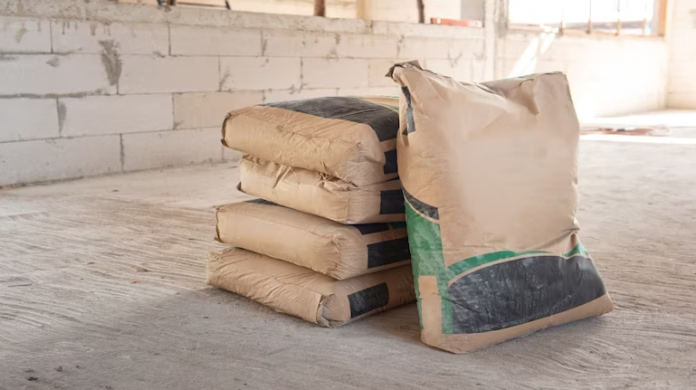
    Cement prices saw a slight increase in January 2025, continuing the upward trend observed in the latter part of 2024. According to analysts at Nomura, the average trade price of cement rose by  ₹2 per bag, reaching  ₹343, compared to  ₹341 in December 2024. However, despite this price increase, the outlook for demand remains uncertain, with regional pricing trends showing mixed results across India.

    The Eastern region experienced the most significant rise, with prices increasing by  ₹5 month-on-month (MoM), reaching  ₹314 per bag. This surge was largely driven by a  ₹20 hike in West Bengal, where demand remains relatively strong. In contrast, the Western region saw a more modest increase of  ₹3 MoM, bringing the average price to  ₹353 per bag. This uptick was driven by a  ₹10 price increase in Gujarat, which also recorded notable volume growth in December 2024. The Central region, however, saw a decline in prices, with the average price falling by   ₹3 MoM to  ₹365 per bag. This decrease reflects weaker demand in December, which analysts attribute to subdued activity in the construction sector. Dealers in the Central region have expressed expectations of continued sluggishness until mid-January, citing colder weather conditions that typically hamper construction activities.

    In the Southern region, cement prices remained stable at  ₹323 per bag, as the region continues to experience weak demand, particularly in Hyderabad. Slower real estate and construction activity are being blamed, along with labor shortages due to regional festivals such as Pongal. However, dealers are hopeful that demand will pick up later in the month as government projects in Kerala, particularly those with deadlines in March 2025, begin to gather momentum. Notably, the Central region was the only one to experience a price drop, with a 1 percent decline in average prices. Other regions, including the East, West, and South, have reported mild to significant increases in pricing. Despite the overall price rise, demand recovery remains uneven, and analysts expect this trend to continue until mid-January.

    In terms of stock recommendations, Nomura analysts continue to favour a positive outlook for UltraTech Cement, maintaining a “buy” rating. Other companies such as Shree Cement, Ambuja Cement, and Ramco Cement also received positive ratings. On the other hand, Nuvoco Vistas Corporation and ACC hold a “neutral” stance, while Dalmia Bharat is recommended for a “reduce” rating. As cement prices show resilience, industry experts are cautious about the uneven pace of demand recovery, particularly with weather conditions and regional factors influencing construction activity across India.

    JSW Cement Gets SEBI Nod for ₹4,000 Crore IPO

    JSW Cement Gets SEBI Nod for ₹4,000 Crore IPO
    JSW Cement Gets SEBI Nod for ₹4,000 Crore IPO

    JSW Cement Gets SEBI Nod for ₹4,000 Crore IPO

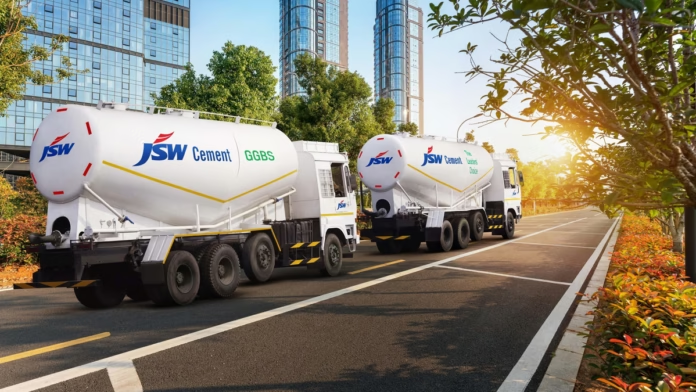
    JSW Cement, a key player in India’s cement industry and part of the Sajjan Jindal-promoted JSW Group, has received the final approval from the Securities and Exchange Board of India (SEBI) to raise ₹4,000 crore through an initial public offering (IPO). The company had filed its IPO documents with SEBI on 16th August 2024, and after a brief delay in September due to pending issues involving the promoter family, the approval has now been granted.

    This marks the first significant public offering in the cement sector since Nuvoco Vistas’ ₹5,000 crore IPO in August 2021 and is poised to be a pivotal event in the Indian stock market. It will also be the fourth company under the JSW Group to go public, following the listing of JSW Infrastructure in October 2024. Despite facing challenging conditions in the cement industry—including subdued demand resulting from prolonged rainfall, delays in infrastructure project funding, and labour shortages—the IPO is moving forward. However, demand is expected to improve in the latter half of FY25, especially with the typically strong Q4, bolstered by increased institutional demand and sustained momentum in the housing and real estate sectors.

    JSW Cement’s IPO comprises a fresh equity issue of ₹2,000 crore and an equal amount through an offer for sale (OFS) by existing shareholders. AP Asia Opportunistic Holdings Pte. Ltd. and Synergy Metals Investments will each offload ₹937.50 crore worth of shares, while the State Bank of India (SBI) will pare ₹125 crore worth of shares. The funds raised from the fresh equity will be directed towards financing the establishment of a new integrated cement unit in Nagaur, Rajasthan, which will account for ₹800 crore of the proceeds. An additional ₹720 crore will be used to reduce the company’s existing debt, which stood at ₹5,835.76 crore as of 31st March 2024. A portion of the capital will be used for general corporate purposes.

    JSW Cement’s proposed greenfield project in Nagaur will include a clinker capacity of 3.30 million tonnes per annum (MTPA) and a grinding capacity of 2.50 MTPA. The plant will manufacture Ordinary Portland Cement (OPC) and Portland Pozzolana Cement (PPC), using limestone sourced from the region. In addition to the Nagaur project, the company has ambitious plans to set up large-scale plants across India. Earlier this year, Managing Director Parth Jindal revealed a ₹3,000 crore investment for the Nagaur unit, part of broader plans that also include mega projects in Odisha, which are expected to involve investments of ₹65,000 crore in total.

    Trump Eyes Greenland to Expand U.S. Influence

      0
      Trump Eyes Greenland to Expand U.S. Influence
      Trump Eyes Greenland to Expand U.S. Influence

      Trump Eyes Greenland to Expand U.S. Influence

      U.S. President-elect Donald Trump has set his sights on acquiring Greenland, a move he views as a way to both expand America’s sphere of influence in the Western Hemisphere and secure a lasting legacy, according to multiple sources familiar with his thinking. This ambition, which was briefly suggested during his first term, has now become a focal point of his foreign policy vision.

      Trump’s comments, made public on Tuesday, raised eyebrows among European allies. He declared that he would not rule out using military or economic actions to acquire the Danish territory once he assumes office on 20th January. These statements have ignited concerns among nations that value the integrity of national borders, especially in an era of rising global instability. While Trump has long been fixated on the idea of acquiring Greenland, insiders close to the President-elect suggest that he is not contemplating the use of military force for such a takeover. Instead, Trump is more likely to employ diplomatic or economic pressure on Denmark to facilitate the acquisition of Greenland, the world’s largest island. According to one insider, Trump sees acquiring Greenland as a way to expand the U.S. territory and leave behind a major geopolitical legacy.

      “The real legacy is you’ve expanded the United States,” said one person close to Trump. “In 70 years, we haven’t added any real estate to the U.S. portfolio. He talks about it a lot.” This sentiment echoes the vision of past U.S. presidents like Dwight Eisenhower, who oversaw the incorporation of Alaska and Hawaii as U.S. states in 1959. Trump’s ambitious foreign policy objectives also seem to include other high-profile territories. Sources reveal that a foreign policy list compiled by his team post-election included not only Greenland but also the Panama Canal and even the prospect of absorbing Canada into the United States.

      Denmark, which has long had sovereignty over Greenland, has firmly rejected any notion of selling the island, although Greenland itself has considerable autonomy in domestic governance, with a population of approximately 57,000. However, Trump and his advisers continue to argue that acquiring Greenland is in the United States’ national security interest, as it would curb foreign influence in the region. His administration is expected to shift more U.S. foreign policy resources and focus toward the Americas, especially in light of concerns about growing Chinese and Russian influence.

      Trump’s desire for territorial expansion aligns with his broader goal of establishing a legacy that will resonate for generations. His push for the acquisition of Greenland is yet another example of his unorthodox approach to foreign policy, one that blends strategic expansion with a personal desire to be remembered in the annals of history. Trump spokeswoman Karoline Leavitt defended the President-elect’s stance, asserting that every decision made will be in the best interests of the United States and its people, with national security and economic concerns at the forefront of these considerations.