Home Blog Page 402

Cement Industry Eyes Growth in 2025 Despite Challenges

Cement Industry Eyes Growth in 2025 Despite Challenges

Cement Industry Eyes Growth in 2025 Despite Challenges

The Indian cement industry is gearing up for improved growth in 2025, as major players look to capitalise on the expected acceleration in demand and higher margins. With hopes pinned on government spending on large-scale infrastructure projects, the industry is targeting an 8% sales growth, bolstered by increased demand for housing and public infrastructure. The consolidation within the industry, driven by acquisitions by prominent corporate houses, is also expected to support this growth trajectory.

In a notable shift, two key players in the sector, UltraTech Cement, part of the Aditya Birla Group, and Ambuja Cements, led by billionaire Gautam Adani, have made significant strides in acquiring smaller cement companies, along with expanding their existing units. These acquisitions amount to more than 50 million tonnes per annum (MTPA) of cement capacity, valued at approximately USD 4.5 billion. With both firms fortifying their positions, their combined efforts are likely to further consolidate the sector’s competitive dynamics. The year 2024 saw challenges for the cement industry, marked by moderate capacity utilisation and lower sales realisations, which negatively impacted topline growth, narrowed margins, and slowed volume growth. Despite these hurdles, the year will be remembered for major acquisitions that have positioned UltraTech and Adani Cement for long-term growth.

Adani Cement, a relatively new entrant, acquired several cement firms, including Saurashtra-based Sanghi Industries, Penna Industries, and Orient Cement. These acquisitions enabled Adani Cement to surpass 100 MTPA of capacity within just two years of entering the sector. This rapid expansion is part of the group’s strategy to increase its cement capacity to 140 MTPA by FY28, nearly reaching the scale of market leader UltraTech Cement, which currently holds 156.66 MTPA of grey cement capacity. UltraTech Cement is also on a robust growth path, with plans to scale up its capacity to 200 MTPA by FY27. In 2024, it completed the acquisition of India Cements Ltd and is in the process of acquiring Kesoram Industries’ Cement Business.

According to Rakesh Surana, Partner at Deloitte India, 2024 has been a year of significant consolidation for the cement industry, resulting in the top five producers commanding nearly 60-65% of the industry’s total capacity. This trend highlights the structural shift towards larger, more powerful cement conglomerates. However, the industry faced muted volume growth in FY25, expected to be just 4-5%, down from the over 10% growth seen in the past three years. Factors such as the extended monsoon season and the election period contributed to the slowdown, causing a decline in price realisations by up to 10% year-on-year. The outlook for FY2025, however, appears promising, with expectations of a 7-8% growth in demand for cement, driven by rural consumption, healthy urban housing demand, and increased government spending on infrastructure projects. The cement sector is also poised to add an estimated 35 MTPA of capacity in the near future.

Industry analysts predict a 4-5% YoY growth in cement volumes, expecting the total volume to reach 445-450 million metric tonnes in FY2025. As demand picks up in the second half of FY2025, particularly in rural areas, the cement industry is expected to show resilience, supported by government infrastructure plans and stronger private sector capital expenditure. Despite the challenges faced in 2024, the cement industry remains optimistic about its future, anticipating a gradual recovery in 2025 as demand picks up and capacity utilisation improves.

Cement Sector Faces Profitability Hurdle for Future Growth

Cement Sector Faces Profitability Hurdle for Future Growth

Cement Sector Faces Profitability Hurdle for Future Growth

The future of investments in the Indian cement industry largely hinges on boosting profitability, with a crucial target of achieving an EBITDA exceeding INR 1,000 per tonne, according to a recent report by IKIGAI Asset Manager. Despite strong demand and industry consolidation, the report points out that achieving this level of profitability requires significant support from pricing strategies.

Currently, the cement industry’s EBITDA stands at INR 800 per tonne, with a post-tax return on capital employed (ROCE) of only 3 percent. After factoring in depreciation and capacity utilization, these figures underscore the need for substantial improvements to justify further investments. To attract incremental investments, the report suggests that profitability must double, which would help the sector meet its growth potential. The report highlights several challenges that could impede growth, particularly the expiration of over 25 percent of limestone mines by 2035. This is a key issue as limestone is a fundamental raw material for cement production. To address these challenges, the report recommends a greater emphasis on operational efficiencies, improved pricing strategies, and innovative ways to control costs.

One potential avenue for improving profitability is through renewable energy. With cheaper alternatives to grid power, the use of renewable energy sources could help reduce operational costs and improve margins for cement manufacturers. Despite this, the report points to weak pricing power in the sector. Over the past decade, cement prices have risen by just 50 percent, far behind inflation in other sectors, highlighting the difficulty in passing on cost increases to consumers. Looking ahead, the next phase of growth for the cement industry will depend on optimizing pricing strategies, increasing the adoption of green energy, and improving overall operational efficiencies. By tackling these areas, the sector can improve its profitability, positioning itself for sustainable growth and attracting future investments.

SEBI to Auction Properties of Nine Companies in February 2025 to Recover Investor Funds

    0
    SEBI to Auction Properties of Nine Companies in February 2025 to Recover Investor Funds
    SEBI to Auction Properties of Nine Companies in February 2025 to Recover Investor Funds

    SEBI to Auction Properties of Nine Companies in February 2025 to Recover Investor Funds

    the Securities and Exchange Board of India (SEBI) has scheduled an auction of 23 properties belonging to nine companies in February 2025. This auction is part of SEBI’s ongoing effort to liquidate the assets of firms that had raised funds without adhering to regulatory norms. Among the companies whose properties will be auctioned are Tower Infotech, Vibgyor Group, GBC Industrial Corporation, Waris Group, Pincon Group, Kolkata Weir Industries Ltd (KWIL), Annex Infrastructure India, I-core Group, and MPS Group.

    The auction process, which has been initiated following the orders of the Calcutta High Court, aims to recoup funds that were collected from investors through non-compliant means. The properties up for auction include a variety of assets such as plots, apartments, and buildings, primarily located in West Bengal. The total reserve price for these properties has been set at Rs 55 crore, as per SEBI’s official notice. The properties belong to various firms, with seven properties each from Tower Infotech and Vibgyor Group, two properties each from Waris Group and GBC Industrial Corporation, and the remaining properties owned by MPS Group, I-Core Group, Annex Infrastructure India, KWIL, and Pincon Group. SEBI has appointed Justice Sailendra Prasad Talukdar as the one-man committee to oversee the liquidation of these assets and ensure that the funds are used to repay the affected investors.

    The auction is set to take place online on February 6, 2025, from 11 AM to 1 PM. SEBI has called for bidders to make their own independent enquiries regarding any encumbrances, litigations, or claims on the properties before submitting their bids. The properties being auctioned have legal complexities attached to them, as they were part of schemes that bypassed regulatory frameworks, leading to investor losses. One notable case is Vibgyor Allied Infrastructure, which in 2009 raised Rs 61.76 crore by issuing optionally fully convertible debentures. Similarly, Tower Infotech raised nearly Rs 46 crore through non-convertible debentures and redeemable preference shares between 2005 and 2010. These funds were collected without meeting the regulatory requirements set by SEBI, which prompted the regulator’s intervention.

    As part of its strategy to safeguard investor interests, SEBI is working to ensure that these liquidated assets are sold efficiently, and the proceeds are channelled back to compensate investors. Adroit Technical Services has been appointed by SEBI to assist in the sale of the properties. This auction is expected to be an important step in SEBI’s broader agenda of ensuring accountability and transparency in the securities market. It also serves as a reminder to businesses and investors alike about the importance of adhering to legal frameworks when raising capital and conducting financial transactions. With the online auction set for February 6, 2025, investors and bidders are encouraged to prepare for the sale and take the necessary steps to ensure they understand the legal status of the properties they may be interested in purchasing.

    UltraTech Takes 8.69% Stake in Star Cement

    UltraTech Takes 8.69% Stake in Star Cement
    UltraTech Takes 8.69% Stake in Star Cement

    UltraTech Takes 8.69% Stake in Star Cement

    UltraTech Cement Ltd has strategically acquired an 8.69% stake in Star Cement Ltd, purchasing shares worth Rs 8.51 billion from the company’s promoter group. The acquisition was completed via a block deal window, with UltraTech securing shares at Rs 235 per share, as disclosed in an exchange filing on December 27. This acquisition, however, remains a non-controlling minority stake for UltraTech.

    Headquartered in Meghalaya, Star Cement has emerged as a key player in the northeastern cement market, commanding a 26.5% market share in the region. The company, which recorded a turnover of Rs 29.1 billion for the financial year 2024, boasts a grinding capacity of 7.7 million tonnes per annum (MTPA) and a clinker capacity of 6.1 MTPA. With an extensive distribution network comprising nearly 2,000 dealers and over 12,500 retailers, Star Cement is poised for further expansion. Notably, premium sales contribute to 10.6% of the company’s total sales. This acquisition forms part of UltraTech’s broader strategy to solidify its position within the Indian cement sector. Recently, UltraTech also increased its footprint by acquiring a controlling 32.72% stake in India Cements, which led to the company triggering an open offer at Rs 390 per share. With this move, India Cements is now a subsidiary of UltraTech, adding an additional 14.5 million tonnes to UltraTech’s overall production capacity.

    Star Cement has been progressively expanding its resources and operations, notably emerging as the preferred bidder for six limestone blocks in Rajasthan’s Beawar district. The estimated geological reserves of these blocks stand at 63.9 million tonnes, spanning an area of 95.68 hectares. Furthermore, the company is in the process of establishing new plants in Assam’s Silchar and Jorhat districts, with a capital expenditure of Rs 3.80 billion planned for the second half of the financial year.  Through this strategic investment, UltraTech not only strengthens its market position but also gains valuable exposure to Star Cement’s dominant presence in India’s northeastern region. The acquisition further bolsters UltraTech’s competitive edge, positioning the company for sustained growth in the years to come.

    Adani Group Stocks Surge; Adani Total Gas Soars Over 11%

      0
      Adani Group Stocks Surge; Adani Total Gas Soars Over 11%
      Adani Group Stocks Surge; Adani Total Gas Soars Over 11%

      Adani Group Stocks Surge; Adani Total Gas Soars Over 11%

      Adani Group Firms See Positive Momentum; Adani Total Gas Soars Over 11%, Adani Enterprises Rises Nearly 8%

      On December 30, 2024, despite the weak overall trend in the equity market, seven companies from the Adani Group ended the day on a high note. The biggest mover was Adani Total Gas, whose shares surged by 11.20%, followed by Adani Enterprises, which saw a jump of 7.65%. Other companies that performed well include Adani Power, which rose by 6.46%, and Adani Energy Solutions, which gained 2.46%. Adani Green Energy also saw an uptick, with shares rising by 2.31%.

      The broader market, however, faced volatility. The benchmark BSE Sensex fell by 0.57%, losing 450.94 points, and closed at 78,248.13. The NSE Nifty also ended lower, dropping 168.50 points or 0.71% to 23,644.90. This decline was attributed to a range of factors, including market corrections and global trends. Notably, there was also some movement in other Adani stocks. NDTV and Sanghi Industries rose marginally, by 0.28% and 0.05%, respectively. However, some Adani companies saw a decline: Adani Ports fell by 0.93%, Ambuja Cements declined by 0.55%, and Adani Wilmar slipped 0.17%. ACC saw a minor dip of 0.05%. Amid the day’s volatility, the Adani Group made significant corporate moves. Adani Enterprises announced its exit from the FMCG joint venture Adani Wilmar by selling its entire stake to Singapore’s Wilmar International and through open market sales. This deal, valued at over USD 2 billion, marked the group’s first major deal since the US bribery indictment, which had clouded investor sentiment earlier.

      As per the statement, Adani Enterprises will sell 31.06% of its 43.94% stake in Adani Wilmar to Wilmar International for Rs 12,314 crore, which translates to a share price of no more than Rs 305 apiece. The remaining 13% stake will be sold on the open market to meet public shareholding norms. This deal is expected to conclude by March 31, 2025. The proceeds from the sale will be redirected to fuel the growth of Adani Enterprises in its core infrastructure businesses, which have been the mainstay of the group’s strategy. This exit marks a notable shift for the Adani Group, which has increasingly focused on its infrastructure-related ventures while stepping back from some non-core areas. The sale of Adani Wilmar represents a strategic move to sharpen the group’s focus and strengthen its financial position. As these developments unfold, the market will be keenly watching the long-term effects of this exit and how the proceeds are reinvested into the group’s core operations. Despite the mixed market trends, Adani Group stocks have managed to maintain positive momentum, with Adani Total Gas leading the way as one of the strongest performers of the day.

      Vande Bharat Trains Revolutionising Indian Rail Travel as a Symbol of Modernisation and Growth

        0
        Vande Bharat Trains Revolutionising Indian Rail Travel as a Symbol of Modernisation and Growth
        Vande Bharat Trains Revolutionising Indian Rail Travel as a Symbol of Modernisation and Growth

        Vande Bharat Trains Revolutionising Indian Rail Travel as a Symbol of Modernisation and Growth

        In the face of rapid urbanisation and a growing demand for efficient transport, Indian Railways has taken significant strides to modernise and modernise its operations. A key milestone in this transformation is the deployment of 136 flagship Vande Bharat trains across the country, designed to provide a world-class travel experience for the Indian public.

        By December 2024, India had launched a remarkable 62 Vande Bharat services, making the semi-high-speed train a symbol of the nation’s aspirations. This progress reflects a broader focus on modernising the railway infrastructure, addressing both passenger comfort and safety. The Vande Bharat trains come equipped with state-of-the-art features, including Kavach technology for enhanced safety, 360-degree rotating seats, accessible toilets for Divyangjan (persons with disabilities), and integrated Braille signages. These innovations aim to improve the travel experience, not just for comfort but also for accessibility.

        The Vande Bharat trains are just one facet of Indian Railways’ ongoing efforts to improve its service offerings. The electrification of railway lines, which now covers an impressive 97% of the broad gauge network, further supports the move towards a greener, more sustainable railway system. In the calendar year 2024 alone, Indian Railways electrified over 3,210 km of tracks, and with plans to become a Net Zero Carbon emitter by 2030, the Railways has already commissioned 487 MW of solar power plants and 103 MW of wind power plants. As part of its commitment to improving rail infrastructure, the Ministry of Railways is also modernising stations under the ‘Amrit Bharat Station Scheme’. This initiative has seen 1,337 stations identified for redevelopment, with 1,198 of these already undergoing work. This is part of a larger, nationwide push to boost infrastructure in ways that support both local communities and India’s growing economy.

        For the real estate industry, the development of railways, particularly with the introduction of Vande Bharat trains and the modernisation of stations, is a major positive. These initiatives enhance connectivity, enabling better access to key commercial and residential hubs across the country. The launch of Vande Bharat services will likely increase demand for property in regions connected by the high-speed rail network, especially as commuter times become shorter, safer, and more comfortable. Furthermore, the development of multimodal logistics terminals under the ‘Gati Shakti’ initiative promises to strengthen the country’s logistics and freight sector, creating more opportunities for real estate developers. With 354 Gati Shakti Multi-Modal Cargo Terminals identified across India, many located on both railway and non-railway land, the infrastructure projects are expected to drive economic growth and boost demand for real estate in industrial hubs.

        In addition, economic corridors such as the Energy, Mineral, and Cement Corridors, High Traffic Density Routes, and Rail Sagar corridors, which are in progress, will enhance trade, boost connectivity, and stimulate regional economic growth. For real estate developers and investors, this is an opportunity to capitalise on the expanding infrastructure and associated growth in population and demand for residential and commercial spaces. The Indian Railways’ initiatives to modernise its services and infrastructure are reshaping both the travel experience and the country’s broader economy. For the real estate sector, these developments present both challenges and opportunities, particularly as improved connectivity drives demand for new developments and opens up regions previously underserved by transportation links.

        Barabanki-Bahraich Highway Set to Become UP’s First Digital Highway

          0
          Barabanki-Bahraich Highway Set to Become UP’s First Digital Highway
          Barabanki-Bahraich Highway Set to Become UP’s First Digital Highway

          Barabanki-Bahraich Highway Set to Become UP’s First Digital Highway

          Uttar Pradesh is set to witness a groundbreaking shift in road infrastructure with the development of the Barabanki-Bahraich highway, which will become the state’s first digital highway. The 101-km stretch, which forms part of NH-927, will not only expand the region’s connectivity but also integrate advanced technology, making travel safer, more efficient, and technologically enhanced.

          The National Highways Authority of India (NHAI) is spearheading this ambitious project, which is slated to begin construction by March 2025. The highway will be a four-lane road featuring optical fiber cables (OFCs) laid along its length, a crucial innovation that will eliminate the need for future excavations, ensuring minimal disruption to the road’s surface. This initiative is in line with NHAI’s broader plan to develop 10,000 kilometers of digital highways across India. The Barabanki-Bahraich highway will be designed with a wide range of modern technological features, aimed at ensuring a superior and safer travel experience. The highway will be equipped with continuous network coverage, which includes 24/7 availability of mobile and internet services, thanks to the optical fiber ducts. These ducts, approximately 3 meters wide, will house the optical cables, providing uninterrupted connectivity along the entire route.

          Moreover, the highway will feature cutting-edge safety measures, such as National Permit Register (NPR) cameras, which will monitor traffic and enforce regulations, helping to reduce accidents. Enhanced lighting systems will ensure visibility, making nighttime driving much safer. These upgrades are expected to facilitate smoother, faster travel, with higher vehicle speeds made possible by the efficient design and technological integration. In addition to its digital capabilities, the Barabanki-Bahraich highway will significantly improve regional connectivity. The route will connect key locations, including Lucknow, Shravasti airport, NH-27, and even extend towards the India-Nepal border. This will ease access to vital areas and is expected to fuel economic growth, particularly in Barabanki, Bahraich, Gonda, and Balrampur districts.

          As the traffic load on this highway is significant, with approximately 25,000 vehicles using it daily, a key feature of this expansion includes the construction of a new 1.3-kilometre-long bridge to alleviate the pressure on the existing Sanjay Setu bridge. The new bridge will streamline traffic flow, as the two bridges will operate on a one-way system. Additionally, a flyover will be built to improve connectivity between the Ayodhya Highway and the existing two-lane road leading to Bahraich. This transformation of the Barabanki-Bahraich highway into a digital highway is expected to bring significant relief to local communities and enhance safety, connectivity, and economic activity in Uttar Pradesh. It is part of a larger vision by the NHAI to create a digital infrastructure backbone for the country, with this highway serving as a pioneer in digital road technology.

          Airlines to Share International Passenger Data with Customs from April 1, 2025

            0
            Airlines to Share International Passenger Data with Customs from April 1, 2025
            Airlines to Share International Passenger Data with Customs from April 1, 2025

            Airlines to Share International Passenger Data with Customs from April 1, 2025

            the Indian government has mandated that all airlines operating international flights to and from India must share detailed passenger data with Indian Customs authorities starting from April 1, 2025. The new requirement, outlined by the Central Board of Indirect Taxes and Customs (CBIC), aims to improve risk analysis and strengthen the interdiction capabilities of authorities.

            Under the new regulation, airlines will need to provide comprehensive information about international passengers at least 24 hours before the flight’s departure. This includes essential details such as the passenger’s name, travel itinerary, mobile number, payment methods (including credit card information), and baggage details. The Passenger Name Record (PNR) system will be used to share this data, which is expected to be a crucial part of India’s enhanced security framework. The Passenger Name Record Information Regulations, 2022, which came into effect in August 2022, introduced the requirement for airlines to share PNR data with Customs. The government’s intention behind this move is to bolster security by enabling better tracking of passengers and improving the efficiency of customs operations. It will also allow Customs authorities to perform advanced risk assessments, thereby identifying potential security risks before passengers arrive at Indian airports.

            To comply with the new regulations, all air transport service providers will need to register with the National Customs Targeting Centre-Passenger (NCTC-Pax) by January 10, 2025. Failure to register could result in penalties, with airlines facing fines ranging from Rs 25,000 to Rs 50,000 for each instance of non-compliance. The CBIC has stressed that this data-sharing requirement is not only essential for compliance but also a necessary step in streamlining India’s airport security and passenger screening systems. The implementation of the new system will begin with a pilot phase starting on February 10, 2025. During this phase, selected airlines will participate to ensure the system works effectively. After the successful completion of the pilot phase, the full-scale operation will commence on April 1, 2025, for individual airlines. Additionally, airlines operating through a global distribution system (GDS) will begin submitting passenger data starting from June 1, 2025.

            The required data will include details such as the name of the passenger, ticket information (including the date of issue), names of other travellers under the same PNR, travel agency information, and details of the flight’s codeshare arrangements. The data collected will also involve mobile phone numbers and email addresses to enable quicker communication in case of emergencies or compliance-related matters. In the long term, the data-sharing initiative aims to improve passenger experience by ensuring smoother and faster clearance at customs checkpoints while enhancing the effectiveness of border control. With growing concerns over security, the move aligns with global standards for passenger screening and customs data collection. The new system represents a shift towards more data-driven approaches to aviation security and could pave the way for similar initiatives in other countries as well.

            Bengaluru Set to Launch 13,000 km Digital Infrastructure Corridor to Streamline Utilities

              0
              Bengaluru Set to Launch 13,000 km Digital Infrastructure Corridor to Streamline Utilities
              Bengaluru Set to Launch 13,000 km Digital Infrastructure Corridor to Streamline Utilities

              Bengaluru Set to Launch 13,000 km Digital Infrastructure Corridor to Streamline Utilities

              The Bruhat Bengaluru Mahanagara Palike (BBMP) has initiated the creation of a 12,800km-long digital infrastructure utility corridor. This project, worth Rs 200 crore, is a significant step towards modernising Bengaluru’s urban infrastructure as part of the ongoing ‘Brand Bengaluru’ campaign.

              Bengaluru’s skyline is often cluttered with hanging optical fibre cables (OFCs) and power transmission lines, which not only create an eyesore but also pose serious safety risks to pedestrians and motorists. With overhead cables snaking across streets, footpaths, and trees, residents have long voiced concerns about the hazards they pose. The BBMP’s solution to these issues is a project that will shift these services underground, integrating telecommunications and electrical infrastructure into a single streamlined system. The digital infrastructure corridor, which will span the entire city, aims to replace the current overhead OFCs with a robust underground optical fibre network. This will integrate telecommunications with power infrastructure, enhancing both the aesthetics and safety of Bengaluru. The project will also feature ducts dedicated to electricity utilities, including Bescom (Bangalore Electricity Supply Company), and Smart City initiatives, with approximately 3,400km of ducts allocated for these purposes, as detailed by BBMP Chief Engineer, BS Prahalad.

              While Bengaluru already has around 15,000km of ducts in place, this new corridor will make use of these existing facilities, reducing the need for additional excavation and construction work. The project will not only eliminate the hazards caused by hanging cables but also improve the city’s pedestrian safety and traffic flow. In an effort to streamline the utility management process, BBMP will charge optical fibre cable providers a fee for using the new underground ducts. This initiative is expected to generate substantial revenue for the city, which will be reinvested into its further development and infrastructure projects.

              BBMP engineers have indicated that the work on this transformative project will begin soon, with the Mahadevapura zone expected to be one of the first areas to see progress. The places where the project will kick off are yet to be officially announced, but local sources confirm that this will be a priority area for implementation. This project is part of a larger national initiative to expand optical fibre infrastructure across India. The National Highways Authority of India (NHAI) is working on developing a 10,000km OFC network to improve internet connectivity in remote regions and accelerate the rollout of advanced 5G and 6G networks. As part of this initiative, 1,367km of optical fibre cable will be developed along the Delhi-Mumbai Expressway, and 512km will be laid along the Hyderabad-Bengaluru corridor. The digital infrastructure corridor will make Bengaluru a pioneer in integrating smart city technologies with efficient urban utilities. It is expected to offer a “plug-and-play” model for telecom services, where telecom providers can lease space in the underground ducts through a user-friendly web portal. This will significantly improve the rollout of broadband and mobile services, ensuring faster internet access for residents and businesses across the city. In the long term, the success of this project could serve as a model for other cities across India, transforming urban landscapes by making them safer, cleaner, and more connected in an increasingly digital world.

              Construction Work Halted in Byculla and Borivali East to Combat Poor Air Quality

              0
              Construction Work Halted in Byculla and Borivali East to Combat Poor Air Quality
              Construction Work Halted in Byculla and Borivali East to Combat Poor Air Quality

              Construction Work Halted in Byculla and Borivali East to Combat Poor Air Quality

              Mumbai, often known for its bustling urban life, has recently been battling a significant rise in air pollution. In response to the deteriorating air quality in key areas of the city, the Brihanmumbai Municipal Corporation (BMC) has taken the drastic step of halting construction work in Byculla and Borivali East. This decision comes after the Air Quality Index (AQI) in these locations consistently exceeded safe limits, prompting concerns for public health and safety.

              On Monday, Bhushan Gagrani, the Commissioner of the BMC, announced that construction activities, both private and government-led, including those managed by the civic body itself, would be suspended in these areas. The measure will remain in effect until the AQI improves to a safer level. Gagrani, who also serves as the chairperson of the Bombay High Court-appointed air quality monitoring committee, stated that non-compliance with this directive would result in legal action under Section 52 of the Maharashtra Regional Town Planning Act. Additionally, police complaints would be filed against offenders. The decision to stop construction work in Byculla and Borivali East is part of a broader initiative by the BMC to combat the worsening air quality in Mumbai, which has been a growing concern for residents and authorities alike. The AQI in Byculla, a prominent residential area, recently peaked at 170, placing it in the “moderately polluted” category. For reference, the AQI system has six categories: good (0-50), satisfactory (51-100), moderately polluted (101-200), poor (201-300), very poor (301-400), and severe (401-500). An AQI above 200, which is consistently seen in Byculla and Borivali East, falls into the “poor” category, which can have adverse effects on the health of sensitive individuals, especially those with respiratory conditions.

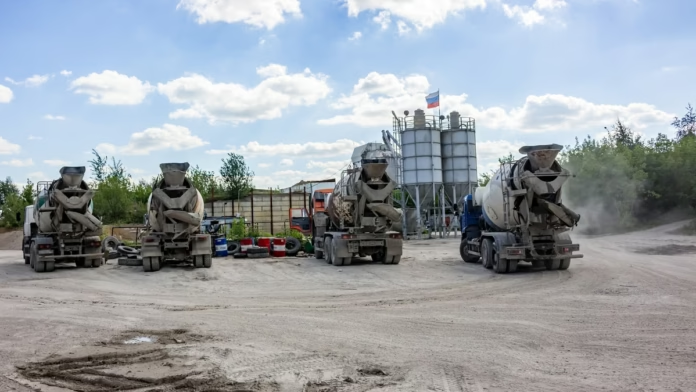
              To tackle the root causes of air pollution, the Maharashtra Pollution Control Board (MPCB) has issued notices to all ready-mix concrete (RMC) plants operating in Mumbai and its adjoining metropolitan regions. With over 500 RMC plants supplying concrete for ongoing construction projects, these plants are significant contributors to pollution. The MPCB has directed that all RMC plants must install sheds to cover 100 per cent of their operational areas in a bid to reduce dust emissions, a major pollutant at construction sites. These proactive measures reflect a growing recognition of the need to balance Mumbai’s rapid urbanisation with environmental responsibility. With thousands of construction projects underway, the city faces the challenge of curbing pollution without stalling its progress. The BMC’s action, while disruptive, aims to prioritise the health and well-being of Mumbai’s residents by addressing the dangerous levels of airborne particles in these two key areas.

              The suspension of construction is not the only step being taken. The BMC has also called on residents to take precautionary measures to protect themselves from the harmful effects of poor air quality. This includes limiting outdoor activities, especially for vulnerable groups such as children, the elderly, and individuals with pre-existing respiratory conditions. As the situation unfolds, the BMC continues to monitor the air quality and plans to lift the construction ban once the AQI returns to a safer level. This move underscores the city’s commitment to protecting its residents from the impacts of air pollution, even as it strives to accommodate its ever-expanding urban landscape.