

India Design Sector Embraces Cloud Inspired Aesthetics

In 2026 India’s design ecosystem is witnessing a subtle yet significant aesthetic shift as architects, designers and developers increasingly favour serene, ‘cloud-inspired’ white palettes that prioritise calm over ornamentation. This emerging trend — rooted in intentional space planning and material sensibility — reflects broader changes in how urban residents conceive luxury and wellbeing in built environments, even as cities grow denser and lifestyles more hectic.
Industry practitioners describe this aesthetic evolution as more than a colour choice. The soft white tone, exemplified by themes akin to Pantone’s “Cloud Dancer”, is being used as a unifying backdrop in residential and commercial interiors that seeks to enhance natural light, spatial clarity and material expression. Designers say it enables crafted details — from artisanal textures to structural elements — to become focal points without visual clutter.In urban homes across India’s major cities, minimalism long associated with modern design is being reinterpreted through warmth and tactility rather than starkness. Real estate developers, recognising the market shift, are integrating these palettes into model apartments and showhomes to appeal to buyers seeking calm, functional spaces that also signal aspirational quality. Developers and market analysts alike see this as part of a broader consumer preference for thoughtful, human-centred environments rather than purely ostentatious finishes.
Urban planners and sustainability experts suggest that design trends often mirror deeper societal priorities. In India’s fast-growing metropolitan regions — where density, environmental stress and social fragmentation are daily realities — the pull towards visually quieter, daylight-enhancing interiors dovetails with an emergent desire for mental wellbeing and spatial respite. Such palettes can make compact apartments feel larger and less taxing, especially as cities wrestle with housing shortages and tighter living quarters.The shift has implications for materials sourcing and supply chains in the construction and interiors sector. Demand for high-quality whites and neutrals encourages producers to innovate in finishes and coatings that are both durable and environment-friendly, while architects experiment with natural materials like light timber, woven textiles and handcrafted surfaces to break monotony. Some sustainable design advocates also point out that reflective light surfaces can reduce reliance on artificial lighting, improving energy efficiency in residential blocks and commercial properties.
However, embracing this trend requires careful climate-sensitive execution. In humid or dusty urban contexts, maintaining pristine white interiors can be resource intensive without thoughtful material choices and maintenance planning. Designers emphasise the importance of selecting finishes and textures that age gracefully, rather than purely cosmetic surfaces that demand frequent upkeep.
For young Indian buyers and renters prioritising lifestyle alongside utility, these direction shifts in design are reshaping expectations. City dwellers increasingly see their living spaces as extensions of personal wellbeing goals — places that should feel expansive, luminous and subtly sophisticated. As luxury in urban India evolves from flamboyance to introspection, the broader built environment looks set to follow, signalling a noteworthy redefinition of contemporary design values.
Also Read: Andhra Pradesh Charts Coal Gasification In Eluru Mines
India Design Sector Embraces Cloud Inspired Aesthetics
Andhra Pradesh Charts Coal Gasification In Eluru Mines

Andhra Pradesh’s government is advancing plans to assess coal gasification at the Chintalapudi-Racherla mining complex in Eluru district, a move that could reshape the region’s energy and industrial landscape by unlocking value from coal reserves while aligning with broader clean energy and resource-efficiency goals. The initiative, currently in preparatory stages, underscores the state’s push to diversify its energy mix and explore lower-carbon alternatives within its traditional energy sectors.
State authorities have initiated technical assessments and stakeholder consultations to evaluate how gasification — a process that converts coal into synthesis gas (syngas) usable as a feedstock for power generation and industrial chemicals — might operate in the existing mining ecosystem. Early work involves resource quality evaluation, logistical mapping and environmental impact studies, with the outcomes expected to shape detailed project proposals and investment plans.Coal gasification is gaining attention nationally as a bridge between fossil fuel resources and cleaner industrial applications. The Union government has previously backed such technologies through capital support schemes to incentivise new facilities that lower emissions relative to conventional coal use. In parallel, major energy firms are exploring syngas and synthetic natural gas (SNG) pathways to leverage domestic coal in more climate-conscious ways, as seen with large projects planned in other states.
Urban planners and energy analysts note that Andhra Pradesh’s coal gasification assessment intersects with the state’s ambitious renewable agenda — including a 160 GW renewable capacity target — by offering a transitional strategy for regions dependent on fossil fuels. However, the blending of traditional coal value chains with cleaner technologies poses complex questions around sustainability, particularly in water use, emissions control and land-use planning.Environmental experts caution that integrating gasification facilities within existing mine leases demands robust safeguards. Gasification involves chemical conversion at high temperatures and can generate effluents and by-products that, if unmanaged, may affect air quality and local ecology. Hence, the planned feasibility assessments are expected to give equal weight to environmental risk modelling and community outcomes.
Local economic development is another core consideration. If realised, coal gasification could attract downstream manufacturing, offering feedstock to chemicals, fertiliser and energy sectors. This may also add employment opportunities in mining-adjacent districts, where traditional extractive jobs have plateaued. However, inclusive growth will hinge on workforce training and equitable access to roles across local communities.
Officials have emphasised that decisions on formal project approval will hinge on comprehensive studies, clearances and cross-sector consultations. As Andhra Pradesh balances its dual ambitions of energy diversification and climate resilience, these initial steps toward coal gasification may lay the groundwork for a more integrated industrial future — one that seeks to reconcile legacy energy resources with emerging sustainability benchmarks.
Also Read: India Explores Coal Bed Methane Potential In Singareni Region
Andhra Pradesh Charts Coal Gasification In Eluru Mines
India Explores Coal Bed Methane Potential In Singareni Region
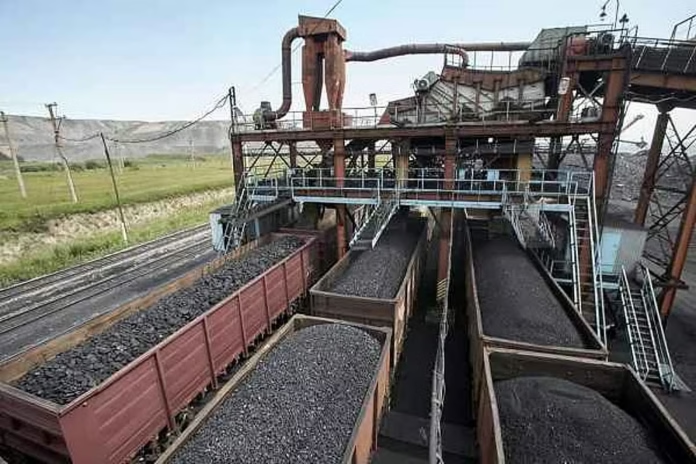
India is tilting its energy infrastructure strategy toward tapping unconventional gas resources, with key discussions underway for coal bed methane (CBM) exploration in the Singareni coal belt. Senior government officials have urged Singareni Collieries Company Limited (SCCL) to participate in upcoming auctions for CBM blocks identified across six districts of Telangana, underscoring a broader shift in energy planning where cleaner fuel options increasingly complement traditional coal production in support of urban energy systems and climate goals.
Coal bed methane — a form of natural gas stored within coal seams — is gaining attention as a lower-carbon fuel relative to surface-mined coal. Preliminary assessments suggest that the three blocks earmarked for exploration could together contain around 19 billion cubic metres of recoverable methane gas, offering a meaningful new energy input for industrial and urban utilities if tapped responsibly. These blocks extend across the districts of Mancherial, Peddapalli, Komaram Bheem, Bhadradri Kothagudem and Mulugu, linking energy potential to a broad swathe of Telangana’s industrial hinterland.Officials from the Ministry of Petroleum and Natural Gas recently met with SCCL’s leadership to encourage the state-owned miner’s participation in the forthcoming auctions and to explore how CBM extraction could align with India’s national energy and “Viksit Bharat 2047” vision. SCCL, which has more than a century of coal-mining experience, is assessing the opportunity, reflecting industry interest in diversifying beyond conventional coal extraction.
Energy planners say that integrating CBM into India’s energy mix could contribute to more resilient and flexible supply models for electricity generation, industrial heat and urban utility services. Unlike coal combustion, which emits significant quantities of carbon dioxide and particulate matter, methane — when used as a direct fuel for power plants or as industrial feedstock — can produce energy with lower greenhouse gas intensity, provided leakages are carefully managed. CBM development also dovetails with broader efforts to strengthen domestic gas production and reduce dependence on imported LNG, a strategic goal for India’s energy security framework.However, experts caution that methane itself is a potent greenhouse gas if released unchecked during extraction, transport or use. Mitigating methane emissions — a focus of the government’s climate commitments — will require robust monitoring systems and best-practice drilling techniques. These environmental safeguards are especially important when resource development abuts growing urban clusters and sensitive ecosystems.
From a regional planning perspective, CBM exploration in the Singareni belt could generate economic opportunities in workforce development, logistics and energy services, complementing the existing coal mining economy. Yet, this must be balanced with careful land-use planning, community engagement and environmental risk assessment to ensure equitable development outcomes across rural and peri-urban communities. Urban planners and environmental advocates also highlight the need to integrate CBM strategies with broader infrastructure planning, particularly grid modernisation and cleaner transport initiatives, to maximise benefits for cities and industrial regions alike.
As India pushes toward cleaner energy alternatives, the outcome of the Singareni CBM auctions and subsequent exploration decisions may offer early insights into how unconventional gas resources can be responsibly harnessed in support of sustainable energy systems and resilient urbanisation.
Also Read: Power Derivatives And Coal Spot Exchange Shape Energy Planning
India Explores Coal Bed Methane Potential In Singareni Region
Power Derivatives And Coal Spot Exchange Shape Energy Planning

India’s energy governance ecosystem is positioning itself to deepen market structures for electricity trading and introduce a dedicated spot exchange for thermal coal, marking a strategic pivot that could reshape how power, urban utilities and infrastructure developers manage energy supply risks and pricing transparency. Policymakers and market operators see these expansions as potential tools to enhance efficiency, integrate renewables and provide clearer price signals for long-term planning across the power value chain.
The proposed electricity futures framework — a platform for trading contracts tied to future delivery of power — aims to give generators, distributors and large consumers hedging instruments against price volatility. In an era where renewable energy integration and peak demand patterns introduce complexity into grid management, forward-looking contracts can offer visibility on future supply conditions, improving planning for distribution utilities and reducing the need for ad-hoc procurement practices.Alongside this, the move to establish a dedicated spot market for coal seeks to address long-standing operational challenges in India’s thermal fuel segment. A spot exchange is intended to facilitate immediate delivery contracts for coal, helping power producers and industrial users access fuel “on demand” while reducing dependence on long-term tie-ups that may not align with real-time operational requirements. By improving transparency in coal procurement, industry strategists believe pricing fidelity and logistical alignment could strengthen supply chain management for energy infrastructure projects.
Energy planners highlight that such market innovations have implications beyond trading desks. Urban infrastructure — particularly in fast-growing metropolitan regions — relies heavily on efficient power supply and stable fuel logistics for water systems, transportation, industrial clusters and municipal services. A more predictable energy market ecosystem allows city authorities and infrastructure owners to better coordinate capacity planning, manage peak loads and forecast operational costs over multi-year horizons.Moreover, as India accelerates its climate commitments and grid decarbonisation agenda, transparent price signals from futures and spot markets can support the integration of renewables. Forward contracts, for instance, enable distribution companies to hedge against intermittency risks associated with solar and wind generation, reducing the need for expensive recourse generation and improving financial planning for green power portfolios.
However, industry analysts emphasise that successful implementation requires robust regulatory frameworks and risk management systems to prevent market distortions. For electricity futures to deliver value to end users and utilities, complexities around settlement mechanisms, delivery obligations and grid balancing protocols must be harmonised with operational realities of India’s largely state-run power distribution framework.Coal, while still a critical fuel source for baseload capacity, is part of a transitional phase in India’s energy landscape. Establishing a spot exchange could support smaller power producers and industrial clusters by improving market access and price transparency, but must be complemented by investments in cleaner energy infrastructure and logistics efficiency to align with long-term sustainability goals.
Urban energy planners also point out that improved market infrastructure alone cannot resolve distribution inefficiencies or transmission bottlenecks, which are often binding constraints in urban grids. Complementary reforms — such as grid modernisation, real-time dispatch optimisation, and targeted infrastructure funding — are essential for the full benefits of enhanced market platforms to reach city utilities and urban residents.As India’s energy markets evolve, the interplay between new trading mechanisms and infrastructure planning will be key in shaping resilient, efficient and climate-aligned power systems that underpin both economic growth and sustainable urbanisation.
Also Read: Dhanbad Toxic Gas Leak Sparks Safety And Urban Health Concerns
Power Derivatives And Coal Spot Exchange Shape Energy Planning
Dhanbad Toxic Gas Leak Sparks Safety And Urban Health Concerns

Residents in the Baghmara area of this coal-belt district blocked a major provincial road over the weekend in protest against alleged toxic gas emissions and smoke from abandoned underground coal mines, reflecting longstanding safety and environmental risks tied to the region’s century-old extraction networks. The action, which briefly disrupted traffic on the Tetulmari-Raiganj main road, drew attention to persistent air-quality concerns that intersect with public health, urban planning and environmental management in mining hinterlands.
Locals said smoke and noxious fumes began billowing from galleries of an old coal block where an outsourced workforce had resumed work on Saturday, prompting fears that trapped gases were being released unpredictably. Officers from the local police and officials from Bharat Coking Coal Limited (BCCL), the state-run miner that owns the land, eventually doused flames and quelled the road blockade, but not before residents voiced deep distrust about the adequacy of safety measures around defunct mine fire zones.The protest reflects broader anxieties linked to the Jharia Coalfield, an area encompassing Dhanbad that has endured underground fires for decades and is one of India’s largest coal reserves. Fires and remnant underground heat make managing gas emissions — often involving carbon monoxide, methane and other combustion by-products — highly complex, especially near densely inhabited settlements. Longstanding attempts to relocate communities, monitor emissions, and cap fires have met resistance and logistical challenges, underscoring governance tensions in balancing industrial legacies with community wellbeing.
Public health officials note that gases such as carbon monoxide can cause respiratory distress, headaches, eye irritation and other acute symptoms at relatively low concentrations, and prolonged exposure in residential corridors raises community safety concerns. Health department teams have previously attended to clusters of residents reporting nausea and breathing difficulties in related leakage incidents around Rajput Basti and surrounding hamlets.Urban development analysts argue that the Dhanbad episode is not isolated but emblematic of deep-rooted infrastructural and environmental risks posed by legacy mining activity in and around expanding urban fringes. With coalfields abutting residential pockets and informal settlements, the absence of systematic hazard mapping and mitigation infrastructure increases vulnerability to airborne pollutants and underground combustion by-products. These issues complicate municipal planning, emergency response coordination, and broader efforts to improve living conditions in mining interiors.
In addition to acute health risks, the unpredictability of underground fires and gas releases can disrupt local transport linkages and civic services, inhibiting safe mobility for commuters, emergency responders, and daily-wage workers — a concern for regional transit planners and livelihood advocates alike.
Meanwhile, local leadership has called on BCCL and state authorities to formalise community liaison mechanisms and publish hazard impact assessments, to address both immediate safety risks and long-term urban resilience. Experts emphasise that integrated strategies — incorporating geological monitoring, fire suppression technology, and community engagement — are essential to mitigate recurrent gas emission threats and support sustainable habitation near legacy mine sites.
Also Read: India Paint Industry Faces Pricing Pressure Amid Demand Slowdown
Dhanbad Toxic Gas Leak Sparks Safety And Urban Health Concerns
India Paint Industry Faces Pricing Pressure Amid Demand Slowdown

As demand for architectural and industrial coatings in India sees a tentative recovery, domestic paint manufacturers are navigating intensifying competition and sustained input cost pressures. Sector leaders at recent industry forums and corporate disclosures highlighted a challenging operating environment through the first half of the fiscal year, with hopes pinned on a pickup in urban infrastructure and housing activity to stabilise demand in the coming quarter.
Demand dynamics for paints are closely intertwined with broader patterns in construction and real estate, where activity in affordable and mid-segment residential segments has remained fragmented. With municipal upgrades, road and civic works lingering at varying stages of execution across states, paint companies are recalibrating production and market outreach to align with pockets of strengthening consumption. A senior industry executive observed that delayed project releases and cautious inventory management by trade partners have moderated sales growth, particularly in tier-III and rural markets.At the same time, competitive intensity has risen, especially among larger organised manufacturers and emerging regional players. Analysts point out that aggressive pricing offers and promotional schemes have become commonplace in several urban corridors as firms seek to protect volume and channel relationships. While this can drive short-term uptake, it squeezes realisation levels at a time when manufacturers are contending with persistent cost volatility.
Input costs — including key raw materials such as titanium dioxide, solvents and speciality resins — remain a focal concern. Though global commodity prices have eased from previous peaks, logistical bottlenecks and margin pressures persist, directing attention to supply-chain optimisation and cost management strategies. Producers are increasingly exploring bulk procurement programmes and factory upgrades to improve material use efficiency, particularly in plants serving dense urban markets.Despite near-term headwinds, infrastructure and housing activity present promising demand levers. Urban redevelopment initiatives under central and state missions, including water supply overhauls and municipal asset upgrades, are expected to stimulate demand for protective and decorative coatings. The construction of urban public spaces, affordable housing projects and expansion of civic utility networks could create incremental requirements for specialised product segments such as weather-resistant paints and coatings with enhanced environmental profiles.
Sustainability considerations are emerging as a differentiator in the market. Manufacturers are expanding low-VOC and eco-labelled product lines to meet growing consumer awareness around indoor air quality and environmental impact. Urban planners and sustainability advocates note that such shifts are not merely cosmetic; they align with broader efforts to reduce lifecycle environmental footprints in residential and commercial building stocks.Challenges remain in synchronising supply with uneven demand across regions. In several southern and eastern states, rapid urbanisation and infrastructure investment have buoyed construction activity, while pockets of slower development in other areas temper overall consumption. Industry specialists suggest that regional segmentation, coupled with agile production planning, will be crucial in navigating these mixed signals.
Looking ahead, stakeholders are watching for a more definitive uptick in project clearances and urban infrastructure spending as catalysts for broader demand recovery. Continued focus on product innovation, supply-chain resilience and alignment with sustainable building practices could help paintmakers convert cyclical headwinds into long-term growth opportunities.
Also Read: India Concrete Pipe Market Set To Grow With Urban Renewal
India Paint Industry Faces Pricing Pressure Amid Demand Slowdown
India Concrete Pipe Market Set To Grow With Urban Renewal

India’s urbanisation momentum and infrastructure renewal plans are propelling demand for reinforced concrete pipes (RCP), a foundational material in drainage, water management and civic utilities. Industry forecasts suggest that rising investments in road upgrades, stormwater systems and city-wide sewer networks could expand the market for RCP solutions substantially through 2035, reflecting the country’s broad push for resilient, climate-adapted urban infrastructure.
Reinforced concrete pipes are critical in urban settings for directing stormwater, sewage and runoff, and their adoption is tightly linked to infrastructure scaling across both burgeoning metropolises and tier-II/III cities. Urban planners point out that durable pipe networks help contain flood risks — a growing concern as extreme weather events increase — while also underpinning long-term water and sanitation goals. This makes RCPs strategically central to state and municipal infrastructure planning.India’s national and state governments have recently elevated investment in water resource management and drainage upgrades as part of urban renewal and climate resilience programmes. Projects under the Smart Cities Mission, AMRUT (Atal Mission for Rejuvenation and Urban Transformation) and National Infrastructure Pipeline are increasingly factoring in durable linear infrastructure components, where reinforced concrete pipes are preferred for their load-bearing capacity and service life in high-traffic corridors. Urban affairs specialists note that aligning these investments with climate-adaptive design will be key to long-term effectiveness.
According to market analysts, India’s RCP segment stands at a crossroads where traditional manufacturing methods are intersecting with technological upgrades such as mechanised batching, improved reinforcement techniques and quality assurance systems. “The shift towards standardised manufacturing and quality certification is enabling more consistent performance, especially under heavy load conditions in urban environments,” said a senior manufacturing consultant. These improvements are critical as cities expand sewerage networks and integrate underground utilities beneath dense road networks.Regional infrastructure projects — including elevated expressways, metro extensions and coastal protection schemes — also contribute to heightened demand for reinforced concrete pipes. In coastal zones, where groundwater tables are high and soil conditions challenging, RCP solutions offer reliability that can reduce long-term maintenance costs and disruption. As a result, manufacturers in states such as Maharashtra, Gujarat and Karnataka are expanding capacity to support local project pipelines and shorten delivery lead times.
Despite strong demand signals, industry stakeholders emphasise persistent bottlenecks. Small and medium-scale manufacturers often face challenges in accessing finance for growth and investing in quality certification, which can affect their ability to compete for large government contracts. Infrastructure developers and policy advisers suggest that targeted fiscal incentives and quality standards frameworks could help elevate the overall supply base, especially as project scale and complexity increase.Environmental concerns are shaping product innovation as well. Reinforced concrete producers are exploring material options that reduce embodied carbon, including supplementary cementitious materials and alternative reinforcement systems. Urban sustainability advocates argue that coupling durable infrastructure with lower carbon profiles will be crucial in meeting India’s climate commitments while delivering essential civic services.
Looking ahead, India’s reinforced concrete pipe market appears poised for steady growth, anchored by expanding urban infrastructure projects and a growing emphasis on durability and climate resilience. The coming decade could see broader adoption of certified manufacturing practices and strategic localisation of supply chains, aligning infrastructure expansion with equitable regional development.
Also Read: India SME Conference Charts Tech led Resilience For Manufacturing
India Concrete Pipe Market Set To Grow With Urban Renewal
India SME Conference Charts Tech led Resilience For Manufacturing

India’s manufacturing and engineering micro, small, and medium enterprise (MSME) ecosystem took centre stage at a major policy and industry forum this week, where business leaders and sector specialists outlined resilience, technology adoption and structural support as pillars for the sector’s next growth phase. The conference, held as a precursor to a larger manufacturing expo, brought senior officials, industry experts and fast-growing engineering enterprises together in India’s commercial capital, signalling an increasing policy and business focus on equipping smaller firms for global competitiveness.
The event’s panel discussions navigated the intersecting challenges of economic volatility, supply-chain bottlenecks and digital transformation, while also spotlighting practical solutions to build resilience. A senior operations executive from a leading receivables exchange stressed the importance of structured financing mechanisms to address persistent liquidity constraints that MSMEs often face, reinforcing that access to working capital remains a critical enabler for sustained industrial activity.Industry scientists and innovation leaders emphasised organisational transformation as a core driver of competitiveness in a technology-driven industrial ecosystem. Sessions featured dialogue on leadership strategies, advanced manufacturing systems and quality benchmarks, reflecting concerns about equipping Indian manufacturing with capabilities to compete on global terms. These conversations mirror broader national ambitions to strengthen value chains and transition from traditional production models to more agile, digitally enabled frameworks.
Economists and policy advisers underscored the policy dimension of SME growth, advocating for fiscal incentives, regulatory clarity and targeted performance-linked programmes that can enhance competitiveness and scale. Such frameworks play a dual role: enabling firms to modernise operations while also creating an environment conducive to investment in skills, automation and innovation — essential elements in India’s broader manufacturing and urban development agenda.The evening culminated in the presentation of industry awards recognising the fastest-growing engineering companies across small, medium and large categories. Winners spanned a diverse set of firms that have demonstrated robust performance amid challenging market conditions, and their recognition reflects the depth and dynamism of India’s engineering ecosystem. These firms — from agile small enterprises to established industrial players — exemplify how adaptive strategies and technology adoption can fuel growth across scales of operation.
Urban development analysts point out that strengthening the SME segment carries implications beyond manufacturing corridors; resilient smaller firms are integral to construction supply chains, built environment services and infrastructure delivery systems that underpin urban growth. Ensuring that SMEs can integrate into larger project ecosystems — with access to finance, technology and markets — will be vital for delivering sustainable, inclusive urban infrastructure.
Looking forward, stakeholders at the event called for continued policy focus on innovation adoption, workforce skill enhancement and supply-chain resilience to harness India’s demographic dividend. With manufacturing poised to contribute more substantively to national GDP and employment, a concerted effort to align MSME strengths with emerging industrial priorities could accelerate equitable economic opportunity across regions and sectors.
Also Read: JK Cement Opens Facility In Buxar To Strengthen Local Supply
India SME Conference Charts Tech led Resilience For Manufacturing
JK Cement Opens Facility In Buxar To Strengthen Local Supply
