HomeUrban NewsBangaloreBengaluru Metro Expansion Fuels Property Price Growth

Bengaluru Metro Expansion Fuels Property Price Growth

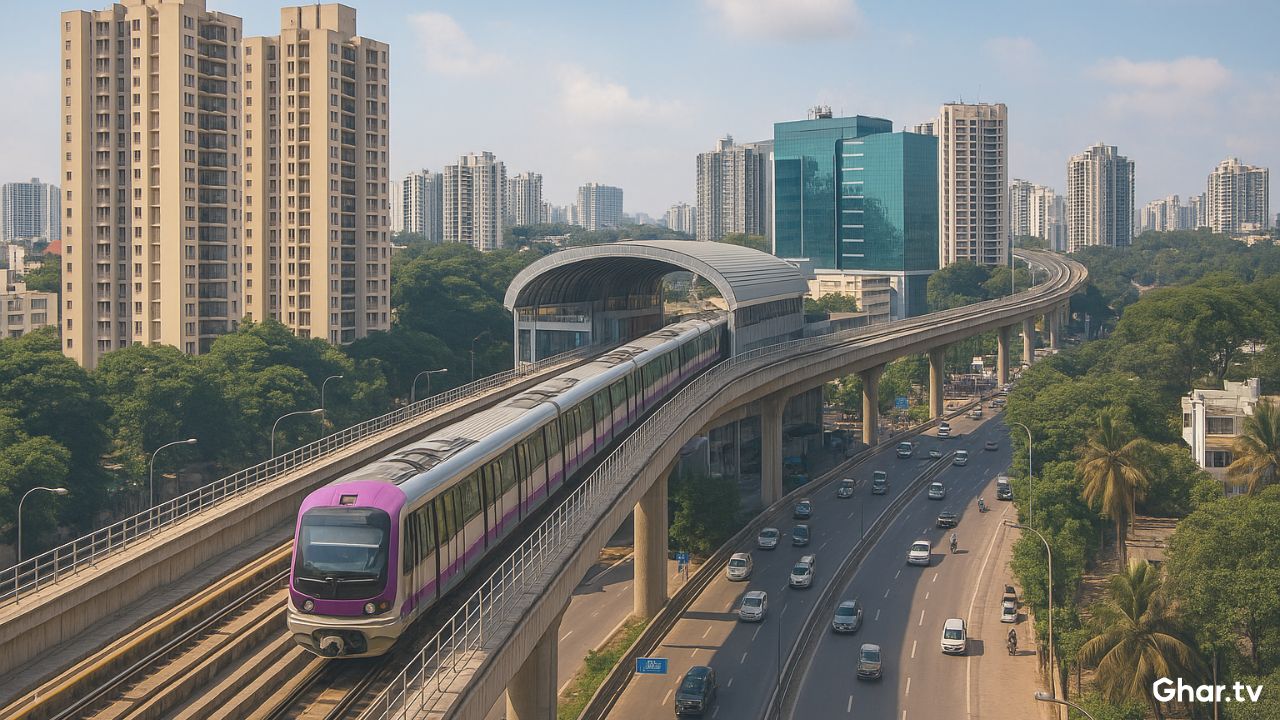
Bengaluru’s expanding metro network is beginning to reshape its housing market, with property values in several southern and central neighbourhoods projected to rise sharply over the next two years. Urban planners and market observers indicate that improved rail connectivity is not only reducing commute times but also altering how residents and developers evaluate location, affordability, and long-term investment potential.

Recent assessments suggest that Bengaluru property prices in areas such as JP Nagar and Bannerghatta Road could increase by as much as 20 to 40 percent by 2027. These neighbourhoods fall along key upcoming metro corridors, particularly the north-south and central alignments currently under phased development. The trend reflects a familiar pattern in the city, where earlier metro lines triggered demand spikes in eastern and central districts. The relationship between transit infrastructure and housing demand is becoming more pronounced. Locations linked to major employment hubs especially technology and industrial clusters are witnessing faster appreciation. Improved access to job centres in southern Bengaluru has already translated into higher residential demand, with mid-income and premium segments showing renewed activity.

Urban analysts note that Bengaluru property prices have historically responded strongly to transport upgrades, but the current phase may have wider implications. Unlike earlier expansions that primarily benefited established corridors, the new metro lines are opening up relatively underserved areas. This could redistribute growth more evenly across the city, potentially easing pressure on saturated zones while encouraging planned urban expansion.However, the surge in property values raises concerns about affordability and inclusivity. As transit-linked micro-markets become more desirable, lower-income households risk being priced out. Experts suggest that without policy interventions such as inclusionary zoning or affordable housing mandates public infrastructure investments may inadvertently deepen spatial inequality.

There are also environmental considerations. Transit-oriented development, if executed responsibly, can reduce reliance on private vehicles and lower urban emissions. Yet unregulated construction along metro corridors could strain local ecosystems, increase congestion at feeder points, and put pressure on civic amenities. Balanced planning, with an emphasis on walkability, green spaces, and efficient last-mile connectivity, will be critical to ensure sustainable outcomes.For the real estate sector, the metro expansion offers both opportunity and responsibility. Developers are increasingly aligning projects with transit nodes, but city planners caution against unchecked density without supporting infrastructure. The long-term success of these corridors will depend on integrating housing with public services, mobility networks, and climate-resilient design. As Bengaluru continues to grow, the interplay between mobility and housing will remain central to its urban future. The coming years will test whether infrastructure-led growth can deliver not just higher Bengaluru property prices, but also a more equitable and liveable city.

Also Read : Bengaluru Office Rent Growth Signals Market Shift
Bengaluru Metro Expansion Fuels Property Price Growth
RELATED ARTICLES

LEAVE A REPLY

Please enter your comment!
Please enter your name here

- Advertisment -spot_img

Most Popular

Recent Comments

Berger Paints Financial Update Eyes Construction Demand

Berger Paints Financial Update Eyes Construction Demand

Berger Paints is preparing to present its first-quarter financial performance for FY27 to institutional investors and market analysts on 5 August, as India’s paints...
India Chemical Manufacturing Gets Policy Boost

India Chemical Manufacturing Gets Policy Boost

The Union government has unveiled the Bhavya Rasayan Scheme, a new policy initiative aimed at strengthening India’s chemical manufacturing ecosystem through targeted support for...
Sumitomo Chemical India Sets Board Meeting Agenda

Sumitomo Chemical India Sets Board Meeting Agenda

Sumitomo Chemical India has scheduled a board meeting to consider and approve its financial results for the first quarter of FY27 on the same...
Jindal Steel Balances Expansion And Earnings Pressure

Jindal Steel Balances Expansion And Earnings Pressure

Jindal Steel reported a weaker financial performance for the first quarter of FY27, with consolidated net profit declining to ₹844 crore, even as the...
SAIL Results Signal Stronger Steel Sector Momentum

SAIL Results Signal Stronger Steel Sector Momentum

Steel Authority of India Ltd. (SAIL) witnessed renewed investor interest after reporting a strong improvement in first-quarter earnings for FY27, supported by better operating...