
HomeIndustriesIndia Decarbonisation Efforts Shift Toward Implementation

India Decarbonisation Efforts Shift Toward Implementation

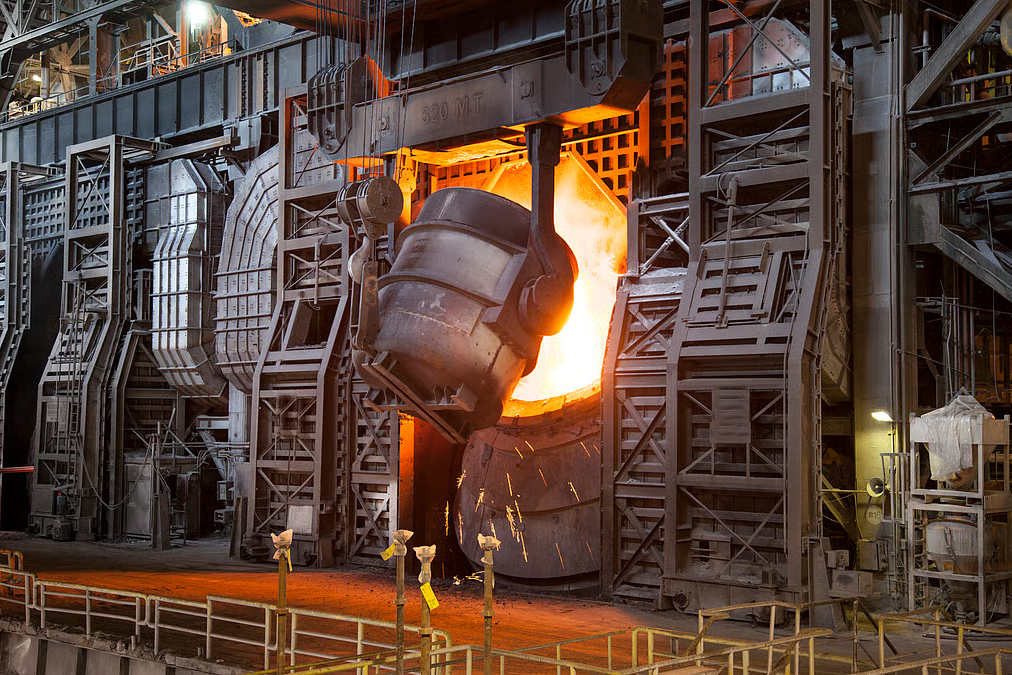
India’s leading industrial, infrastructure and energy businesses used World Environment Day to outline a fresh round of sustainability targets and decarbonisation measures, signalling a broader shift in how corporate climate strategies are being tied to economic growth, urban expansion and industrial competitiveness.

The announcements come as Indian cities confront rising climate risks, growing energy demand and mounting pressure to reduce emissions without slowing development. Across sectors including metals, mining, mobility, energy and utilities, companies highlighted investments in renewable energy, cleaner production systems, resource efficiency and emissions reduction programmes. While such commitments have become increasingly common, industry observers note that the focus is gradually moving from target-setting to measurable implementation, particularly in sectors that underpin urban infrastructure and construction. The significance of these efforts extends beyond corporate sustainability reporting. Heavy industries such as steel, mining and manufacturing remain central to India’s urbanisation story, supplying materials for housing, transport networks, industrial corridors and public infrastructure. Their ability to lower carbon intensity could influence the environmental footprint of future city-building activities. Recent investments in low-carbon industrial technologies and renewable energy integration indicate that businesses are increasingly preparing for a future in which climate performance becomes a competitive as well as regulatory requirement.

Experts caution, however, that corporate climate pledges alone will not deliver the scale of transformation needed. India’s urban population continues to expand, creating additional demand for electricity, construction materials, mobility systems and water resources. Decarbonisation efforts therefore need to be linked with broader planning priorities, including energy efficient buildings, sustainable transport networks and circular resource management. Without these connections, emissions reductions achieved within company operations could be offset by wider growth in urban consumption.The growing emphasis on corporate decarbonisation also reflects changing investor expectations and evolving climate regulations worldwide. Businesses operating in export-oriented sectors face increasing scrutiny over supply-chain emissions, renewable energy use and environmental disclosures. As a result, sustainability is no longer viewed solely as an environmental issue but as a factor affecting market access, financing costs and long-term resilience.

Several companies reported progress in reducing operational emissions, increasing renewable power procurement and adopting cleaner technologies. Yet analysts stress that transparent reporting, independent verification and time-bound execution will ultimately determine whether these commitments produce meaningful environmental outcomes. For India’s cities, the relevance is immediate. As urban centres seek pathways to lower emissions while sustaining economic activity, the success of corporate decarbonisation efforts could influence how future infrastructure is financed, designed and delivered. The next phase will depend less on declarations and more on whether measurable reductions can be achieved across the industries shaping the country’s built environment.

Also Read : RBI Rate Pause Strengthens India Residential Real Estate Market
India Decarbonisation Efforts Shift Toward Implementation
RELATED ARTICLES

LEAVE A REPLY

Please enter your comment!
Please enter your name here

- Advertisment -spot_img

Most Popular

Recent Comments

Western India Housing Venture Signals Expansion

Western India Housing Venture Signals Expansion

A new real estate joint venture with a planned development pipeline valued at around ₹5,000 crore signals growing investor confidence in India's organised property...
Pune Residential Growth Shifts Across Corridors

Pune Residential Growth Shifts Across Corridors

The Western Pune micro markets are entering a new phase of residential expansion as housing demand extends beyond established neighbourhoods into emerging urban corridors....
Noida Flexible Workspace Expands Commercial Capacity

Noida Flexible Workspace Expands Commercial Capacity

A major Noida flexible workspace expansion in the National Capital Region is reinforcing the city's emergence as one of India's fastest-growing commercial office destinations....
Bengaluru Office Leasing Reflects Technology Expansion

Bengaluru Office Leasing Reflects Technology Expansion

A fresh Bengaluru office leasing transaction involving nearly 27,000 square feet of Grade A workspace has reinforced the city's continued strength as India's leading...
Assam Hospitality Expansion Reaches Jorhat Corridor

Assam Hospitality Expansion Reaches Jorhat Corridor

A new Jorhat hotel project planned in Assam is set to expand the organised hospitality footprint in the state's Upper Assam region, reflecting growing...
