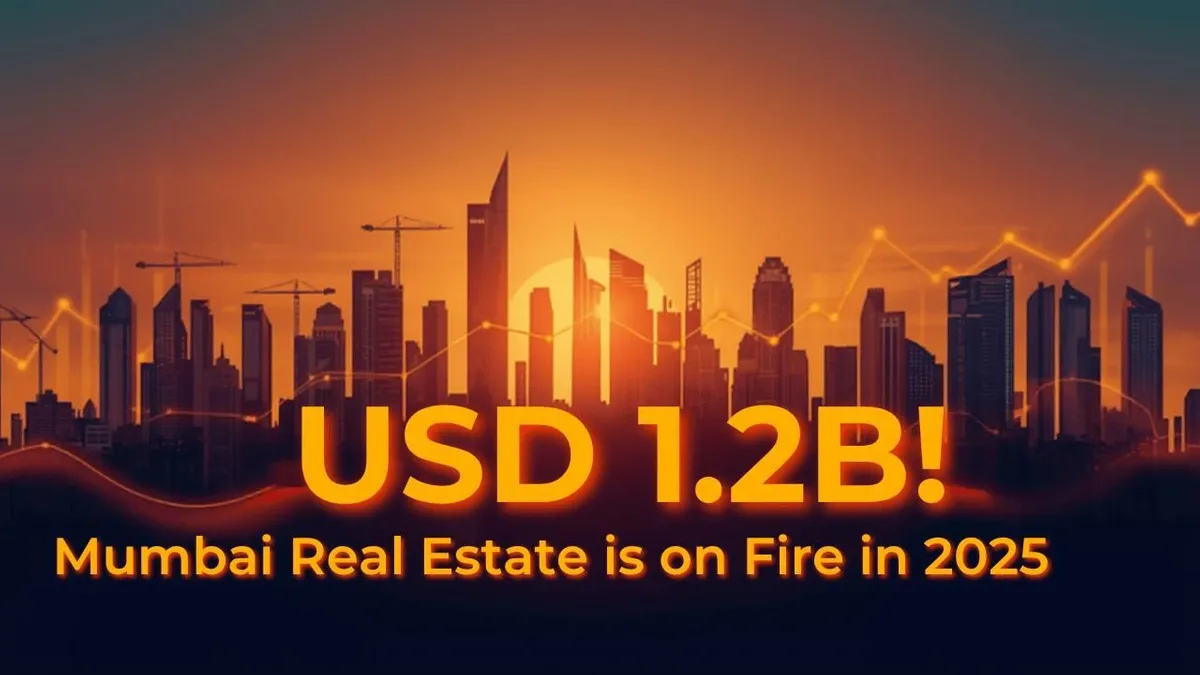
Mumbai has reasserted itself as India’s premier destination for institutional real estate investment, registering over USD 1.2 billion in inflows during the first nine months of 2025. This marks the fourth consecutive year the city has exceeded the USD 1 billion milestone, reflecting a full restoration of pre-pandemic investor confidence. Strong fundamentals, infrastructure expansion, and a balanced mix of domestic and foreign capital are driving the city’s recovery.
At a national level, India’s institutional real estate investments reached USD 4.7 billion between January and September 2025, a slight decline from the previous year. Market analysts anticipate the total for 2025 could range between USD 6 billion and USD 6.5 billion, making it the second-highest annual inflow on record. Notably, domestic investors now contribute 48% of total inflows, up from previous years, while foreign investors account for 52%, providing resilience amid global economic volatility.In Mumbai, the sectoral distribution highlights the city’s diverse investment appeal. Residential projects led with USD 377.6 million, largely propelled byredevelopment schemes. Offices followed at USD 339.71 million, supported by steady leasing activity, while logistics and industrial assets attracted USD 269.3 million. Mixed-use commercial developments received USD 155 million, and data centres drew USD 54.6 million, signalling growing investor interest in digital infrastructure.
Foreign investors dominated Mumbai’s inflows, contributing 67% of the total, led by significant participation from the United States (USD 500 million) and Japan (USD 297 million). Domestic institutions provided USD 398 million, reinforcing a well-balanced investor base. An official from Cushman & Wakefield noted, “The combination of global and local capital is stabilising the market while reflecting confidence in India’s long-term growth trajectory.”Infrastructure projects are playing a pivotal role in shaping investor sentiment. Initiatives such as the Mumbai Trans Harbour Link, Coastal Road expansion, Metro network extensions, and the upcoming Navi Mumbai International Airport are transforming urban connectivity, creating new micro-markets, and enhancing Mumbai’s attractiveness for commercial and residential development.
Looking ahead, experts say the city’s real estate market is entering a phase of sustainable growth. Rising institutional interest, diversified asset allocation, and infrastructure-led urban transformation are expected to maintain investment momentum. The shift also aligns with broader urban development goals, including creating inclusive, resilient, and environmentally conscious urban spaces that integrate housing, work, and lifestyle opportunities.
Mumbai Records One Point Two Billion Dollars Real Estate Investment Inflows 2025