 The Announcement Fatigue
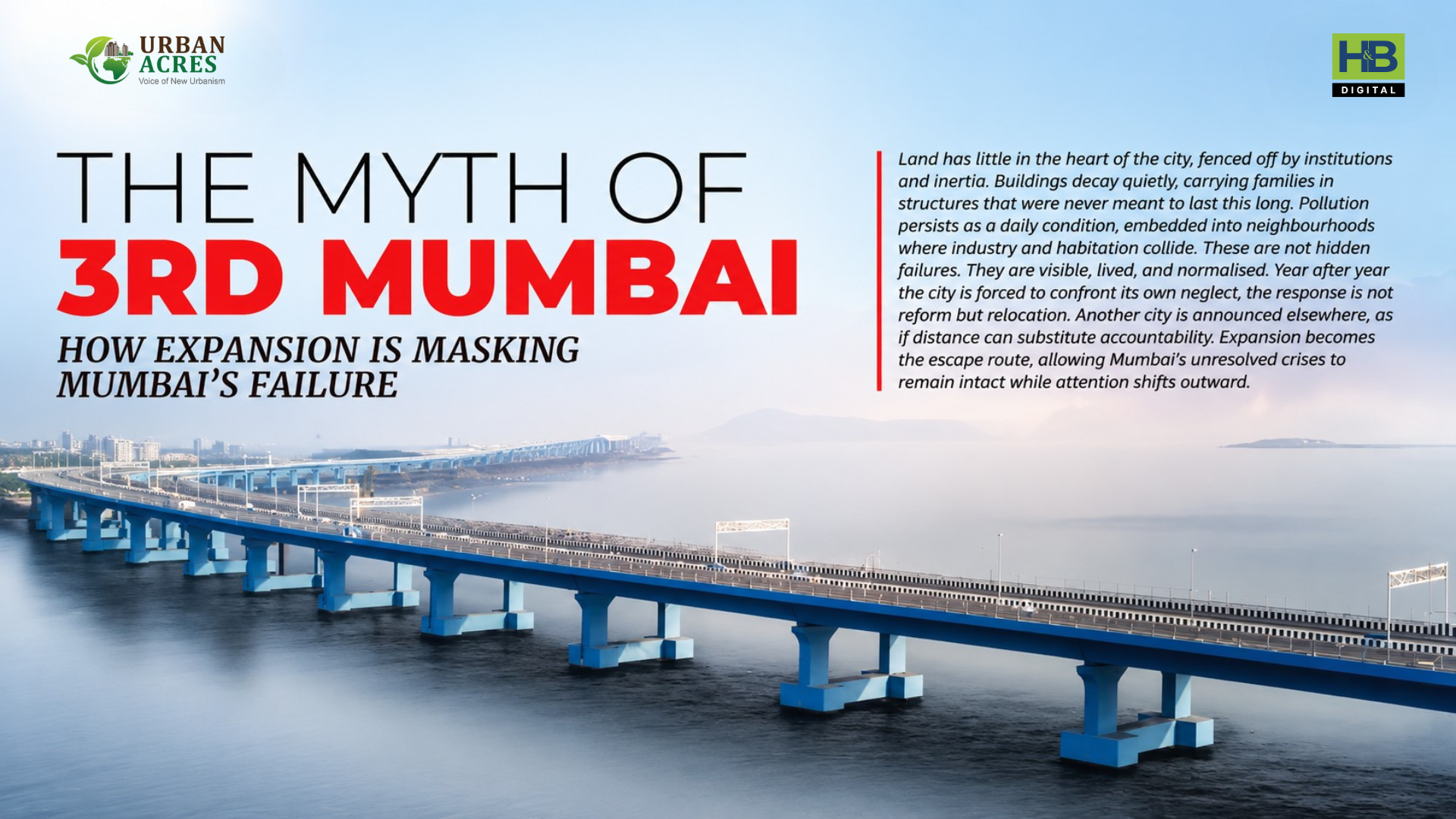
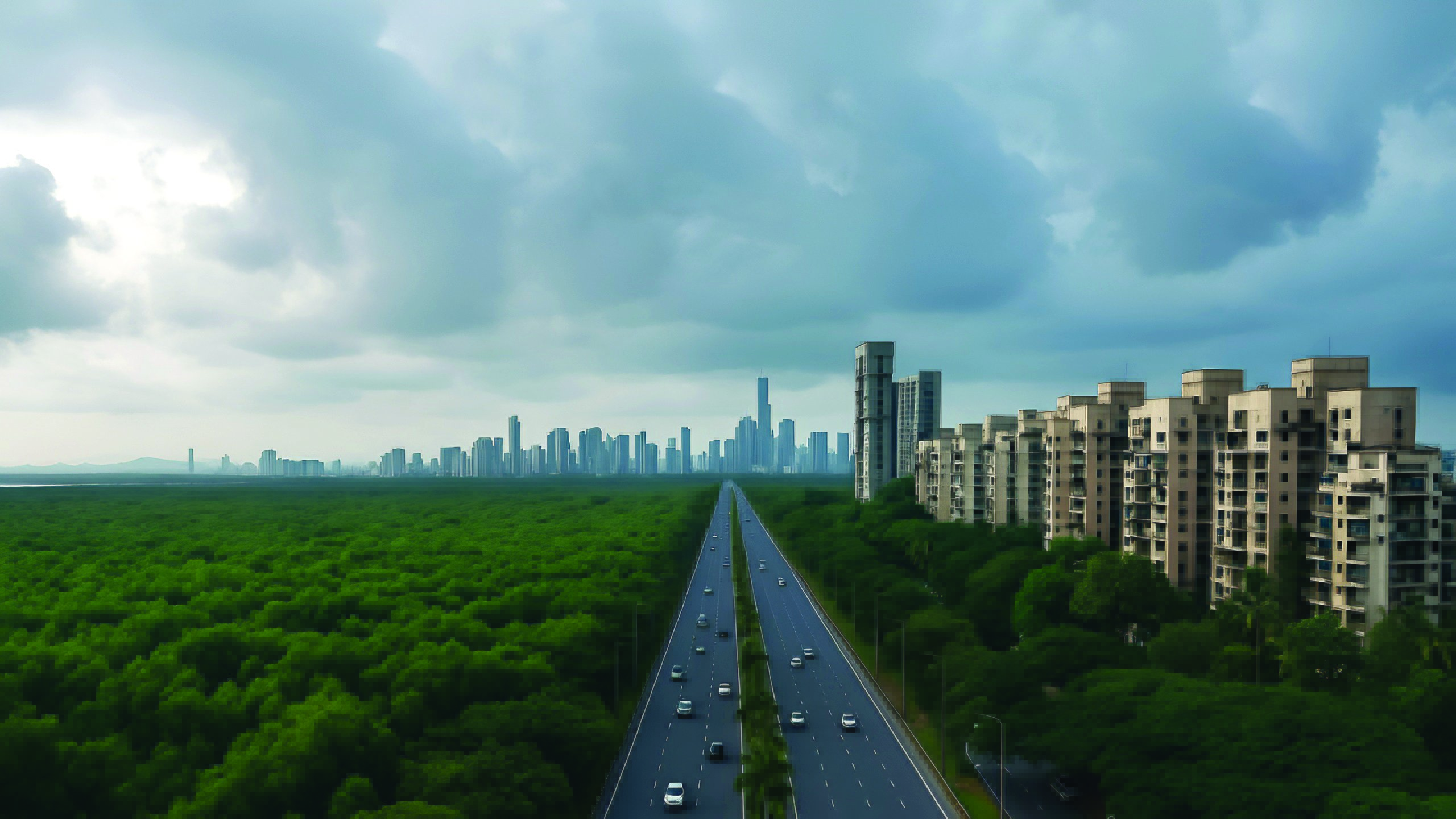
Mumbai is forever being promised an escape from itself. Every few years, like a ritual performed when the city becomes too loud, too crowded, too angry to ignore, a new idea is unveiled — 3rd Mumbai. 4th Mumbai. The Next Growth Corridor. The names change, the maps
stretch outward, the colours on planning presentations become greener, bluer, cleaner. Hope is exported to the outskirts. Expansion is sold as salvation. As if congestion can be cured by distance.
As if inequality dissolves when pushed far enough away. As if cities, like cluttered rooms, simply need an extra wing. But Mumbai’s real problem has never been the lack of space. It has been the refusal to confront what already exists.
Inside the city, time has stalled. Buildings grow old without being allowed to die or be reborn. Millions live suspended between legality and neglect. Prime land sleeps behind barbed wire and institutional indifference. The city gasps. It is not because it is full, but because it is unfinished.
And yet, instead of repair, we announce replacements. Instead of healing, we propose migration. The city’s failures are not interrogated; they are outsourced. Each new Mumbai is not a vision of the future. It is an admission of surrender. A quiet confession that fixing the original city is politically inconvenient, administratively exhausting, and morally risky. So, we look away. We draw new lines on empty land. We call it progress. The question, then, is not why Mumbai needs another city. The question is far more disturbing: Why does Mumbai remain broken when the answers lie buried within its own geography — ignored, idle, and deliberately unseen?
This is not the story of a city growing.
It is the story of a city being abandoned while still alive.
The Expansion Pattern When Remedies Became Repetitions
Mumbai’s response to its own congestion has never been sudden. It has unfolded in phases in which each was announced as a solution, only to be eventually absorbed into the same cycle of strain it was meant to escape.
The first formal remedy arrived not as an afterthought, but as a planned alternative. Navi Mumbai was conceived in the 1970s as India’s most ambitious counter-magnet. Designed by CIDCO as a decentralised, self-sufficient city, it was meant to do what Mumbai could no longer do — distribute population, employment, and infrastructure in balance.
Industrial zones, residential nodes, transport corridors, and open spaces were plotted with intent. Navi Mumbai was not an accident of growth; it was a product of planning optimism.
Yet even this carefully imagined city became, over time, an extension rather than an alternative. Employment density lagged housing. Dependence on Mumbai persisted. Daily migration replaced decentralisation. The remedy worked, but only partially, and never at the scale required to relieve the original city.
When Navi Mumbai proved insufficient, the gaze shifted closer home. Thane, once dismissed as a peripheral district, was rebranded as the next urban frontier. Improved rail connectivity, large land parcels, and comparatively lower prices transformed it into Mumbai’s pressure valve.
Residential towers rose rapidly, infrastructure followed unevenly, and employment remained selectively concentrated. Thane grew — fast, vertically, and profitably — but without a commensurate metropolitan plan integrating mobility, services, and civic capacity at scale.
What followed was not strategy, but spillover. As land prices climbed and planning discipline weakened, growth leaked outward into the suburbs. Not by design, but by inevitability.
Mira Bhayandar, Vasai Virar, Kalyan Dombivli absorbed population at a pace infrastructure could not match. What emerged were dense residential belts with limited employment
bases, overburdened transport systems, and civic bodies constantly playing catch-up.
This phase of growth was neither formally planned nor officially acknowledged as a strategy. It happened because the city needed space, developers needed land, and governance looked the other way. Rail lines became lifelines. Roads turned into parking lots. Water, drainage, healthcare, and education infrastructure lagged behind sheer human volume.
What links these phases is not geography, but intent. Each expansion was reactive. Each treated congestion as a spatial problem, not a structural one. Instead of repairing Mumbai’s internal dysfunctions — land lock-ins, stalled redevelopment, fragmented governance — the city repeatedly chose displacement. Pressure was pushed outward, never resolved inward. Navi Mumbai was the plan.
Thane was the adjustment.
The extended suburbs were the consequence.
Together, they reveal a pattern that continues to define Mumbai’s urban imagination: when fixing becomes difficult, expansion becomes doctrine.
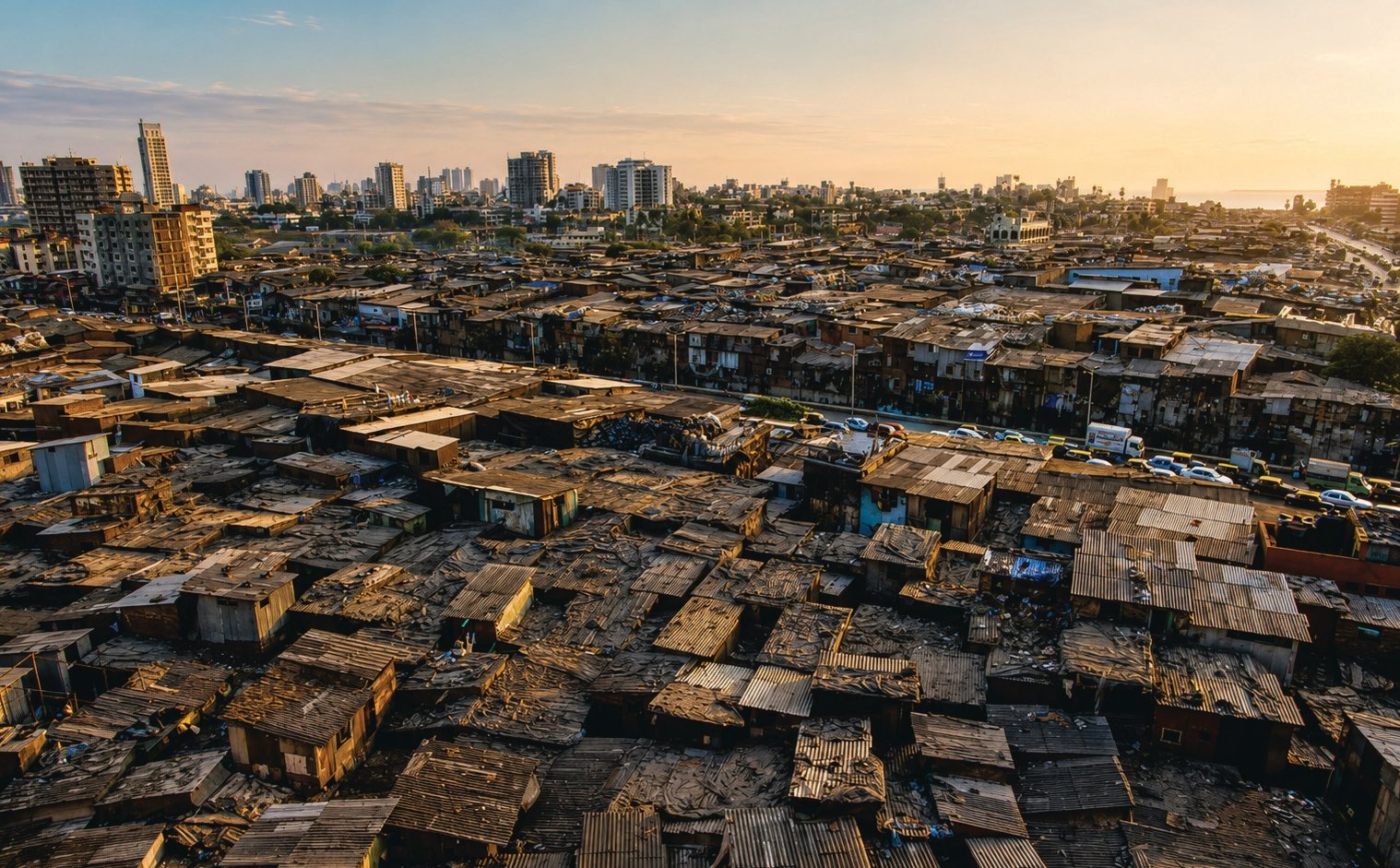 The Frozen 30% Mumbai Land
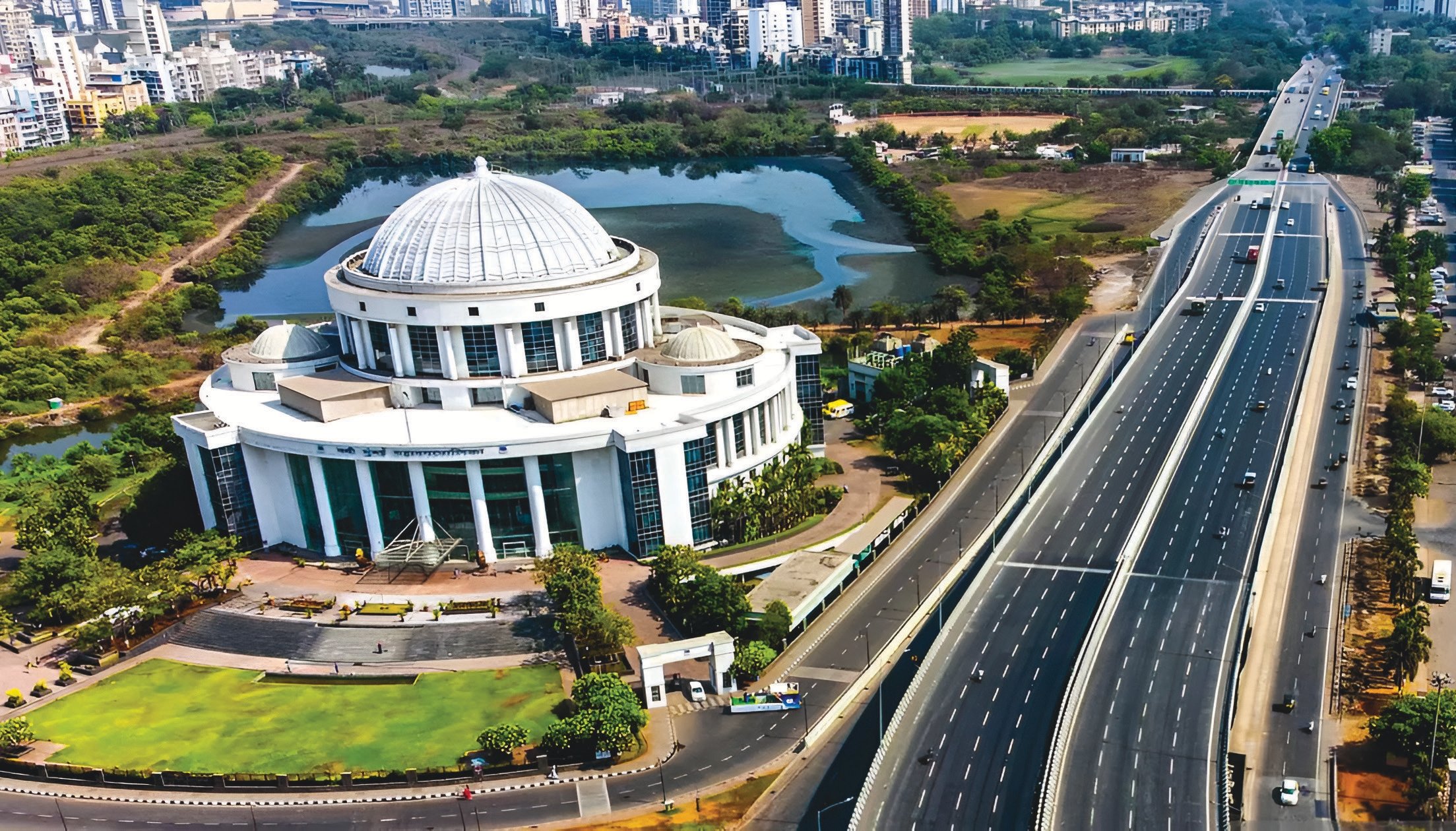
Mumbai’s most visible contradiction is also its most normalised one. Informal settlements occupy nearly a third of the city’s land, yet they exist outside the moral urgency of crisis and outside the administrative speed of reform.
They are spoken about endlessly, acted upon reluctantly, and resolved almost never.
This land is not hidden. It sits beside railway tracks, underneath flyovers, against glass towers, behind five-star hotels, and along the city’s most valuable corridors. It is not marginal land. It is prime urban geography, frozen in a permanent state of postponement.
The idea of rehabilitation, on paper, was meant to be Mumbai’s moral correction. The creation of it promised a mechanism where dignity and density could coexist — formal homes, legal tenure, infrastructure, and a city stitched back together. Instead, the process slowed into something more damaging than failure: inertia.
Projects move, but barely. Files circulate. Developers wait. Residents age. Entire neighbourhoods remain locked in negotiation for decades, caught between consent thresholds, legal disputes, political interference, and shifting policies. The slum, meanwhile, does not disappear. It consolidates. It grows taller, denser, and more complex. A vertical informal city inside the formal one.
What emerges is not housing scarcity, but housing limbo. Policy paralysis has ensured that no single stakeholder is fully accountable. The state blames developers. Developers blame feasibility. Bureaucracy blames litigation. Politicians blame public resistance. And residents are left navigating a system that promises upliftment while delivering uncertainty. In this paralysis, delay becomes profitable — for some — and devastating for most.
Overlaying this dysfunction is vote-bank urbanism, the most corrosive layer of all. Informality is not merely tolerated; it is strategically preserved. Slums become political capital — protected, promised, threatened, reassured — but rarely resolved. Rehabilitation becomes an election slogan rather than an execution mandate. The city learns to treat illegality not as a planning failure, but as an electoral asset.
The result is a cruel paradox. Mumbai is one of the densest cities in the world, yet it wastes land through underdevelopment. Millions live compressed into sub-human conditions on land that could accommodate dignified housing, open spaces, social infrastructure, and economic activity — if only redevelopment moved at the pace of human need rather than political convenience.
This is what density without dignity looks like. Children grow up without sunlight. Families live with permanent insecurity. Infrastructure is retrofitted where it should have been designed. Fire, health, and sanitation risks are not anomalies; they are structural features. And still, the city looks elsewhere for land — towards forests, wetlands, and agricultural belts — instead of confronting the injustice embedded within its own footprint.
Slum land is often described as ‘complicated’. But complexity is not an excuse for abdication. Other global cities have resolved informal housing through scale, speed, and political clarity. Mumbai, by contrast, has chosen hesitation — allowing a third of itself to exist in a suspended state where legality, safety, and dignity are endlessly deferred.
The tragedy is not that slums exist.
The tragedy is that they are allowed to remain unresolved by design.
As long as this 30 per cent remains frozen, every new city announcement rings hollow. Because no amount of expansion can compensate for a city that refuses to fix the most visible fracture in its own body.
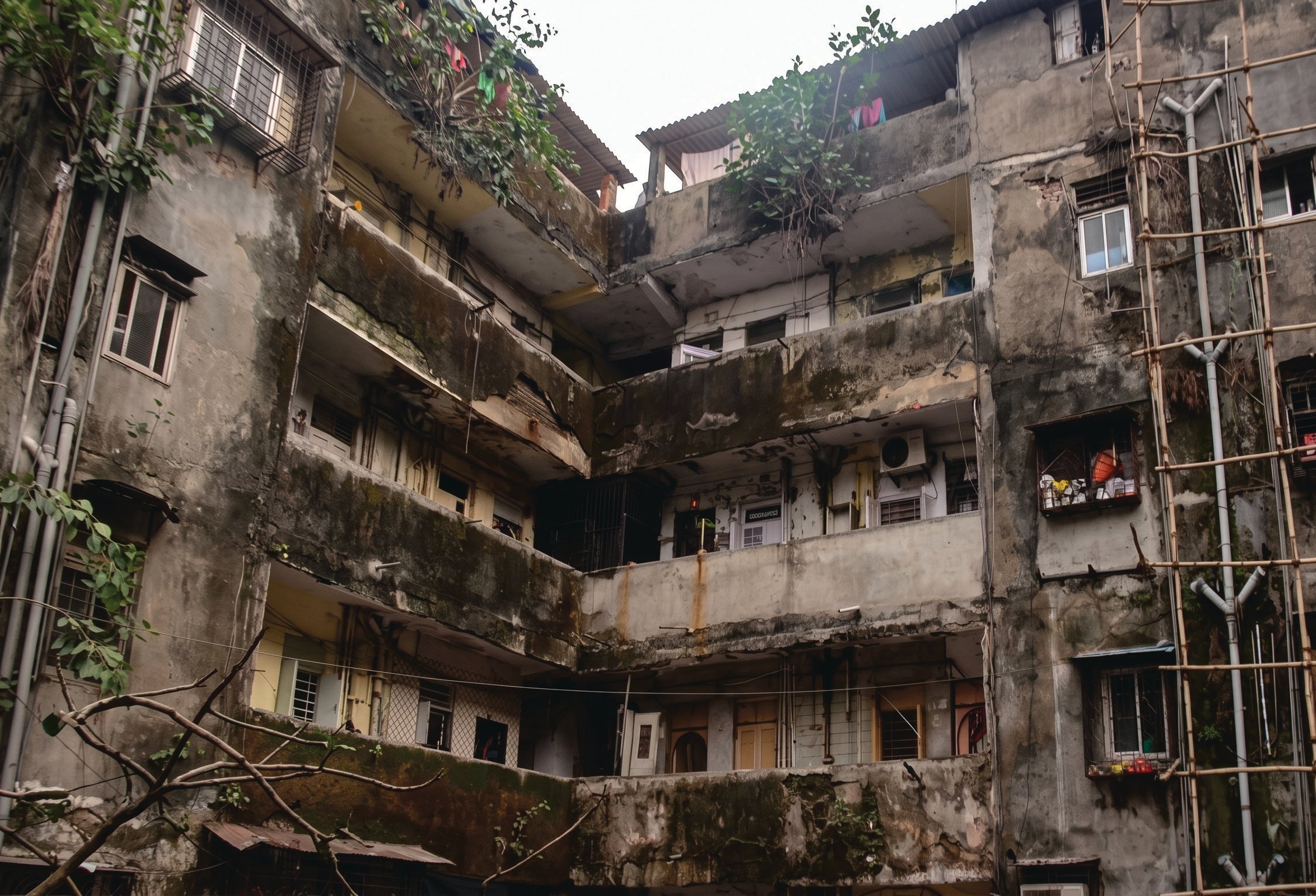 Ageing Housing Stock – Another 30% of Land Waiting Uncertainty
Mumbai’s second great land paralysis does not arrive with sirens or headlines. It stands quietly — wrapped in peeling paint, corroded balconies, sagging beams, and walls softened by decades of monsoons. It is an ageing city within the city. Nearly 30 per cent of Mumbai’s housing stock, largely constructed before 1991, dominates the island city and older central zones, surviving not on engineering strength but on habit, hope, and prolonged delay.
These buildings were never designed for the lives they now carry. They were built for fewer people, lower heights, lighter loads, and a climate that was less punishing. Today, they bear illegal extensions, vertical additions, water seepage, outdated services, and decades of deferred maintenance. Many are functionally obsolete and structurally fatigued, yet they remain inhabited because the machinery meant to replace them moves slower than gravity — and far slower than risk.
Redevelopment, in theory, should have been Mumbai’s quiet revolution. A process that replaces danger with safety, inefficiency with optimisation, decay with dignity — all without displacement. In practice, it has mutated into an expensive approval ecosystem where complexity is monetised, delay is rewarded, and urgency quietly dies.
The first choke point is consent. What appears democratic on paper becomes paralytic in reality. Mandated thresholds demand years of persuasion, bargaining, and informal negotiation. Meetings stretch endlessly. Objections surface strategically late. Agreements are reopened after they are signed. In the absence of time-bound frameworks, consent ceases to be protection — it becomes a permanent veto.
Financing follows, reluctantly and unevenly. Redevelopment is capital-heavy, front-loaded, and exposed to regulatory unpredictability. Banks hesitate. Cash flows stretch thin. Smaller developers overpromise to win societies; larger ones overcalculate risk and slow down. Projects stall mid-stream, leaving residents in transit accommodation far beyond promised timelines. A two-year inconvenience quietly turns into five or seven years of dislocation.
Regulatory delays complete the triangle of dysfunction. Clearances move through departments that do not speak to one another. Height approvals, fire NOCs, environmental conditions, heritage restrictions — each layer adds cost and uncertainty, none adds speed. There is no synchronised clock, no single-point accountability, no penalty for delay and no reward for efficiency. The system does not fail dramatically; it coagulates.
Within this maze thrives a more corrosive pathology: corruption embedded within society management structures. Managing committees transform into power centres rather than facilitators. Decisions are influenced not by feasibility or safety, but by informal incentives — personal gains, future allotments, side agreements. Transparency evaporates. Trust fractures. Litigation becomes inevitable.
Into this chaos step developers, circling aggressively around every viable society. Redevelopment turns into a bidding war of promises — larger homes, higher corpus, faster delivery, luxury finishes, zero cost. These promises are rarely grounded in financial reality. They are consent-weapons. Feasibility is postponed until after agreements are signed, and reality arrives only when cranes stop moving.
But even where redevelopment does move, it produces new failures.
Plush neighbourhoods attract an excess of developer interest, while less glamorous areas are starved of attention. Capital flows selectively. Safety becomes location-dependent. Risk is concentrated where returns are lower. The city ends up renewing privilege faster than necessity.
Worse, redevelopment often happens without urban context. Old bungalows and low-rise buildings are replaced by tall residential towers with little consideration for roads, drainage, parking, water supply, or emergency access. Density multiplies vertically while civic infrastructure remains stubbornly horizontal. The city grows heavier without growing wider.
In areas like Pali Hill, small residential plots have been transformed into high-rise towers — but the roads remain narrow, winding, and unprepared for increased traffic, service vehicles, and daily congestion. The building is new; the neighbourhood is not.
The same mistake was repeated on a far larger scale in former mill districts like Lower Parel. Mills were replaced by malls, offices, and commercial towers — symbols of Mumbai’s economic transformation. But the roads remained unchanged. Traffic exploded. Public transport buckled. What was sold as urban renewal became a case study in infrastructural negligence.
This is redevelopment without responsibility — vertical growth without horizontal planning.
The cumulative effect is devastating. Redevelopment slows not because it is impossible, but because it has been reduced to speculative negotiation rather than treated as a public safety mission. Structural risk, ignored long enough, quietly mutates into humanitarian risk. Buildings collapse during monsoons. Families lose homes overnight. Emergency evacuations become routine news items instead of citywide alarms.
And yet, the city waits.
It waits while buildings weaken.
It waits while lives remain exposed.
It waits while new cities are announced elsewhere.
This is not urban renewal.
It is managed decay, a system so expensive, so contested, and so morally compromised that collapse becomes the path of least resistance. Mumbai does not lack land. It lacks a redevelopment ecosystem that values speed, safety, urban integration, and sincerity over spectacle, speculation, and selective profit.
Until that changes, another 30 per cent of the city will continue to stand — not because it is safe, but because it has been conveniently forgotten.
Private Trusts & Institutional Lock-ins – The Silent 10%
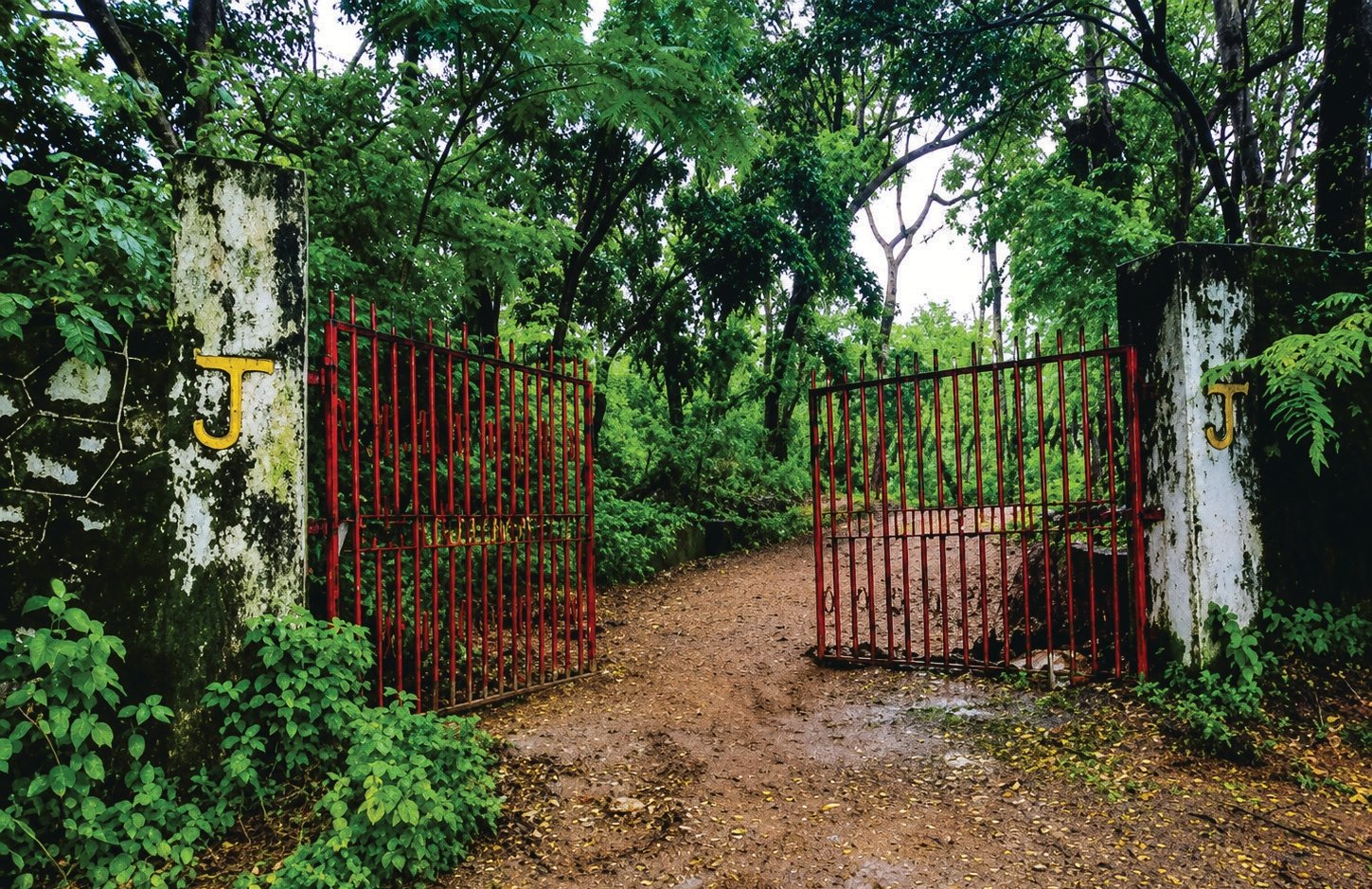
There is a quieter form of land scarcity in Mumbai — one that does not arrive with the urgency of slums or the fragility of ageing buildings. It exists behind compound walls, locked gates, inherited titles, and moral exemptions. Roughly 10 per cent of the city’s land lies with private trusts, religious institutions, and legacy corporate estates, forming an invisible geography of inaccessibility within one of the world’s most land-starved cities.
This land is not illegal. That is precisely its strength. Charitable and religious trusts occupy vast parcels across the city — land granted generations ago under colonial or early post-Independence arrangements, often at nominal rates and with vaguely worded public-purpose clauses.
Over time, purpose blurred into possession. Hospitals became underutilised. Schools stopped expanding. Open land remained fenced off, neither developed nor surrendered. The moral shield of charity ensured minimal scrutiny, while the city continued to densify around it.
Accountability, in these cases, is neither clearly defined nor periodically reviewed. Trust deeds are rarely audited against contemporary urban needs. There is no statutory obligation to demonstrate land optimisation, social impact per square metre, or relevance to current demographics. Land, once justified as benevolence, is allowed to age into irrelevance.
Religious institutions mirror this pattern, often more visibly. Large temple, church, and mosque estates sit amid dense neighbourhoods, functioning as low-density enclaves in high-density zones. While spiritual and cultural roles are unquestionable, urban planning rarely interrogates the disproportion between land consumed and public benefit delivered. Faith becomes a planning exemption, insulating large tracts from the pressures faced by ordinary citizens and housing societies.
Then there are legacy corporate estates — mill lands, factory campuses, staff colonies — remnants of an industrial Mumbai that no longer exists. Some have been redeveloped partially, others remain administratively intact but economically obsolete. Ownership structures are complex, litigation is common, and decision-making is slow. What remains is land that does not fully belong to the past nor serve the present.
What unites these holders is not intent, but insulation. They are shielded from market pressure, political urgency, and public questioning. Their land does not respond to housing demand, infrastructure needs, or environmental logic. It simply waits.
In a functioning city, land is periodically re-evaluated. Not confiscated, not vilified, but re-contextualised. In Mumbai, however, private institutional land enjoys permanence without performance. There is no city-wide mechanism asking whether these parcels still serve the purpose for which they were granted, or whether adaptive reuse could align them with today’s urban realities.
The consequence is subtle but profound. While ordinary residents negotiate consent, approvals, and financing to redevelop dangerous buildings, vast low-density estates remain untouched. While forests and agricultural land are earmarked for ‘future cities’, prime urban land remains frozen out of civic responsibility.
This is not a call for expropriation. It is a call for accountability without exception. Mumbai’s land crisis is not just about what is occupied illegally or collapsing structurally. It is also about what is legally idle, morally unquestioned, and strategically ignored.
Until private trusts and institutional land are brought into the same conversation as every other square metre of the city, Mumbai will continue to expand outward — not because it must, but because confronting privilege is harder than acquiring new land elsewhere.
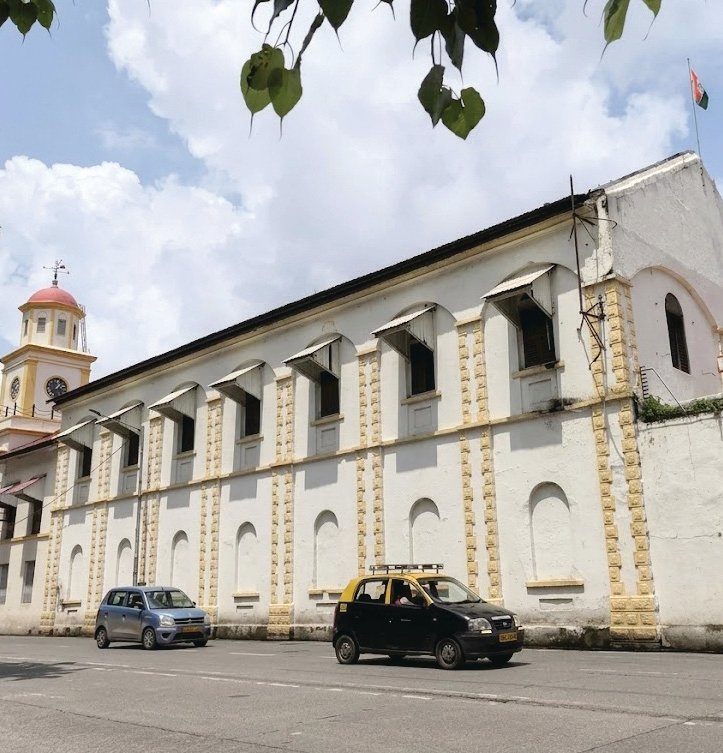
Central Government Land – Unlocking the ‘Untouchable’ 10%
If Mumbai’s slums represent informality and its ageing buildings represent neglect, then central government–controlled land represents immunity.
Nearly 10 per cent of the city’s land is held by defence establishments, public sector undertakings, and central agencies — vast, strategically located parcels embedded deep within the urban core. This land is neither invisible nor marginal. It sits along coastlines, transport corridors, and residential catchments, shaping the city’s geography while remaining largely disconnected from its planning logic.
What distinguishes this land is not merely ownership, but detachment. Defence land occupies some of Mumbai’s most valuable and well-connected zones, maintained at extremely low density in a city desperate for space. While national security considerations are non-negotiable, the absence of periodic spatial audits means that operational necessity is rarely separated from inherited sprawl. Large tracts remain frozen in configurations designed for another era, another threat landscape, another city size.
Public sector undertakings mirror this inertia. Agencies such as BPT Indian Oil, BPCL Bharat Fertilizer, and BARC control thousands of acres within Mumbai’s most stressed urban zones. Much of this land was acquired when ports, refineries, and storage depots were central to the city’s economy. That economic geography has since shifted, but the land has not.
Utilisation remains low. Integration with surrounding neighbourhoods is minimal. Waterfronts are fenced off. Transport interfaces are underdeveloped. The city grows around these enclaves, bending infrastructure awkwardly to accommodate land that does not respond, reciprocate, or adapt Then there are high-risk, high-sensitivity installations like BHABHA ATOMIC RESEARCH CENTRE, situated within one of the densest metropolitan regions in the world. Their presence raises uncomfortable questions — not only about land use efficiency, but about long-term urban safety, environmental exposure, and disaster preparedness. These are questions rarely asked in public, and never answered through an integrated planning framework. What is striking is not the legitimacy of central ownership, but the absence of coordination.
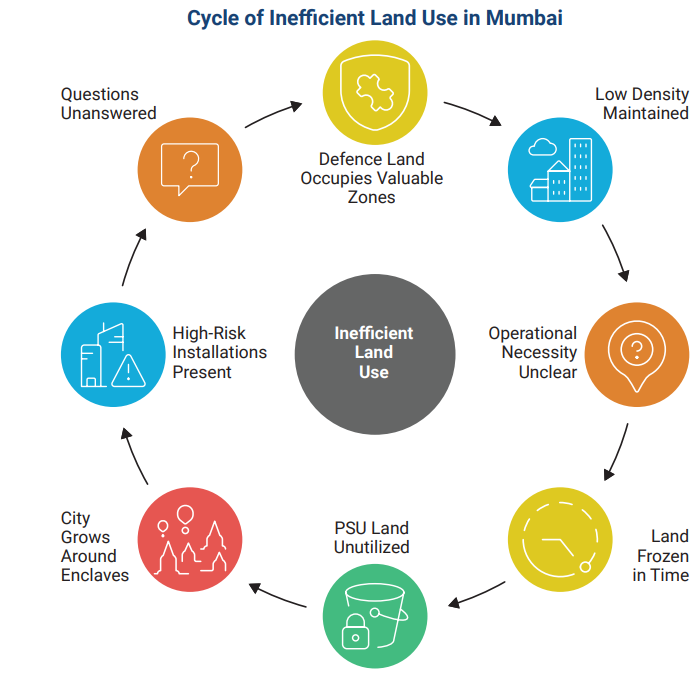 There is no unified city–centre land policy that aligns central holdings with metropolitan priorities. No institutional platform where the city, the state, and the Centre negotiate land optimisation, phased release, mixed-use integration, or risk relocation. Each parcel is governed vertically, through its own ministry, mandate, and internal logic — immune to the horizontal realities of the city around it. In effect, Mumbai is planned in fragments. While municipal bodies struggle to assemble small plots for affordable housing, transit-oriented development, or open spaces, massive centrally held lands remain untouched. Not because they are indispensable in their entirety, but because no mechanism exists to reimagine them collectively. The city adapts to these lands; these lands do not adapt to the city. This institutional siloing carries a cost. When land within the city is locked beyond negotiation, pressure inevitably shifts outward — towards wetlands, forests, and agricultural belts.
Expansion becomes the default response, not because it is efficient, but because the centre refuses to yield. Mumbai’s tragedy is not that the Centre owns land. It is that this land is governed as if the city does not exist around it. Until central agencies are brought into a shared metropolitan vision — one that balances national interest with urban survival — Mumbai will remain a city that grows by avoidance, expanding endlessly at the edges while its most valuable land lies idle at the heart.
Case Study 1:
Bombay Port Trust The Great Idle Land
Few stories capture Mumbai’s planning failure as starkly as the fate of the Bombay Port Trust (BPT). Spread across approximately 2,000 acres, much of it lining the eastern waterfront, this land represents one of the largest contiguous public land banks in the heart of the city — and one of its greatest missed opportunities.
This was not marginal land. It was not peripheral. It sat at the intersection of trade, transport, employment, and housing — land that global cities would have transformed into mixed-use waterfront districts, logistics hubs, public promenades, and economic engines. In Mumbai, it slowly slipped into bureaucratic paralysis and physical decay.
From Strategic Asset to Administrative Orphan
BPT’s land holdings date back to an era when ports were the primary drivers of Mumbai’s economy. Over time, shipping patterns changed. Containerisation reduced spatial requirements. Port operations became more mechanised and less land-intensive. Large portions of docklands and storage yards lost their original operational relevance.
Yet the land was never reimagined.
Instead of a structured transition plan, BPT remained governed by a central mandate that prioritised legacy port operations over metropolitan integration. Decision-making stayed vertical — reporting to the Centre, not responding to the city. Mumbai grew around the port, while the port remained frozen in a different century.
What followed was a vacuum — and vacuums never stay empty.
Encroachment as a Symptom, Not the Disease
As land lay underutilised, encroachments crept in — informal housing, small-scale commercial activity, scrap yards, godowns, and unauthorised extensions. These were not sudden invasions but decades-long seepage, enabled by weak on-ground enforcement and the absence of a redevelopment roadmap.
Encroachment thrived precisely because the land had no future.
- No timeline.
- No project.
- No clarity.
In global planning terms, this is a known failure pattern: when public land remains idle, it becomes politically and socially difficult to reclaim. Each year of inaction hardens informal occupation into permanence. Rehabilitation costs rise. Legal complexity multiplies. What could have been proactive urban renewal becomes reactive damage control.
 Underutilisation on a Global Waterfront
Even where land was not encroached upon, utilisation remained astonishingly low. Vast tracts sat behind rusting fences, disconnected from road networks, rail integration, or public access. The eastern waterfront, potentially Mumbai’s answer to London Docklands or Hamburg HafenCity, remained largely invisible to the city it bordered.
There was no comprehensive land audit linking port requirements with surplus land. No phased release strategy. No mixed-use vision combining logistics, housing, commercial development, and public space. Each proposal that emerged over the years stalled between ministries, committees, and jurisdictional overlaps.
The land did not fail Mumbai.
Governance did.
Bureaucratic Inertia as Urban Policy
At the heart of the failure lay institutional misalignment. BPT land was central-government owned, city-adjacent, and city-critical — yet no single authority was empowered to replan it holistically. The port’s mandate discouraged risk. The city lacked leverage. The state oscillated between ambition and accommodation.
Every redevelopment conversation became trapped in questions of control rather than outcomes. Who owns the land? Who approves of the change of use? Who benefits? Who compensates whom? Years passed debating structure while the city paid the price of inaction.
In the meantime, Mumbai pushed outward, towards wetlands, forests, and distant corridors, citing land scarcity.
The Opportunity That Was Lost — And Still Is
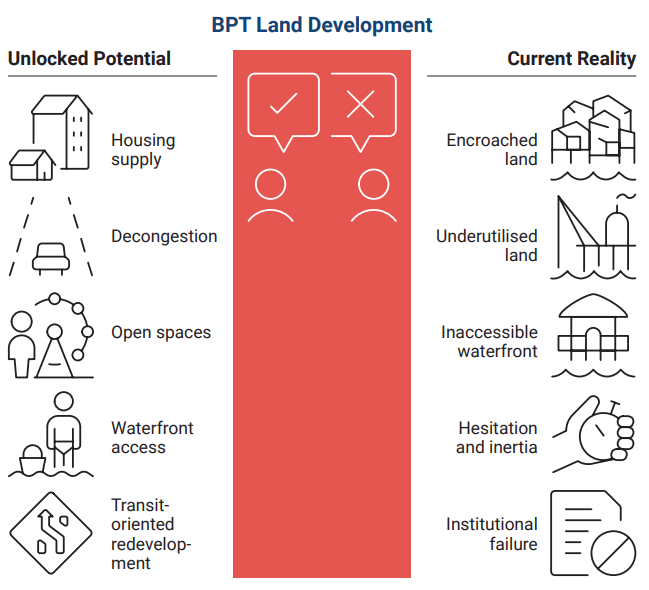
Had even a fraction of BPT’s land been unlocked in a time-bound, integrated manner, Mumbai could have addressed multiple crises simultaneously:
- Inner-city housing supply
- Decongestion of central business districts
- Creation of public open spaces
- Waterfront access for citizens
- Transit-oriented redevelopment along the harbour edge
Instead, the city inherited the worst of all outcomes: encroached land that is politically sensitive, underutilised land that is economically wasteful, and a waterfront that remains largely inaccessible.
The lesson from BPT is not merely about ports or policy. It is about what happens when land is allowed to exist without a future.
Encroachment did not kill the opportunity. Underutilisation did. Encroachment was only the consequence. Mumbai did not lose 2,000 acres overnight. It lost them slowly — through hesitation, fragmentation, and the quiet acceptance of inertia.
And until this land is reclaimed not just physically, but institutionally and imaginatively, every new city announcement elsewhere will remain an admission that Mumbai failed to recognise the value of what it already had.
Case Study 2: The Land Trapped in a Refinery Past
There are cities that move forward by confronting their past, and there are cities that carry their past like an untreated wound. Mumbai belongs, tragically, to the latter.
In the heart of Mumbai’s eastern suburbs lies a massive, overlooked contradiction: nearly 1,000 acres of land held by oil and gas PSUs. These vast industrial tracts, roughly 500 acres each held by major corporations, persist as relics of Mumbai’s past as a heavy industrial port.
The uncomfortable question is not ideological. It is practical. Does Mumbai still need polluting refineries inside its urban core in 2026?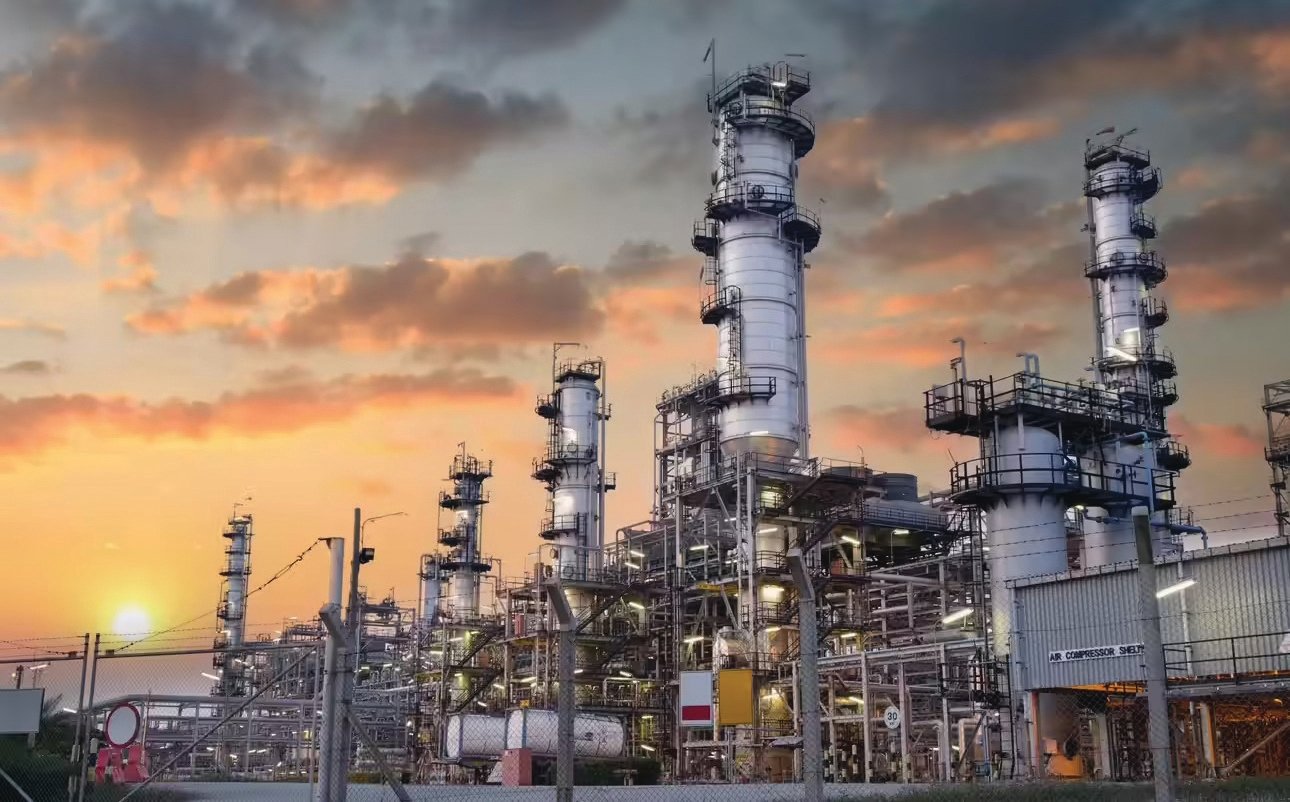
When Strategic Became Stubborn
These refineries were established when land was cheap, the city was smaller, and industrial proximity to ports made economic sense. At the time, they were symbols of national self-reliance — strategic assets critical to energy security.
But cities evolve. Economies shift. Risk profiles change. What was once strategic has now become stubborn geography — vast, low-density, high-risk land uses surrounded by residential neighbourhoods, rail corridors, highways, and informal settlements. The refineries did not move as the city enveloped them. They stayed put, protected by national importance and administrative immunity.
And so, Mumbai adjusted around them — dangerously.
Pollution as Collateral Damage
The environmental cost of this inertia is not abstract. It is lived daily in surrounding localities like Mahul, Chembur, Wadala where residents have long complained of toxic air, industrial emissions, health crises, and compromised quality of life. The city’s poorest often live closest to its most hazardous land uses — a pattern repeated across urban India, but rarely acknowledged at scale.
In terms of planning, this is indefensible. Refineries are high-risk installations. They demand buffer zones, controlled access, and disaster mitigation planning. In Mumbai, these buffers have been quietly eroded by population pressure and institutional denial. The result is a city where hazard and habitation coexist, not by design, but by neglect.
Maharashtra as a state does not lack space elsewhere in the state — or even within regions like Raigad or Thane — to relocate such installations gradually, safely, and strategically and environmentally. What it lacks is the political will to challenge legacy land use in the name of urban safety.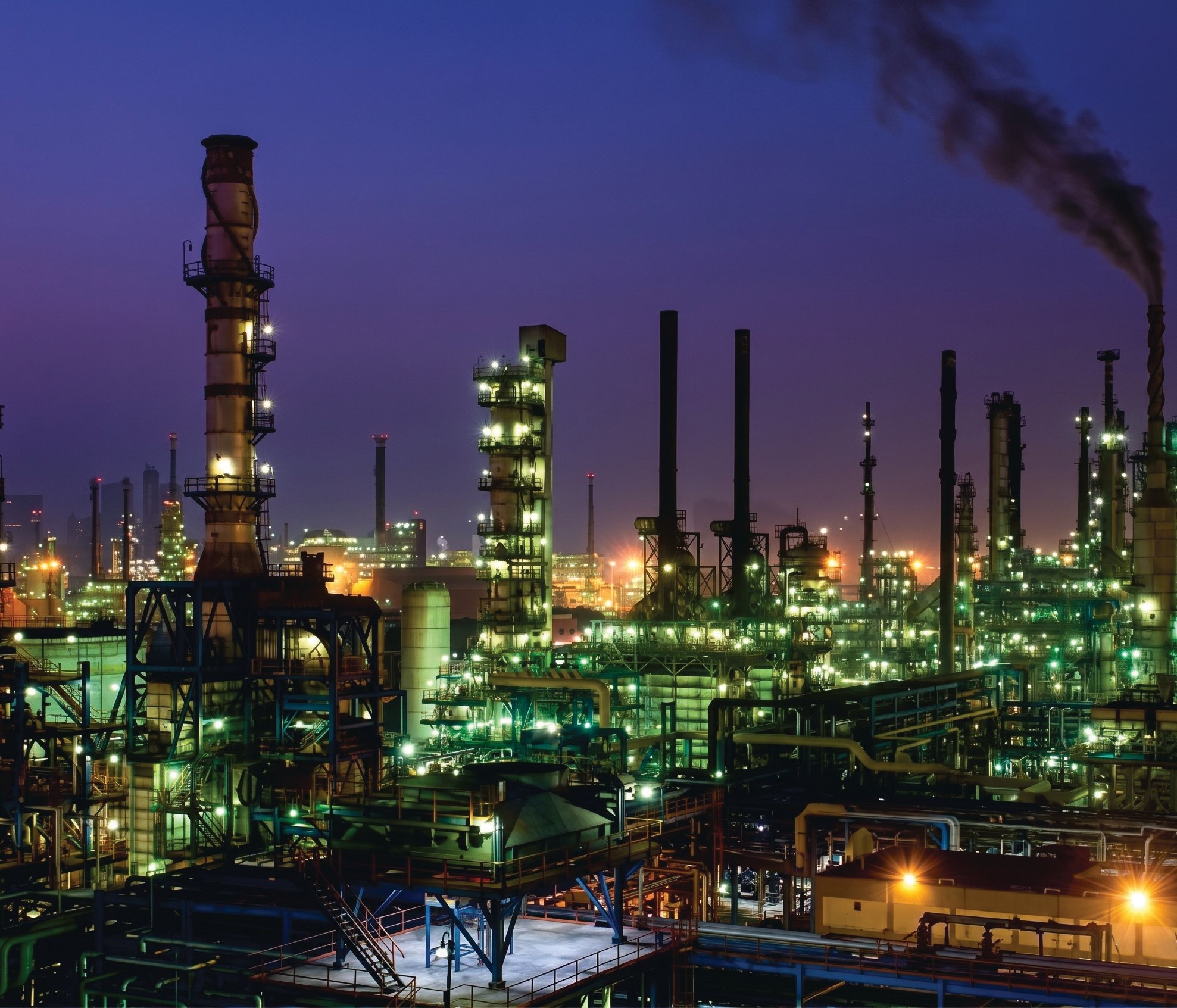
Underutilised Land in a Starved City
Even setting pollution aside, the land economics are staggering. Thousands of acres lie locked into single-use industrial zoning in a city gasping for housing, open space, and employment diversification. This is not land working at peak efficiency; it is land frozen by mandate.
Globally, cities that once housed inner-city refineries, from London to Seoul, have relocated them, reclaiming waterfronts and industrial belts for mixed-use redevelopment, public access, and economic renewal. Mumbai, instead, continues to treat relocation as unthinkable, while simultaneously claiming land scarcity as justification for urban expansion into ecologically sensitive zones.
A Post-Industrial City in Denial
Mumbai calls itself a financial capital, a services hub, a global city. Yet it continues to host a heavy polluting industry in the heart of its residential geography — a contradiction that no branding exercise can mask.
This land could have been reimagined decades ago:
- As mixed-use urban districts
- As employment hubs aligned to a modern economy
- As green buffers and public waterfronts
- As housing zones easing pressure elsewhere
Instead, it stands as proof that in Mumbai, legacy often outweighs logic.
The refineries did not fail Mumbai. Time changed, and policy refused to respond.
As long as oil and gas PSUs remain frozen inside the city — untouchable, under-questioned, and unintegrated — Mumbai’s claim of land scarcity will remain hollow. Because a city that cannot renegotiate its past has no authority to redesign its future.
And every time a new Mumbai is announced elsewhere, the smoke rising silently from these refineries answers back. Reminding us that the city never ran out of land. It ran out of courage.
Greenwashing Expansion While Polluting the Core
Mumbai speaks the language of sustainability fluently — in conferences, policy notes, glossy presentations. It promises green corridors, carbon neutrality, and climate resilience. The vocabulary is polished. The intent is performative. The reality, however, remains stubbornly carbon-heavy, spatially unjust, and morally inverted.
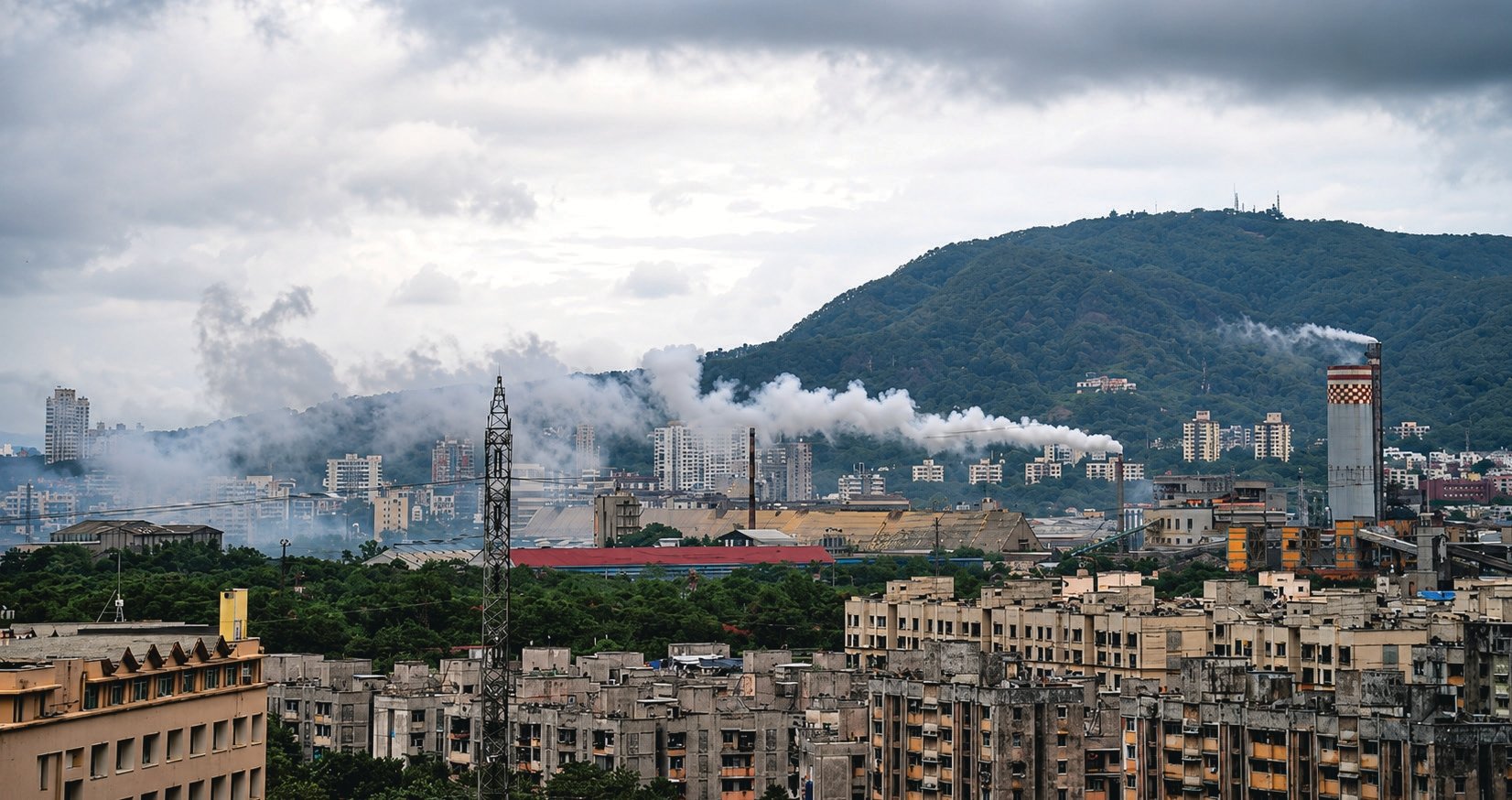
At the heart of the city, coal still burns. Thermal infrastructure continues to power a metropolis that claims to be preparing for a cleaner future, even as its most vulnerable residents inhale the cost of that contradiction.
Chimneys rise quietly within city limits, their presence justified by reliability, legacy, and institutional inertia. Pollution is no longer seen as a crisis. It is treated as background noise, absorbed into the urban fabric like humidity or dust.
What makes this dependence particularly perverse is not the existence of thermal power, but where it exists. Industrial emissions are embedded inside residential geographies, pressed up against informal settlements and lower-income neighbourhoods. Exposure is not accidental; it is structural. The city’s poorest live closest to its most toxic decisions, while environmental rhetoric floats safely above them.
And yet, when expansion is discussed, it is framed as an environmental necessity. Forests at the edge of the metropolis are reclassified, fragmented, and sacrificed in the name of decongestion. While wetlands are described as ‘underutilised’, agricultural land is called ‘non-productive’. The ecological cost of new cities is rationalised as inevitable — the price of progress.
What is rarely acknowledged is the asymmetry of this sacrifice. While forests are cleared and farms are flattened, vast swathes of prime urban land within Mumbai remain idle, underutilised, or locked behind institutional mandates. Pollution is tolerated in the core, while ecological assets are destroyed at the periphery. The city poisons what it inhabits and destroys what could have protected it.
This is greenwashing in its most sophisticated form — not the denial of environmental harm, but its careful relocation. Damage is shifted outward, made invisible, rebranded as development. The language of sustainability is used not to reduce harm, but to legitimise expansion without introspection.
The irony deepens when climate resilience is invoked. Mumbai’s vulnerability to flooding, heat stress, and air pollution is well documented. Yet policy response favours land acquisition over land correction, sprawl over repair. Instead of reclaiming and remediating polluted industrial zones within the city, the planning imagination leaps beyond them — as if distance alone can undo ecological damage.
In this framework, environmentalism becomes selective. The city chooses which ecosystems to value and which populations to expose. It speaks of the future while refusing to clean up the present. It promises green cities while maintaining grey cores.
A truly sustainable Mumbai would not begin by cutting into forests or farmland. It would begin by confronting its own emissions, relocating its hazards, reclaiming its idle land, and redistributing environmental risk more justly. It would understand that sustainability is not an add-on to expansion — it is a discipline of restraint.
Until then, every green map will remain a contradiction layered over a polluted reality. And every new city announced in the name of the environment will quietly confirm what Mumbai has learned to do best — protect the rhetoric, not the ecology.
Case Study 3: The High-Risk Industrial–Atomic Zone of Mumbai (Trombay Belt)
There are parts of Mumbai where planning does not fail loudly — it fails quietly, through silence, familiarity, and the slow erosion of logic. Trombay is one such place. What appears on a map as a cluster of institutional land is, in reality, a deeply layered contradiction — a dense residential city growing around infrastructure that was never meant to coexist with it.
Fertiliser production, thermal power generation, and atomic research — three fundamentally different, high-sensitivity activities — occupy contiguous land in a geography that is no longer industrial, no longer isolated, and no longer buffered. At the centre of this contradiction lies scale.
The Bhabha Atomic Research Centre (BARC) occupies roughly 1,200+ acres, forming the largest single landholding in the belt — a secured, low-density enclave within one of the most crowded urban regions in the world. Adjacent to it, Rashtriya Chemicals and Fertilizers (RCF) at Trombay spreads across approximately 700+ acres, while Tata Power’s Trombay thermal station occupies another 250–300 acres along the coast.
Individually, each of these installations has a logic. Collectively, they represent a geography that has outlived its context.
These were decisions of another time — when Trombay sat at a distance from the city, when industrial adjacency did not mean residential exposure, when buffer zones were real, and when the idea of risk was spatially manageable.
But Mumbai does not respect historical boundaries. It expands, absorbs, compresses. Over decades, the city has folded itself around Trombay. Settlements have come closer, sometimes formally, often informally. Roads and rail lines have cut through what were once isolation buffers. The distance between hazard and habitation has narrowed — not through planning, but through inevitability.
And yet, the land use has remained unchanged. This is where the contradiction deepens. Not in the existence of these installations — but in the absence of any serious re-evaluation of their place within a transformed city. Planning, in theory, is an adaptive discipline. It responds to shifts in density, economy, ecology, and risk. In Trombay, planning has been replaced by continuity. The original logic has been preserved long after its assumptions have dissolved.
What emerges is a condition far more subtle than conflict — it is coexistence without reconciliation. The presence of atomic, chemical, and thermal infrastructure in such proximity to dense populations creates a layered exposure — environmental, operational, and hypothetical. It is not that the city is unaware of this. It is that the city has chosen not to articulate it.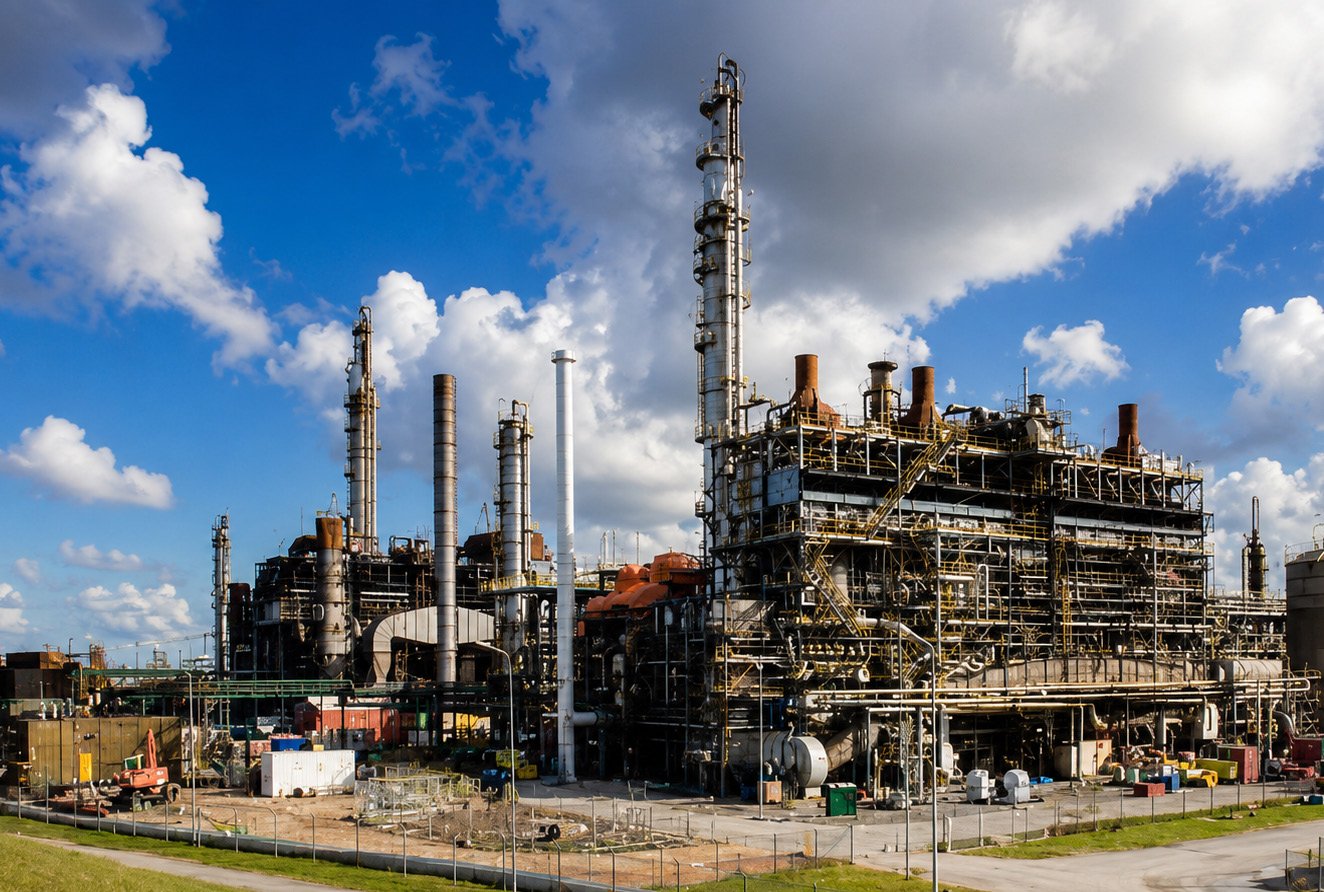
Familiarity becomes a substitute for safety. Decades without visible catastrophe are read as evidence of stability. The absence of failure is mistaken for proof of adequacy. But risk, especially in urban systems, does not announce itself incrementally. It accumulates quietly and reveals itself suddenly. In a city like Mumbai, where evacuation itself is a logistical impossibility at scale, the margin for error is not thin — it is non-existent.
Yet the conversation does not happen. There is no metropolitan dialogue that asks whether this land — at this scale — should remain in its current form. No integrated assessment that weighs national importance against urban exposure. No phased roadmap that imagines reduction, relocation, or even partial reconfiguration.
Instead, the question is avoided entirely. And avoidance has consequences beyond safety. Because while this land remains locked in low-density, single-use, high-sensitivity activity, the city continues to argue that it has no land. The contradiction is almost architectural in its precision:
high-value land remains frozen at the centre, while low-value land is consumed at the edges. This is not inefficiency. It is a hierarchy of convenience. It is easier to expand outward than to negotiate inward. Easier to acquire new land than to question existing power. Easier to relocate people than to relocate risk.
And so Trombay remains — not just as an industrial belt, but as a symbol of something deeper. A city that has learned to live with unresolved risk. A planning system that prefers silence over scrutiny. An urban imagination that expands faster than it reflects. The question, ultimately, is not whether these installations should exist.
The question is whether a city of Mumbai’s density can afford to stop asking where they should exist.
Livability Index Failure
Why Does Mumbai Still Feels Underdeveloped?
Mumbai likes to count things. Kilometres of metro lines. Flyovers commissioned. Coastal roads inaugurated. The arithmetic is impressive, the announcements confident. And yet, for those who live in the city, livability remains an elusive promise. Something constantly spoken of, rarely experienced.
Failure lies not in ambition, but in proportion.
Infrastructure in Mumbai is built as if population density were an afterthought. Transit lines are laid down, but the neighbourhoods they serve remain congested, underserviced, and socially thin. Mobility improves in fragments, while daily life remains compressed into shrinking personal and civic spaces. Movement is prioritised; living is deferred.
Open space tells the story more brutally than any statistic. In a city that prides itself on scale, access to breathing room is a luxury rationed by pin codes. Parks are scarce, playgrounds vanish quietly, waterfronts remain fenced, and what little public space exists is overburdened beyond recovery. Livability is reduced to survival, recreation to endurance.
The imbalance becomes starker when transport upgrades race ahead of housing and social infrastructure. Metro stations rise where schools do not. Highways widen where clinics are absent. Transit-oriented development becomes transit-adjacent speculation, while hospitals, anganwadis, libraries, and community spaces fall behind or disappear altogether. The city moves faster, but it does not move better.
This skewed prioritisation creates a peculiar illusion of progress. Projects are completed, yet neighbourhoods feel unfinished. Commutes shorten for some, while quality of life deteriorates for many. Infrastructure becomes an event, not a system — inaugurated, photographed, and forgotten, even as its surrounding ecosystem collapses under pressure.
The deeper irony is spatial. Mumbai expands outward relentlessly, absorbing distant land to ease internal congestion, while its core quietly decays. Buildings age without replacement. Public spaces shrink without protest. Social infrastructure erodes invisibly. The city grows wider, but its heart weakens.
What emerges is a metropolis that looks modern in aerial photographs and feels underdeveloped at street level. A city where efficiency is engineered, but dignity is improvised. Where growth is measurable, but well-being is anecdotal.
Livability is not created by infrastructure alone. It is produced by balance — between density and space, mobility and access, speed and safety. Mumbai, however, has mastered imbalance. It builds movement faster than it builds care. It adds kilometres before adding capacity.
And so, despite its wealth, its scale, its ambition, Mumbai continues to feel incomplete — not because it has grown too fast, but because it has grown without learning how to live with itself.
Until livability is treated not as an index to be climbed, but as a condition to be experienced, Mumbai will remain trapped in a strange paradox — a global city that moves relentlessly forward, while quietly failing the simple act of making daily life humane.
The Missing Urban Governance Layer
Mumbai is not short of power. It is short of alignment. The city is governed not as a single organism, but as a loose assembly of authorities, each holding a fragment of control, none holding the whole responsibility. The state plans, the Centre and Private Players own, the local and statutory bodies administer — and between them, land waits. Decisions dissolve into correspondence. Urgency is lost in jurisdiction.
This fragmentation is not accidental; it is structural. State government agencies announce visions that require land they do not control. Central agencies and private players sit on assets they are not mandated to optimise for urban life. Local bodies and other statutory bodies like MMRDA, SRA, MHADA are left to manage consequences without the authority to reshape causes. The city becomes a negotiation table where everyone has a seat, but no one chairs the meeting.
What is missing is not expertise or intent, but a metropolitan conscience — a unified governance layer that sees land not as departmental property, but as a shared civic resource. Mumbai has transport authorities, development authorities, housing authorities. What it lacks is a Metropolitan Land Authority with the power to audit, coordinate, and time-bound land use across jurisdictions.
In the absence of such an institution, land policy drifts. Parcels remain frozen because releasing them requires consensus across ministries that do not share timelines or incentives. Redevelopment is discussed in principle, postponed in practice. Monetisation becomes episodic, triggered by fiscal stress rather than urban strategy.
Time, in this system, has no discipline. There is no city-wide redevelopment clock. No binding roadmap that sequences land release, rehabilitation, remediation, and reintegration. Projects move when conditions align, not when the city needs them. Delay carries no penalty. Inaction costs no one directly, while its impact is absorbed collectively by residents.
This vacuum breeds inconsistency. While one agency densifies without social infrastructure, another preserves land without purpose. Environmental risk, housing shortage, transport strain — all are treated as sectoral problems rather than symptoms of a single planning failure.
A city cannot function this way.
Integration is not an administrative luxury; it is the minimum condition for urban survival at scale. Without it, planning becomes reactive, expansion becomes default, and governance becomes commentary rather than command.
Mumbai’s crisis is not a lack of land, money, or ideas. It is the absence of a platform where these forces are aligned under a single, accountable vision. Until such a layer exists — empowered, transparent, and time-bound — the city will continue to grow by fragmentation.
And in a fragmented city, even the best intentions fail to add up. Mumbai does not need more plans. It needs one system that can make them speak to each other.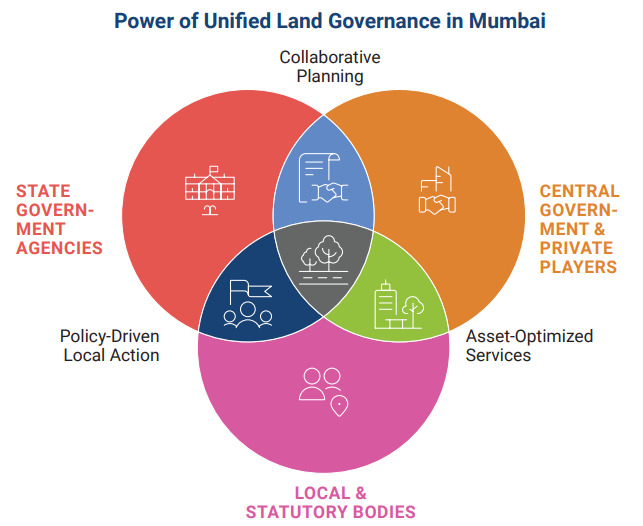
Developers as Vultures of Land Capitalism
Mumbai’s transformation is often narrated as a story of ambition — towers rising, skylines stretching, cities multiplying. But beneath this narrative lies a more uncomfortable truth: the city is no longer being developed for people; people are being adjusted to suit real estate.
The irony is complete and unapologetic. The entire imagination of urban development has been surrendered to land value. In Mumbai, real estate does not follow the city. The city follows real estate.
Land is not unlocked to solve housing shortages or improve livability. It is hoarded first — quietly, strategically, legally — and infrastructure arrives later, like an apology. Roads, metros, water lines, and public services trail behind speculation, legitimising what has already been captured. Planning becomes a post-facto endorsement of private accumulation.
This is ‘land capitalism’ in its purest form. Developers are often framed as risk-takers, visionaries, nation-builders. In reality, the system rewards a different behaviour altogether — patience without responsibility. Those who can acquire land early, sit on it longest, and wait for public investment to inflate its value emerge as winners. Construction becomes secondary. Delivery becomes negotiable. What matters is control, not completion.
This is why expansion is irresistible. New cities are announced not because the old city has been repaired, but because fresh land offers a cleaner slate for accumulation — fewer disputes, weaker resistance, faster approvals. Agricultural land, forest edges, and peripheral villages are easier to convert than confronting entrenched interests inside Mumbai. It is simpler to buy silence at the edges than negotiate justice at the centre.
Infrastructure, in this model, is not a public good. It is a value amplifier. Metros are not built to decongest neighbourhoods; they are built to unlock floor space index. Highways do not serve communities; they serve inventory. Every new corridor is a speculative promise, every new announcement is an invitation to hoard. The city’s circulatory system is redesigned to keep capital moving, not people comfortable.
What disappears in this process is time — human time. Residents wait years for redevelopment while land trades hands multiple times. Communities are displaced in the name of future housing that never quite arrives. Informality is tolerated until it becomes inconvenient, then erased without rehabilitation. The city moves fast for capital and painfully slow for citizens.
Land capitalism thrives on imbalance — scarcity manufactured through delay, urgency created through neglect. A city allowed to decay internally creates moral permission to expand externally. Each failure becomes justification for the next acquisition. Each broken promise becomes the preface to a larger project.
And so developers circle, not always maliciously, but predictably, responding to incentives that reward extraction over integration. They do not plan cities; they harvest them. What remains is not urban fabric, but urban residue — fragments of infrastructure, islands of luxury, oceans of compromise.
The tragedy is that this system does not even produce good cities. It produces profitable ones. Mumbai today is not underdeveloped by accident. It is underdeveloped by design — kept perpetually unfinished so that land always appears scarce, urgency always appears fresh, and expansion always appears inevitable.
Until land is treated not as a commodity to be cornered, but as a commons to be optimised, the city will remain trapped in this cycle. Infrastructure will keep chasing speculation. Development will keep arriving after displacement. And Mumbai will continue to grow — richer on paper, poorer in life.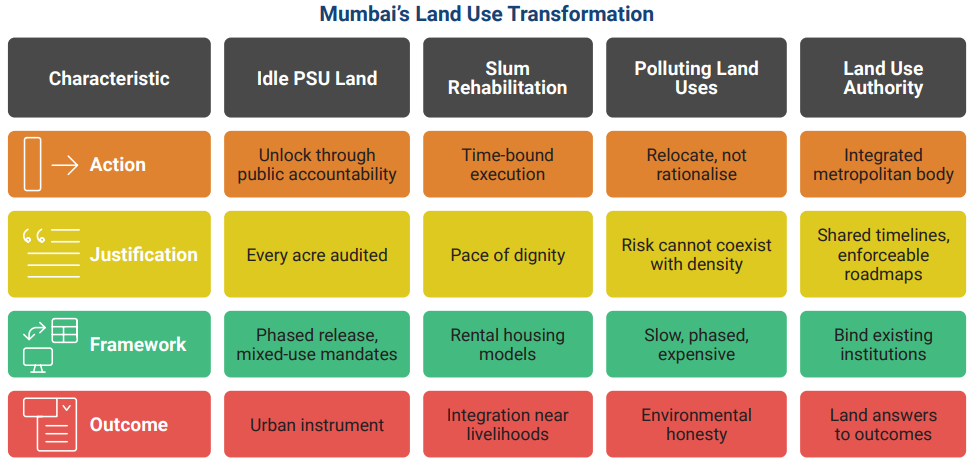
What a Fixed Mumbai First Policy Would Look Like
A fixed Mumbai would not arrive with a launch date. It would not need a logo. It would not be announced from a podium with satellite maps and speculative numbers.
It would begin quietly, with restraint. The first principle would be almost radical in today’s vocabulary: redevelop before you expand. The city would look inward before it looks outward. Ageing buildings would be treated as a safety emergency, not a consent puzzle. Slums would be addressed as land already owned by the city’s future, not as political inconvenience. Expansion would become the last option, not the first reflex.
This would immediately change the moral geometry of planning.
Forests and farms would stop being sacrificial buffers for urban failure.
Peripheral land would no longer compensate for central neglect. The city would learn to finish what it started.
A fixed Mumbai would then confront its most uncomfortable truth — that vast amounts of land are already public, already serviced, already strategic — and yet locked away. Idle PSU land would be unlocked, not through backroom monetisation, but through public accountability. Every acre would be audited. Every use is justified. Every surplus explained.
This would not mean reckless sell-offs or privatisation disguised as reform. It would mean transparent frameworks — phased release, mixed-use mandates, social infrastructure quotas, and public access as a non-negotiable condition. Land would stop being a fiscal emergency lever and start becoming an urban instrument.
Slum rehabilitation, long trapped between cruelty and paralysis, would finally move at the pace of dignity. Time-bound execution would replace endless eligibility debates. Rental housing models would acknowledge the city’s mobile workforce, seasonal labour, and economic precarity — people who need stability without the burden of ownership traps.
Rehabilitation would no longer mean exile to the margins. It would mean integration — near livelihoods, transport, schools, and care. The slum would cease to be a bargaining chip and become what it always should have been: a failure the city takes responsibility for.
Environmental honesty would follow. A fixed Mumbai would stop pretending that risk can coexist indefinitely with density. Polluting and high-risk land uses would be relocated, not rationalised. This would be slow, phased, expensive — and unavoidable. Refineries, thermal plants, hazardous industries would be moved out of dense residential zones, not because catastrophe has struck, but because it eventually will.
This is what mature cities do: they act before the apology.
Most critically, a fixed Mumbai would repair its governance architecture. An integrated metropolitan land-use authority would replace the current patchwork of silos. This body would not replace existing institutions, but bind them into a single planning conscience — with shared timelines, enforceable roadmaps, and public accountability. Land would no longer answer only to ownership; it would answer to outcomes.
Time would finally matter. Delays would carry costs. Inaction would be visible. Every redevelopment, every rehabilitation, every land release would sit on a public clock — not drifting endlessly through committees, but moving because the city demands it. A “Fixed Mumbai First” policy would not promise perfection. It would promise completion.
It would recognise that cities do not fail because they grow too much, but because they refuse to
resolve themselves. And that expansion, without resolution, is not vision. It is escape. Mumbai does not need another city yet. It needs the courage to finish becoming the one it already is.
A City at Risk of Permanent Incompleteness
Mumbai does not suffer from a shortage of land. It suffers from a shortage of courage. Courage to confront what lies idle. Courage to dismantle legacy privilege. Courage to repair before replicating.
The city’s crisis has never been spatial; it has always been institutional and moral. Land exists — in slums waiting for dignity, in buildings waiting for safety, in public estates waiting for purpose, in polluted zones waiting for remediation. What is missing is the will to engage these realities honestly, without detours or distractions.
Instead, Mumbai has learned a dangerous habit: announcing futures to avoid fixing the present. Each new city proposed beyond its edges is not an act of ambition, but an act of abdication. It allows the original city to remain incomplete — structurally fragile, environmentally compromised, socially divided — while attention shifts elsewhere.
A 3rd Mumbai cannot compensate for a 1st Mumbai left unfinished. No amount of expansion can undo the damage of neglect. No new corridor can replace institutional reform.
Cities do not collapse only through disasters. They also collapse through permanent postponement, when every problem is acknowledged, debated, and then deferred. Mumbai is at risk not of stagnation, but of becoming endlessly unresolved: always growing, never healing. To fix Mumbai is not to dream bigger, but to look closer. To value repair over spectacle. To treat land not as a commodity to be escaped from, but as a responsibility to be completed.
Until that shift occurs, Mumbai will continue to expand outward, carrying its unfinished self into every new promise — a city forever in motion, and forever incomplete.