
HomeLatestUltraTech leadership exit amid cartel probe scrutiny

UltraTech leadership exit amid cartel probe scrutiny

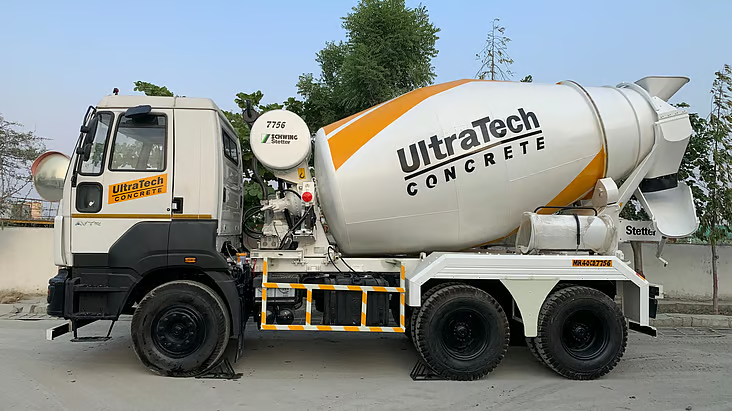
A senior leadership exit at UltraTech Cement has drawn renewed attention to regulatory scrutiny within India’s cement sector, as competition authorities continue to examine alleged cartelisation in large-scale procurement contracts. The development highlights growing oversight in industries central to the country’s infrastructure and urban expansion.

The company confirmed that its chief legal officer stepped down from the role in early July, with the departure taking effect immediately. The exit coincides with an ongoing investigation by the Competition Commission of India (CCI), which has been reviewing potential anti-competitive practices linked to cement supply contracts for public sector projects. The probe stems from allegations that multiple cement manufacturers coordinated bidding behaviour in tenders issued by a major state-run energy company. According to regulatory findings, companies including UltraTech Cement and others were asked to submit detailed financial records and responses after preliminary investigations indicated possible violations of competition norms. While the company has attributed the leadership change to personal reasons, the timing has intensified scrutiny of governance frameworks within the sector. Legal experts suggest that senior-level exits during regulatory reviews often raise broader questions about compliance systems, internal controls, and risk management practices—especially in industries with high public sector exposure.For India’s urban economy, the implications extend beyond corporate developments. Cement is a foundational material for infrastructure, housing, and industrial construction, making fair competition in its supply critical for cost efficiency and project delivery.

Any distortion in pricing or procurement processes can have cascading effects on public spending, construction timelines, and affordability of urban infrastructure.Urban planners note that cartelisation risks are particularly significant in government-linked projects, where large volumes and standardised specifications create opportunities for coordinated bidding. Such practices, if proven, can inflate project costs and limit market access for smaller or emerging players, ultimately affecting the inclusivity of economic growth in the construction ecosystem.The ongoing scrutiny also reflects a broader shift in regulatory focus. As India accelerates investments in highways, metro systems, and energy infrastructure, competition authorities are increasingly monitoring sectors that underpin these developments. Transparent procurement and competitive pricing are seen as essential to ensuring that public investments translate into equitable and efficient urban outcomes.At the same time, the episode underscores the need for stronger corporate governance in industries tied closely to resource use and environmental impact. Cement manufacturing remains energy-intensive, and regulatory compliance now extends beyond financial practices to include sustainability reporting, emissions control, and responsible sourcing.

Looking ahead, the outcome of the investigation could shape industry practices, particularly in how companies approach bidding, disclosure, and compliance. For cities and citizens, the priority remains clear: ensuring that the materials driving urban growth are sourced through transparent, accountable systems that support both economic efficiency and long-term sustainability.

Also Read: India cement growth masks ACC profit decline

UltraTech leadership exit amid cartel probe scrutiny
RELATED ARTICLES

LEAVE A REPLY

Please enter your comment!
Please enter your name here

- Advertisment -spot_img

Most Popular

Recent Comments

Delhi Master Plan 2047 Could Reshape Urban Housing

Delhi Master Plan 2047 Could Reshape Urban Housing

Delhi’s long-term planning framework could alter how the capital adds homes, renews ageing neighbourhoods and uses scarce urban land. The Delhi Development Authority’s Draft...
Delhi NCR Corridors Reshape Premium Housing Demand

Delhi NCR Corridors Reshape Premium Housing Demand

Delhi-NCR’s premium housing market is increasingly concentrating around two infrastructure-led corridors: Dwarka Expressway in Gurugram and the Noida-Greater Noida Expressway. Fresh H1 2026 market...
Delhi Redevelopment Tests High Rise Housing Model

Delhi Redevelopment Tests High Rise Housing Model

Delhi is preparing to replace ageing government housing in Gulabi Bagh, Bahapur and Kalyanwas with taller residential buildings, bringing land efficiency and transit-linked planning...
Sonipat Emerges as NCR Housing Pressure Spreads

Sonipat Emerges as NCR Housing Pressure Spreads

Sonipat is entering a new phase of urban growth as rising housing costs in established NCR markets push more buyers towards peripheral locations. The...
India Real Estate Faces Fresh Cost Pressures

India Real Estate Faces Fresh Cost Pressures

India’s property market is entering a more uncertain phase as the West Asia conflict pushes up energy and construction costs, but demand has yet...
