
In this exclusive conversation, Rajesh Dogra shares how Eros Group, through its automated parking brand Skyzone, is addressing structural urban challenges with engineered, intelligent, and future-ready solutions.
Q Let’s begin by sharing the origin of Eros Group’s entry into automated parking, and how your journey has aligned with the evolution of India’s urban infrastructure?
Eros Group’s entry into automated parking was not just a business decision, it was a direct response to a structural urban challenge. As cities like Mumbai and other metros began facing acute land constraints, conventional parking was becoming increasingly inefficient and unsustainable.
We recognised early that urban India was moving vertically, and infrastructure had to evolve accordingly. Automated parking offered a natural solution optimising land use, improving user experience, and introducing engineering precision into what was largely an unorganised space.
This led to the creation of Skyzone, our dedicated platform for automated parking. Over time, we’ve witnessed a clear shift from initial resistance to strong demand. Today, automated parking is no longer a luxury; it is becoming essential to smart urban development. At Eros, we are not just building parking systems, we are engineering the future of urban space.
 Q What are the most critical gaps in current parking infrastructure, and how do automated systems change this equation?
The challenge is not just land scarcity, it is inefficient utilisation of available space and the absence of integrated planning. Parking is often treated as an afterthought, resulting in congestion, poor user experience, and loss of valuable real estate potential.
The key gaps today are low space efficiency, manual dependency, and lack of system-driven operations.
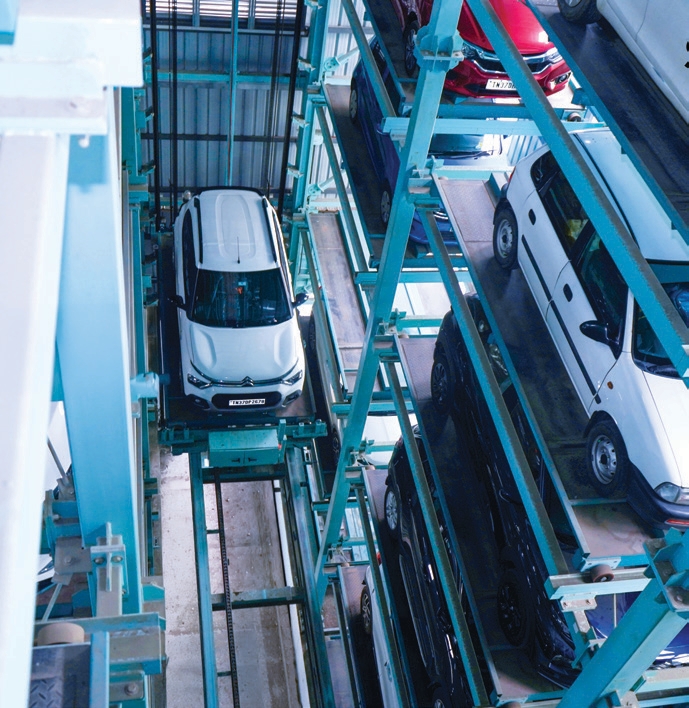
Automated parking fundamentally changes this by increasing capacity within the same footprint, eliminating ramps and dead spaces, and delivering a safe, predictable, and seamless experience.
Through Skyzone, we are driving a shift from unorganised parking to engineered infrastructure, thereby enabling better land monetisation for developers and more structured mobility for cities.
Q As urban density increases, how do automated parking systems contribute to space optimisation in high-density developments?
In cities like Mumbai and Bengaluru, space is the most valuable asset. Automated parking unlocks this value by building vertically rather than spreading horizontally.
By eliminating ramps and optimising layouts, we can increase parking capacity by two to three times within the same footprint. More importantly, this frees up usable space, whether for amenities or additional saleable area. Through Skyzone, we see automated parking as a core enabler of efficient urban design.
Q With the growing preference for larger vehicles like SUVs, how has your engineering approach evolved?
Vehicle profiles have changed significantly, and our engineering has evolved in response.
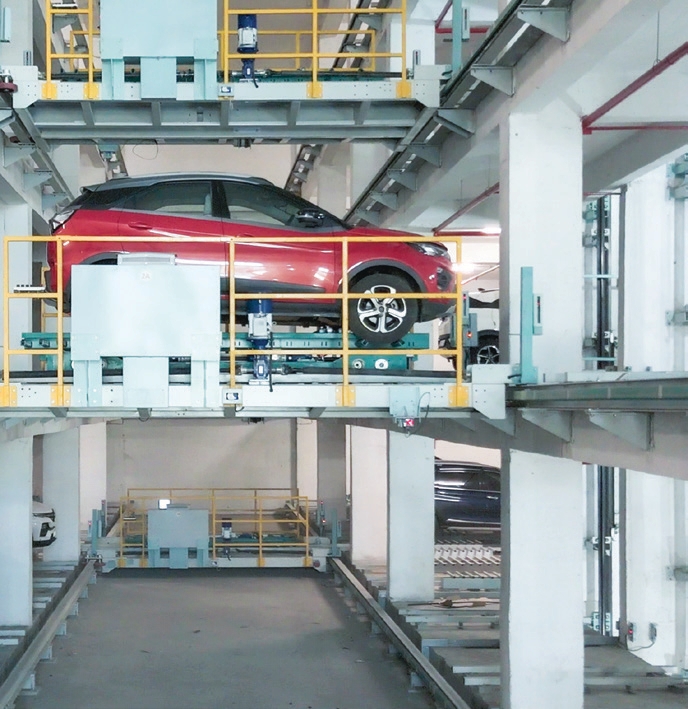
We have enhanced load-bearing capacities, redesigned system dimensions, and integrated advanced safety mechanisms. This includes stronger structural frameworks, upgraded drive systems, and multiple layers of safety interlocks and sensors.
The objective is to ensure stability, safety, and reliability while accommodating heavier and larger vehicles without compromising efficiency.
 Q How are technologies like RFID, IoT, and ANPR enhancing efficiency and convenience?
User expectations today are shaped by digital ecosystems. Parking is expected to be seamless, intuitive, and contactless. Technologies such as RFID, IoT integration, ANPR, and mobile-based controls enable faster vehicle identification, real-time system monitoring, and reduced human intervention. This significantly improves both efficiency and user convenience.
Through Skyzone, we are integrating these technologies to create a connected, frictionless parking experience.
Q From a developer’s perspective, how do automated systems compare with conventional parking in terms of cost and value?
Automated parking is often perceived as a higher upfront cost, but in reality, it is a more efficient allocation of capital.
When you consider the cost of conventional parking, such as additional RCC, excavation, and loss of saleable area, the economics become comparable. The real advantage lies in unlocking value. Developers can maximise usable space, improve project viability, and accelerate sales. Even with long-term maintenance considerations, the overall return on investment remains significantly stronger. Through Skyzone, we position automated parking not as a cost, but as a revenue enabler.
Q Sustainability is becoming central to urban development. How do your solutions contribute?
Sustainability is closely linked to efficiency. A significant portion of urban emissions comes from vehicles circulating in search of parking. Automated systems eliminate this by enabling quick, system-driven parking and retrieval, reducing idle time, fuel consumption, and internal traffic movement. Additionally, vertical optimisation reduces the need for excessive construction and excavation, contributing to a lower environmental footprint. Through Skyzone, we see automated parking as a step toward cleaner and more efficient urban living.
 Q What are the most common concerns developers have before adopting automated parking systems?
The most common concerns revolve around reliability, maintenance, user acceptance, and long-term costs. There is often a perception that automated systems are complex or difficult to manage. Our role is to address this through robust engineering, clear service structures, and dependable after-sales support. Once developers understand the operational reliability and value benefits, the mindset shifts quickly, moving from hesitation to confidence.
Q Reliability is critical. How do predictive maintenance and remote monitoring ensure performance?
Reliability is not reactive but engineered. Through Skyzone, we focus on preventive and predictive maintenance supported by IoT-enabled monitoring systems. This allows us to identify potential issues in advance and take corrective action proactively.Combined with strong after-sales support, this ensures minimal downtime and consistent performance across the system lifecycle.
Q With the rise of electric vehicles, how are you integrating EV infrastructure into your systems?
The transition to electric mobility is inevitable, and parking infrastructure must evolve alongside it. We are actively working on integrating EV charging within automated parking ecosystems. This involves both engineering integration and coordination with power infrastructure and regulatory frameworks. Our goal is to create systems that are not just storage solutions, but energy-enabled infrastructure which is aligned with the future of mobility.
Q Do you see adoption expanding beyond metro cities? What will drive this shift?
Yes, we see strong potential in Tier 2 and Tier 3 markets. As urbanisation spreads, these cities are beginning to face similar constraints, including rising vehicle ownership, increasing land costs, and growing awareness of structured infrastructure. These factors will drive the adoption of automated parking beyond metros.
Q Looking ahead, how will AI and smart city frameworks reshape parking in India?
Parking will evolve from a static utility to a dynamic, intelligent component of urban mobility. With AI and smart city integration, systems will become more predictive, connected, and responsive, integrating with broader mobility platforms and user ecosystems.
Contactless access, automated valet systems, and app-based reservations will redefine user convenience and experience. For developers and city planners, parking will shift from a cost center to a data-driven asset, unlocking new revenue streams and urban efficiency.
Q A landmark project that reflects Eros Group’s capabilities?
We have delivered several landmark projects through Skyzone that reflect both engineering strength and real- world impact. One of our earliest projects is at Ruby Hall Clinic, a 150-car standalone tower commissioned in 2010, which continues to operate reliably today, demonstrating long-term durability. We have also executed high-rise installations, including 100 metre towers at Ashar Metro in Thane, showcasing our capability in vertical parking systems. More recently, the Jehangir Hospital project, a 300-car automated parking system, highlights the importance of reliability in critical environments such as healthcare. Across all these projects, the common thread is engineering precision, efficient space utilisation, and measurable impact in dense urban environments.
In cities like Mumbai and Bengaluru, space is the most valuable asset. Automated parking unlocks this value by building vertically rather than spreading horizontally.