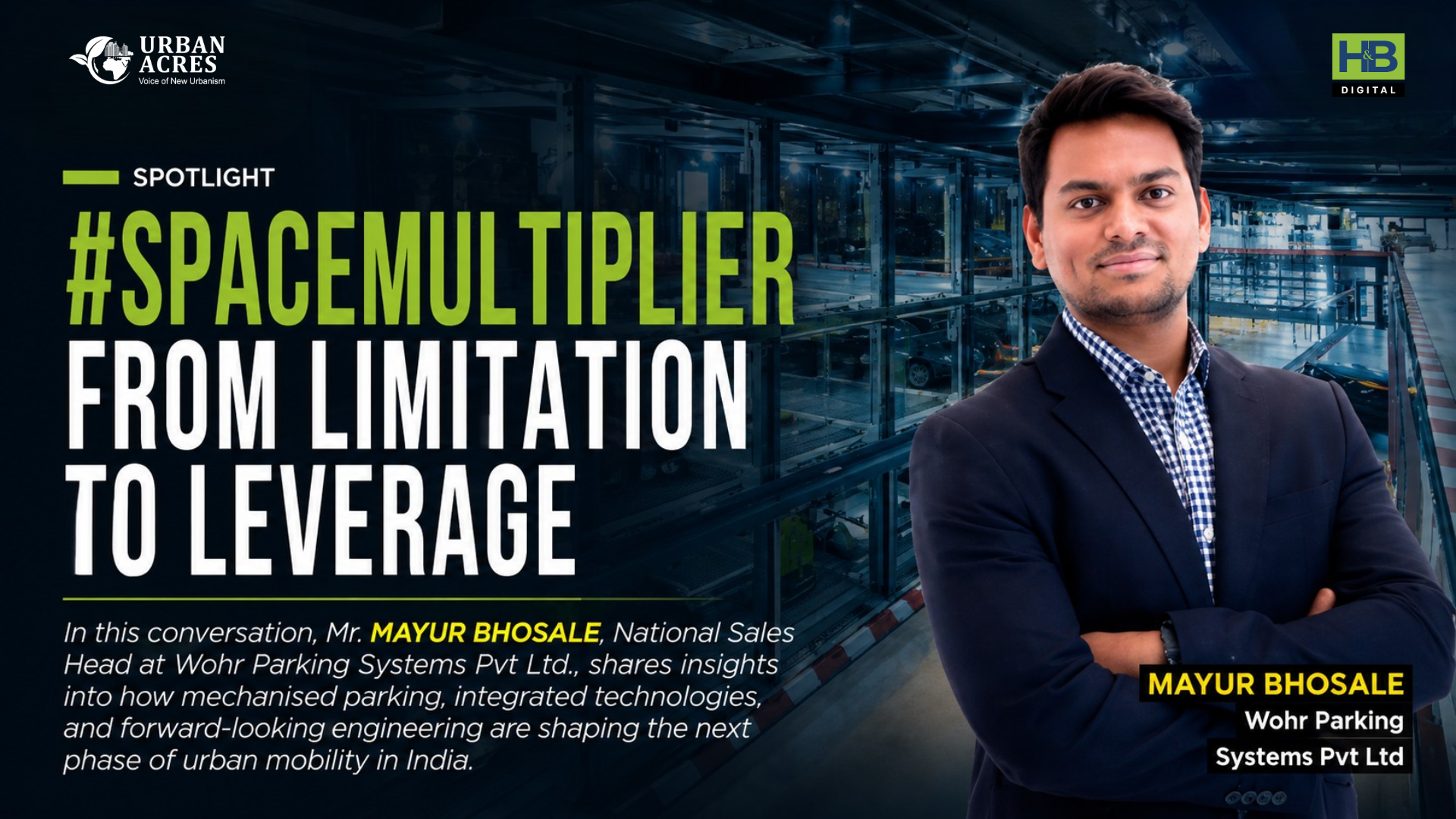
In this conversation, Mr. Mayur Bhosale, National Sales Head at Wohr Parking Systems Pvt Ltd., shares insights into how mechanised parking, integrated technologies, and forward-looking engineering are shaping the next phase of urban mobility in India
Q Could you briefly share your company’s journey in the Indian market and how your offerings have evolved to meet the rising demand for secure, efficient parking systems?
WOHR, backed by 120 years of proven German engineering, stands as a pioneer and undisputed leader in the car parking system industry. Since entering the Indian market, we have consistently delivered the most practical and cost-efficient parking solutions, proudly installing over 1,80,000 parking spaces across the country. We provide a complete mechanized car parking solution at the planning stage of a project. This helps architects and builders to accommodate the desired car parking numbers in a project.
Two decades ago, when we introduced multilevel parking to India, the concept was met with hesitation. Traditional parking was the norm, and change was resisted. But we stayed the course, confident in the future. Today, as users experience the unmatched convenience and driving comfort of mechanised, power-operated systems, the shift is undeniable.
The industry is now transforming from basic key-operated systems to intelligent, remote-operated solutions. At WOHR, technology has always been our backbone. Our products adhere to European (EN) standards and follow stringent safety norms. We continuously evolve with time, offering world-class systems designed for maximum efficiency, safety and seamless operation.
Q What are the key challenges you’ve faced in deploying intelligent access solutions in India, and how have you adapted your technologies or services to address them?
The current Indian scenario is changing the building structure. Building Management Systems (BMS) are integrated from the entrance gate to access inside the office. Within this path, the person driving the car goes to the parking area, parks the vehicle, accesses through elevators and reaches their desired office floor. The user expects one swipe at every hurdle and the parking system is one of the key links which is also expected to have BMS continuity.
Q What smart technologies such as RFID, ANPR, IoT, or cloud-based systems have you integrated into your parking solutions, and how are they enhancing user experience and operational efficiency?
Yes, we have integrated touchless technology in our systems. Post-Covid, we introduced RFID and remote operation, which omitted the use of conventional push button operating panels. WPS has also upgraded systems with new PLC software, allowing app-based integration for an enhanced customer experience.
Q How do your solutions improve convenience for residential gated communities, commercial complexes, malls, and high-traffic zones such as industrial parks and logistics hubs?
Every day, new challenges emerge due to increasing traffic. To overcome these challenges, we study traffic analysis, the requirement of accommodating maximum cars, and the footfall of vehicles with constraints of peak hours. This becomes necessary for the end user to park the vehicle effortlessly and safely within the parking area.
Q Are your parking systems designed with energy efficiency, especially in the context of sustainability goals?
Yes, our systems are designed on the concept of “Green Parking,” which are also compatible with EV charging facilities.
Q In what ways do your systems help reduce traffic congestion, waiting time at entry/exit points, and vehicle idling—thereby supporting lower carbon emissions?
WOHR systems integrated with BMS provide a dedicated parking spot within the parking area. This reduces the need for vehicles to circle while searching for parking, which eventually lowers carbon emissions. For large projects, parking arrangements are planned during the project stage itself. This helps in organising the entire parking management in advance, where entry and exit points are predefined to avoid unnecessary vehicle movement.
Q How do the needs and expectations of residential projects differ from commercial or public infrastructure projects when it comes to smart access and parking automation?
In the residential segment, end users prioritise simplicity and low operating costs (OPEX). Since maintenance and running costs are borne directly by individual residents, there is a strong preference for parking solutions that are easy to operate, reliable, and cost-efficient over the long term.
In contrast, for commercial developments, the focus shifts toward efficiency and performance. While the end user does not directly bear the cost, building management aims to maximise parking capacity, ensure smooth traffic flow, and minimise waiting time for users.
Across both segments, the expectation is converging toward smart, dependable systems—solutions that deliver high uptime, minimal maintenance requirements, and a seamless user experience. Ultimately, whether residential or commercial, the emphasis is on optimising space while ensuring operational efficiency and user convenience.
Q What are the most requested features or functionalities today from developers, resident welfare associations (RWAs), and commercial property owners?
The passenger vehicle landscape in India has evolved significantly in recent years, with a clear shift from sedans to mid-size and high-end SUVs. This change has a direct impact on parking design, as larger vehicle dimensions demand wider platforms, higher load capacities, and greater manoeuvring space.
At the same time, the rapid adoption of electric vehicles is reshaping parking infrastructure. EVs are typically heavier due to battery systems and require integrated charging provisions, making it essential for parking solutions to be structurally robust and future-ready.
From a regulatory standpoint, frameworks like the Real Estate (Regulation and Development) Act, 2016 have brought greater transparency and accountability. Developers are now required to clearly define and disclose the parking space dimensions allocated to end users, ensuring usability and protecting consumer interests.
Together, these shifts are pushing the industry toward more adaptive, compliant, and future-oriented parking designs—capable of accommodating evolving vehicle types while aligning with regulatory and sustainability requirements.
Q Can you share a few notable case studies where your access or parking solutions have been deployed successfully—particularly in smart cities, airports, or high-density urban developments?
We have successfully delivered several large-scale parking and access solutions across high-density urban developments, airports, and premium commercial projects in India. At Aero Mall, Pune, which is directly connected to Pune International Airport via a foot overbridge, we implemented a puzzle parking system that enabled the creation of over 150 additional parking spaces alongside conventional parking. A similar deployment has also been executed at Chennai International Airport. In World Trade Center, Nauroji Nagar, Delhi, we delivered a large-scale installation of over 2,000 parking spaces for a high-profile government-backed commercial development.
At Godrej Centre, Pune, our systems manage approximately 7,000 parking spaces through a combination of puzzle and stack parking, including integrated two-wheeler parking.
One of the most notable deployments is at One BKC in Mumbai, featuring one of India’s largest and most sophisticated automated multi-level robotic parking systems. While the initial requirement was for 250 car spaces, our solution engineering enabled the delivery of 1,148 spaces within the same footprint—demonstrating the concept of space multiplication.
Q Looking ahead, what trends or innovations will define the future of parking and access management in India?
The future of parking and access management in India will be driven by a convergence of automation, data intelligence, and seamless user experience.
AI-led systems such as ANPR will become standard, enabling touchless entry and exit, enhanced security, and real-time monitoring. These systems will increasingly integrate predictive analytics to support smarter traffic flow and proactive decision-making.
Cloud-connected infrastructure will play a critical role, where parking systems will no longer operate in isolation. Remote diagnostics, preventive maintenance, and real-time system monitoring will significantly reduce downtime and improve efficiency.
Another major shift will be toward fully contactless ecosystems, including digital payments, mobile-based access, and app-driven user journeys.
Finally, integration with Mobility-as-a-Service platforms will redefine how parking fits into the broader urban mobility ecosystem. Parking will become a connected node linked with public transport, ride-sharing, and EV infrastructure.
While the pace of innovation is rapid, the direction is clear—smarter, connected, and user-centric parking solutions will define the future.