Greater Noida Ashtech Group Commences Luxury Housing Project Investing Rs 1800 Crores Now

Mumbai Developer Launches Notan Jewel Targeting Over Four Hundred Crore Revenue

Mumbai’s commercial property segment is set for another boost as a well-known developer has unveiled a new office-and-retail project in Bandra, aiming to generate more than ₹400 crore in revenue. The development, located on Turner Road, signals renewed confidence in the city’s premium business districts as demand rises for modern, energy-efficient workplaces aligned with evolving urban needs.
The project, positioned as a boutique commercial asset, spans roughly 90,000 sq ft of construction area, with around half of this marked as leasable space. Industry experts say the scale reflects a broader pattern in Mumbai, where compact, high-efficiency commercial buildings are increasingly preferred over large monolithic office towers. This shift is attributed to changing work models, sustainability requirements, and the need for flexible layouts that support future-proof urban growth.A senior representative from the company said the Bandra launch is part of a longer-term strategy to strengthen its presence in high-value micro-markets. The official added that the project builds on the developer’s legacy of creating premium real estate products while responding to Mumbai’s evolving urban and environmental priorities. Bandra, which remains one of the city’s strongest commercial corridors due to its connectivity and mixed-use character, continues to attract investments from developers seeking to cater to businesses looking for centrally located, modern facilities.
The upcoming building incorporates several features designed to enhance occupant experience and support sustainable operations. These include a grand arrival lobby, a mechanised car-tower system for optimised parking, high-speed elevators, smart building management systems and round-the-clock security. Recreational elements such as a rooftop pickleball court, breakout areas and flexible meeting spaces indicate the growing emphasis on well-being and community-oriented work culture in Indian office design.Urban planners note that Bandra’s steadily increasing commercial density underscores the need for real estate that integrates efficiency with inclusive design. While the new project is not explicitly marketed as green-rated, its reliance on compact layouts, automated systems and reduced land footprint reflects broader market shifts toward resource-conscious development. They add that such projects can play a role in enhancing urban productivity when supported by improved mobility, public spaces and last-mile infrastructure.
The developer has outlined plans to introduce four commercial projects in the 2025–26 financial year, with two already under way. Together, these additions reinforce the company’s intent to contribute to Mumbai’s mixed-use growth model, which combines residential, commercial and leisure spaces to create more liveable and economically resilient neighbourhoods.As Mumbai continues to evolve into a denser, more diversified urban economy, the success of such mid-sized commercial buildings will depend on how effectively they balance business aspirations with sustainable and socially responsive design. For Bandra’s business district, the new project adds another node in its ever-expanding commercial landscape while signalling investor confidence in the city’s long-term growth trajectory.
Mumbai Developer Launches Notan Jewel Targeting Over Four Hundred Crore Revenue
Mumbai Danube Event May See Shah Rukh Khan Launch Iconic SRK Tower

Mumbai is preparing for a closely watched real estate showcase this week as Dubai-based Danube Properties stages a high-profile event in the city on 14 November. Industry chatter suggests the gathering may feature a major celebrity partnership, with speculation pointing towards Bollywood actor Shah Rukh Khan. If confirmed, the collaboration could add fresh momentum to the growing trend of star-associated developments in global property markets.
Danube Properties, led by its founder and chairman, has built a strong foothold in Dubai’s competitive residential sector. Over the past year, the developer has intensified its outreach to Indian buyers, who remain one of the largest investor groups for Dubai real estate. The Mumbai event follows a similar gathering earlier this year, which reportedly drew significant traction from non-resident Indians and domestic high-net-worth investors.In recent days, the company has released a series of teaser videos hinting at a major announcement. The promotional material refers to a “moment that will define the year” and alludes to a partnership that could reshape a section of Dubai’s urban skyline. Industry observers note that such language typically precedes the unveiling of a flagship project, possibly featuring sustainability-centred design or mixed-use components that appeal to modern global investors.
Adding to the intrigue are statements from senior company representatives who spoke of a collaboration bold enough to mark a new chapter in real estate branding. Hints about “a tower built behind a celebrity’s name” have intensified online speculation, with blurred promotional visuals prompting fans to suggest that Shah Rukh Khan may serve as the face of the new initiative. While the developer has not confirmed any details, the ambiguity has fuelled exceptional engagement on social media.The prospect of a celebrity-linked development also highlights the changing dynamics of property marketing in cities such as Dubai, where lifestyle differentiation, architecture, and brand association are increasingly used to attract global buyers. Analysts say that if such a project materialises, it will need to balance glamour with long-term sustainability targets, including energy-efficient design, low-carbon materials, and inclusive public spaces factors that are now central to both investor expectations and urban development regulations.
As the Mumbai event approaches, stakeholders across the property sector are watching closely. A potential unveiling of a high-profile tower could strengthen Danube’s visibility in international markets while reinforcing the broader shift towards branded residences and celebrity-endorsed developments. For Indian buyers, the event may offer insights into new investment avenues shaped by cultural resonance as well as architectural ambition.
Regardless of the final reveal, the gathering underscores the increasingly interconnected nature of global urban development. Mumbai’s role as the launch venue reflects the city’s significance as a bridge between Indian investors and international real estate markets, particularly those prioritising forward-looking, resilient, and sustainable growth.
Mumbai Danube Event May See Shah Rukh Khan Launch Iconic SRK Tower
Mumbai Gurugram See One Lakh Sq Ft New Flexible Workspace Expansion By 91Springboard

India’s flexible office market continues to scale rapidly as workspace provider 91Springboard has secured around one lakh sq ft of new office space across Mumbai and Gurugram. The company confirmed that both facilities will be operational by the next quarter and are intended to support the growing footprint of Global Capability Centres (GCCs), large corporates, MSMEs, and late-stage start-ups seeking adaptable and well-connected work environments. The expansion comes at a time when demand for managed and sustainable workspace solutions is rising across major Indian cities.
Of the newly leased footprint, approximately 40,000 sq ft is located at Hiranandani Business Park in Andheri East, one of Mumbai’s established commercial clusters with strong public transport connectivity. The remaining 60,000 sq ft is housed within DLF World Trade Park in Gurugram, situated along the NH-48 corridor and surrounded by a growing ecosystem of technology, consulting and enterprise firms. Both Grade A properties have been curated to offer energy-efficient building systems, collaborative zones, and improved access to public transit aspects that industry experts say are increasingly defining tenant preferences in Indian metro business districts.With these additions, 91Springboard has already expanded its national portfolio by over half a million sq ft in the 2025 calendar year and plans to add another million sq ft by the end of the fiscal. The company has also launched ten new hubs this year, extending its reach across Mumbai, Delhi, Pune, Gurugram and Chennai. According to senior officials, the emphasis is on locations where businesses can reduce commute time, optimise operational costs and strengthen workplace well-being priorities closely aligned with India’s broader agenda of building more inclusive and low-carbon urban business ecosystems.
The Mumbai and Gurugram centres join a network of 43 hubs that now span Bengaluru, Goa, Hyderabad, Noida and other major cities. Industry analysts say this distributed portfolio has enabled flexible workspace providers to attract a wider range of occupiers, particularly firms transitioning from traditional leases to hybrid models. Such spaces often promote more sustainable real estate consumption by reducing underutilised floor area and supporting shared infrastructure, which can lower carbon intensity per employee.India’s coworking market has also emerged as the most mature globally, according to recent industry assessments, outperforming established markets such as the UK, France, Japan and the United States. Analysts attribute this growth to India’s expanding GCC ecosystem, cost competitiveness, and a shift towards managed workplaces that offer operational resilience and a sense of community features that are increasingly valued by both corporations and employees navigating hybrid work expectations.
For cities such as Mumbai and Gurugram, the continued expansion of flexible offices supports wider urban goals: enabling women, young professionals, and small enterprises to access workspace closer to home, reducing commute burdens, and promoting more equitable participation in urban economies. As India’s office market evolves, the next phase of growth will likely hinge on how workspace providers integrate energy-efficient systems, transit-oriented development and inclusive design to meet the expectations of a diversifying workforce.
Mumbai Gurugram See One Lakh Sq Ft New Flexible Workspace Expansion By 91Springboard
Suraj Estate to Invest Big: ₹850 Crore for Mahim Commercial Space

Mumbai’s commercial property landscape is set for a significant expansion as a leading real estate developer prepares to invest nearly ₹850 crore in a new office-led development in Mahim. The project marks the company’s first large-scale foray into the commercial segment and signals renewed confidence in South Central Mumbai as an emerging business cluster with strong multi-modal connectivity.
Planned across three-fourths of an acre, the development is expected to deliver around 2.09 lakh sq ft of carpet area. With a Gross Development Value estimated at ₹1,200 crore, the project will occupy two adjoining plots acquired between 2021 and 2024. Industry watchers note that this level of investment underlines growing demand from enterprises seeking well-connected, climate-conscious workplaces closer to established transport corridors.The proposed complex will include a 14-storey tower with 182 office units, supported by retail and food outlets designed to encourage walkability and reduce last-mile travel needs. A senior executive at the firm said the project aims to integrate sustainable design and operational efficiency, a feature increasingly prioritised by institutional occupiers seeking energy-efficient buildings in dense urban districts.
Mahim’s strategic location along Senapati Bapat Marg has played a central role in shaping the developer’s expansion plans. The corridor provides access to both western and central suburban railway networks, the Aqua Line metro, Tulsi Pipe Road and major employment centres such as Dadar, Prabhadevi, Lower Parel and the Bandra–Kurla Complex. Urban transport planners highlight that the upcoming BKC–Senapati Bapat Marg connector will further reduce travel times to the Western Express Highway and both Mumbai airports, reinforcing Mahim’s viability as a decentralised commercial hub.
This investment adds to more than ₹1,600 crore worth of projects launched by the developer in the current financial year, reflecting a broader shift in the company’s portfolio strategy. Experts note that developers are increasingly diversifying into commercial real estate to tap into rising demand from mid-sized firms seeking upgraded workspaces without the premium pricing of traditional CBD areas.South Central Mumbai has steadily emerged as a preferred zone for such developments, particularly as new transport infrastructure enhances last-mile connectivity and redistributes business activity across the city.
Analysts also point out that modern commercial buildings in this belt offer a unique opportunity to embed sustainability-led technologies, which can reduce operational emissions and support a more equitable urban growth model.As Mumbai continues to build high-capacity mobility networks, real estate activity around transport corridors is likely to intensify. For Mahim and its adjoining localities, the latest commercial addition signals renewed investor interest and the potential for more integrated, transit-oriented urban development in the years ahead.
Suraj Estate to Invest Big: ₹850 Crore for Mahim Commercial Space
Mumbai Infrastructure Boom Drives Property Prices Up To Twenty Three Percent Across Corridors

Mumbai’s pace of infrastructure development is redefining the city’s property market, with several major corridors recording price rises of up to 23 per cent between the first halves of 2024 and 2025. The surge reflects a combination of faster travel times, new mobility choices and renewed interest in well-connected neighbourhoods, strengthening the city’s long-term appeal for both homebuyers and investors.
Multiple large-scale projects including the Coastal Road, the Mumbai Trans Harbour Link (MTHL), metro line expansions and the upcoming international airport in Navi Mumbai are beginning to shift real estate dynamics across the wider metropolitan region. Urban analysts note that this growth cycle is markedly different from previous ones because new infrastructure is not only expanding connectivity but also influencing where people choose to live and the kind of developments entering the market.
The Coastal Road, connecting South Mumbai to Worli, has had a visible impact on the western seafront. The improved mobility along the corridor has strengthened demand for premium residential and commercial spaces, with average rates in parts of Worli and its adjoining precincts rising around 14 per cent in a year. A city planner explained that improved access to the waterfront is encouraging developers to prioritise sustainable redevelopment in older luxury clusters.The MTHL, India’s longest sea bridge, is proving transformative for Navi Mumbai. By reducing travel time between Sewri and Nhava Sheva to under thirty minutes, the link has repositioned Ulwe, Panvel and the wider logistics belt as strategic investment destinations. Property values in these micro-markets have increased about 20 per cent, as improved access to the new airport and warehousing hubs broadens economic prospects for the region.
Metro line expansions are also reshaping residential decisions, particularly in western and central suburbs. The addition of more than 100 km of new routes has reduced reliance on private vehicles and enabled more sustainable commuting patterns. Neighbourhoods such as Andheri, Dahisar, Mira Road and the Bandra–Kurla Complex corridor have seen price appreciation of roughly 13 per cent. Industry experts highlight that stations are becoming nuclei for mixed-use development, enhancing walkability and supporting low-carbon mobility.The under-construction Navi Mumbai International Airport continues to influence values in NAINA and nearby nodes, with prices rising by 23 per cent in Ulwe and Kharghar. Meanwhile, the Goregaon–Mulund Link Road tunnel is emerging as an important connector between the eastern and western suburbs, stimulating mid-income housing demand across Goregaon and Mulund.
Sector specialists say that while the appreciation reflects strong investor sentiment, the challenge ahead lies in ensuring that growth supports inclusive and climate-resilient development. As Mumbai prepares for further infrastructure expansion, the emphasis on equity, sustainability and long-term planning will determine how effectively the benefits of connectivity reach diverse communities.
Mumbai Infrastructure Boom Drives Property Prices Up To Twenty Three Percent Across Corridors
Massive Backlog Vasai Delivers Only 189 Out Of 1,106 Sanctioned PMAY Rural Homes

Vasai’s rural housing programme under the Pradhan Mantri Awas Yojana (PMAY) is lagging significantly behind annual targets, with only a fraction of the sanctioned homes completed despite funding approvals and a firm deadline set for March 2026. The slow progress has renewed concerns about the viability of rural housing delivery in rapidly urbanising districts and the financial strain placed on low-income households attempting to build climate-resilient homes.
This year, 1,106 homes were approved for construction across Gram Panchayats in Vasai taluka. However, official data indicates that just 189 houses have been completed so far, leaving more than 900 units still under construction. An official involved in the monitoring process said that while beneficiary approvals have been completed for 1,107 applicants, the pace of on-ground work has remained uneven due to rising input costs and irregular fund flows.
Under PMAY–Gramin, each eligible household receives a subsidy of ₹1.20 lakh to ₹1.5 lakh, released in instalments linked to construction milestones. While the assistance is intended to support basic housing needs, beneficiaries report that the contribution now covers only a small share of total construction expenses. Labour charges and the cost of essential materials such as cement, sand and bricks have increased sharply over the past year, widening the gap between subsidy limits and real market rates.According to field officers, several households have been unable to progress beyond foundation or plinth stages because savings have been exhausted. For many families dependent on seasonal work or informal incomes, absorbing additional costs has become unfeasible. Industry experts note that affordable rural housing schemes must adapt to inflationary pressures and climate-resilient building requirements if they are to remain effective instruments for reducing housing inequality.
Vasai’s villages including Arnala, Bhatane, Chandrapada, Kalamb, Sakwar and more than twenty others have witnessed increased scrutiny as construction deadlines approach. Local authorities are continuing to collect pending documentation, verify eligibility, and release instalments in phases. However, beneficiaries claim that delays in receiving funds often halt progress for weeks, especially where households rely solely on scheme disbursements to resume construction.Urban policy analysts argue that India’s rural housing mission can succeed only when financial support is paired with technical assistance, predictable instalment schedules, and community-level planning to encourage sustainable and disaster-resistant design.
As coastal districts like Palghar face intensifying climatic risks, building durable and inclusive housing becomes essential not only for welfare but also for long-term resilience.With barely over a year left to meet the completion target, Vasai’s PMAY rollout will test the administrative capacity of local bodies and the affordability framework underpinning the scheme. Residents hope that revised subsidies or interim support measures will prevent the backlog from widening and enable more families to secure stable, dignified housing.
Massive Backlog Vasai Delivers Only 189 Out Of 1,106 Sanctioned PMAY Rural Homes
Panvel Urges Property Owners To Use 75 Percent Penalty Waiver Under Abhay Yojana

The Panvel Municipal Corporation (PMC) has intensified its appeal to residents to make use of its ongoing tax relief scheme, which offers a 75 per cent waiver on penalty charges for overdue property taxes. With the initiative set to close on 15 November, civic officials have urged property owners to clear pending dues within the limited window, calling it a crucial opportunity to support both household finances and urban service delivery.
Municipal authorities reported strong public response to the scheme since its rollout, with revenue collections reaching more than ₹594 crore so far. According to officials, the combination of penalty waivers and streamlined payment processes has encouraged many households to regularise long-pending dues. They added that reliable property tax collection is essential for maintaining urban services, especially in fast-growing municipal areas like Panvel, where demand for infrastructure continues to expand. A senior civic official said the waiver aims to “reduce financial stress on residents while improving the city’s fiscal health,” noting that the administration has issued repeated reminders in the lead-up to the deadline. Officials emphasised that property taxes remain a major source of funding for civic amenities, including water supply, waste management, and climate-resilient infrastructure.
To improve ease of payments, the corporation has been actively promoting digital platforms, including the PMC website and two dedicated mobile applications. Property owners paying online are eligible for a 2 per cent immediate discount, a move aimed at reducing administrative costs and encouraging wider adoption of cashless transactions. Civic administrators say digital payments also improve transparency and reduce delays, helping build trust between residents and municipal authorities. In a bid to link taxation with sustainability objectives, the PMC has also announced rebates for eco-friendly upgrades to buildings. Properties equipped with solar panels, rainwater harvesting systems, or protective shade structures qualify for a 2 per cent concession, while housing societies practicing scientific waste management receive an additional 2 per cent rebate. Urban experts view such incentives as small but meaningful steps towards encouraging climate-responsive behaviour at the household and community level.
Further expanding its digital governance tools, the corporation recently launched ‘Tax Mitra’, an automated chatbot designed to help residents access tax information with greater convenience. The platform provides real-time details on outstanding payments, billing history, and applicable rebates, and also guides users through online payment options. A senior official described the chatbot as part of a broader effort to “deliver citizen services that are faster, more accessible, and more transparent.” With the deadline approaching, officials have reiterated the importance of participating in the waiver programme, saying it would not only ease financial burdens on property owners but also strengthen municipal capacity to deliver equitable, climate-resilient urban services in the years ahead.
Panvel Urges Property Owners To Use 75 Percent Penalty Waiver Under Abhay Yojana
MMRDA Plans 2.2km Six Lane Bridge To Connect Thane And Bhiwandi Faster

Mumbai’s regional mobility network is set for a significant upgrade with the Mumbai Metropolitan Region Development Authority confirming plans for a six-lane bridge linking Thane’s Kolshet area with Kalher in Bhiwandi. The 2.2-kilometre structure, designed as a direct creek crossing, is expected to slash road travel time between the two hubs from nearly 45 minutes to under ten, offering faster access to one of the region’s most important industrial belts.
The ₹430-crore project forms part of a broader strategy to improve connections across the eastern belt of the Mumbai Metropolitan Region, which has long faced congestion due to limited cross-creek mobility options. Officials noted that tenders have now been issued and construction is targeted for completion within three years, subject to environmental and statutory clearances. The bridge is expected to ease pressure on ageing routes such as Balkum Naka and the Kasheli bridge, both of which force commuters and freight carriers to take long, circuitous detours. Bhiwandi, known for its textile, logistics, and warehousing ecosystem, has witnessed significant growth in freight and commuter movement over the past decade. The planned bullet train station in the town is likely to intensify this trend. Urban planners observed that creating faster east-west links is essential for supporting industries that depend on time-sensitive movement while reducing emissions arising from idling traffic and distance-intensive detours. A senior official added that the new connection has been prioritised to strengthen the region’s economic backbone while improving safety and reducing fuel consumption.
The authority has also proposed the Bhiwandi Notified Surrounding Area to streamline future development, including a textile-cum-industrial park and a multimodal corridor. Experts highlighted that without additional creek crossings, the industrial cluster risks stagnation due to worsening congestion. “Bhiwandi will require more resilient infrastructure as its economic footprint expands,” an infrastructure expert said, noting that well-designed mobility links could help the region transition towards cleaner and more efficient transport systems. Beyond economic benefits, the planned bridge is positioned as a step toward fostering more inclusive and sustainable urban growth. Faster connectivity between Thane and Bhiwandi is expected to improve access to jobs, shorten daily commutes, and reduce vehicle emissions — factors that align with the long-term vision of creating equitable and low-carbon cities. Officials emphasised that the project’s design would incorporate safety features and provisions for future public transport routes, reflecting a shift toward integrated mobility planning.
While construction activity will take time to gather pace, the project signals a strategic push to build climate-resilient, high-capacity infrastructure in heavily industrialised zones. If executed within its planned timeline, the bridge is expected to ease chronic bottlenecks and support the region’s transition to cleaner, more efficient, and more inclusive urban mobility.
MMRDA Plans 2.2km Six Lane Bridge To Connect Thane And Bhiwandi Faster
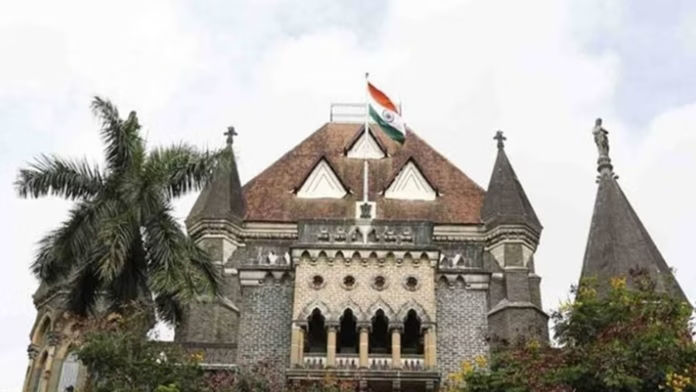
Mumbai High Court Restrains Imperial Towers Developer From Unapproved Construction Beyond 2009 Plan