
Metro Cities Witness Double Digit Property Price Surge In Q3 2025 PropTiger

Mumbai 3.0 Takes Shape, Panvels Record Growth Signals Major Market Shift
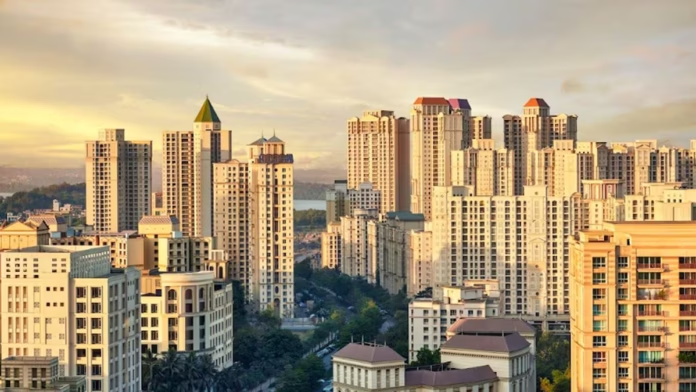
The balance of power in Mumbai’s real estate market is tilting rapidly. Once the undisputed satellite hub of the Mumbai Metropolitan Region (MMR), Thane is now losing ground to emerging corridors such as Panvel, Kalyan–Dombivli, and Ambernath. Analysts say this transformation marks a structural shift driven by affordability, infrastructure investment, and improved regional connectivity.
According to property consultancy data, Navi Mumbai including Panvel accounted for nearly 39 per cent of all new residential project launches in the July September 2025 quarter, the highest across MMR. This surge reflects the city’s growing attractiveness as a self-sustaining urban hub supported by upcoming infrastructure like the Mumbai Trans Harbour Link (MTHL), Navi Mumbai Metro, and the international airport. These projects are reshaping mobility, shortening commute times, and fuelling sustainable urban expansion.
In contrast, Thane, which long dominated as the region’s residential powerhouse, is showing signs of saturation. While its mid-segment housing prices rose around 20 per cent year-on-year, growth in new launches has slowed. Developers and homebuyers are increasingly turning their attention to less congested belts offering larger land parcels for integrated townships and affordable housing.
“Panvel and Beyond” has emerged as the most promising development frontier, where mid-segment property prices have jumped by 27 per cent over the past year the sharpest rise in MMR. Areas like Khopoli and Rasayani are also witnessing steady investor traction due to their relative affordability and improved connectivity to key employment zones.Developers are responding swiftly to this demand shift. Several major builders, including prominent Mumbai-based firms, are investing heavily in Panvel and its surrounding corridors.
Industry observers note that developer confidence has risen sharply, with a 7.1 per cent quarter-on-quarter increase in new project supply between Q2 and Q3 2025. Much of this momentum is linked to infrastructure-led urbanisation and policies promoting balanced regional growth.Experts emphasise that this trend presents an opportunity to build more sustainable and inclusive townships, avoiding the pitfalls of high-density, resource-stressed urban cores. Panvel’s planned development model and proximity to key infrastructure make it an ideal candidate for future-ready, low-carbon housing ecosystems.
As the MMR’s growth map is redrawn, Thane’s challenge will be to reinvent itself through redevelopment, green housing, and mobility improvements. For now, Panvel stands out as the new engine of real estate growth symbolising Mumbai’s gradual shift toward a more distributed, connected, and sustainable urban future.
Mumbai 3.0 Takes Shape, Panvels Record Growth Signals Major Market Shift
Pune Witnesses Inteva Products ₹50 Crore Expansion Boosting 400 Jobs And Mobility Innovation

Global automotive systems supplier Inteva Products LLC has announced a significant expansion of its India operations with the launch of a new manufacturing facility in Pune, signalling renewed confidence in the country’s rapidly evolving mobility sector. The move reinforces India’s position as a preferred hub for advanced automotive innovation and sustainable manufacturing.
The US-headquartered company, which has been active in India for over 17 years, plans to invest ₹50 crore in its second Pune plant. The new unit is expected to create more than 400 new jobs and deepen local integration across supply chains. Industry experts say this investment aligns with the government’s Make in India vision while boosting regional employment and skill development in Maharashtra’s growing auto corridor.
The new facility will focus on next-generation products tailored for Indian original equipment manufacturers (OEMs). These include frameless window regulators, small light Inteva motors, power folding and glass actuators, as well as advanced closure systems like electronic latches, frunk latches and power tailgates. Such technologies aim to make vehicles lighter, safer, and better suited for the country’s shift towards electric and smart mobility.
Executives at Inteva highlighted that the new Pune plant complements the company’s technical centre in Bengaluru, which currently employs over 320 professionals, including 180 engineers, who focus on design, validation and simulation for global projects. The centre serves as a critical engineering hub within Inteva’s international network, reflecting India’s growing importance in global automotive R&D.
Industry observers note that the expansion comes at a time when global suppliers are accelerating localisation to enhance resilience and sustainability in supply chains. “Inteva’s investment showcases the long-term confidence multinational firms have in India’s capability to deliver innovation, cost efficiency and sustainability at scale,” said a senior industry analyst.
Founded in 2008 and headquartered in Troy, Michigan, Inteva Products provides a range of environmentally responsible systems that enhance vehicle safety and performance. The company’s leadership reiterated its commitment to sustainable manufacturing and customer-centric innovation.According to Gerard Roose, President and CEO of Inteva Products, “This expansion reflects our confidence in India’s growth potential and our shared pursuit of sustainable, future-ready mobility.”
Sanjay Kataria, VP and Managing Director for India and Rest of Asia, added that the new facility would strengthen collaboration with OEMs while supporting local communities through job creation and skill enhancement.
With Pune continuing to attract major automotive and EV investments, Inteva’s expansion underscores a broader trend India’s transformation from a manufacturing base to a global innovation hub for next-generation mobility solutions.
Pune Witnesses Inteva Products ₹50 Crore Expansion Boosting 400 Jobs And Mobility Innovation
Mumbai Real Estate Attracts Over USD 1.2 Billion Investment In 2025 Boom
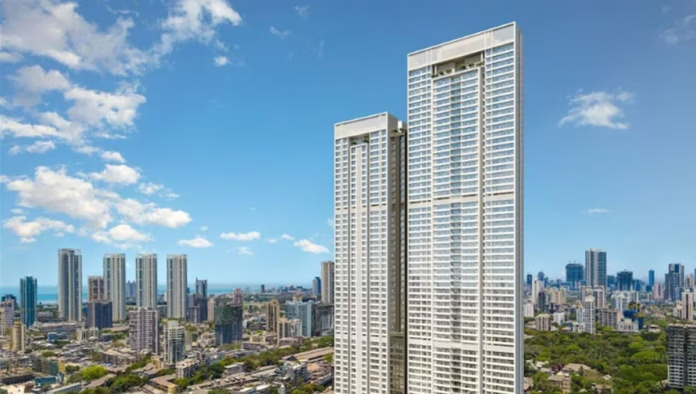
Mumbai’s property market has reaffirmed its position as India’s most preferred real estate investment hub, drawing over USD 1.2 billion in institutional inflows during the first nine months of 2025, according to a recent India Capital Markets report by Cushman & Wakefield.
The achievement marks the fourth consecutive year in which the city has crossed the billion-dollar threshold, underscoring both investor confidence and the region’s evolving infrastructure ecosystem.At a national scale, India attracted approximately USD 4.7 billion in institutional investment between January and September 2025. Analysts anticipate that the year could close with USD 6–6.5 billion in total inflows positioning 2025 as one of the most robust periods for the country’s property sector in recent times.
A senior market expert observed that Mumbai’s appeal lies in its “blend of large-scale redevelopment, expanding connectivity, and strong leasing performance.” The growth in domestic institutional participation has been especially significant, with Indian investors accounting for 48% of the total inflows, while international funds largely from the United States and Japan contributed the remaining 52%. This balance has helped stabilise market sentiment amid global macroeconomic uncertainties.
Office assets commanded the highest investor attention at 35% of total inflows, driven by resilient leasing demand in business districts. Residential projects followed at 26%, reflecting renewed end-user demand and redevelopment opportunities. Retail and logistics assets accounted for 12% and 9% respectively, while data centres continued to emerge as a new frontier for institutional capital.
Mumbai’s real estate success story is also anchored in its infrastructure upgrades. Projects such as the Mumbai Trans Harbour Link, Coastal Road, ongoing metro expansions, and the upcoming Navi Mumbai International Airport have enhanced investor confidence in long-term growth. These public investments are unlocking new corridors for residential and commercial expansion, particularly in the MMR region.
Industry observers note that sustainability considerations are also shaping investor strategy. Developers are increasingly integrating green certifications, energy-efficient materials, and transit-oriented planning to attract global funds that prioritise environmental performance. This alignment between growth and sustainability is seen as key to Mumbai’s next investment cycle.As India’s financial capital continues to strengthen its real estate fundamentals, Mumbai remains not only a symbol of investor resilience but also a testing ground for sustainable and inclusive urban development models.
Mumbai Real Estate Attracts Over USD 1.2 Billion Investment In 2025 Boom
Mumbai To Transform 319 City Ponds Into Eco Tourist And Public Spaces
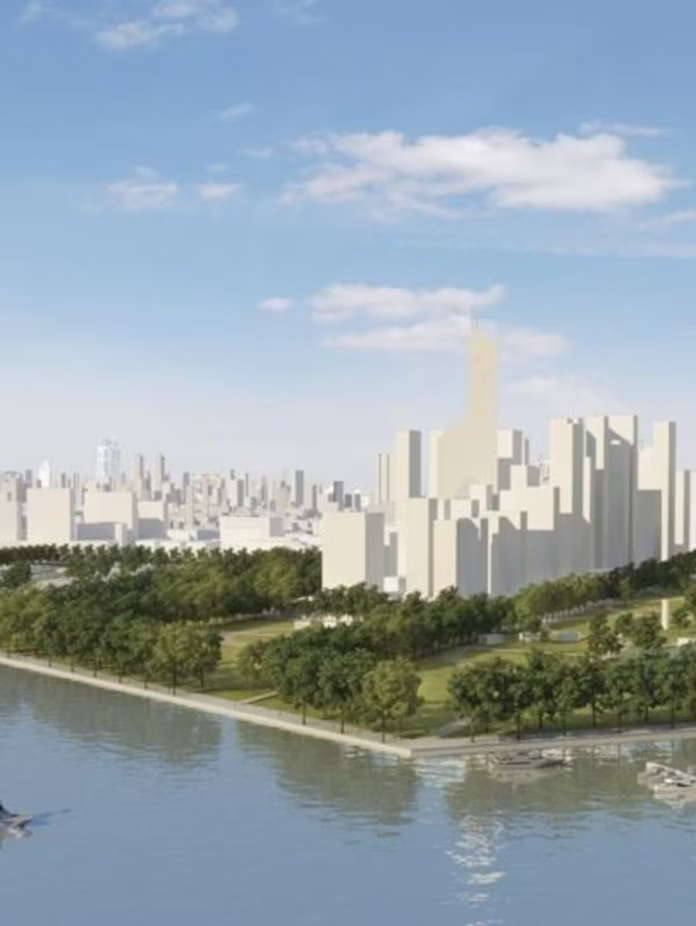
In a major step toward enhancing Mumbai’s urban ecology, the Brihanmumbai Municipal Corporation (BMC) has launched a citywide initiative to restore 319 ponds and convert them into accessible public and tourist-friendly spaces. The project aims to revive the city’s neglected water bodies while improving biodiversity, promoting heritage conservation, and expanding open recreational areas for residents.
The initiative will be implemented in phases, beginning with 30 ponds selected across different wards based on their ecological condition, location, and public access. According to civic officials, this first phase will serve as a pilot to develop restoration models before scaling up citywide. The effort forms part of a broader strategy to integrate blue-green infrastructure into Mumbai’s urban design a critical move for climate resilience and water management in a city facing rising heat and rainfall extremes.
Funding for the project will primarily come through Corporate Social Responsibility (CSR) collaborations with private companies. By adopting this partnership model, the BMC seeks to ease financial pressure on municipal budgets while engaging the private sector in sustainable urban development. “The idea is to blend ecological restoration with public benefit and cultural value,” said a senior civic planner involved in the initiative.
Of the 319 ponds identified, 309 are under BMC’s jurisdiction, while the remaining ten fall under state agencies such as the Maharashtra Housing and Area Development Authority (MHADA) and the Mumbai Metropolitan Region Development Authority (MMRDA). The civic body has begun compiling detailed surveys, documenting each pond’s depth, water quality, and surrounding land use to prepare customised rejuvenation plans.The restoration process will include de-silting, strengthening embankments, introducing natural vegetation, landscaping, improving lighting, and developing walking pathways and seating zones. Officials added that each design will balance ecological restoration with community use ensuring ponds become safe, inclusive spaces for leisure, festivals, and learning.
Special attention will be given to heritage ponds such as Banganga Tank in Walkeshwar and Bandra Talao, both of which hold significant historical and cultural value. The BMC aims to position these heritage sites as eco-tourism landmarks that celebrate Mumbai’s layered history while promoting environmental awareness.Urban experts have welcomed the plan as a step toward re-establishing the city’s “lost relationship with water”. They note that restored ponds can serve as natural carbon sinks, recharge groundwater, and act as community anchors in densely built neighbourhoods.If executed effectively, Mumbai’s pond revival could serve as a blueprint for other Indian cities grappling with rapid urbanisation and shrinking public spaces reaffirming the importance of water bodies in building resilient, inclusive, and liveable cities.
Mumbai To Transform 319 City Ponds Into Eco Tourist And Public Spaces
Mumbai Firm Woodpeckers Global Crosses One Million Square Feet Premium Design Milestone Across India

Mumbai’s design-build leader, Woodpeckers Global, has achieved a significant milestone in India’s real estate design sector surpassing one million square feet of completed premium sales office spaces across the country. The achievement underscores how experiential design, speed of execution, and engineering precision are reshaping India’s property marketing landscape.
For more than a decade, the firm has specialised in designing and executing high-impact real estate experience centres the first point of contact between homebuyers and developers. These spaces, once temporary marketing setups, have evolved into sophisticated, brand-driven environments that merge architecture, storytelling, and sustainability.
Industry observers note that Woodpeckers Global’s success reflects a broader transformation in how developers approach design. “Sales offices are no longer just functional spaces they are immersive experiences that communicate brand value,” said an industry expert. “Firms like Woodpeckers have bridged creativity and engineering to deliver both speed and scale.”With over 350 in-house professionals across architecture, design, fabrication, and project management, the company provides fully integrated solutions from structural design and interior execution to landscaping and lighting. This turnkey model reduces dependency on external vendors, allowing developers to launch projects faster while maintaining design integrity and consistency across markets.
Woodpeckers Global’s client portfolio includes some of India’s largest developers Godrej Properties, Adani Realty, Lodha Group, Hiranandani, VTP Realty, and Piramal Realty, among others. A client retention rate of over 90 percent reflects the firm’s reliability and quality-driven reputation.Operating across Mumbai, Pune, NCR, Bengaluru, and Hyderabad, the company has expanded its footprint pan-India, supported by modular construction systems that enable quick assembly without compromising durability. These techniques have proven especially useful in fast-paced real estate markets, where developers often race against launch timelines.
Sustainability is emerging as a quiet yet deliberate part of the company’s strategy. The firm increasingly uses recyclable materials, energy-efficient lighting, and modular frameworks to reduce waste aligning with India’s growing focus on environmentally responsible development.Woodpeckers Global’s journey from bespoke interiors to large-format experience centres mirrors the evolution of India’s real estate sector itself from volume-driven construction to value-driven storytelling.
Its milestone is less about the square footage and more about how design continues to influence buyer sentiment, sales velocity, and urban identity.
As Indian cities expand, the need for innovative, sustainable, and emotionally resonant design will only deepen. Firms like Woodpeckers Global are not merely building structures they are shaping the physical and psychological gateways of urban living.
Mumbai Firm Woodpeckers Global Crosses One Million Square Feet Premium Design Milestone Across India
Delhi And Chennai Lead India Housing Market Value Surge By 20 Percent In FY26

India’s residential real estate sector is entering a decisive phase of value-led expansion. Even as sales volumes stabilise, the overall market value is expected to surge by nearly 20 per cent in FY26, signalling a strong shift toward premium housing and affluent urban demand, according to new research by a leading property consultancy.
The report highlights that India’s top seven cities Mumbai Metropolitan Region (MMR), Delhi-NCR, Bengaluru, Pune, Hyderabad, Chennai, and Kolkata collectively recorded housing sales worth ₹5.59 lakh crore in FY25 across about 4.22 lakh units. This figure is projected to rise beyond ₹6.65 lakh crore in FY26, supported by sustained appetite for luxury and upper-mid segment homes.
Industry experts note that while the number of transactions has plateaued, the average ticket size and overall transaction value have grown sharply. “After a period of rapid absorption post-pandemic, the housing market has matured. Buyers today prioritise space, location, and lifestyle amenities over sheer affordability,” said a senior real estate advisor.
Data from the first half of FY26 reveals that Delhi-NCR and Chennai are outperforming other metros. NCR clocked sales of over ₹75,800 crore from 29,000 units nearly three-quarters of its FY25 value while Chennai achieved 71 per cent of last year’s total sales value within six months. Conversely, MMR, India’s largest housing market, showed slower momentum, achieving only 45 per cent of FY25’s value so far.
This regional divergence underscores a structural transition in India’s housing economy. Cities undergoing infrastructure upgrades and witnessing corporate growth such as NCR, Bengaluru, and Chennai are driving demand for high-value residential spaces, while mature markets like Mumbai are moderating after years of high pricing.Developers are realigning their portfolios to cater to this trend. Roughly 42 per cent of new launches in H1 FY26 were in the premium and luxury categories, indicating a decisive pivot toward aspirational living. Investors and developers alike view this as a sign of long-term stability rather than speculative demand.
Analysts describe this evolution as India’s “value consolidation” phase a time when quality, design, and sustainability increasingly define real estate success. As India’s urban middle class grows wealthier and more discerning, the country’s housing sector appears poised to become both financially stronger and more resilient, even amid global economic headwinds.
Delhi And Chennai Lead India Housing Market Value Surge By 20 Percent In FY26
India Housing Market Value To Jump 20 Percent In FY26 As Volumes Stagnate

India’s residential property sector is transitioning into a new phase of value-led growth. While the volume of housing transactions remains largely unchanged, the total market value is projected to rise by nearly 20% in FY26, according to fresh research by ANAROCK. The surge reflects a shift towards premium housing demand in metropolitan and Tier-I cities.
The study estimates that housing sales worth ₹5.59 lakh crore were recorded in FY25 across India’s seven largest urban markets Mumbai Metropolitan Region (MMR), Delhi-NCR, Bengaluru, Pune, Hyderabad, Chennai, and Kolkata. This figure is likely to exceed ₹6.65 lakh crore in FY26, representing one of the strongest fiscal performances for the sector since the pandemic recovery.
Although sales volumes have stabilised, analysts note that value growth continues to accelerate. “India’s housing market has decoupled volume from value,” said a senior researcher at ANAROCK. “While sales numbers dipped 14% last year, the value of transactions grew by 6%, demonstrating a preference for higher-ticket properties and lifestyle-oriented living.”
Demand for luxury and ultra-luxury housing priced above ₹1.5 crore has surged, driven by affluent domestic buyers and Non-Resident Indians (NRIs) viewing real estate as a stable, inflation-resistant investment. In the first half of FY26, 42% of all new launches fell within the premium segment, underlining developers’ strategic pivot toward larger, amenity-rich projects.
Industry experts suggest this reflects a behavioural shift among urban buyers who increasingly prioritise comfort, connectivity, and community infrastructure over affordability. Limited new launches in the lower-income segment have further lifted the average ticket size across cities.Delhi-NCR and Chennai are emerging as standout performers. NCR achieved nearly three-quarters of its FY25 total housing value within six months of FY26, propelled by strong corporate expansion and infrastructure upgrades. Chennai, too, reached over 70% of its annual target in the same period, buoyed by technology-sector demand and rising investor confidence.
In contrast, MMR, India’s largest market, saw slower momentum, achieving only 45% of last year’s value. High land prices and project saturation are cited as key challenges. Bengaluru, Pune, Hyderabad, and Kolkata reported moderate but stable growth patterns.Developers and fund managers interpret the current trends as signs of a maturing market. Rather than chasing volume, developers are prioritising delivery efficiency, premium positioning, and sustainable urban design. Experts believe this phase will consolidate India’s housing ecosystem into one driven by value, quality, and end-user demand.As the market rebalances post-pandemic, FY26 could mark a defining year where Indian real estate moves from recovery to resilience, cementing its status as a long-term wealth-creation avenue.
India Housing Market Value To Jump 20 Percent In FY26 As Volumes Stagnate
Pune PMRDA Rolls Out 208 Projects Worth Rs 33700 Crore Over Five Years

The Pune Metropolitan Region Development Authority (PMRDA) has unveiled an ambitious ₹33,700-crore master plan to transform key industrial hubs, including Hinjawadi, Chakan, and Ranjangaon, over the next five years. Covering 208 projects, the initiative aims to modernise infrastructure, expand civic amenities, and strengthen the region’s industrial ecosystem, signalling a strategic push to position Pune as a leading integrated urban-industrial centre.
According to a senior official at PMRDA, groundwork for projects worth ₹900 crore will commence shortly, laying the foundation for a wider development agenda designed to balance industrial growth with sustainable urban planning. “Our approach ensures that infrastructure improvements and business facilitation go hand in hand, while addressing local environmental and civic considerations,” the official said. The master plan includes targeted measures to address challenges faced by industrial enterprises. PMRDA is establishing a dedicated cell staffed with Assistant Town Planners and Assistant Directors to handle entrepreneur grievances, streamline approvals, and fast-track building permissions, fire safety certifications, and other critical clearances. Officials emphasised that empowering taluka-level offices with greater decision-making authority will reduce bureaucratic delays and enhance efficiency for businesses.
Industry stakeholders were actively engaged during a workshop organised by PMRDA, with representatives from the Chakan Industrial Association, Western Maharashtra MIDC Chamber Federation, and the Deccan Member of Commerce Industrial Association providing feedback on practical challenges. Presentations outlined development works across major industrial zones, including Hinjawadi, Chakan, Talegaon, Ranjangaon, and Pirangut, emphasising both infrastructure and service delivery improvements. Regular coordination has been embedded into the plan, with review meetings scheduled every three months between PMRDA officials and industrial association representatives to ensure timely resolution of operational issues. “Continuous dialogue with entrepreneurs allows us to maintain a business-friendly environment while adhering to sustainable development principles,” a senior PMRDA officer explained.
The master plan also prioritises eco-conscious urbanisation. Projects will integrate renewable energy solutions, green building practices, and enhanced mobility networks, aligning with broader state objectives for zero-carbon, inclusive, and resilient cities. Collaboration with municipal councils, gram panchayats, and the Maharashtra Industrial Development Corporation ensures that industrial expansion benefits local communities, enhances employment opportunities, and promotes sustainable urban growth. By investing in infrastructure, streamlining governance, and fostering industrial competitiveness, PMRDA aims to make Pune’s extended industrial belt a model of integrated urban and economic development, reinforcing its position as a hub for industry, innovation, and sustainable city planning.
Pune PMRDA Rolls Out 208 Projects Worth Rs 33700 Crore Over Five Years
Pune Launches Abhay Yojana Granting 75 Percent Penalty Waiver On Pending Property Tax Dues
