Jaipur Rugs Brings Architecture Inspired Rugs To Milan
Indian handmade carpet manufacturer Jaipur Rugs is presenting a new design-led rug series during Milan Design Week, bringing together architectural thinking and traditional textile craftsmanship. The launch positions the brand within a growing global dialogue around material innovation and sustainable craft in interior design. The unveiling forms part of the programme surrounding Salone del Mobile, where designers, architects and manufacturers gather each year to showcase ideas shaping the future of buildings, interiors and urban living. The collection will also be displayed at the brand’s Milan showroom and through a special installation at the Crespi Bonsai Museum, a venue known for its landscaped Japanese gardens.
The design series interprets architectural façade patterns into woven surfaces, translating structural forms into tactile patterns. Instead of bold colours typically associated with decorative rugs, the pieces rely on neutral tones and layered textures that reflect contemporary interior design trends focused on material authenticity and longevity. Industry observers say the Jaipur Rugs Milan Design Week presentation reflects a broader shift in the global interiors market. As urban housing becomes more compact and environmentally conscious, designers are increasingly emphasising materials that combine durability with low-impact production. Handmade textiles particularly those using natural fibres are gaining renewed attention for their ability to balance aesthetics with sustainability.
Each piece in the new series has been produced by artisan networks in Rajasthan, where the company maintains a large weaving ecosystem. According to industry estimates, the organisation works with tens of thousands of rural artisans, a majority of whom are women. This decentralised production model has become an important case study for inclusive manufacturing in the design sector, linking rural livelihoods to global luxury markets. Urban development specialists note that such craft collaborations also reflect changing consumer expectations in the built environment. With real estate developers, hospitality operators and architects seeking differentiated interiors, handcrafted materials are increasingly integrated into residential towers, boutique hotels and cultural spaces.
The Jaipur Rugs Milan Design Week showcase therefore extends beyond a product launch. It illustrates how architecture, design and craft traditions can intersect in ways that support both creative experimentation and economic inclusion. For cities pursuing more sustainable design ecosystems, the integration of natural materials and labour-intensive craft industries into modern interiors offers a pathway to reduce industrial footprint while strengthening cultural economies. As global design platforms continue to spotlight material innovation, collaborations linking architecture and traditional craft may become a defining theme of future interior environments.
A large commercial development in Noida has received national recognition at the ET Real Estate Conclave & Awards 2026, highlighting the growing role of integrated business districts in shaping India’s next phase of urban growth. The project, developed by BPTP Limited, was honoured with the Iconic Project Commercial award, drawing attention to the scale and planning approach behind the company’s commercial hub in Sector 94.
The recognition was announced during the industry gathering held at Taj Santa Cruz in Mumbai, where developers, urban planners, architects and investors met to review emerging trends in India’s rapidly transforming real estate sector. Events such as this increasingly focus on projects that combine economic activity with long-term urban sustainability, reflecting a shift in how commercial infrastructure is evaluated.
Industry observers say the Iconic Project Commercial award signals the rising importance of mixed-use districts that integrate office spaces, retail areas and public amenities within a single urban ecosystem. The Noida project cited by the jury has been planned as a large commercial cluster designed to support business activity while aligning with evolving workplace expectations such as flexible office layouts, pedestrian connectivity and energy-efficient design. Urban planners note that developments of this type are becoming central to metropolitan expansion across the National Capital Region. With corporate occupiers seeking well-connected locations and employees prioritising accessible work environments, integrated commercial hubs are increasingly replacing isolated office parks. Sector 94 in Noida has emerged as a strategic location due to its proximity to major transport corridors, residential catchments and cross-city connectivity to New Delhi.
Real estate analysts say projects in this corridor are being shaped not only by market demand but also by changing expectations around sustainable urban form including green building standards, efficient land use and the integration of public spaces within private developments. According to industry experts attending the conclave, recognition for commercial projects is gradually expanding beyond architectural scale or financial performance. Criteria now often include environmental considerations, walkability, and the ability of a project to support long-term economic ecosystems rather than short-term real estate cycles. The developer behind the Noida project has been active in the Delhi-NCR region for more than two decades, delivering residential communities, commercial spaces and township developments. Its latest commercial district reflects a broader trend where real estate companies are positioning large business hubs as anchors for employment generation and urban economic growth. As India’s metropolitan regions continue to expand, the spotlight on integrated commercial districts suggests that future developments will increasingly be judged on how well they balance business infrastructure with resilient and people-centred urban design.
A newly completed hillside residence in Pune spanning nearly 15,000 square feet highlights how India’s luxury homes market is evolving beyond visual opulence toward design that integrates landscape, wellness, and flexible social spaces. Urban planners say such residences increasingly reflect the lifestyle expectations of affluent urban households seeking privacy, sustainability, and experiential living environments rather than purely decorative architecture.
Located along Pune’s hill-facing residential belt, the expansive villa demonstrates a planning approach where spatial scale is carefully balanced with human comfort. Large residences in India’s growing luxury housing segment often risk becoming visually imposing yet functionally disconnected from everyday life. In this project, designers addressed that challenge through careful zoning, material restraint, and daylight-led interiors that allow monumental volumes to remain livable. The central feature of the residence is a double-height living space rising approximately 25 feet, acting as the social core of the home. Extensive glazing frames the surrounding hill landscape while bringing in natural daylight, a strategy architects increasingly employ to reduce reliance on artificial lighting and strengthen visual connections with the outdoors. Industry observers say such spatial openness has become a defining element of modern luxury homes, especially in cities like Pune where proximity to natural topography adds real estate value.
Beyond the central living area, interconnected social zones enable movement across entertainment and family spaces without strict compartmentalisation. A bar lounge integrated within the main gathering space illustrates how contemporary residential design increasingly blurs boundaries between hospitality-style amenities and private domestic living. Elsewhere in the home, a family lounge overlooking the swimming pool creates a more relaxed environment for daily use. Sliding glass doors open directly to the pool deck, extending the living area outdoors and reinforcing an architectural approach where indoor and outdoor zones operate as a continuous environment. At the centre of the plan sits a skylit spiritual courtyard housing a private prayer space. The feature introduces a contemplative element within an otherwise modern framework, demonstrating how cultural traditions continue to shape the design language of high-end luxury homes in India’s urban markets. Private areas within the villa are organised around five bedrooms, each opening to individual terraces with uninterrupted hill views.
While each room incorporates distinct materials and textures, the overall palette across the house remains restrained, relying on natural stone, timber finishes, metal detailing, and layered textiles. Leisure and wellness infrastructure forms another key component of the property. A dedicated home theatre, games room, private gym, and pool lounge provide recreational areas that support both family interaction and large gatherings. Developers and architects say such amenities are now standard expectations among buyers in the premium housing segment. Urban development experts note that projects like this reflect a broader transformation in Indian residential design. Wealthier homeowners are increasingly prioritising wellness, climate-responsive architecture, and flexible spaces that support both private retreat and social engagement. As cities like Pune expand into surrounding hill regions, the challenge for planners will be ensuring that high-end residential growth remains environmentally responsible while preserving natural landscapes that make these locations desirable in the first place.
Ahmedabad residential supply boosted by Lotus Park project
Ahmedabad’s expanding residential landscape is set to receive a fresh addition after a major engineering and construction firm secured a contract worth nearly ₹116 crore to build the Lotus Park housing project in the city. The project, planned on a 54,000 sq ft site, highlights continued investment in mid-sized urban developments as Ahmedabad’s real estate sector responds to population growth, infrastructure expansion and rising demand for organised housing.
Industry officials familiar with the project say the contract covers the civil construction of residential structures along with related site infrastructure and services. The developer is expected to complete the Lotus Park project within about two years, adding new housing inventory to a market that has seen steady residential activity across western India.Ahmedabad has witnessed significant urban expansion in recent years, driven by improved connectivity, industrial growth and the emergence of new economic corridors. Residential developments such as the Lotus Park project are often viewed as indicators of how the city’s housing market is adapting to increasing migration, employment opportunities and changing household preferences. Urban planners note that mid-scale developments on compact land parcels play an important role in shaping the housing ecosystem of rapidly growing cities. Projects built on relatively smaller urban plots can help optimise land use and create denser yet planned neighbourhoods that support infrastructure efficiency, public services and walkable communities.
Experts tracking urban development say the Lotus Park project reflects a broader pattern across tier-one and emerging metropolitan centres, where developers are focusing on residential clusters supported by essential utilities and shared infrastructure. Such projects typically include drainage, internal roads, and other services required for sustainable residential environments. Ahmedabad’s property market has remained comparatively resilient, supported by steady industrial activity and infrastructure investments across Gujarat. Real estate analysts believe new projects like Lotus Park can help maintain a balanced housing pipeline, particularly as demand gradually shifts toward organised residential complexes that offer structured layouts and community facilities.
From a city-planning perspective, the success of projects such as the Lotus Park project also depends on how well they integrate with surrounding urban infrastructure. Access to transport networks, water supply, waste management systems and energy-efficient construction practices are increasingly becoming key considerations for developers and municipal authorities alike. As Ahmedabad continues to grow into one of western India’s major urban centres, the pace and quality of new housing developments will play a crucial role in shaping its long-term sustainability. Developments like the Lotus Park project are likely to contribute to that trajectory, provided they align with broader goals of responsible land use, resilient infrastructure and inclusive urban growth.
India Star Cement ESG Rating Signals Sustainability Push
Assam’s push to expand industrial capacity received a boost with the inauguration of a new cement manufacturing facility in Cachar district, developed by Star Cement. The new Star Cement Cachar plant is expected to strengthen the availability of construction materials across the Barak Valley while supporting infrastructure development and housing construction in southern Assam.
Located in Bihara in Cachar district, the facility has been developed as a greenfield cement plant with an annual production capacity of around two million tonnes. The project marks one of the largest industrial investments in the Barak Valley in recent years and reflects growing interest in expanding manufacturing activity in the northeastern region.The commissioning of the Star Cement Cachar plant is seen as part of a wider strategy to decentralise industrial growth in Assam. While upper Assam has traditionally hosted most of the state’s heavy industries, policymakers have increasingly focused on promoting investment in southern districts such as Cachar, Hailakandi and Karimganj. Expanding manufacturing capacity in the Barak Valley is expected to create local employment opportunities and strengthen regional supply chains.
Industry specialists note that cement plants often act as anchors for wider economic activity. Large manufacturing units require extensive logistical support, including transportation networks for raw materials, equipment suppliers and service providers. As a result, such projects typically generate secondary economic benefits for surrounding communities and businesses.The Star Cement Cachar plant also features logistics infrastructure designed to support large-scale distribution of cement across the Northeast. A dedicated railway siding has been developed to enable efficient movement of raw materials and finished products. Improved rail connectivity is particularly important in the region, where challenging terrain has historically increased transport costs for construction materials.
Demand for cement in the Northeast is expected to rise steadily as infrastructure investment accelerates. Government initiatives aimed at improving road connectivity, expanding urban infrastructure and strengthening regional transport networks are driving demand for building materials across several states. Housing construction and public works projects are also contributing to growing consumption of cement in emerging urban centres.For Star Cement, which is headquartered in the Northeast and has built a strong presence in regional markets, the new facility represents a strategic expansion of its production network. The company has steadily increased its manufacturing footprint to meet rising demand for cement in infrastructure projects and real estate development.Urban development analysts say the availability of locally produced cement can help improve project timelines and reduce the logistical burden of transporting materials over long distances. This is particularly relevant for states in the Northeast where improving access to construction inputs can accelerate infrastructure delivery.
As cities in Assam and neighbouring states continue to grow, the Star Cement Cachar plant is expected to play an important role in supporting the region’s construction ecosystem. The project highlights how industrial investment in building materials can directly influence the pace of urban expansion, infrastructure development and economic growth across emerging regions of India.
India’s growing intersection between industry and sport took another step forward as Star Cement Indian Football League partnership was announced, positioning the building materials company as the title partner of the national football competition for the 2025–26 season.
The collaboration signals a broader effort to strengthen the commercial foundation of domestic football while allowing companies linked to infrastructure and urban development to expand their engagement with communities through sport. The league, administered by the All India Football Federation, serves as the second tier of India’s professional football system and plays an important role in nurturing clubs and emerging players across the country. Officials associated with the competition say partnerships of this nature are crucial for sustaining professional football leagues and improving organisational stability. The arrival of a corporate partner helps support league operations, marketing initiatives, and broader fan engagement programmes, all of which are essential for developing a competitive domestic football ecosystem.
The Star Cement Indian Football League partnership also reflects the company’s increasing involvement in sporting initiatives that extend beyond its core manufacturing business. Headquartered in India’s northeastern region, Star Cementis the largest cement manufacturer in the region and has steadily expanded its presence in infrastructure and housing markets across the country. Football holds a particularly strong cultural presence in the Northeast, where several clubs and fan communities have contributed to the sport’s growth at the national level. Industry observers note that companies with roots in the region often view football as a natural platform for community engagement, youth development, and regional identity.
The league itself recently entered a new phase following its rebranding from the long-running I-League to the Indian Football League, marking an attempt to refresh the competition’s structure and visibility within India’s football pyramid. The 2025–26 season began in late February and features clubs from multiple football centres including Goa, Kashmir, Kerala, Meghalaya, Mizoram, Punjab, Rajasthan, Telangana and West Bengal. For Indian football administrators, securing a title partner comes at a time when the sport is seeking to rebuild momentum and expand its professional base. The national football roadmap aims to strengthen domestic competitions while improving pathways for clubs to move through the league system and reach the top-tier competition.Analysts tracking India’s sports economy say corporate involvement from sectors such as infrastructure, manufacturing and technology has become increasingly important in sustaining leagues and grassroots programmes. These partnerships not only provide financial support but also help widen the sport’s reach among new audiences.
In that context, the Star Cement Indian Football League partnership illustrates how industries tied to the country’s physical development are also contributing to the growth of cultural and sporting platforms. As India’s football ecosystem evolves, collaborations between corporate institutions and sporting bodies are likely to remain central to building a stronger and more sustainable domestic league structure.
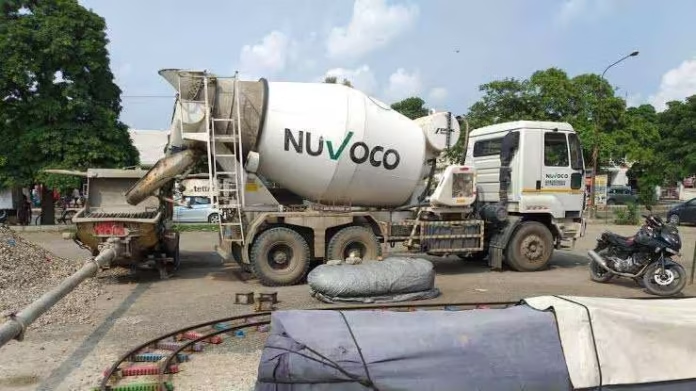
India’s construction materials sector is witnessing steady demand as infrastructure expansion and housing activity accelerate across several regions. Within this environment, Nuvoco Vistas cement demand has seen a notable uptick, reflecting broader momentum in the country’s building materials ecosystem.
Industry observers say the increase in volumes is largely linked to growing construction activity in eastern and northern India, where urban expansion and infrastructure programmes are driving sustained consumption of cement and related materials. The company, which operates multiple integrated cement plants and grinding units, has been expanding its reach in these markets to capture emerging demand from both public and private construction projects.A senior industry analyst said that cement producers with strong regional networks are benefiting from increased government spending on transport infrastructure and urban development. Large road projects, logistics corridors, and housing developments are creating a consistent pipeline of demand for cement manufacturers. In this context, Nuvoco Vistas cement demand has risen as construction activity gathers pace across multiple states.
India’s cement sector is closely tied to the country’s urbanisation trajectory. With millions of people expected to migrate to cities over the next decade, the need for new housing, commercial buildings, and urban infrastructure is expanding rapidly. Cement producers play a central role in this transformation, supplying essential materials for everything from metro rail systems and bridges to residential towers and industrial facilities.Nuvoco Vistas, part of the diversified Nirma Group, has positioned itself as a key supplier of cement, ready-mix concrete and modern building solutions. The company has steadily expanded its manufacturing network and distribution channels to serve both large infrastructure contractors and local construction markets.
Sector specialists note that manufacturers are also investing in operational efficiency and sustainability as environmental considerations gain prominence in the built environment. Cement production is energy-intensive and contributes significantly to industrial emissions. As a result, companies are exploring alternative fuels, energy-efficient kilns, and blended cement formulations that reduce the carbon footprint of construction materials.These developments are particularly relevant as cities increasingly adopt climate-resilient infrastructure strategies. Urban planners and policymakers are encouraging construction methods that balance rapid development with environmental responsibility, creating opportunities for cement producers that can supply lower-emission materials.Demand dynamics across the sector remain broadly positive. Infrastructure spending by central and state governments continues to expand, while residential construction is gradually recovering in several urban markets. Together, these trends are supporting stable consumption of cement across the country.
For manufacturers such as Nuvoco Vistas, the rise in Nuvoco Vistas cement demand underscores the scale of India’s ongoing construction cycle. As cities grow and infrastructure investment deepens, cement producers are expected to remain a vital link in the supply chain powering the country’s next phase of urban development.
Ambuja Cement Strategy Shift Reshapes Industry Competition
India’s cement industry is entering a phase where profitability and product value may begin to outweigh the traditional race for higher output. The Ambuja cement strategy to prioritise margins and premium products over aggressive volume expansion reflects a broader recalibration within the country’s building materials sector as companies adapt to shifting construction demand and rising cost pressures.
Industry observers say the move comes after years of capacity expansion and acquisitions that significantly increased the company’s production base. With installed capacity already above 100 million tonnes annually and plans to scale further in the coming years, the focus is now shifting toward improving plant utilisation and strengthening price realisations rather than pursuing rapid volume gains alone.The Ambuja cement strategy is being closely watched across the sector because it highlights a structural transition underway in India’s cement market. Large manufacturers have spent the past decade expanding capacity to capture demand from highways, housing projects, and industrial corridors. However, analysts say that as supply increases across the industry, maintaining profitability will increasingly depend on operational efficiency, logistics optimisation, and differentiated product offerings.
A key component of this shift involves increasing the share of premium cement variants and improving trade channel sales, which typically deliver stronger margins than bulk supply to large infrastructure projects. Company data shows that premium product penetration has been steadily rising as firms target urban construction markets where quality and specialised materials command better pricing.Another factor shaping the strategy is the consolidation underway in India’s cement sector. Recent acquisitions and mergers have helped create larger production networks with improved logistics and cost synergies. For Ambuja, integrating previously acquired cement businesses into a unified operating platform is expected to strengthen supply chains and reduce duplication across operations.
Despite the shift toward value-driven growth, the company continues to pursue long-term capacity expansion to serve India’s expanding construction economy. Industry forecasts suggest the cement sector could see significant capacity additions over the next several years as companies prepare for rising demand linked to infrastructure spending and urban development programmes.Demand fundamentals remain relatively strong. Cement consumption across major producers grew about 7 percent year-on-year recently, supported by government infrastructure projects and a gradual revival in construction activity after earlier price corrections in the market.Urban planners and industry specialists note that the transition toward higher-value construction materials also aligns with evolving building practices. As cities pursue more durable, energy-efficient, and climate-resilient infrastructure, demand for specialised cement formulations and blended materials is expected to rise.
For the cement sector, the Ambuja cement strategy may signal a broader industry pivot—from chasing market share through capacity alone to building sustainable profitability in a rapidly expanding construction landscape. If successful, the approach could redefine how India’s largest cement producers compete in an era of large-scale urbanisation and infrastructure investment.
India Cement Margins Under Pressure Amid Gulf Crisis
India’s construction economy is entering a phase of accelerated expansion, with the India cement market poised for sustained growth as large infrastructure investments, urban housing demand, and industrial construction reshape the country’s built environment. Industry assessments suggest demand for cement could continue rising steadily through the decade as government spending and private real estate development gain momentum.
Analysts tracking the India cement market say the sector is closely tied to the country’s urbanisation trajectory. India is experiencing one of the fastest urban transitions globally, with hundreds of millions expected to move to cities in the coming years. This demographic shift is translating into higher demand for residential housing, transport networks, and commercial real estate — all of which rely heavily on cement as a core construction material. Recent projections indicate cement consumption in India may grow by roughly 6–7 percent annually in the near term, supported by strong activity in both infrastructure and housing projects. Government spending on roads, railways, logistics corridors, and energy infrastructure is expected to sustain construction demand across multiple regions. Infrastructure programmes are emerging as a central driver of demand. Major public investment initiatives and national connectivity plans have expanded the pipeline of construction projects, including highways, industrial corridors, ports, and urban transit systems. The National Infrastructure Pipeline alone covers thousands of projects designed to strengthen economic connectivity and modernise urban infrastructure, directly boosting cement consumption across the country.
Housing development remains the single largest consumer segment for cement. Affordable housing initiatives and private residential projects are expanding rapidly as cities respond to rising population pressures. Experts note that while infrastructure demand is rising faster, housing construction continues to account for the majority share of cement use, reflecting the scale of India’s housing requirements in both urban and rural regions. Industry capacity is also expanding to keep pace with future demand. Production capacity additions across multiple companies are expected to increase total industry output significantly over the next few years, allowing the sector to support large-scale infrastructure and real estate activity. Capacity expansion is widely seen as necessary to avoid supply bottlenecks as construction activity accelerates. At the same time, sustainability considerations are beginning to shape the sector’s long-term strategy. Cement production is energy intensive and a major source of industrial emissions, prompting manufacturers to explore alternative fuels, blended cement formulations, and low-carbon technologies. Industry observers say these innovations will be critical as cities pursue climate-resilient infrastructure and lower-emission construction materials.
For India’s urban future, the trajectory of the India cement market reflects more than industrial growth. It signals the scale of physical transformation underway — from highways and rail corridors to housing and commercial districts. As cities expand and infrastructure investment intensifies, the sector is expected to remain a central pillar of the country’s development economy in the years ahead.
Visakhapatnam Saint Gobain Opens Low Carbon Ceiling Plant
India’s push toward low-carbon construction materials is gaining momentum as manufacturers begin aligning production processes with emerging sustainability goals in the built environment. In a move reflecting this shift, Saint-Gobain Indiahas commissioned a near-net-zero manufacturing facility for gypsum ceiling tiles in Visakhapatnam, strengthening domestic production of interior building materials while reducing the carbon footprint of manufacturing.
The facility, developed under the company’s Gyproc business, represents India’s first near-net-zero gypsum ceiling tiles plant. Commissioned in December 2025, the factory has an annual production capacity of around 5 million square metres of ceiling tiles and will manufacture PVC-laminated gypsum panels designed for commercial and institutional buildings. Located in Visakhapatnam on India’s eastern coast, the plant is positioned to improve supply efficiency for construction markets across the country. The strategic location also allows the manufacturer to strengthen logistics access to rapidly expanding urban regions where commercial offices, educational institutions, healthcare facilities and public infrastructure projects are driving demand for interior building materials.Gypsum ceiling tiles have become a widely used component in contemporary building design. In modern homes, offices and public buildings, suspended ceiling systems help conceal electrical wiring, HVAC ducts and service lines while improving acoustic performance and indoor comfort. Lightweight gypsum-based panels are also favoured for their fire resistance and ease of installation compared with traditional ceiling materials.
Industry observers say the commissioning of a near-net-zero gypsum ceiling tiles plant signals a broader transformation in India’s building materials manufacturing sector. Construction companies are increasingly prioritising products that support energy-efficient building design and lower lifecycle emissions, particularly as sustainability frameworks and green building certifications gain influence in project planning.The Visakhapatnam facility incorporates advanced manufacturing systems intended to minimise environmental impact. According to the company, the plant includes modern dust-collection technology and process controls designed to improve operational efficiency while maintaining workplace safety and environmental performance. Products manufactured at the facility meet international standards such as BS EN 520 and BS EN 14190, ensuring durability and performance for ceiling systems used in commercial and institutional spaces.
The development also aligns with the manufacturer’s broader global sustainability roadmap, which aims to achieve net-zero carbon emissions by 2050. By introducing near-net-zero manufacturing practices in India, the company is attempting to scale low-carbon construction materials closer to domestic markets while strengthening local production capacity.For India’s construction ecosystem, the project highlights a growing emphasis on sustainable manufacturing within the building materials industry. As cities expand and demand for modern interiors rises in offices, hospitals, schools and residential developments, ceiling systems are becoming a significant segment of the interior architecture market.
Urban development experts note that the shift toward lower-carbon building materials will likely accelerate in the coming decade as India’s real-estate sector adapts to climate goals, energy-efficiency standards and greener construction practices. Facilities such as the Visakhapatnam plant may therefore play a key role in shaping how interior building materials are produced for the country’s next generation of homes and commercial buildings.