HomeReal EstateArchitectureJaipur Office Building Redefines Heat Resilient Architecture

Jaipur Office Building Redefines Heat Resilient Architecture

A newly completed Jaipur office building along one of the city’s busiest arterial corridors is drawing attention among planners and real estate observers for how it blends climate-conscious design with evolving workplace demands. The project introduces a contemporary commercial structure in an area dominated by older business premises, signalling how India’s tier-two cities are rethinking workplace architecture to address extreme heat, density and sustainability pressures.

Positioned within a high-traffic commercial stretch, the development represents one of the first modern office projects to emerge in the neighbourhood in recent years. Urban planners say such interventions are becoming increasingly important in cities like Jaipur, where older commercial zones are gradually transitioning into mixed-use business districts. The building’s layout reflects a shift in office design priorities. Service areas and circulation zones are concentrated along the southern edge, allowing workspaces to remain flexible across each floor. Smaller offices occupy lower levels, while larger corporate suites are located higher up, enabling different scales of enterprises to operate within the same structure. Industry observers note that this approach reflects growing demand for adaptable office environments as businesses experiment with hybrid work models and scalable leasing.

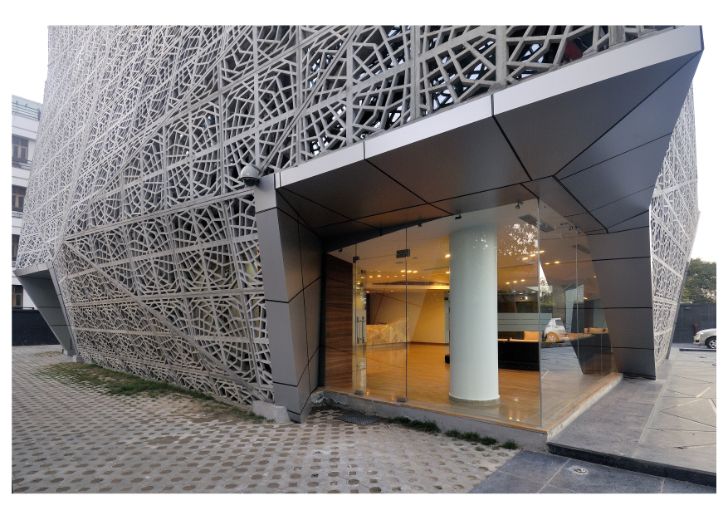
One of the most distinctive features of the Jaipur office building is its dynamic western façade, which faces the main road. Two angled vertical volumes lean in opposite directions, creating recessed terraces and semi-outdoor decks at every level. These shaded zones serve multiple purposes: reducing direct heat exposure, improving occupant comfort and offering outdoor work or relaxation spaces in an otherwise dense urban setting. Architectural experts say such passive cooling strategies are becoming essential in cities experiencing prolonged heatwaves. By reducing direct solar gain and encouraging shaded outdoor areas, buildings can lower energy consumption associated with mechanical cooling. The structure also integrates a façade system inspired by traditional lattice screens long used in Rajasthan’s historic architecture. Instead of stone, however, the screens are made using lightweight foam concrete incorporating recycled materials. Beyond referencing regional design traditions, these perforated panels act as thermal buffers that limit heat penetration while allowing air movement.

Between the screen layer and the glass façade lies a narrow planted strip running around the building’s perimeter. Urban designers highlight that this vegetated buffer helps filter noise from the surrounding traffic while adding greenery to an otherwise dense commercial environment. At ground level, public-facing amenities such as a restaurant and meeting facilities activate the street edge, a feature often encouraged by urban planners seeking more pedestrian-friendly commercial districts. Meanwhile, rooftop amenities including landscaped spaces and employee recreation areas aim to improve workplace well-being. The project incorporates several environmental measures including rainwater harvesting, water recycling systems and rooftop solar energy generation. Much of the structure is built using fly ash bricks, a by-product of thermal power plants increasingly used in lower-carbon construction. As cities across India grapple with rising temperatures and rapid urbanisation, developments like this Jaipur office building illustrate how commercial real estate is beginning to integrate climate resilience with evolving workplace design. For urban policymakers, such models may offer a blueprint for upgrading ageing commercial districts while reducing environmental impact.

Also Read : Jaipur Residence By Studio Timescape Celebrates Craft
Jaipur Office Building Redefines Heat Resilient Architecture
RELATED ARTICLES

LEAVE A REPLY

Please enter your comment!
Please enter your name here

- Advertisment -spot_img

Most Popular

Recent Comments

India Co Living Housing Sees Fresh Expansion

India Co Living Housing Sees Fresh Expansion

India’s organised rental housing sector is witnessing another phase of expansion as co-living operators increase investments to meet rising demand from students and young...
Bengaluru GCC Expansion Drives Office Market Shift

Bengaluru GCC Expansion Drives Office Market Shift

India’s commercial office landscape is undergoing a structural transformation as Global Capability Centres (GCCs) emerge as the dominant occupiers of premium workspace, reinforcing the...
Shiva Cement Limestone Mines Gain Approval

Shiva Cement Limestone Mines Gain Approval

A regulatory clearance for limestone and dolomite mining in Odisha has strengthened the raw material pipeline for Shiva Cement, marking a significant development for...
Sagar Cements Earnings Signal Cement Sector Challenges

Sagar Cements Earnings Signal Cement Sector Challenges

Sagar Cements reported a consolidated net loss for the first quarter of FY27, reversing the profit recorded a year earlier, as cost pressures and...
India Paint Sector Backs Affordable Home Upgrades

India Paint Sector Backs Affordable Home Upgrades

Birla Opus Paints has introduced a financing initiative that allows households to spread the cost of painting and home improvement projects through equated monthly...