
India Housing Sector Drives Waterproof Joint Systems

India Hindware Expands Smart Bathroom Technology Range

India’s bathroom and sanitaryware market is gradually shifting toward technology-enabled fixtures as urban housing evolves and consumers demand higher standards of hygiene, automation and design. In line with this trend, Hindware has introduced a new smart sanitaryware product aimed at integrating automation and modern aesthetics into residential bathrooms.
The company has launched the Starc smart wall-mount toilet, part of its premium bathroom solutions portfolio, designed to combine sensor-based functionality with compact architectural design suited to contemporary homes. The product integrates multiple automated features intended to reduce physical contact and enhance user convenience in daily bathroom routines. Among its key functions are automatic flushing, sensor-activated seat opening and closing, and remote-controlled operation, reflecting the growing influence of smart home technologies in bathroom design. The system also incorporates a self-cleaning nozzle, oscillating water spray and warm air drying functions aimed at improving hygiene and comfort.
The launch reflects a broader shift within India’s sanitaryware sector, where manufacturers are increasingly incorporating electronics and automation into conventional plumbing fixtures. Industry analysts say this transformation is driven by multiple factors: growing urbanisation, the rise of premium housing projects, and greater consumer awareness around hygiene and water efficiency.Smart toilets—once considered luxury products primarily used in high-end hotels or international markets—are gradually entering India’s residential segment. Architects and interior designers note that the demand is particularly visible in metropolitan cities where compact urban housing encourages space-saving designs such as wall-mounted fixtures. These installations help optimise bathroom layouts while maintaining a minimalist aesthetic.
The Starc smart wall-mount toilet also includes adjustable seating temperature, customisable water pressure and temperature controls, a foot-touch flush system and a digital interface for managing various functions. These features are intended to provide users with personalised comfort while maintaining sanitation standards in frequently used spaces. Industry observers say the adoption of smart sanitaryware is also linked to broader urban development trends. As residential buildings increasingly incorporate smart lighting, security systems and automated appliances, bathrooms are becoming part of the connected home ecosystem.
From an urban infrastructure perspective, the sanitaryware industry is also under pressure to innovate around water conservation and efficient plumbing systems. Smart fixtures that optimise water flow and flushing efficiency could play a role in reducing water consumption in densely populated cities.India’s sanitaryware market has expanded significantly over the past decade, supported by housing development, renovation activity and government initiatives aimed at improving sanitation infrastructure. With rising disposable incomes and changing consumer expectations, companies are now competing to introduce products that combine functionality with digital convenience.
For manufacturers such as Hindware, the introduction of intelligent sanitaryware represents both a design innovation and a response to the changing expectations of urban households. As smart home adoption grows across Indian cities, technology-enabled bathroom fixtures are likely to become an increasingly visible part of modern residential architecture.
Also Read: India Float Glass Demand Rises With Green Buildings
India Hindware Expands Smart Bathroom Technology Range
India Float Glass Demand Rises With Green Buildings

India’s construction sector is increasingly turning to advanced glazing materials as green building standards and energy-efficient design reshape the country’s urban landscape. Industry analysts say the demand for float glass—a core material used in windows, façades and architectural glazing—is expected to grow steadily over the coming decade as sustainable building codes and modern design trends gain momentum.
Float glass, produced through a molten glass “float bath” process that creates flat, uniform sheets, forms the backbone of modern architectural glazing systems. It is widely used in commercial towers, residential windows, glass façades and interior partitions. The growing push for energy-efficient buildings is accelerating demand for higher-performance variants such as coated, tinted and Low-E (low emissivity) glass, which improve insulation and reduce solar heat gain. Globally, demand for float glass is expected to expand through 2035 as stricter energy-efficiency standards and green building certifications encourage the use of advanced glazing technologies. Policies promoting energy-efficient building envelopes—such as international green building frameworks and local sustainability standards—are encouraging architects and developers to adopt high-performance glass solutions that improve thermal efficiency.
India is expected to be a major contributor to this growth. Rapid urbanisation, expanding infrastructure programmes and rising commercial real-estate development are creating strong demand for architectural glass. Industry estimates suggest the domestic float glass market reached about ₹152.7 billion in 2025 and could grow significantly over the next five years as construction activity increases. Architectural applications dominate the sector, accounting for a large share of consumption as glass becomes a defining feature of modern buildings. Office towers, retail complexes and transport hubs increasingly incorporate glass façades to maximise natural light and enhance building aesthetics. At the same time, energy codes and sustainability frameworks are pushing developers toward glazing systems that improve thermal performance and reduce cooling loads in tropical climates.
Another factor driving the float glass market is the growth of solar energy infrastructure. Solar photovoltaic modules require specialised high-transmission glass to protect solar cells while allowing maximum light penetration. As India expands its renewable energy capacity, demand for solar glass is expected to increase alongside conventional architectural applications.Automotive manufacturing also contributes to market expansion. Vehicle production requires large quantities of float glass for windshields, windows and safety glazing, creating a parallel demand stream for domestic glass manufacturers.
However, the sector faces several operational challenges. Float glass manufacturing is highly energy-intensive, relying on continuous high-temperature furnaces and raw materials such as silica sand and soda ash. Volatility in energy prices and raw-material supply can therefore affect production costs and industry margins. Despite these challenges, analysts believe India’s float glass industry is well positioned for long-term growth. With cities expanding vertically and sustainable construction gaining policy support, high-performance glazing materials are likely to become an integral component of future building design.
For India’s urban development agenda, the rise of float glass signals a broader shift toward materials that combine architectural aesthetics with energy efficiency—an increasingly important requirement as cities strive to balance rapid growth with climate-responsive building practices.
Also Read: India Construction Costs Face Energy Price Pressure
India Float Glass Demand Rises With Green Buildings
India Construction Costs Face Energy Price Pressure
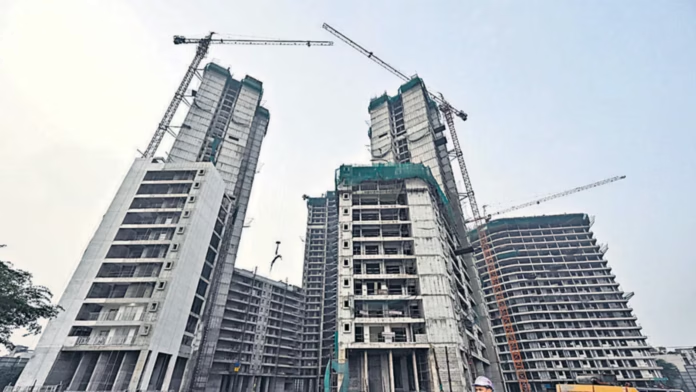
India’s construction and infrastructure sectors could face renewed cost pressures as rising global energy prices and geopolitical tensions in West Asia begin to ripple through building material supply chains. Industry analysts warn that materials widely used in housing, commercial development and infrastructure projects—including steel, aluminium and cement—may become more expensive if energy markets remain volatile.
The concern stems from the sharp rise in global oil prices linked to escalating conflict in the Middle East. Disruptions to energy production and shipping routes in the region have pushed crude prices significantly higher, raising concerns across energy-importing economies such as India. For the construction industry, the impact is particularly significant because many core building materials are highly energy-intensive to manufacture. Cement kilns, steel furnaces and aluminium smelters rely heavily on fossil fuels and electricity to operate. As energy costs climb, production expenses for these materials typically rise as well. Transport costs are another critical factor. Construction materials often move long distances between manufacturing plants, distribution hubs and project sites. Higher diesel prices increase logistics costs across this supply chain, adding further pressure on builders and developers.
Industry experts say the immediate impact in India may be gradual rather than sudden. Many infrastructure and real-estate projects already under construction are tied to fixed procurement contracts that limit short-term price changes. However, if global energy prices remain elevated for several months, future project budgets and new housing launches could begin reflecting higher material costs.Economists are also monitoring broader macroeconomic risks. India imports more than 85% of its crude oil requirements, making its economy sensitive to sustained increases in global energy prices. Any prolonged disruption to energy supply routes—particularly through the Strait of Hormuz—could intensify fuel price volatility and ripple across multiple industrial sectors. For developers and infrastructure planners, this uncertainty adds another layer of complexity to project financing and cost forecasting. Steel, cement and aluminium together represent a substantial share of construction expenditure, meaning even moderate price increases can significantly affect project budgets.
Urban development experts note that the impact could vary across segments. Large government infrastructure projects with long planning horizons may absorb temporary price fluctuations, while smaller private developments—especially housing and commercial construction—could be more sensitive to rising input costs.At the same time, the situation is drawing attention to a deeper structural issue within the construction industry: its heavy reliance on energy-intensive materials. Cement and steel production alone account for a large share of industrial energy consumption and carbon emissions globally. Some planners argue that this volatility may accelerate interest in alternative building materials, energy-efficient manufacturing processes and circular construction practices. These shifts are increasingly seen as essential for building more resilient and climate-aligned urban infrastructure.
For now, developers and contractors across India are closely watching energy markets. If geopolitical tensions continue to push fuel prices higher, the country’s construction sector could soon face another round of cost adjustments that reshape project economics and building timelines.
Also Read: Goa Maritime Sector Seeks Local Regulatory Hub
India Construction Costs Face Energy Price Pressure
Goa Maritime Sector Seeks Local Regulatory Hub

Goa’s maritime workforce is urging authorities to establish a Mercantile Marine Department office in Vasco, arguing that the absence of a local regulatory centre forces seafarers to travel to distant cities for mandatory certifications and examinations. Industry groups say the move could significantly strengthen the coastal state’s maritime ecosystem while improving access to services for thousands of marine professionals.
Representatives of the state’s maritime officers’ community recently submitted a proposal to the state government outlining the operational challenges faced by seafarers based in Goa. According to the memorandum, the lack of a Mercantile Marine Department office within the state means professionals must travel to larger port cities to complete essential administrative procedures linked to their employment. India’s Mercantile Marine Department functions as the primary regulatory authority overseeing merchant shipping operations. Its responsibilities include implementing maritime safety regulations, certifying seafarers, monitoring vessel compliance and enforcing international shipping standards related to crew welfare and ship construction.
Currently, most of the department’s field offices operate from major maritime centres such as Mumbai, Chennai and Kolkata. For professionals based in Goa, this arrangement often requires time-consuming travel to obtain documentation such as continuous discharge certificates, dangerous cargo endorsements and other specialised maritime approvals.
Industry representatives say establishing a Mercantile Marine Department office in Vasco could simplify these procedures and reduce administrative delays for maritime professionals working in the region. Vasco, located in South Goa, is home to one of the state’s key port clusters and supports a large community of seafarers, marine engineers and shipping professionals.
Urban infrastructure experts note that strengthening regulatory institutions within coastal cities can have wider economic implications. Ports and maritime industries are critical drivers of trade, logistics and employment across India’s western coastline. Expanding administrative capacity in these regions is often seen as essential for supporting port-led development and sustainable maritime growth.
The proposal submitted to the government also includes plans for a dedicated maritime hub within South Goa. Industry groups have suggested developing a maritime complex that would host training facilities, professional development programmes and industry events. Such a centre could support knowledge exchange between shipping professionals, regulators and training institutions. Maritime economists say the concept reflects a broader shift toward strengthening regional maritime ecosystems. As India expands port infrastructure and shipping activity under national logistics strategies, smaller coastal states are increasingly seeking to build institutional capacity to support maritime employment and services locally.
For Goa, where tourism and port activity both play major roles in the economy, the presence of a Mercantile Marine Department office could also contribute to long-term workforce development. Easier access to regulatory services may encourage more young professionals to pursue maritime careers, while also supporting existing seafarers working on international shipping routes.
State officials reviewing the proposal have acknowledged the operational concerns raised by maritime professionals. Policy experts say the next step will involve assessing administrative feasibility and coordination with central maritime authorities, which oversee the functioning of Mercantile Marine Department offices across the country. If implemented, the initiative could mark an important step toward strengthening Goa’s maritime governance infrastructure. For coastal economies seeking sustainable growth, improving institutional access for seafarers remains a key element in building resilient maritime cities.
Goa Maritime Sector Seeks Local Regulatory Hub
Ahmedabad Housing Market Expands With Infrastructure Growth

Ahmedabad is emerging as one of India’s most dynamic residential property markets, with housing transactions estimated at nearly ₹67,000 crore in 2025. This surge means the Ahmedabad housing market now represents roughly eight percent of the country’s total primary residential sales value, highlighting the growing importance of western India’s urban centres in shaping national real estate trends.
Industry estimates indicate that India’s primary residential sector recorded sales of more than 6.14 lakh housing units last year, generating transaction values exceeding ₹8.4 lakh crore. Within this landscape, the Ahmedabad housing market has expanded steadily, supported by infrastructure investments, industrial growth and a rising profile as a business and logistics hub. Urban economists say Ahmedabad’s real estate performance reflects a broader shift underway in India’s urban development pattern. While metropolitan cities continue to attract capital, emerging Tier-2 urban centres are increasingly drawing both homebuyers and institutional investors due to better infrastructure planning, lower entry costs and improving quality-of-life indicators.
Ahmedabad’s price trajectory also reflects a relatively stable housing environment. Residential property values in the city have recorded moderate annual growth over the past five years, averaging just over three percent annually. Market analysts note that such gradual appreciation has helped maintain affordability for middle-income households while ensuring steady asset growth for investors. In the past year alone, housing prices in the city registered close to a three percent increase. Property consultants attribute the trend to sustained buyer demand, expanding employment opportunities and ongoing infrastructure improvements that have strengthened connectivity across the metropolitan region. Buyer preferences within the Ahmedabad housing market show a clear tilt towards three-bedroom apartments. Developers say this configuration has become the most commonly launched and purchased unit type across new residential developments, particularly within the mid-income segment.
Homes priced between ₹50 lakh and ₹1 crore have accounted for the largest share of sales activity. Properties in the ₹50 lakh to ₹75 lakh bracket recorded the highest number of transactions, followed by homes in the ₹75 lakh to ₹1 crore category. Units priced between ₹1 crore and ₹1.5 crore also saw notable demand, reflecting the city’s gradual shift toward higher-value housing segments. Unsold housing inventory mirrors these demand patterns, suggesting that developers have aligned new supply closely with prevailing buyer preferences. Urban planners say this balance between supply and demand is critical to maintaining stability in the residential market while preventing excessive price volatility.
Nationally, the premium housing segment continues to dominate real estate transaction value. Homes priced above ₹1 crore account for the majority of total residential sales value across India, driven by rising incomes and increasing demand for larger homes and lifestyle-oriented developments. Ahmedabad’s growth story is also tied to broader economic changes. Industrial expansion, logistics infrastructure and academic institutions have strengthened the city’s economic ecosystem, attracting professionals and entrepreneurs from across the region.
Urban development specialists emphasise that the continued expansion of the Ahmedabad housing market will require careful planning to ensure infrastructure capacity keeps pace with real estate growth. Investments in public transport, green spaces and climate-resilient urban infrastructure will be essential to sustain long-term liveability. As India’s urbanisation accelerates, cities like Ahmedabad are expected to play an increasingly important role in shaping the future of housing demand beyond the country’s largest metropolitan regions.
Ahmedabad Housing Market Expands With Infrastructure Growth
Goa Tenant Verification Rules Strengthen Rental Oversight

The Goa government has introduced a new compliance framework for rental housing that requires landlords to formally verify the identity of tenants and submit occupancy details to local authorities. The Goa tenant verification rules, notified under state legislation governing tenancy verification, make it mandatory for property owners to maintain records of occupants and share information with police within a specified timeframe.
The regulation applies to residential properties across the state and forms part of a broader effort to formalise tenant documentation in regions experiencing high levels of temporary migration. Officials say the Goa tenant verification rules are intended to strengthen oversight of rental accommodation while creating a structured system for maintaining tenant records.
Under the framework, landlords must collect identity documentation from individuals occupying rented premises and submit the details to the nearest police station within five days of the tenant moving in. Authorities have also introduced digital submission channels to simplify the reporting process and reduce the administrative burden on property owners.
Failure to comply with the reporting requirement can attract penalties under the law. Property owners who do not verify tenants or fail to provide the required information may face legal action, including possible imprisonment of up to six months or a financial penalty. Enforcement officials are also authorised to inspect property records to confirm that landlords are maintaining accurate documentation. Law enforcement agencies say maintaining verified tenant records can support crime prevention efforts and improve traceability in cases where individuals involved in unlawful activities attempt to use rental housing as temporary accommodation. States with high levels of tourism and seasonal employment often face challenges in tracking short-term residents, particularly in urban and coastal areas.
Urban policy analysts note that Goa’s rental housing market is unique compared with many other Indian states. The region attracts a large number of domestic migrants, tourism workers, students and temporary professionals each year. This dynamic population has created a strong demand for rental accommodation across both urban centres and coastal settlements.
As a result, authorities believe the Goa tenant verification rules will help create a more transparent system for managing tenancy arrangements. By maintaining verified records of occupants, police and local administrations can develop a centralised database that supports investigations and strengthens civic oversight.
Housing experts say that regulatory clarity can also improve trust in the rental housing sector. Clear documentation requirements protect both landlords and tenants by establishing formal tenancy records and reducing disputes over occupancy or identity verification.
However, urban governance specialists also emphasise the need for accessible digital systems to ensure compliance does not become overly burdensome for small property owners or individuals renting out single units. Simplified procedures and public awareness campaigns will be critical to the effective implementation of the policy.
The introduction of the Goa tenant verification rules reflects a wider trend across Indian states to standardise tenancy documentation in rapidly evolving urban housing markets. As rental housing becomes an increasingly important component of urban living, policymakers are likely to continue refining systems that balance public safety, administrative efficiency and tenant rights. For Goa, where tourism-driven migration continues to shape local housing patterns, the success of the policy will depend on how effectively authorities integrate technology, enforcement and citizen awareness into the state’s rental governance framework.
Goa Tenant Verification Rules Strengthen Rental Oversight
Pune Real Estate Growth Drives Teerth Realties Plans

Pune’s western suburbs are emerging as one of the city’s most active real estate zones, with developers increasing investments in residential and commercial projects along the Baner–Balewadi–Hinjewadi corridor. Among those expanding their presence is Teerth Realties Pune, which has been developing office and housing projects in areas benefiting from improved connectivity and proximity to major technology hubs.
Urban planners say Pune’s property market is evolving rapidly as infrastructure upgrades and employment growth reshape development patterns across the metropolitan region. Micro-markets such as Baner, Balewadi, Sus and Hinjewadi have gained prominence in recent years due to their access to the city’s information technology parks and expanding road networks.
The presence of large technology campuses in Hinjewadi and surrounding areas has significantly influenced real estate demand. Businesses operating in the IT and IT-enabled services sectors increasingly prefer Grade A office spaces close to workforce clusters and transit corridors. This shift has encouraged developers to create modern office infrastructure designed for technology firms and hybrid working environments.
Against this backdrop, Teerth Realties Pune has been developing projects across the western growth corridor, focusing on a mix of commercial and residential properties. Industry observers note that developers active in these locations are seeking to capture demand from both companies establishing regional offices and professionals seeking homes near employment hubs. One of the company’s commercial developments in Baner reflects this trend. The office complex provides workspace designed for technology and service sector companies, located within commuting distance of several business districts including Hinjewadi, Wakad and Aundh. Such projects are becoming increasingly common in Pune’s western corridor as firms look for modern office environments outside older central business districts.
Residential development has also accelerated across neighbouring suburbs such as Sus, where mid-rise and high-rise housing communities are being constructed to cater to working professionals employed in nearby technology parks. Urban economists note that these neighbourhoods offer a combination of connectivity to employment centres and relatively lower land costs compared with established city localities. As a result, developers are increasingly planning integrated residential communities that combine housing with open spaces, social amenities and improved access to mobility infrastructure. Such projects are designed to respond to changing lifestyle expectations among urban households, particularly younger professionals moving to Pune for employment opportunities.
From an urban development perspective, planners say the continued expansion of housing and office supply along the western corridor underscores the importance of coordinated infrastructure planning. Road connectivity, public transport links, water supply and green spaces will play a crucial role in determining whether these fast-growing suburbs evolve into sustainable urban districts. Experts also highlight that balanced growth in emerging corridors can reduce pressure on older parts of the city while distributing economic activity more evenly across the metropolitan area. With Pune’s technology sector continuing to expand and infrastructure investments reshaping mobility patterns, Teerth Realties Pune and other developers are likely to remain active in these emerging corridors. The longer-term challenge for the city will be ensuring that rapid real estate development aligns with infrastructure capacity and climate-resilient urban planning.
Pune Real Estate Growth Drives Teerth Realties Plans
Pune AI Property Tax Mapping Plan Advances

Pune’s civic administration is examining the use of advanced digital tools to improve revenue collection by identifying properties that remain outside the municipal tax database. The Pune AI property tax initiative under evaluation by the city administration aims to detect unassessed buildings using satellite imagery and geographic data, potentially bringing thousands of properties into the municipal tax network while strengthening a crucial funding stream for urban infrastructure.
Officials say the Pune AI property tax initiative could help address long-standing gaps in property assessment across the city. Municipal records indicate that hundreds of thousands of structures within city limits have not been formally assessed for property tax. Many of these properties are located in recently merged suburbs, redeveloped housing societies with expanded built-up areas, or areas where municipal data has not kept pace with rapid construction activity.
Urban governance experts note that identifying such properties through traditional physical surveys has historically been slow and resource-intensive. Large cities with fast-growing real estate markets often struggle to keep municipal databases updated as redevelopment projects, vertical housing and mixed-use developments reshape neighbourhoods. To overcome these challenges, the civic administration is evaluating technology-based solutions that can analyse multiple datasets simultaneously. Under the proposed Pune AI property tax framework, artificial intelligence systems would compare satellite images, building footprints, geographic information system mapping and municipal property records. Discrepancies between registered information and actual built structures could then be flagged for verification by municipal officials.
City administrators believe such systems could help identify buildings where the recorded built-up area differs from the actual structure, as well as detect properties that may not be registered within the municipal tax database at all. Analysts say these digital methods are increasingly being used by cities globally to improve tax compliance while modernising urban governance systems. Property tax remains one of the most important revenue sources for municipal corporations, financing essential services such as road maintenance, drainage networks, waste management and public infrastructure. However, Pune’s property tax collections have been lower than anticipated during the current financial year, prompting the administration to explore new approaches to strengthen revenue.
Municipal data indicates that property tax receipts have reached only a portion of the annual target so far, highlighting the importance of expanding the tax base rather than relying solely on higher rates. Officials believe identifying unassessed properties could significantly increase revenue without placing additional financial pressure on compliant taxpayers. Urban policy specialists say modernising municipal tax systems is also critical for long-term planning. Accurate property databases allow city authorities to better understand patterns of real estate development, assess infrastructure needs and plan service delivery more efficiently.
At the same time, discussions are continuing within the civic administration regarding potential property tax policy changes, including proposals related to tax rates and exemptions for smaller housing units. Such decisions are expected to be taken after deliberation by the municipal standing committee. If implemented, the Pune AI property tax system could mark a shift towards data-driven urban governance, helping the city manage rapid real estate growth while improving fiscal capacity to fund essential infrastructure and services for its expanding population.
Pune AI Property Tax Mapping Plan Advances
Noida Sees New Premium Managed Office Centre
