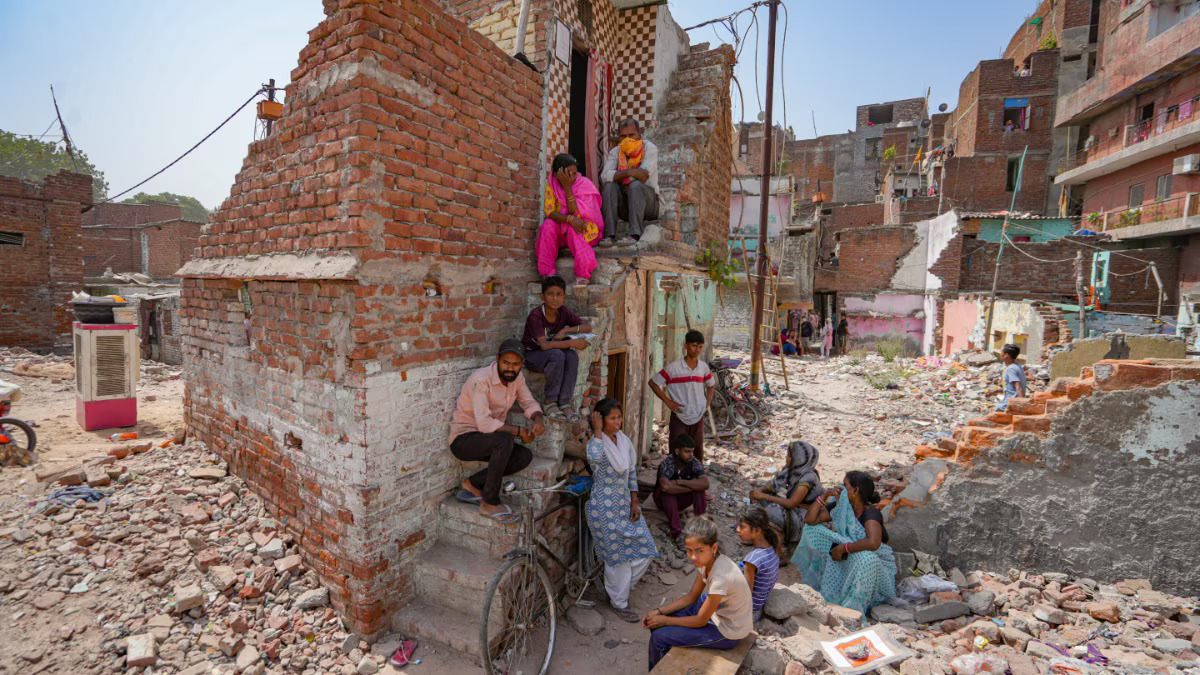
Delhi Development Authority (DDA) has demolished over 300 illegal structures at Bhoomiheen Camp in South Delhi’s Govindpuri. The cleared land will be repurposed to construct permanent housing for approximately 4,500 Jhuggi‑Jhopri (JJ) dwellers from Navjeevan and Jawahar Camps, aligning with the government’s ethical urban redevelopment policy
Delhi’s land‑managing authority explained that most razed constructions, numbering around 344, had been vacant and occupied illegally for approximately two and a half years. The camp covered nearly five acres of DDA land, which had remained under encroachment despite earlier housing allocations. Notices were issued to encroachers, and court petitions were dismissed. Consequently, no stay orders blocked the demolition. This drive continues earlier efforts under the ‘Jahan Jhuggi Wahan Makan’ policy, which guarantees alternative housing before slum clearance. Between November 2022 and May 2023, 1,862 eligible households were relocated from Bhoomiheen Camp to economically weaker section (EWS) flats in Kalkaji Extension, following guidelines from the Delhi Urban Shelter Improvement Board (DUSIB).
Eligibility for rehabilitation required inclusion in voter lists from 2012 to 2015 and possession of specific documents like electricity bills or driving licences. Homeowners engaged in commercial use, undocumented residents, or those living upstairs without separate ration cards were deemed ineligible. Thirty‑four ineligible households successfully appealed and were granted housing. Under the Rs 11.41 lakh construction cost, each EWS flat offers 25 sqm carpet area with modern amenities such as living rooms, bedrooms, bathrooms, kitchens, and balconies. Beneficiaries contributed a nominal Rs 1.12 lakh toward the cost. The DDA highlighted that the demolition was legally sanctioned following the Delhi High Court’s dismissal of 55 writ petitions by 435 residents—leaving only one stay in place.
However, the operations drew criticism. Reports from Millennium Post recounted pre-dawn demolitions around 5 am, with extensive police presence. Many residents, who awoke to their homes being razed, claimed insufficient notice, and expressed distress at the timing amid a heatwave as remarked by domestic workers forced out into high temperatures. Critics accused the government of undermining its housing pledge. AAP leaders contended that the demolition contradicted earlier assurances tied to caste and urban poor welfare. Delhi’s Chief Minister defended the operation, stating it complied with legal directives and assured that alternative housing had been provided. Urban planners and housing experts broadly support the DDA’s approach, noting that informal settlements impair civic infrastructure—blocking roads and drainage, increasing flood risk, and compromising public amenities. Reclaiming land is essential for sustainable city development, green zones, and infrastructure expansion.
Still, analysts stress the importance of discretion in enforcement. Sudden evictions, especially during extreme weather, can inflict acute hardship. They recommend transparent notification systems, extended relocation periods, legal aid for contesting residents, and advancing reconstruction readiness before clearance. The ambitious redevelopment of Govindpuri fits a larger pattern of Delhi’s slum regeneration under Central and local policies. To date, the city has seen nearly three lakh formal housing units approved under PMAY-U’s in-situ model. Projects like Kalkaji Extension, Jailorwala Bagh, and Kathputli Colony underscore a shift towards dignified slum transformation. Comparing across Indian metropolises, Delhi lags behind Maharashtra and Gujarat in executing PPP‑driven redevelopment. Experts believe the Govindpuri project could catalyse future infrastructure‑linked rehousing schemes—provided timely implementation and meaningful community consultation follow.
As bulldozers excavate the rubble in Govindpuri, the government must deliver on its housing promise. Only then will reclaimed land be transformed into equitable, zero‑carbon, and gender‑inclusive communities—turning demolition into reconstruction rather than displacement.
DDA Demolishes 300 Structures in Govindpuri for Housing Project