

HomeLatestJanpath Handloom Expo Connects Weavers Buyers

Janpath Handloom Expo Connects Weavers Buyers

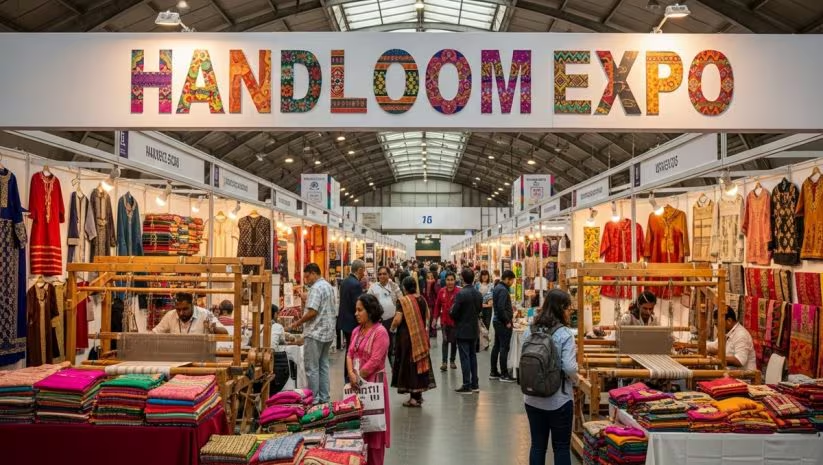
New Delhi’s Janpath district is set to host a major handloom marketplace initiative, bringing weavers from across India directly to urban consumers in a move that blends cultural preservation with inclusive economic growth. The Special Handloom Expo at Handloom Haat aims to strengthen market access for artisan communities while boosting footfall in one of the capital’s best-known retail corridors. 

Organised through the National Handloom Development Corporation under the Ministry of Textiles, the event gathered participants from 21 states, offering handwoven sarees, dress materials, home furnishings, shawls and contemporary apparel. Unlike conventional wholesale-led trade fairs, the format prioritises direct business-to-consumer sales, allowing weavers to retain a larger share of earnings and build direct customer relationships. That distinction matters in India’s urban economy. Handloom remains one of the country’s largest decentralised employment sectors, supporting millions of weaving and allied households, many in rural and semi-urban regions. Yet producers often face weak bargaining power, fragmented supply chains and rising competition from machine-made substitutes. Events such as the Delhi Handloom Expo can help narrow that gap by connecting makers with city demand. For Delhi, the location is equally significant. Janpath has long functioned as a bridge between tourism, heritage retail and everyday city commerce. Revitalising such public retail spaces with curated artisan markets can strengthen local spending, improve pedestrian activity and diversify urban commerce beyond malls and e-commerce platforms.

The timing also aligns with changing consumer behaviour. Across Indian metros, younger buyers are showing greater interest in traceable products, natural fibres and goods with cultural value. Handloom fabrics often meet these preferences while offering lower-energy production methods than mass industrial textile systems. In that sense, the Delhi Handloom Expo sits at the intersection of sustainability and lifestyle demand.Urban planners increasingly argue that climate-resilient city economies need stronger local and regional production ecosystems rather than dependence on distant, carbon-heavy supply chains. Handloom clusters, which rely more on skilled labour than energy-intensive manufacturing, can support that transition when linked to modern retail channels and digital discovery.Still, temporary expos alone cannot solve structural issues. Artisan incomes remain vulnerable to raw material costs, inconsistent orders and limited design innovation. Long-term gains will depend on credit access, branding support, logistics networks and regular urban selling platforms that move beyond festival-season commerce.The event reportedly included around 60 stalls spanning handloom and handicraft categories, indicating growing institutional interest in experiential marketplaces where commerce and cultural storytelling coexist. 

For citizens, the appeal is practical as much as cultural: direct purchases can offer authenticity, product variety and better value while supporting livelihoods that are often invisible in urban consumption chains.The broader lesson from the Delhi Handloom Expo is that sustainable urban growth is not only about metros, flyovers and towers. It is also about creating marketplaces where traditional skill, fair income and modern city demand can meet on equal terms.

Also Read: India Tactile Homes Redefine Apartment Luxury

Janpath Handloom Expo Connects Weavers Buyers
RELATED ARTICLES

LEAVE A REPLY

Please enter your comment!
Please enter your name here

- Advertisment -spot_img

Most Popular

Recent Comments

Ashiana Housing Plans 3000 Senior Living Apartments Across Chennai Region

Ashiana Housing Plans 3000 Senior Living Apartments Across Chennai Region

A major expansion in age-focused housing is set to reshape Chennai’s residential landscape, with Ashiana Housing preparing to develop nearly 3,000 apartments dedicated to...
Chaudhary Group and MLA Group Partner for JW Marriott Hotel Development in Siliguri

Chaudhary Group and MLA Group Partner for JW Marriott Hotel Development in Siliguri

A major hospitality-led real estate investment is set to reshape Siliguri’s evolving urban landscape, with plans advancing for a new luxury hotel development in...
Kerala Clears ₹3200 Crore for Thiruvananthapuram Ring Road Land Acquisition

Kerala Clears ₹3200 Crore for Thiruvananthapuram Ring Road Land Acquisition

The Kerala government has approved approximately ₹3,200 crore for land acquisition linked to the proposed Outer Ring Road connecting Vizhinjam and Navaikulam in the...
Arnya Realestates Expands Real Estate Lending With ₹1000 Crore Residential Debt Fund

Arnya Realestates Expands Real Estate Lending With ₹1000 Crore Residential Debt Fund

India’s residential real estate market is witnessing a renewed flow of institutional capital as investment managers seek to address financing gaps in housing development....
Google Commits ₹671 Crore to Lease 6.2 Lakh Sq Ft Office Space in Gurugram

Google Commits ₹671 Crore to Lease 6.2 Lakh Sq Ft Office Space in Gurugram

A major office leasing transaction in Gurugram has reinforced the National Capital Region’s position as one of India’s most significant corporate and technology employment...