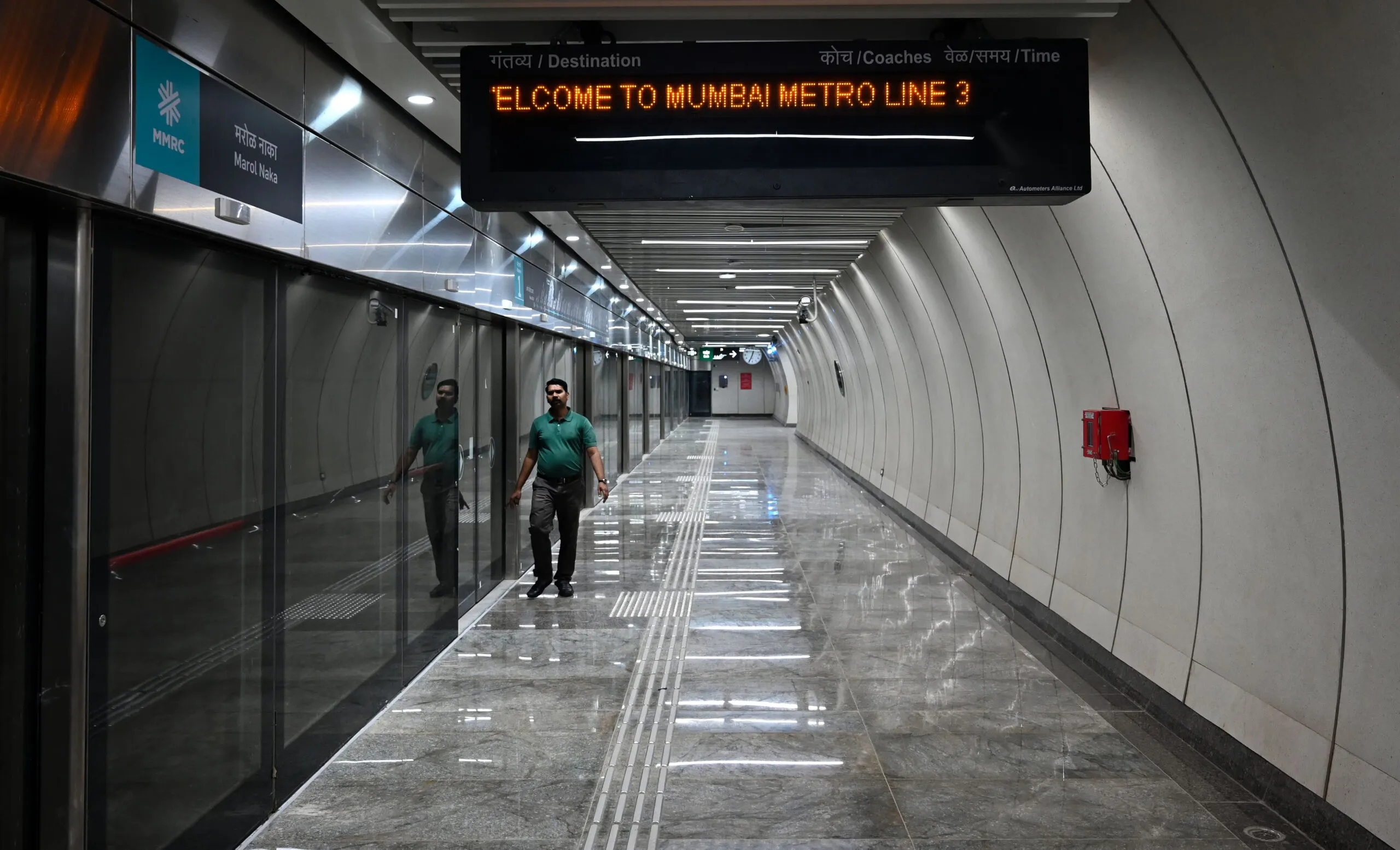
Mumbai’s underground Metro Line 3 corridor will now come under a stricter regulatory framework as the Mumbai Metro Rail Corporation (MMRC) has made its approval mandatory for any redevelopment, construction, demolition, or excavation within 50 metres of the alignment. The move, announced through a public notice dated 30 November 2025, aims to safeguard the structural integrity of the 33-kilometre Aqua Line running from Cuffe Parade to Aarey Colony and ensure citizen safety in dense urban neighbourhoods.
According to MMRC officials, the revised protocol is essential given the complex geotechnical conditions surrounding deep tunnel infrastructure. Structures located close to underground transit systems face heightened risks if construction activity is not carefully supervised. The agency has directed all property owners, cooperative housing societies, and developers falling within the 50-metre influence zone to obtain prior clearance from its planning department before initiating any form of redevelopment or structural modification.The public notice emphasised that poorly managed construction sites can pose significant safety hazards to pedestrians and commuters, including incidents involving toppling machinery, collapsed scaffolding, or falling debris. Officials noted that the requirement for advance approval is intended not as a hurdle but as a protective mechanism for both the metro system and surrounding neighbourhoods. To this end, project proponents must adhere to strict operational safety standards and conduct regular inspections of heavy equipment.
The renewed focus on safety comes at a time when interest in redevelopment along the Aqua Line is surging. MMRC has received over 30 queries from developers seeking to leverage the Transit-Oriented Development (TOD) policy introduced by the state government. The scheme allows higher Floor Space Index—up to a maximum of five—for projects located within 500 metres of ten key Metro 3 stations. Experts note that this incentive is likely to reshape several older precincts in south and central Mumbai, enabling vertical growth while promoting a shift towards public-transport-centric living. Urban planners point out that such measures are a necessary balance between redevelopment ambitions and the need for long-term urban resilience. Compact, transit-oriented growth reduces reliance on private vehicles, supports emissions reduction, and encourages walkable neighbourhoods. However, they argue that ensuring structural safety around tunnelling infrastructure is equally critical, especially in a coastal city with aging building stock.
The enhanced oversight is expected to bring more predictability to redevelopment timelines, as developers will need to factor in MMRC’s clearance stage early in project planning. For residents and housing societies, the policy offers clarity on the approval pathway while reinforcing the importance of responsible construction in high-density zones. As Mumbai continues expanding its mass transit network, the new norms underline the city’s effort to integrate safety, sustainability, and long-term planning into its redevelopment framework—an approach seen as vital to creating a resilient, inclusive, and lower-carbon urban future.
MMRC Orders Strict Approval Before Any Redevelopment Or Construction Occurs Within Fifty Metres