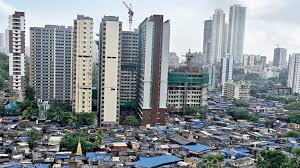
With greenfield land in Mumbai virtually exhausted, policymakers and developers are converging on cluster redevelopment as the city’s most viable path for urban renewal, signalling a decisive shift in how India’s financial capital will expand over the next decade.
At a recent industry forum in New Delhi, senior representatives from the Maharashtra Housing and Area Development Authority, industry bodies including NAREDCO Maharashtra and CREDAI-MCHI, and private developers underscored that the future of Mumbai’s housing supply lies in large-scale brownfield transformation rather than peripheral sprawl. Cluster redevelopment which consolidates multiple ageing buildings into integrated, master-planned precincts is gaining traction as infrastructure and civic services struggle to keep pace with incremental, plot-by-plot reconstruction. Officials from MHADA indicated that public-led redevelopment programmes are expected to generate thousands of housing units priced closer to construction cost, ensuring that affordability and social inclusion remain embedded within renewal frameworks. Industry leaders noted that financing patterns are also evolving. Institutional capital is increasingly evaluating large, aggregated redevelopment projects involving public agencies and slum rehabilitation authorities, given clearer land titles and coordinated planning. However, investors remain cautious about fragmented society-level redevelopments, where internal disputes and consent thresholds can delay execution.
Developers stressed that trust and governance are often as critical as financial modelling. In dense neighbourhoods, redevelopment requires alignment between resident associations, builders and authorities. Without transparent communication and time-bound approvals, projects risk cost overruns and stalled delivery a persistent concern in Mumbai’s real estate cycle. Sustainability experts at the discussion argued that cluster redevelopment presents a rare opportunity to retrofit environmental resilience into the urban core. Instead of merely replacing old structures with taller towers, integrated plans can incorporate energy-efficient façades, improved drainage networks, green buffers and waste management systems. Given Mumbai’s vulnerability to flooding and heat stress, embedding climate adaptation within redevelopment is no longer optional but essential. Urban planners point out that isolated redevelopment often overburdens existing roads and utilities. By contrast, cluster-led models allow coordinated upgrades to water supply, sewage treatment and open space ratios. When executed well, such projects can improve liveability while optimising land use in a city constrained by geography. Participants broadly agreed that regulatory predictability, digitised approval systems and innovative funding mechanisms including blended finance and rental housing models will be critical to scaling redevelopment. Without structural reforms, the ambition to transform ageing housing stock into safer, greener neighbourhoods could stall.
As Mumbai grapples with ageing buildings, rising population density and limited land reserves, cluster redevelopment appears poised to define the next chapter of its urban evolution. The challenge now lies in balancing commercial viability with inclusive growth and long-term environmental resilience.
Also Read: Versova Welcomes Ajmera Ultra Luxury Project
Mumbai Bets On Cluster Redevelopment Future