
HomeNewsMumbai BMC Expands Slum Redevelopment Push

Mumbai BMC Expands Slum Redevelopment Push

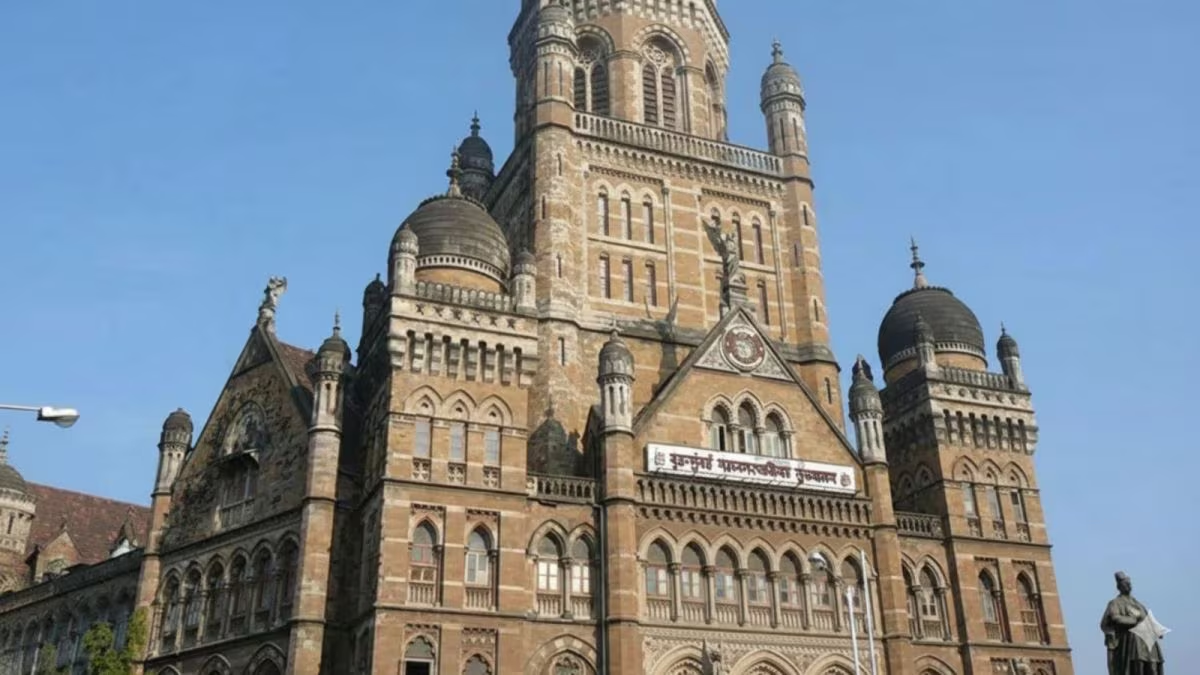
Mumbai’s civic administration has initiated a fresh round of slum redevelopment by inviting developers to participate in 26 informal housing clusters across the city, signalling a renewed attempt to unlock stalled land parcels and accelerate in-situ rehabilitation. The move is part of a wider state-backed framework that positions the Brihanmumbai Municipal Corporation (BMC) as a planning authority for select Slum Rehabilitation Authority (SRA) schemes.

According to municipal officials, the newly opened clusters span nearly 4.48 lakh square metres and include large pockets in Govandi, along with smaller settlements in Ghatkopar West, Chembur and Vile Parle. Several of these sites had previously failed to attract sufficient developer interest during earlier bidding rounds, while others are being introduced to the market for the first time.
The initiative follows a government resolution issued last year that authorised multiple public agencies to undertake slum redevelopment through joint ventures with the SRA. Of the 64 projects placed under the BMC’s planning jurisdiction, dozens have already been offered to the market in earlier phases. The current tranche reflects an effort to sustain pipeline momentum amid Mumbai’s persistent housing deficit.

Slum rehabilitation in Mumbai is structured around cross-subsidy. Developers are required to first construct free rehabilitation units for eligible residents  typically ranging between roughly 21 and 28 square metres of carpet area  before unlocking the right to build and sell additional units in the open market. Industry observers say this sequencing aims to protect rehabilitation outcomes but can affect project viability depending on land value, infrastructure capacity and market absorption. Under existing rules, only developers with prior experience in slum redevelopment are eligible to apply. While explicit consent thresholds are not mandated at the bidding stage for such government-led schemes, selected developers must undertake structured outreach and awareness activities with both slum and non-slum occupants. Experts note that transparent communication and livelihood-sensitive transition planning are essential to prevent project delays and legal disputes.

Urban economists point out that Govandi and Chembur, where the majority of land parcels are located, sit within Mumbai’s eastern growth corridor, an area seeing incremental infrastructure investment and improved connectivity. If executed responsibly, redevelopment could improve access to sanitation, drainage and safer housing while releasing land for better-planned urban form. However, past experience suggests that rehabilitation outcomes depend heavily on project execution, financing discipline and integration with local transport and social infrastructure. High-density vertical redevelopment without adequate open space, ventilation and community facilities can strain already fragile neighbourhood ecosystems.

For Mumbai   where informal housing remains a structural feature of the urban economy   the latest redevelopment push will test whether large-scale rehabilitation can align commercial feasibility with inclusive city planning. As the BMC advances its role as planning authority, attention will turn to design quality, environmental performance and long-term liveability  factors that increasingly define whether redevelopment strengthens or merely reshapes the city’s built fabric.

Mumbai BMC Expands Slum Redevelopment Push 
RELATED ARTICLES

LEAVE A REPLY

Please enter your comment!
Please enter your name here

- Advertisment -spot_img

Most Popular

Recent Comments

UltraTech Cement Stock Faces RERA Era Demand Shift

UltraTech Cement Stock Faces RERA Era Demand Shift

UltraTech Cement stock ended lower as investors weighed stronger quarterly earnings against the costs and execution risks of expanding beyond cement. The shares closed...
India RERA Projects Face New Steel Quality Needs

India RERA Projects Face New Steel Quality Needs

India’s expanding infrastructure and real estate pipeline is creating a larger role for stainless steel, but industry capacity alone may not be enough to...
Mumbai Luxury Project Moves Closer To RERA Approval

Mumbai Luxury Project Moves Closer To RERA Approval

Mumbai’s tightly held Nepean Sea Road property market has gained fresh attention after Sunteck Realty acquired full ownership of Tanirika Infrastructure for ₹22.40 crore....
Pune MHADA Lottery RERA Check Before Buying Homes

Pune MHADA Lottery RERA Check Before Buying Homes

Pune’s latest MHADA housing lottery has put 4,462 homes on the market across Pune and Pimpri-Chinchwad, with advertised prices beginning at about ₹11.55 lakh...
Delhi NCR Infrastructure Redraws Gurugram Housing Map

Delhi NCR Infrastructure Redraws Gurugram Housing Map

India’s next phase of urban growth is moving beyond established city centres as major transport projects improve access to peripheral areas. Tunnel links, ring...
