HomeBricks & MortarWonder Cement Tests Electric Trucking At Industrial Scale

Wonder Cement Tests Electric Trucking At Industrial Scale

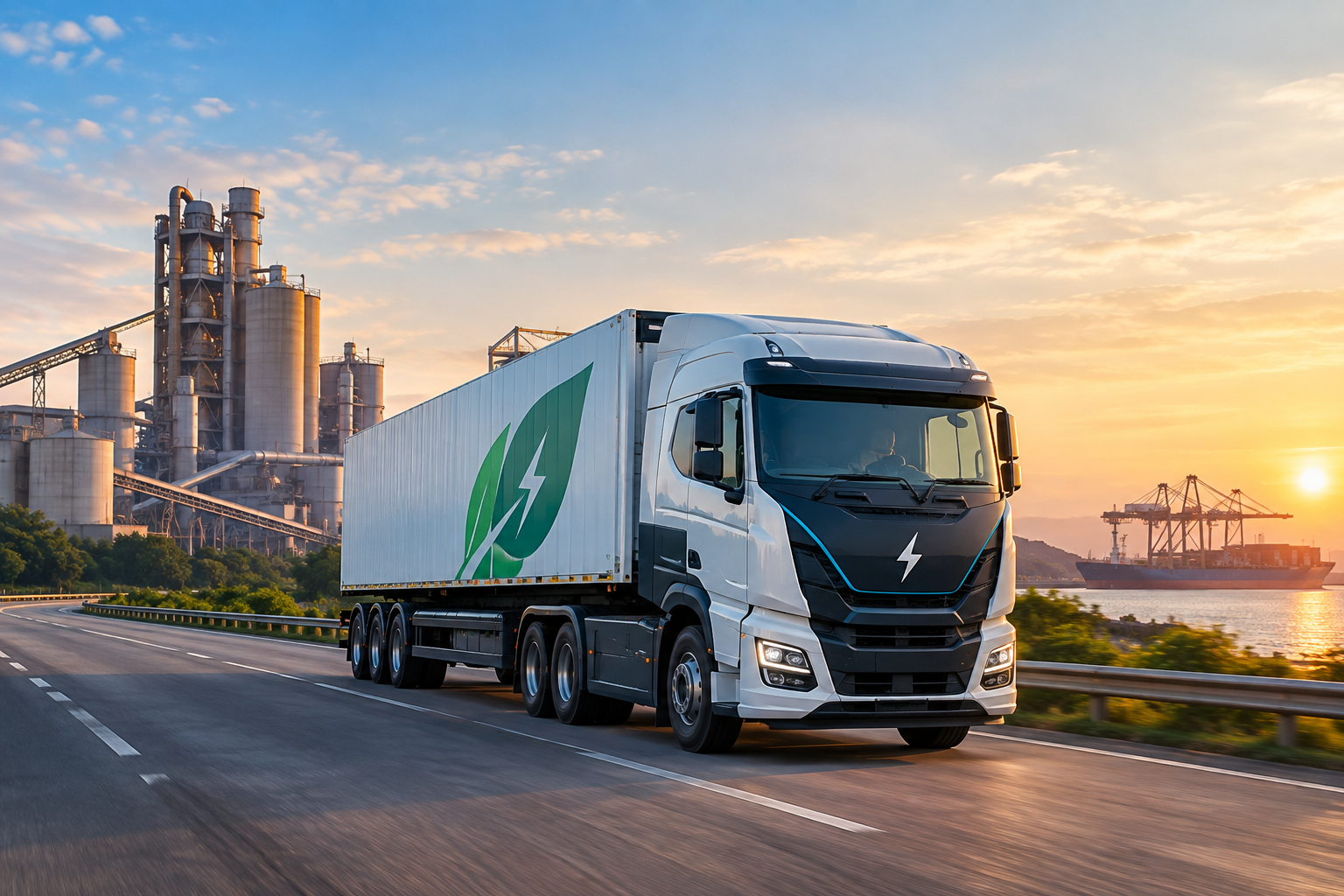
A large-scale electric trucking deployment is moving from trial operations towards routine freight movement on routes linking Rajasthan with Gujarat’s ports. Around 250 heavy-duty electric tractor-trailers are being deployed from Nimbahera, with the network crossing Rajasthan, Madhya Pradesh, Maharashtra and Gujarat. The shift matters because freight corridors are among the harder parts of transport to electrify, requiring dependable charging, high vehicle utilisation and predictable turnaround times.

The electric freight corridor connects Nimbahera with Dahej and Tuna ports over roughly 1,450 km. The first 30 vehicles entered operations from the cement plant in July, with the wider fleet now being introduced for regular commercial duties. The operators say the trucks are being used on schedules comparable with conventional diesel vehicles rather than being restricted to short-distance or demonstration runs. That distinction is important for the economics of freight electrification. Heavy trucks spend long hours on the road, carry large loads and have limited tolerance for charging delays. The corridor therefore depends on 13 dedicated charging locations, comprising 39 chargers, to keep vehicles within the turnaround requirements of industrial logistics. This infrastructure requirement also highlights a wider challenge: replacing diesel trucks at scale requires investment beyond the vehicle itself.

The vehicle being deployed has a 55-tonne gross combination weight and uses a 282 kWh lithium iron phosphate battery. Its permanent magnet synchronous motor produces up to 280 kW and 2,000 Nm of torque. The manufacturer reports a tested range of up to 198 km under a duty cycle involving a loaded journey and an empty return. A fixed-battery version can charge from 20% to full in about an hour, while another configuration uses battery swapping to reduce vehicle downtime. For cities and industrial regions, the significance extends beyond replacing diesel consumption. Freight movement supports construction, housing, manufacturing and port activity, but it also adds to transport emissions along heavily used corridors. Shifting part of this movement to electric power could reduce tailpipe emissions and noise near logistics-intensive areas, although the overall climate benefit will also depend on the electricity mix and the efficiency of charging infrastructure.

The companies estimate that the full deployment could avoid about 39,500 tonnes of carbon dioxide emissions annually. That figure is a company projection rather than an independently verified outcome, so actual savings will depend on vehicle utilisation, electricity sources, route conditions and the performance of the charging network.The electric freight corridor will ultimately be judged by more than fleet size. Reliable charging, battery performance, operating costs, grid capacity and infrastructure access will determine whether similar models can move into other cement, steel, mining and construction supply chains. That could make freight electrification a broader infrastructure question, rather than simply a vehicle technology shift.

Also Read : India Cement GST Cut Reshapes Construction Choices
Wonder Cement Tests Electric Trucking At Industrial Scale
RELATED ARTICLES

LEAVE A REPLY

Please enter your comment!
Please enter your name here

- Advertisment -spot_img

Most Popular

Recent Comments

JSW Dulux Share Split Sets New Retail Entry Point

JSW Dulux Share Split Sets New Retail Entry Point

JSW Dulux is set to implement a 1:10 equity share subdivision after shareholders approved the proposal, with October 22, 2026 fixed as the record...

Shalimar Paints Targets Premium Homes With Cooler Exteriors

Shalimar Paints Targets Premium Homes With Cooler Exteriors

Shalimar Paints has introduced a two-part exterior coating system aimed at premium housing, bringing waterproofing, heat management and decorative performance into a single application...
Ludhiana Steel Prices Put MSME Growth Under Pressure

Ludhiana Steel Prices Put MSME Growth Under Pressure

Ludhiana’s manufacturing base is facing renewed cost pressure as sharp steel price movements and reported supply constraints unsettle industries that depend heavily on the...
Tata Steel Sees Private Investment Broadening Across India

Tata Steel Sees Private Investment Broadening Across India

Private investment is showing wider signs of recovery across manufacturing, construction, technology and infrastructure, according to observations shared at the 53rd National Management Convention...
India Steel Prices Push Construction Costs Higher

India Steel Prices Push Construction Costs Higher

India’s steel market has entered a period of renewed cost pressure, with flat steel prices reaching levels last seen in 2022 as expensive coking...