The Announcement Fatigue
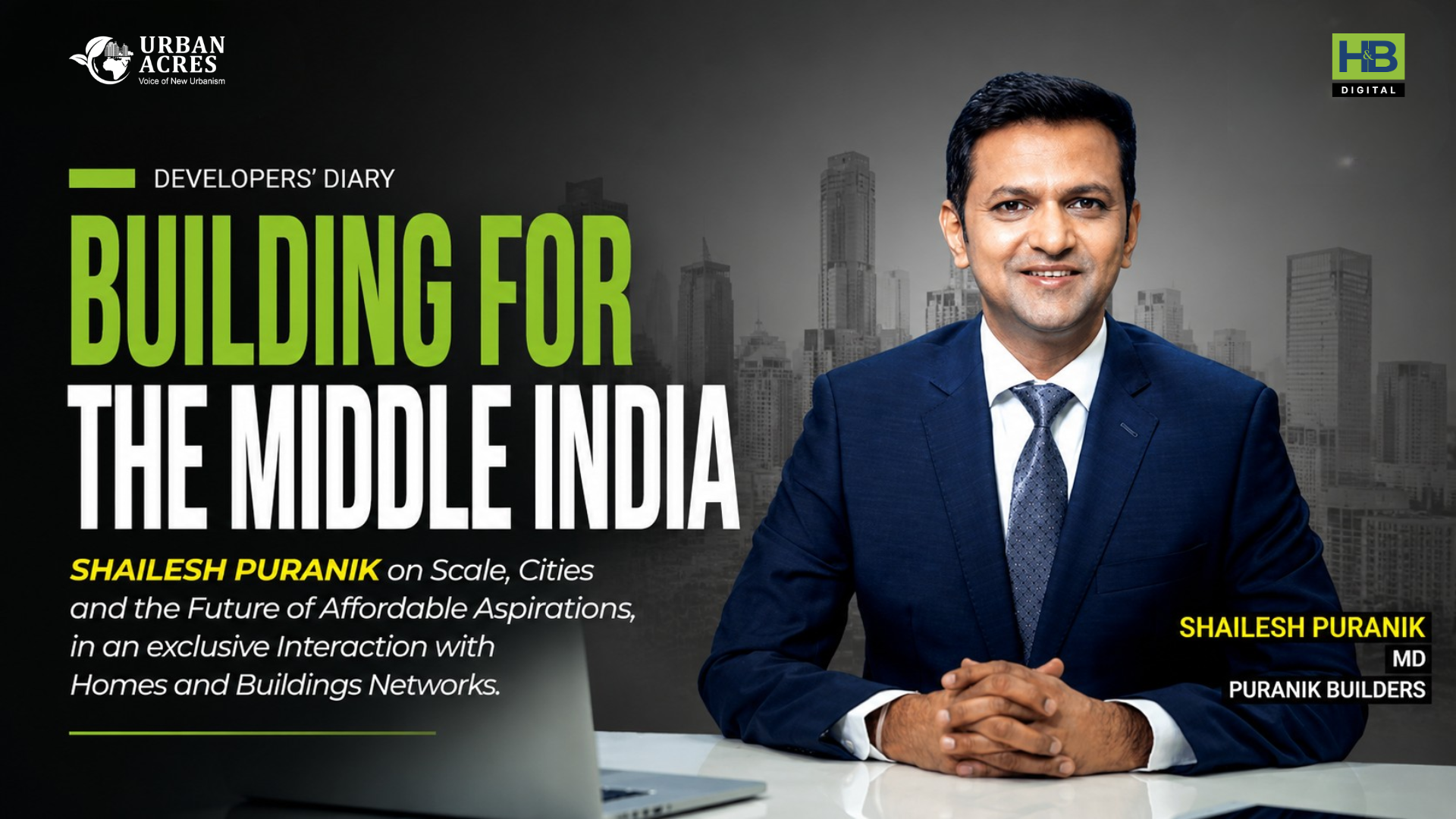
Shailesh Puranik on Scale, Cities and the Future of Affordable Aspirations, in an exclusive Interaction with Homes and Buildings Networks.
Q Puranik Group has completed over three decades in real estate — a period during which India’s housing needs, regulations and consumer expectations have transformed dramatically. How do you reflect on this journey?
Our journey is deeply rooted in architecture and city-building. My father was an architect who worked with Dr. Homi Bhabha on the BARC projects, and that exposure to institution-led development shaped our thinking early on. After completing my architecture degree in the early 1990s, I joined the family business. Together with my cousins, I began developing small-format projects, focusing on single buildings in Thane and Nashik.
Over time, as cities expanded and housing demand became more structured, we evolved with them. Today, we develop large-scale townships and gated communities across Maharashtra—from Thane and Mumbai to Pune, Nashik and Karjat. What has remained constant, however, is our focus on the mid-income segment. That is our core strength. Middle India is aspirational, value-conscious and deeply invested in long-term stability—and we have built our organisation around understanding that psyche.
Q Your portfolio shows a clear progression from individual buildings to integrated townships. What prompted this shift in scale and thinking?
Scale is not a choice anymore. It is a necessity. As land availability shrinks and cities densify, the responsibility of developers increases. Townships allow us to think beyond building and focus on ecosystems: infrastructure, mobility, lifestyle, community and long-term sustainability.
Today, we are executing projects with 5,000 to 10,000 homes in locations like Karjat, Thane and Pune. Our ambition is to have a meaningful presence across every micro-market in the Mumbai Metropolitan Region (MMR) and Pune Metropolitan Region (PMR). These regions are not monolithic; each micro-market functions like an independent city with its own demand-supply dynamics. Scale gives us the ability to respond thoughtfully to these nuances.
Q Indian homebuyers today are globally exposed and culturally conscious. How has this influenced the way Puranik Group approaches design and product planning?
Housing is ultimately a social mirror. As society evolves, architecture must respond. Today’s homebuyer is informed, well-travelled and exposed to global design languages through travel and digital platforms. This is especially true even in the mid-income segment.
We were among the early developers introducing theme-based housing for this segment. Projects like LD Espanola in Pune and Ruma Bali in Thane weren’t about superficial aesthetics; they were about storytelling and experience.
Over time, expectations have become more functional too. Air conditioning, which was once a luxury, is now a necessity, even in kitchens. Homes must support comfort, efficiency and modern lifestyles without becoming unaffordable.
Q Did the COVID-19 pandemic permanently change what Indians seek in their homes?
Without a doubt. COVID fundamentally altered how people perceive their homes. The house is no longer just a place to sleep, it is a workspace, a wellness zone and a social refuge. Demand for larger apartments, dedicated workspaces and open balconies has risen sharply. We also see a renewed preference for gated communities—not only for security, but for holistic living. Amenities like jogging tracks, gyms and green spaces are no longer aspirational add-ons. They are actively used and valued. The pandemic accelerated trends that were already emerging, and I believe these shifts are here to stay.
Q The sector has undergone structural reforms through RERA, GST and demonetisation. How do you assess their long-term impact?
RERA has been transformational. It brought transparency, accountability and discipline into an industry that was often perceived as opaque. Today, real estate is no longer unorganised. It is regulated, monitored and far more credible in the eyes of consumers.
GST, while conceptually sound, still needs simplification. The absence of full input tax credit increases costs for both developers and homebuyers. If rationalised, GST can significantly improve affordability.
Demonetisation was disruptive in the short term, but it accelerated the shift towards formal capital, cleaner transactions and institutional participation in real estate.
Q From a policy standpoint, what is the one reform the sector urgently needs?
Industry status for real estate. It is long overdue. Real estate is capital-intensive, employment-generating and central to economic growth—yet access to institutional finance remains limited, particularly for land acquisition.
Schemes like SWAMIH have helped, but they are not enough. Industry status would lower borrowing costs, improve funding access and ultimately reduce home prices. It is a reform that would benefit developers, banks, the government and most importantly, the homebuyer.
Q In markets like Mumbai, premiums and approval costs significantly inflate housing prices. Is the current structure sustainable?
Approval-related costs in Mumbai are extremely high. Between premiums, development charges, cess, GST and stamp duty, nearly 30–40% of a project’s cost goes to the exchequer. This leaves limited room for pricing flexibility.
What we’ve consistently communicated to policymakers is simple: reduce upfront costs, and economic activity will multiply. We saw this post-COVID—temporary reductions led to higher transaction volumes and increased overall revenue for the government. Affordability and revenue growth are not opposing goals; they are interconnected.
Q Sustainability is no longer optional. How is Puranik Group integrating environmental responsibility into large-scale housing?
Sustainability must be practical and scalable. Across our projects, we incorporate solar energy for common areas, sewage treatment and water reuse systems, composting and improved natural ventilation to reduce energy dependence.
We are also investing in better insulation and passive design to lower cooling requirements. With increasing government support and awareness, sustainability is moving from compliance to value creation. The objective is simple: homes that are healthier for residents and lighter on the planet.
Q There is often a perception that real estate is male-dominated. How does your organisation address gender inclusion?
That perception is outdated. In our organisation, women hold leadership roles across architecture, finance, engineering, design and even site operations. Gender is irrelevant. What matters is competence, education and commitment. Real estate needs diversity of thought. Inclusive teams build better cities.
Q Finally, how do you view Thane and the broader MMR in the context of future urban growth?
Thane sits at the geographic and infrastructural heart of MMR. Its connectivity to Navi Mumbai, the central suburbs and western corridors, makes it uniquely positioned. Social infrastructure is already mature, and future transit investments will only strengthen its role.
Over time, I see MMR and PMR evolving into a continuous metropolitan region, especially with new airports and expressway networks. We are aligning our growth strategy with this reality. We believe in building not just homes, but resilient urban communities.