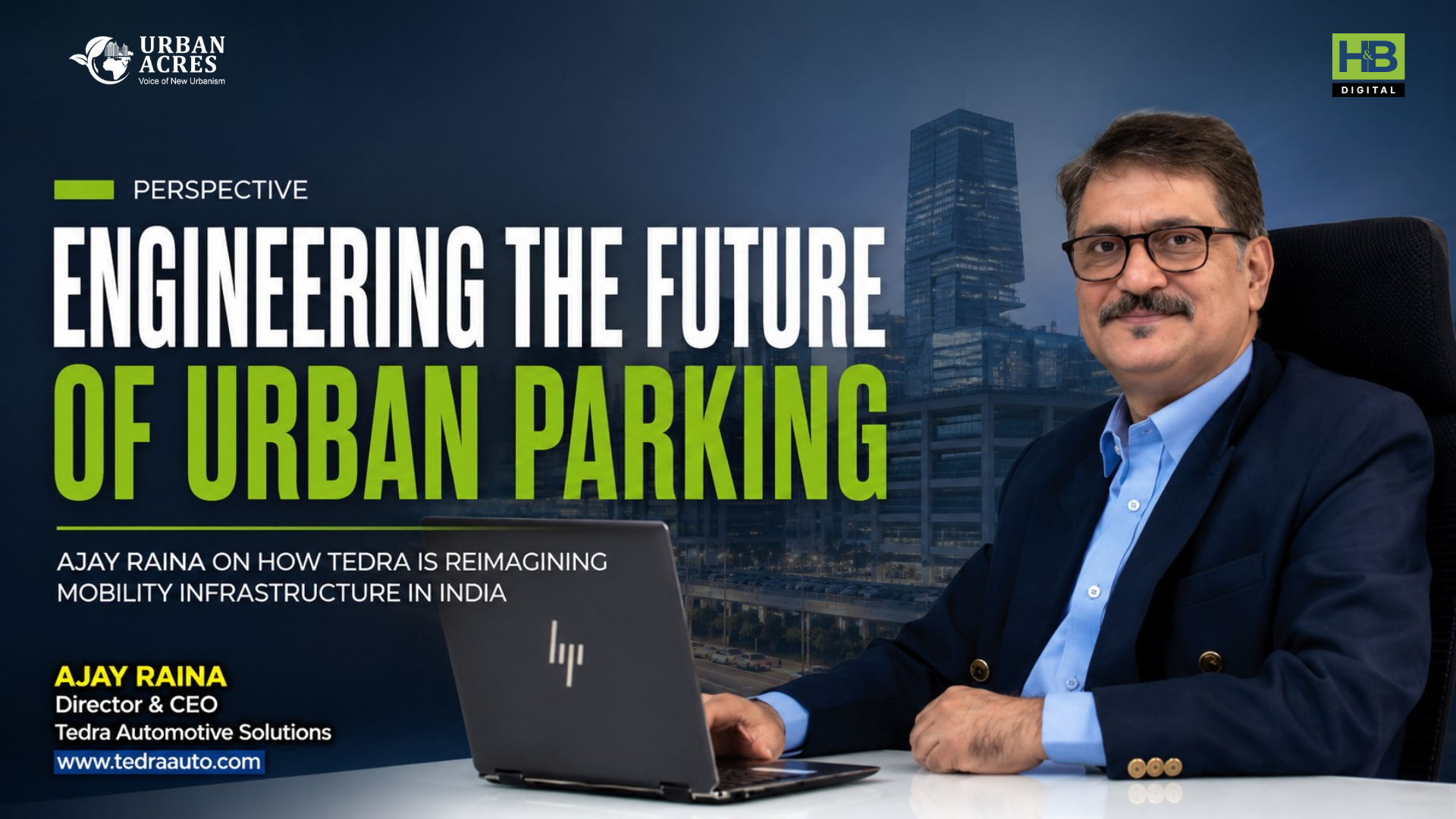
In rapidly densifying Indian cities, where land is scarce and vehicle ownership is rising exponentially, parking is no longer a backend utility—it is critical urban infrastructure. At the forefront of this transformation is Ajay Raina, Director & CEO of Tedra Automotive Solutions, a company that has evolved from a modest mechanical workshop into a technology-led mobility solutions provider.
In this conversation with Homes & Buildings, Raina outlines how engineering precision, indigenous innovation, and digital intelligence are converging to redefine parking in India.
From Fabrication to Future-Ready Mobility Systems
Tedra’s journey mirrors the evolution of India’s urban challenges.
“Back in 2011, we started as a 6,000 sq. ft. workshop with a 10-member team,” Raina recalls. “Today, we operate two large-scale manufacturing plants spanning over 2 lakh sq. ft., with a workforce exceeding 250 and a nationwide footprint.”
But scale alone does not define Tedra’s transformation. What distinguishes the company is its transition from a mechanical product manufacturer to a systems-driven mobility partner.
“Our approach has always been anchored in three non-negotiables—safety, affordability, and efficiency. Whether it’s a basic stack parking system or a fully automated robotic solution, these principles govern every design and deployment.”
This philosophy has enabled Tedra to build one of the most diverse portfolios in the Indian parking ecosystem—ranging from stackers and puzzle systems to high-density towers and robotic parking solutions.
Precision Engineering Meets Intelligent Systems
As parking systems become more complex, reliability hinges on engineering discipline and technological integration.
“At the core, parking is an engineering product—but today, it’s equally a digital system,” Raina explains.
Tedra has invested heavily in advanced manufacturing capabilities, including robotic welding, CNC laser cutting, and precision fabrication technologies. This ensures structural integrity, load consistency, and long-term durability across installations.
Equally critical is the integration of real-time diagnostics and control systems.
“Most of our automated systems are equipped with intelligent display interfaces. If there is a malfunction—whether sensor-related, motor-driven, or software-based—it is instantly identified through error codes. This allows immediate intervention, often even before the user escalates the issue.”
For large-scale installations such as towers and robotic parking, Tedra is also embedding centralised monitoring architectures, enabling remote diagnostics and faster service response—bringing the operational philosophy closer to that of elevators and smart infrastructure systems.
Reclaiming Urban Space: Parking as a Value Multiplier
In cities like and, where land economics are unforgiving, parking solutions directly influence project feasibility and profitability.
“Traditional parking consumes horizontal space. Our systems unlock vertical potential,” says Raina.
The impact is transformative:
- Stack systems can instantly double parking capacity
- Rotary systems can accommodate up to 20 cars in the footprint of just 2
- Tower parking can scale vertically to accommodate 100+ vehicles
“This fundamentally changes how developers utilise FSI. Instead of allocating large land parcels for parking, they can optimise buildable area and enhance saleable value.”
In an era where households increasingly own multiple vehicles, efficient parking is no longer a convenience—it is a critical value proposition for homebuyers.
The Sustainability Imperative: Reducing Invisible Urban Waste
One of the most overlooked contributors to urban emissions is the time spent searching for parking.
Raina quantifies this inefficiency with striking clarity:
“In cities like Mumbai, a vehicle can consume 2–3 litres of fuel per month just searching for parking. When you scale that across millions of vehicles, the environmental and economic cost is staggering.”
Automated and organised parking systems address this inefficiency by:
- Reducing vehicle idling and circulation time
- Lowering fuel consumption and emissions
- Optimising land use through vertical development
However, Raina is quick to point out that technology alone is not enough.
“To truly unlock the benefits, we need integrated urban planning—public parking infrastructure, policy support, and eventually, real-time parking data integration.”
Smart Systems, IoT & Predictive Maintenance
With the rise of smart cities, parking infrastructure is expected to function as part of a connected ecosystem.
Tedra is already embedding elements of this future.
“Our systems are equipped with diagnostic intelligence. Error detection, fault classification, and response protocols are built into the system architecture.”
In high-capacity installations, the company is exploring microcontroller-based communication systems that can transmit performance data to central hubs—enabling:
- Remote monitoring
- Predictive maintenance
- Reduced downtime
“This is where parking infrastructure begins to behave like smart infrastructure—self-aware, responsive, and data-driven.”
Make in India: Engineering Independence as a Competitive Edge
At a time when many infrastructure technologies rely on imports, Tedra has taken a firm stance on indigenous manufacturing.
“We are a 100% Made-in-India company—not just in assembly, but in engineering and sourcing as well.”
This approach delivers three strategic advantages:
- Cost efficiency through localised supply chains
- Customisation aligned with Indian urban conditions
- Quality control through end-to-end manufacturing oversight
In a sector where safety and reliability are paramount, this control becomes a critical differentiator.
R&D and the Next Frontier: Robotics & AI Integration
Innovation at Tedra is not incremental—it is institutionalised.
“As a policy, we aim to launch at least two new products every year,” Raina states.
Recent advancements include:
- Higher-capacity multi-configuration tower systems (2×2, 3×2 layouts)
- Enhanced high-rise rotary systems
- Dedicated two-wheeler automated parking solutions
The next leap, however, lies in robotics.
“We are working on fully robotic parking systems where vehicle handling will be completely automated—no human intervention. The system will park and retrieve vehicles autonomously.”
Looking further ahead, Raina envisions the integration of AI-driven parking intelligence, where vehicles can interact with city-wide parking data systems—similar to advanced mobility ecosystems in global cities.
Lifecycle Value & Service as Differentiators
In infrastructure, performance is measured not at installation, but over decades.
“Our systems are designed for a lifecycle of 25 years,” Raina notes.
To support this, Tedra has built one of the most robust after-sales ecosystems in the industry:
- A 110+ member dedicated maintenance team
- Integration with platforms like for service management
- Rapid-response protocols with real-time tracking and reporting
“This ensures not just uptime, but accountability. Every service call is logged, tracked, and resolved with complete visibility.”
Vision 2030: From National Leader to Global Player
Looking ahead, Tedra’s ambitions are both clear and aggressive.
“By 2030, we aim to be among the top three players in the automated parking industry.”
While domestic demand remains the immediate focus—driven by rapid urbanisation—the company is preparing for global expansion.
“The future of parking will be defined by automation, AI, and user-centric design. Our goal is to stay ahead of that curve—technologically and strategically.”
Closing Perspective
As cities grapple with congestion, emissions, and land scarcity, parking is emerging as a silent but critical lever of urban efficiency.
Through a combination of engineering rigour, digital intelligence, and indigenous innovation, Tedra Automotive Solutions is positioning itself not merely as a parking solutions provider—but as a key enabler of future-ready urban mobility.