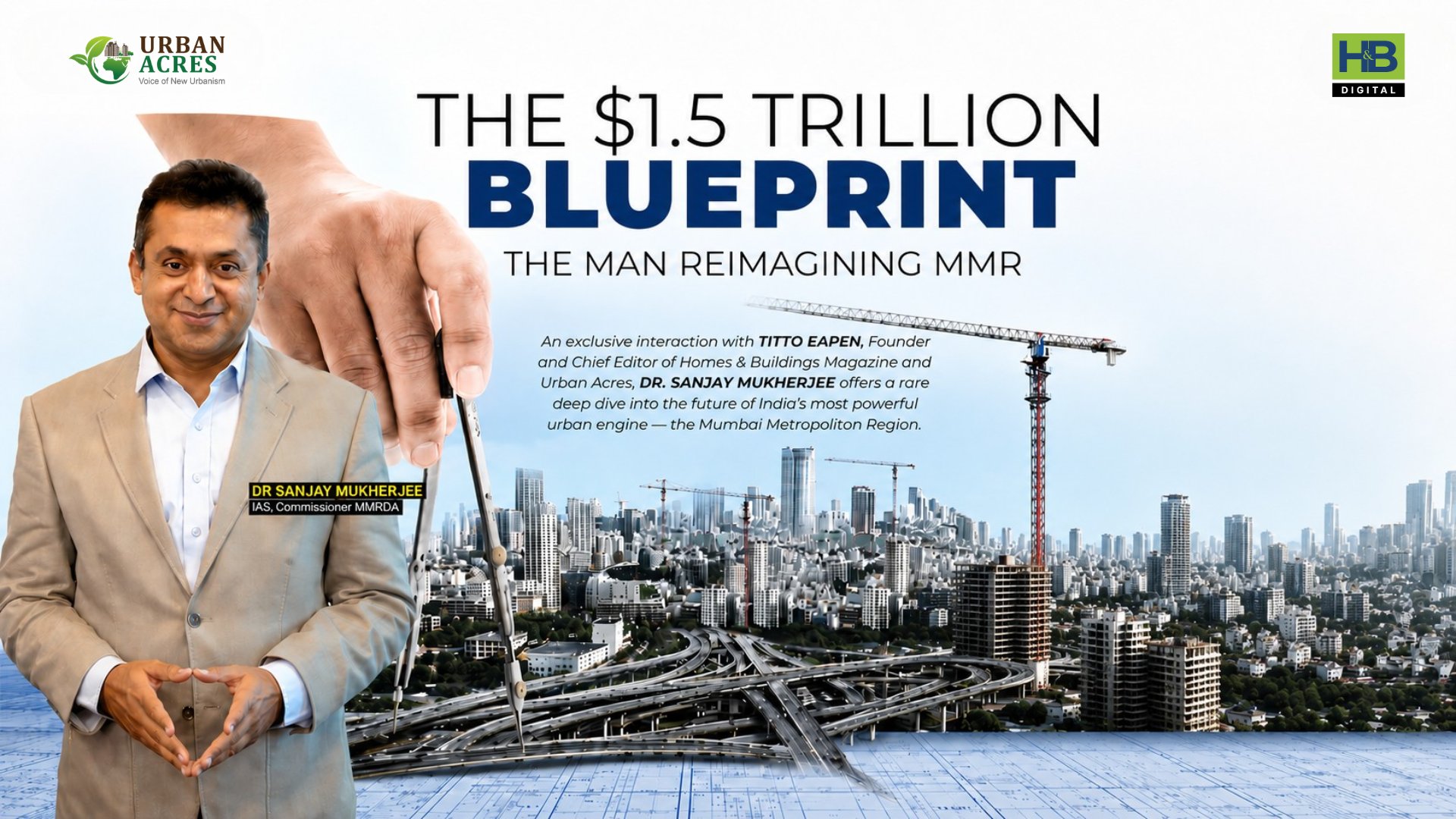
In an exclusive interaction with Titto Eapen, Founder and Chief Editor of Homes & Buildings Magazine and Urban Acres, Dr. Sanjay Mukherjee offers a rare deep dive into the future of India’s most powerful urban engine — the Mumbai Metropolitan
Region.
At a time when Mumbai is preparing for its most ambitious leap since its creation, the Metropolitan Commissioner of MMRDA opens up about the blueprint behind a $400-billion economy by 2030 and a $1.5 trillion regional vision over the coming decades. From the rise of Mumbai 3.0 to new financial districts, from transformative sea links and metro networks to inclusive housing and climate-resilient planning,
Dr. Mukherjee shares the thinking, philosophy and precision that guide the city’s next chapter.
This is not just a conversation about infrastructure. It is a conversation about identity, growth, sustainability, and the future of urban India — with the man reimagining Mumbai for the world.
Q Dr. Mukherjee, we know you as the force behind Navi Mumbai’s transformation and today as the man building a ‘Third Mumbai’ through projects worth nearly ₹3 lakh crore — something no country in the world is doing at this scale. But before the visionary, there’s a story — the child, the student, the young aspirant who chose public service. Take us back to the beginning. Where did your journey start, and what shaped the civil servant you eventually became?
I was born in the early ’70s in Nagpur — the heart of India. I studied at Somalwar High School, a school we proudly joked was ‘world-famous in Nagpur’. After 12th, I joined Government Medical College, but during my internship I decided to attempt the Civil Services. I cleared the IPS on my first try, and with some encouragement, appeared again and made it into the IAS the next year, fortunately in the Maharashtra cadre.
Along the way, I completed Level-1 of the CFA programme and a BA in History and Public Administration to strengthen my understanding of governance.
My first posting as a probationer was in Thane. I handled independent charge of several municipal councils — Mira Bhayander, Nalasopara, and others — and then served in Palghar, Dahanu, and rural Latur where the earthquake reconstruction was underway. Soon after, I became the country’s youngest Collector in Jalgaon.
My entry into large-scale infrastructure came in Nagpur as Joint MD of the Maharashtra Airport Development Corporation, working on MIHAN. We raised ₹238 crore through land mortgage without a government guarantee. It was my first real lesson in project finance. I later served as Collector of Nagpur and Chairman of the Nagpur Improvement Trust.
Mumbai happened when I was posted to the State Excise Department — a role that still makes me smile. In four years, we grew excise revenue from ₹5,000 crore to ₹14,000 crore, a 30% annual growth rate that continues even today.
At BMC, as Additional Municipal Commissioner (Projects), I handled the Mumbai Coastal Road — redesigning it, securing approvals, and launching execution. Then came the Medical Education Department — and COVID. After the pandemic work, I moved to CIDCO for three years before being appointed to lead MMRDA.
And that’s the journey — from Nagpur’s school corridors to steering one of the world’s largest urban transformation programmes in MMR today.
Q For the past decade, I’ve watched your work closely. And when we trace the evolution of MMR, your imprint is unmistakable. But one chapter that always stands out is CIDCO — a rare example of a city imagined on paper and built almost exactly as planned. With an international airport rising, JNPT reinventing itself, and global-scale infrastructure pouring in, Navi Mumbai is on the brink of becoming a world address. When you look back, does Navi Mumbai today reflect the blueprint you once envisioned? Or, as a planner and administrator, do you feel there are still pieces that could have been pushed further, done differently, done better?
Navi Mumbai is one of Maharashtra’s proudest urban stories — a bold idea that actually worked. And its roots go back to a remarkable political decision in the 1970s. Leaders at that time understood that Mumbai, as India’s financial capital, would keep swelling, and the only way to protect it was to build a satellite city with the same ambition, the same scale.
The land that eventually became Navi Mumbai was almost barren. But once it was notified as a new town, something unique in Maharashtra’s legislation came into play — CIDCO received the authority to acquire all land within the notified boundary. The state initially acquired land on CIDCO’s behalf, but as CIDCO strengthened financially, it took charge of land acquisition itself. With that, the organisation began crafting one of the most comprehensive
master plans the country had ever seen.
What set Navi Mumbai apart, though, wasn’t just its planning, it was the dignity with which CIDCO treated the people whose land built the city. The project-affected families were placed at the core of the development model: the famous 12.5% developed land formula, scholarships, employment opportunities, and structured schemes that ensured they rose with the city, not despite it. This is why their economic progress today is so visible, and why entrepreneurship thrives in many of the nodes.
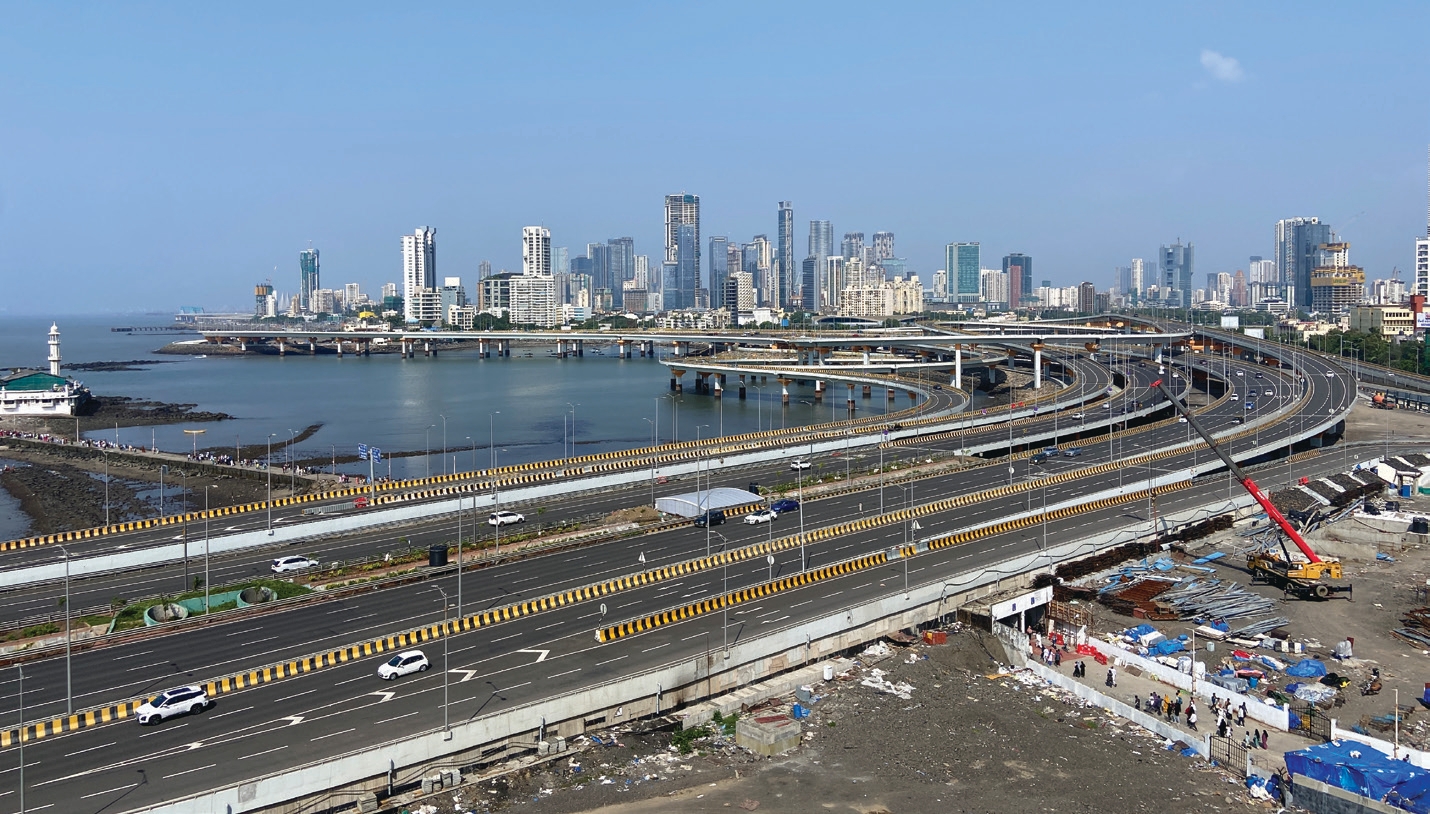
If something held back the Navi Mumbai story in its early years, it was connectivity. The north had Vashi and Airoli, but the southern belt remained isolated. With the completion of Atal Setu, that barrier has finally dissolved. The entire southern hinterland, for
decades waiting for a direct link, is now open. And here again, proactive political leadership deserves credit; completing a project of that magnitude transforms not just traffic but destiny.
Could more have been done? Of course. Any administrator looking back honestly will say there’s always room for improvement. But what excites me is the next chapter. Two massivenew cities — KSC New Town, often called Mumbai 3.0, and CIDCO’s NAINA — are now taking shape. Add the Navi Mumbai Integrated Industrial Area being developed by Reliance, and suddenly you are looking at nearly 650 square kilometres of land that will evolve into a true fourth-generation urban ecosystem.
And a modern city cannot be exclusive. It must echo Mumbai’s own character — a place where the richest and the most modest dreamers can both build their futures. A place where diversity is not an outcome but the foundation. For any city to succeed, it needs that mix, that inclusivity, that sustainable balance.
That, to me, is the real promise of the Navi Mumbai story — a city built on vision, on fairness, on ambition, and now entering a phase where its scale could rival the world’s most futuristic urban centres.
Q One of the most significant responsibilities you handled at CIDCO was the Navi Mumbai International Airport, a project that remained stuck for nearly 12 years. Under your tenure, the project finally began moving, and the pace at which it progressed over the last few years has been remarkable. How do you look at the airport’s journey today? And once it becomes fully operational, what kind of impact do you foresee on MMR’s overall growth trajectory?
When the Navi Mumbai Airport was initially conceived, a study had estimated that it had the potential to increase India’s GDP by almost 1%. That gives a sense of how transformative this project is. Along with the Mumbai Trans Harbour Link, it is one of those rare developments that can fundamentally alter the region’s economic landscape.
When I took charge of CIDCO in 2020, the project was facing several major challenges. The then concessionaire was unable to move the work forward, and CIDCO too was struggling to break the deadlock. Around the same time, there was a change of ownership at the parent company level. Adani Airports took over Mumbai International Airport Limited and became the controlling stakeholder in the Navi Mumbai Airport as well.
But even with a new concessionaire, the groundwork still had to be completed.
- Land acquisition was pending.
- The river diversion had not yet been executed.
- High-voltage transmission lines needed to be shifted.
- And around 11,000 people still had to be resettled.
What I am proud of is that all of this — land acquisition, resettlement, river diversion, hill cutting, and utility shifting — was completed within a year to a year and a half. And importantly, it happened without any confrontation. There was no forced eviction, no negative headlines. Every family moved voluntarily. Even the last person who had approached the High Court eventually asked to relocate on his own, and CIDCO gave him that opportunity.
CIDCO built new towns for the project-affected families, and their 12.5% developed land entitlement was allotted in the new Pushpak Nagar. When project-affected people are placed at the centre of the planning process, development becomes far smoother and more humane — and that is evident in this case.
Another crucial milestone was financial closure. Under SBI’s leadership,
a consortium of lenders extended the required credit line. This was followed by a Pragati meeting chaired by the Hon’ble Prime Minister, where clear timelines were laid down for both the government and the concessionaire. Once timelines are fixed, everyone knows exactly what needs to be done.
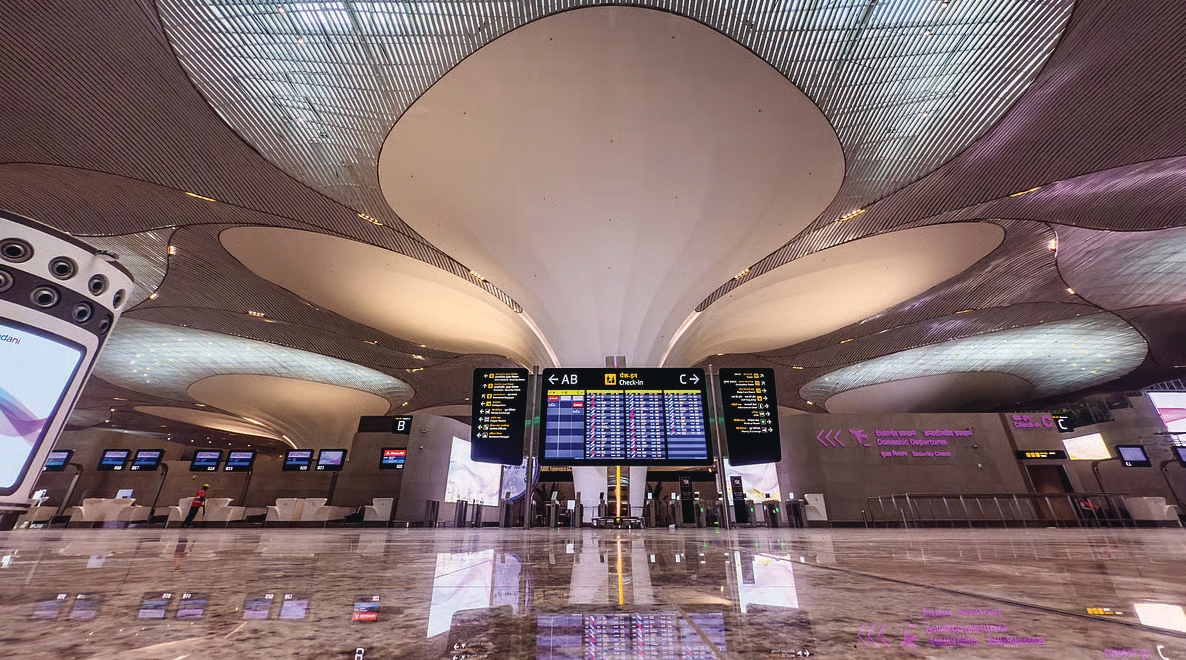
Today, the airport is essentially complete. And the impact on MMR will be immense — from economic expansion to new employment hubs, improved logistics, and the opening up of entirely new growth corridors. The airport will not just support Mumbai’s growth; it will redefine it.
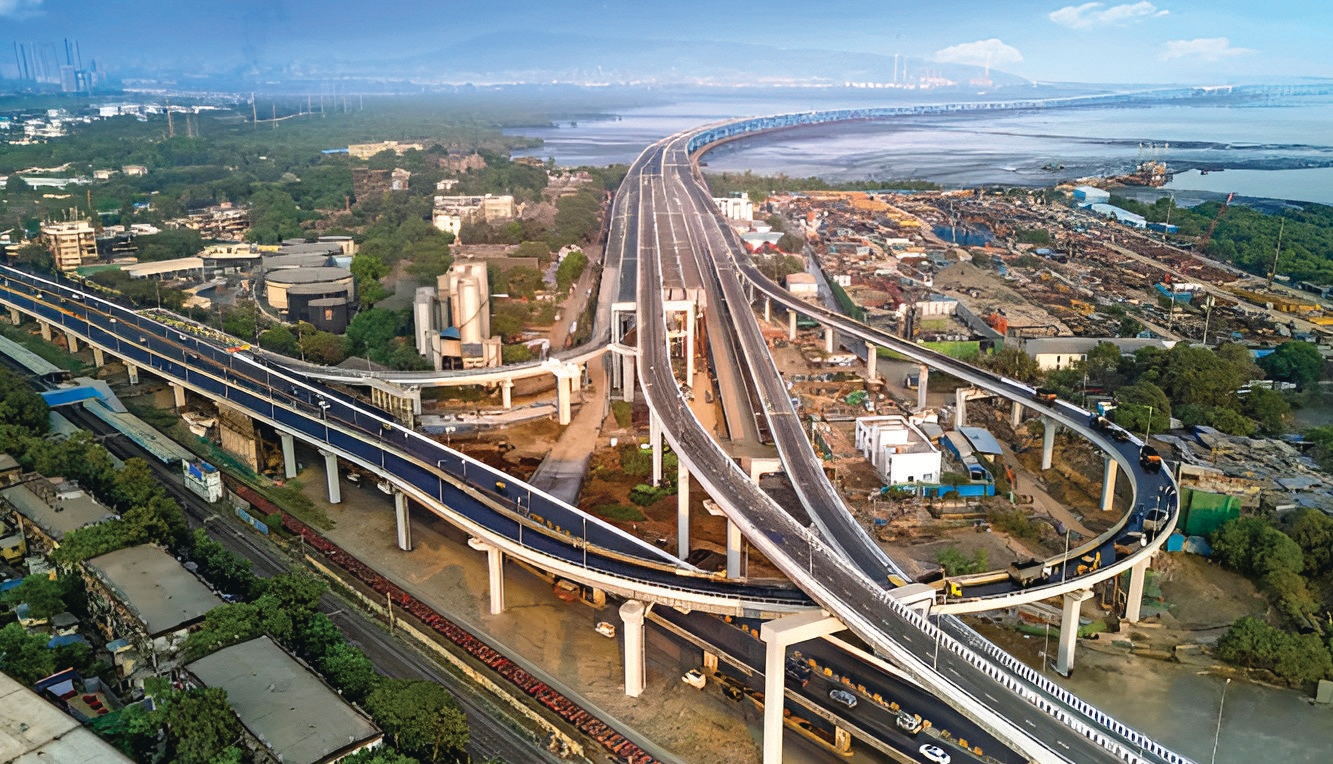
Q Today, you’re leading MMRDA — an organisation handling an enormous scale of work: over 350 km of Metro corridors, more than 200 km of new road networks with sea links, tunnels, and expressways, along with plans to create future-ready growth hubs. How different is this challenge compared to CIDCO? And how prepared is MMRDA financially to deliver such a massive infrastructure push over the next five years?
The scale is completely different.
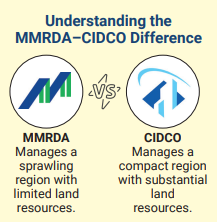
CIDCO, although extremely important, is a more compact organisation with a defined project area — essentially Navi Mumbai, from Airoli to JNPT, and now the NAINA region. MMRDA, on the other hand, is spread across five districts, covering a far larger and more diverse geography. Our KSC New Town, what people call Mumbai 3.0, lies even beyond NAINA, extending to where the Atal Setu lands and further. Managing such a sprawling region is naturally a far bigger challenge.
The second major difference is the financial model. CIDCO has a substantial land bank, which gives it the advantage of land monetisation to support its projects. MMRDA’s land bank, however, is primarily BKC, and most of that land has already been sold over the years. That means we must rely on stronger financial structuring and robust project appraisal, rather than land resources, to fund our infrastructure.
I’m happy to say that we have now achieved financial closure for all our major projects. Every significant project has been assessed and appraised by a top financial institution — and only after that appraisal has funding been sanctioned. We are working with the leading financial institutions of India and the world, including global lenders, domestic banks, and premier development finance institutions of the Government of India.
Very recently, the Hon’ble Chief Minister witnessed the signing of a MoU between MMRDA and these development financial institutions amounting to ₹4.07 lakh crore. That’s the scale of credit line available for our future infrastructure programmes.
But it’s important to be clear: this is not an open cheque for uncontrolled spending. Funds will only be drawn up for projects that have clear financial closure, meaning the project can eventually pay for itself. If a project is not financially viable, MMRDA does not have the cushion to take it up casually. Sustainability and accountability are essential factors for our funding model.
Q When people compare Delhi Metro with Mumbai Metro, the pace often becomes a point of discussion. Yes Mumbai’s terrain is far more complex — underground water, rivers, heritage precincts, salt pans, and extremely dense neighbourhoods. At a fundamental level, what has really shaped the pace of the Metro in Mumbai? Is it financial constraints, or are there deeper structural and environmental realities that explain why the timeline looks different from Delhi?
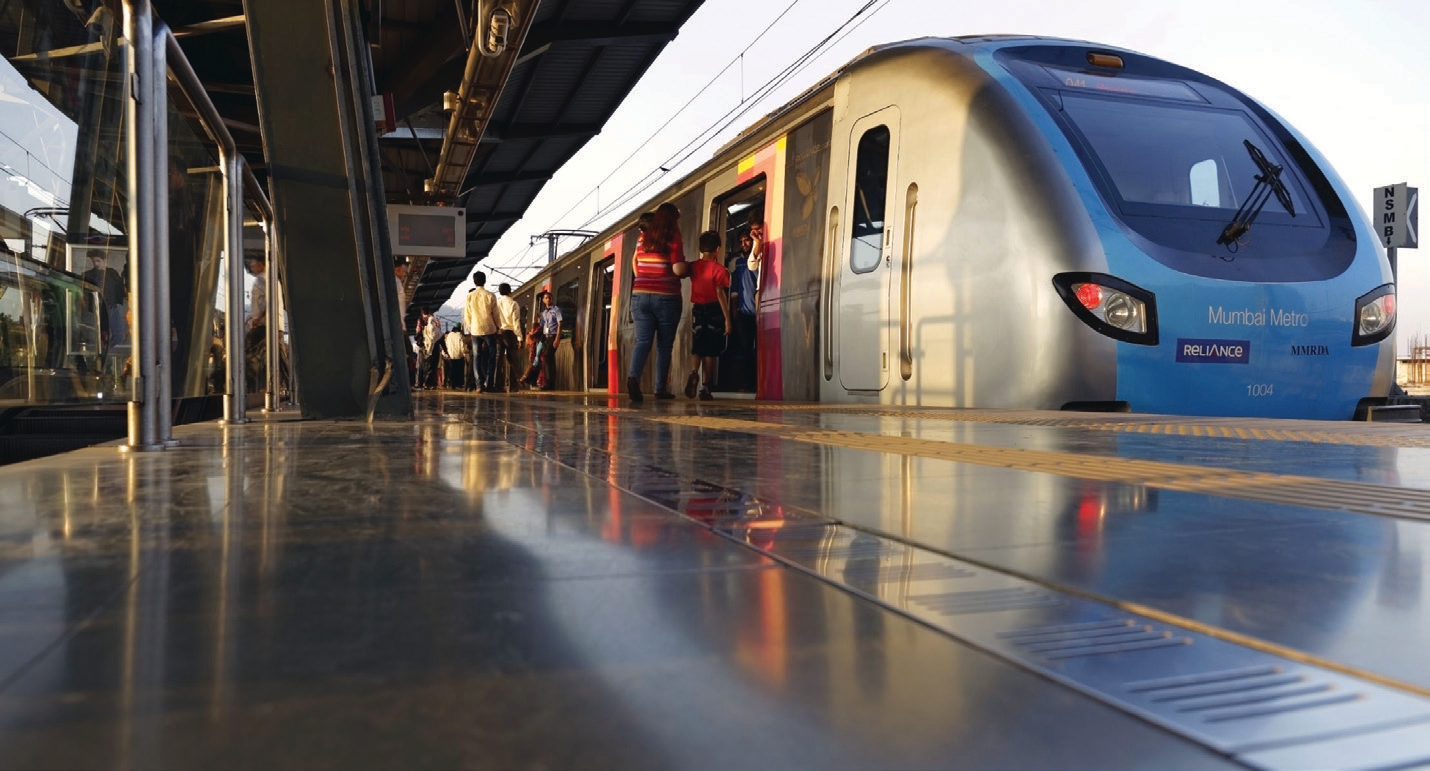
I would hesitate to compare Mumbai Metro with Delhi Metro. The two cities are built very differently, and the challenges are not comparable. Also, it’s not entirely accurate to say that Mumbai’s Metro has been moving slowly for 12 or 15 years. Line 1 was completed on time. After that came Line 3, one of the most complex underground corridors in the country, and today MMRDA is already operating four metro lines.
If you add the Navi Mumbai Metro, which we commissioned at CIDCO, Mumbai now has close to 100 kilometres of operational network. Most of these projects began only in the last few years, not a decade back, and they involve exceptionally difficult engineering.
Mumbai’s biggest challenges are very specific to Mumbai. Much of the land falls under CRZ, salt pans or environmentally sensitive zones, so getting permissions takes time because compliance is essential. The city’s density is unlike any other: you’re building in the middle of continuous traffic, not in isolated corridors. That makes even routine construction far more complex.
Then there is the human element. Mumbai has a large number of project-affected families, and our responsibility is to resettle them properly. We do not move ahead unless resettlement is done in a dignified and complete way. It’s the right approach, but naturally, it extends timelines.
Sustainability is another dimension. Every major project needs to pass through several environmental and safety approvals. For MMRDA — and for me personally — sustainability is not an afterthought; it is central to how we plan. And of course, financing is different too. The metro lines handled by MMRDA are not funded by the Government of India. They are funded by the Government of Maharashtra and by MMRDA itself, through debt raised only when a project can pay for itself. That financial discipline also shapes the pace.
What is important is that work has never stopped. If you visit any metro site, you will see activity everywhere. Trials are already underway on two lines. The Hon’ble Chief Minister has set a clear direction that most of the metro lines should be completed in the next two financial years, and we are firmly on track.
So, I would respectfully disagree that Mumbai is slow. Mumbai is complex. And against that complexity, the progress being made today is significant and steady.
Q There was a plan at one stage for the government to take over Metro Line 1. You were also in a legal dispute with the private partner. What is the status of that situation?
The Government of Maharashtra has taken a clear decision on this — the cabinet has decided not to pursue the acquisition of Metro Line 1. So, as of now, there is no plan to take over that line or any other privately operated metro corridor.
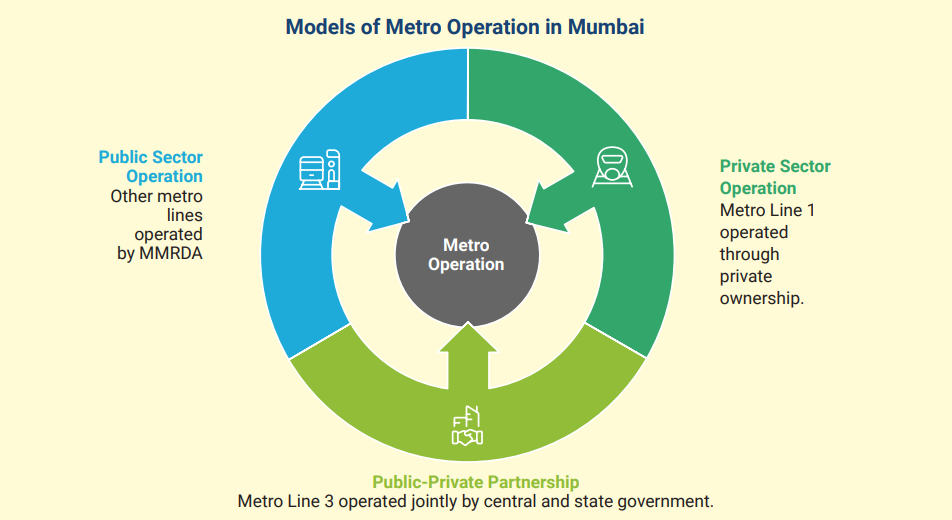
Metro Line 1 continues to be operated by Reliance Infrastructure Limited through Mumbai Metro One Private Limited. MMRDA holds a 26% minority stake, but operational control lies entirely with the concessionaire. And that is how it should be. Mumbai is a city where the private sector has always played a strong role, and public–private partnerships work best when each side respects the other’s space. The company runs the system independently, while regulatory approvals, where required, come to government bodies like BMC, MMRDA or the relevant state departments. Interestingly, Mumbai now has all three models functioning together.
- One metro run by the private sector.
- One (Line 3) operated through an equal partnership between the Government of India and Government of Maharashtra.
- And the rest run entirely by MMRDA.
Despite these different models, the passenger experience is unified. The National Common Mobility Card is now active, so commuters can use a single card across all metro lines. That’s the direction we want to move in — coordinated mobility, even with diverse operating structures.
Q In our conversations with major infrastructure stakeholders in Mumbai, a recurring theme is the complexity of approvals and clearances. Mumbai has multiple agencies — MMRDA, SRA, MHADA, heritage authorities, and the Urban Development Department — all operating within the same geography.
Does this decentralised structure create hurdles for large infrastructure projects? And do you believe Mumbai needs a more centralised mechanism, a common platform where all stakeholders align their priorities? Is there any such thinking or proposal within the Maharashtra government at this stage?
I am not aware of any formal proposal of that nature, although from time to time there has been discussion about having a ‘CEO of Mumbai’. But in my view, the Chief Minister of Maharashtra is effectively the person who leads the state, and Mumbai is very much at the centre of that leadership.
MMRDA itself is designed as an overarching coordinating body. The Municipal Commissioner of Mumbai, the commissioners of other municipal corporations, elected representatives — all of them are part of our Authority. So, the structure already ensures that every major stakeholder has a seat at the table. This system has worked well in terms of coordination, decision-making, and resolving issues across agencies.
As far as approvals and clearances are concerned, they are part of planned and sustainable development. If a project needs permission, then that is simply an essential step in the process. Timelines must be factored in during planning; the key is to anticipate them rather than be surprised by them.
We also must recognise that specialised agencies exist for a reason. SRA focuses on slum redevelopment. MHADA looks after building redevelopment. The municipal corporations handle civic functions. MMRDA handles arterial roads and major infrastructure across the metropolitan region. Each organisation works within its mandate, and that division of responsibility is necessary in a city as large and layered as Mumbai.
The Government of Maharashtra keeps a very close watch on all major projects, and Mumbai receives continuous attention because of its importance to the state and the country. In my view, the current ecosystem functions well, and the leadership in place ensures that coordination happens when it is needed.
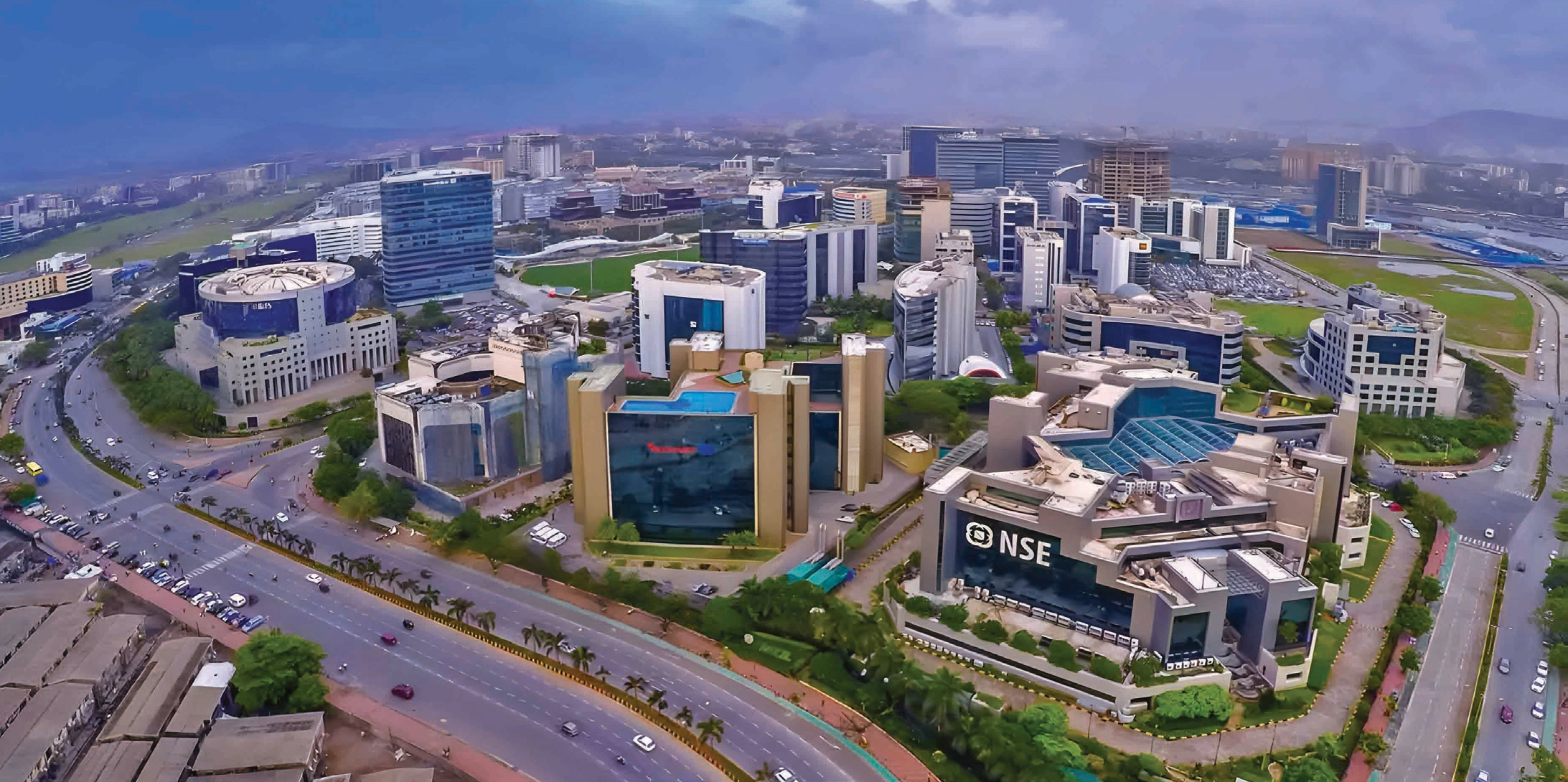
Q MMRDA’s primary land bank has traditionally been BKC. One more concern is that Mumbai has not created any major new business district after BKC. Most other parts of the city are becoming increasingly residential. As a result, we are beginning to see a kind of brain drain — high-value professionals from finance, IT and other knowledge sectors are moving to other states or countries, while the city continues attracting mostly unskilled or semi-skilled workers. This increases pressure on the urban core and reduces Mumbai’s competitiveness. In that context, what is your plan to create more BKC-like commercial hubs — places that offer affordable office spaces and lower establishment costs — so that Mumbai can retain and attract top talent? Is there a concrete roadmap for this?
On the point about brain drain, I believe it requires deeper study. Mumbai’s defining strength has always been its inclusivity, and people across all categories — from highly skilled professionals to blue-collar workers — continue to see opportunity here. But since this is not my specific area of expertise, I will not comment beyond that.
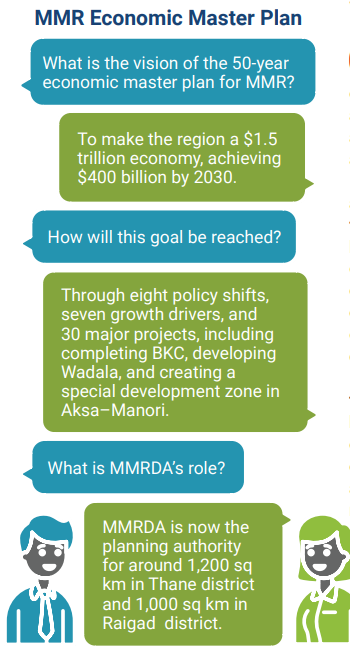
As far as developing another BKC is concerned, it is important to remember what BKC was originally designed to be — an international financial hub. It was built with a very clear purpose, and over time it has grown into exactly that. With similar long-term thinking, we worked with NITI Aayog to prepare a 50-year economic master plan for MMR, with the vision of making this region a $1.5 trillion economy, and achieving $400 billion by 2030. To reach that goal, we have identified eight policy shifts, seven growth drivers and 30 major projects. Among these:
- Completing the remaining development of BKC
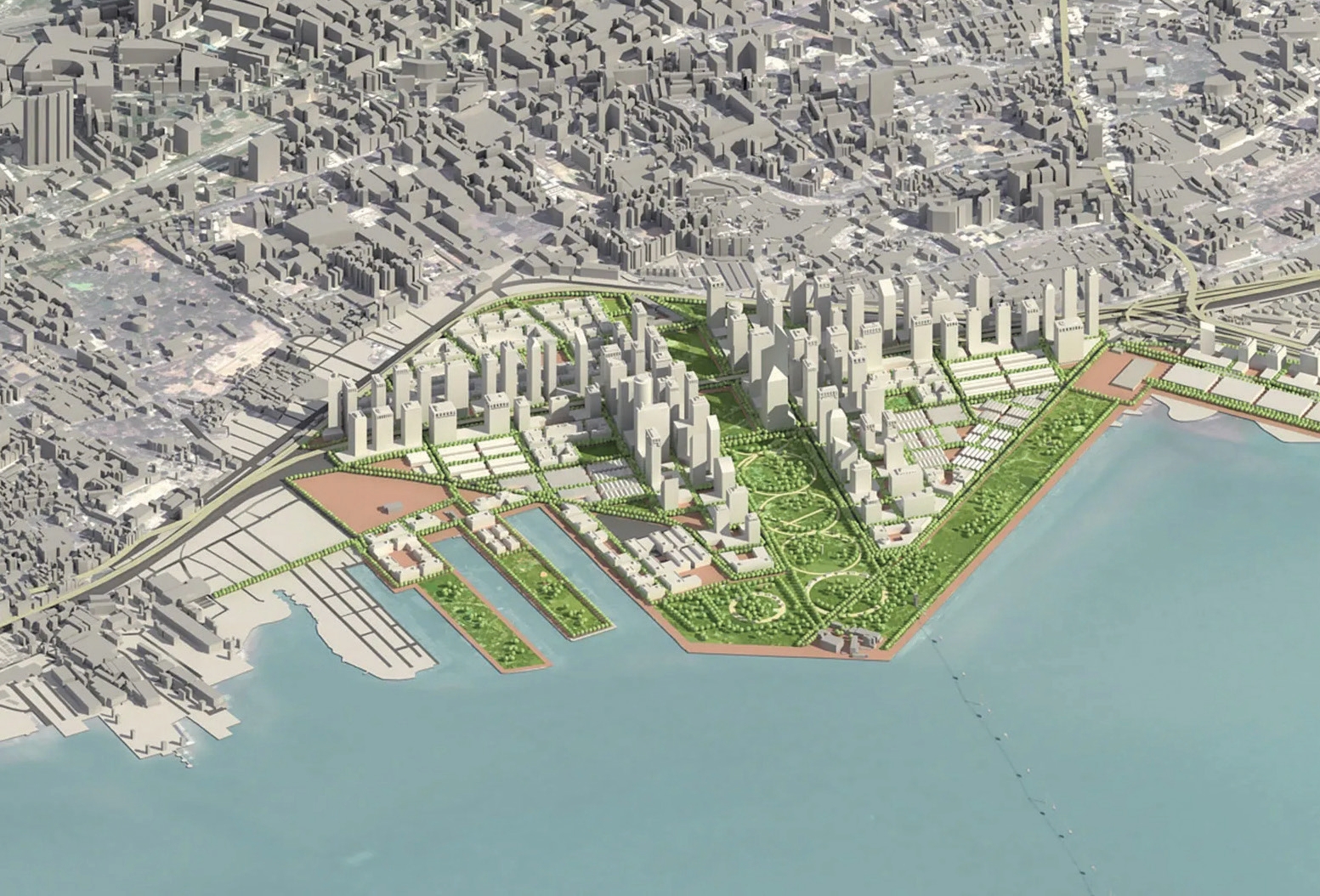
- Developing Wadala as a major commercial hub — an announcement you will hear very soon
- Creating a special development zone in the Aksa–Manori coastal belt, comprising about 265 hectares of government land, which is larger than the initial BKC land
These are already part of the roadmap.
Beyond that, the larger future lies in the KSC New Town — Mumbai 3.0. I am also pleased to share that the state government has decided to transfer 33,954.31 hectare land from the state revenue department to the MMRDA to create basic infrastructural facilities, as well as to monetise it so that it can fund key infrastructure projects. These land parcels are spread across Thane, Raigad and Palghar districts..
As we prepare the new Development Plan, we will identify multiple growth centres — each with a focused economic purpose. Some may specialise in logistics, some in specific industries, others in emerging service sectors. These centres will help create affordable, well-planned commercial ecosystems across the region, reducing pressure on the traditional city core.
People often ask when this will materialise. It’s important to remember that area development is a long-term exercise. BKC began in 1975 and continues to evolve even today. Our goal is not speed alone, but sustainable, future-ready, balanced growth. The planning and financial groundwork for that future has already begun.
Q I’m very tempted to ask you something from the perspective of an observer, a layman and a journalist. We speak about a Third Mumbai, a New Mumbai — but when I look at the existing city, I often feel that barely 20% of Mumbai is truly developed. Nearly 30–40% of land is occupied by slums, another major share lies with old housing societies, and a significant portion consists of large institutional and industrial land holdings.
Just along the eastern waterfront, there’s almost an entire alternate Mumbai sitting idle: 900 hectares with Mumbai Port Trust, over 600 hectares with ONGC, plus land with BARC, Tata Power, RCF, BPCL, and several private players. Add salt pan lands, and we are talking about 10,000 acres lying unused for decades. Alongside this, we are living in a time of sensitive geopolitics and serious climate challenges.
Many of these installations are legacy-era industries — some coal-based, some high-emission, some with radiation-related concerns — and naturally, they raise questions about urban suitability in today’s context. So, my question is, within the larger planning vision for MMR, is there any discussion or thought around relocating such industries to more appropriate zones with modern emission standards, and freeing this land for newer forms of development? Is this conversation taking place at any level?
These are very loaded statements, and we need to approach them with caution. When we describe any installation as hazardous or polluting, we must remember that every facility you mentioned operates only after receiving all requisite permissions. These are not arbitrary operations. They are governed by strong regulatory frameworks, and the people running them are equally responsible citizens, as conscious of safety and environment as any of us.
Second, the idea of what is ‘developed’ or ‘undeveloped’ also needs nuance. A city does not become better simply by converting every parcel of land into a concrete cluster. Green spaces, open tracts, and institutional buffers are equally important. Not every empty expanse is meant to be built upon, nor should urban planning be driven only by construction.
The issue of slums, however, is a very real and very important one. The Government of Maharashtra has already introduced a new policy on housing and slum redevelopment. MMRDA itself has taken up the redevelopment of the Ramabai Ambedkar Nagar slum, nearly 17 hectares, and the site has been fully vacated. Work will begin very soon. This is a priority because dignified housing is central to creating a humane city.
But when we talk about the broader vision, I believe cities must grow organically. Transformations happen in phases, over time, and in ways that balance economic needs, environmental responsibility, and social realities. Sudden or forced change is neither practical nor sustainable. The discussions you refer to — about long-term land use, about shifting certain activities, about future urban forms — are part of ongoing thinking across various levels of government. But they must be rooted in careful planning, environmental responsibility, and legal frameworks, not just broad assumptions.
Mumbai’s evolution has always been gradual, layered, and resilient. That process must continue thoughtfully, not abruptly.
Q My earlier question wasn’t about blaming or labelling any installation as polluting. It was more about the global compulsion to decarbonise cities. Mumbai, too, has long-term climate commitments — 2050, 2070. In that larger context, do you believe such large industrial plants and legacy-era facilities can realistically continue in the same form within the city?
In the larger climate conversation, it’s important to acknowledge where India stands. Recently, it was recognised that India is the only country that has met its committed targets toward net-zero. No other nation has achieved that level of compliance. So, I think it’s equally important to look at what has been accomplished, not just at what remains to be done.
There’s a story that illustrates this. Imagine a room with beautiful tiling, and in one corner there’s a single tile that doesn’t match. Two people walk in. One says, ‘What a beautiful room’. The other points only to the mismatched tile. Both observations are valid, but the question is: which one captures the true direction of the space?
My view is similar. While it is necessary to recognise areas that need improvement, it is equally important to appreciate the progress, the intent, and the direction we are moving in. And the direction — both in terms of emissions reduction and sustainable development — is very clear and very positive.
Q You’ve spoken about inclusive development, robust infrastructure, economic expansion and the geographical spread of the region. If you were to look at the year 2030, what is your ultimate vision for MMR? How do you envisage the Mumbai Metropolitan Region Five years from now?
We have put this vision down on paper. Together with NITI Aayog, we prepared the Economic Master Plan for MMR, which lays out a clear roadmap for the region’s future. This master plan has been approved by the Chief Minister, the Deputy Chief Minister, the Cabinet of Maharashtra, and has also been presented to and accepted by the Hon’ble Prime Minister of India. NITI Aayog has been a full partner in this entire process.
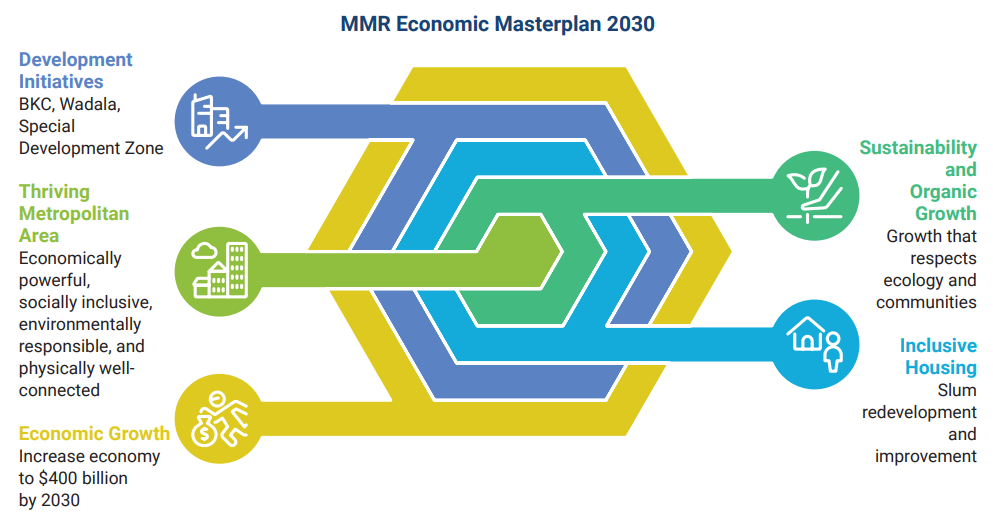
Economically, the goal is very clear: MMR must grow from a $140 billion economy to a $400 billion economy by 2030.
That is the benchmark we have set, and every project we undertake aligns with that direction.
Within this framework, inclusive housing plays a central role. Slum redevelopment and improvement remain critical priorities. The development of the remaining parts of BKC, the transformation of Wadala, the Special Development Zone along the northern coast — all these initiatives are clearly identified in the master plan. The growth hubs you referred to earlier are also part of this long-term structure.
Two themes run through the entire document: sustainability and organic growth. The region must grow in a way that respects its ecology, its people, and its long-term resilience. And the growth must be designed for the citizens who live here — not for abstract projections, but for real communities.
That, in essence, is the vision for 2030: A region that is economically powerful, socially inclusive, environmentally responsible and physically well-connected — a metropolitan area that grows with its people, and for its people.
Q Now when we talk about the Third Mumbai or Mumbai 3.0, what is the planning philosophy behind it? Are we looking at a vertically dense city, or a more inclusive, mixed-use model with residential, commercial, industrial and IT ecosystems growing together? What is the thinking within the government, and how are you shaping that vision?
The government’s guiding principle has always been inclusivity. India is a democracy, and every policy we draft is shaped not just by constitutional values but also by what Gandhiji called his talisman — to look at the poorest person and ask whether the decision helps improve his or her life. That ethos is deeply embedded in our planning.
Inclusivity is not just an ideal; it’s something India has demonstrated in real terms. I was reading a recent study which mentioned that a decade ago, 24.4% of Indians could not afford two square meals a day. Today, according to World Bank figures, that number is around 4.2 or 4.3%. This is the largest poverty reduction in
human history, simply because the scale of India makes the achievement extraordinary.
So, inclusivity is in our DNA as a nation, and naturally, it becomes the foundation of how the government plans new cities. Whether it is Mumbai 3.0, new townships, or large-scale regional planning, the goal is not to create exclusive enclaves but to build cities that bring everyone together — cities that allow people from all economic backgrounds to live, work, and grow in the same ecosystem.
The newer planning models, including the Third Mumbai, will therefore be mixed-use, integrated and inclusive. They will have residential areas, employment hubs, commercial centres, industry clusters, and social infrastructure coexisting within a balanced, sustainable urban fabric. That is not just a design choice; it’s a reflection of who we are as a country and what we aspire to build.
Q We’ve spoken about 2030, but I want to look further ahead. Several global studies warn that by 2050, nearly 20–30% of Mumbai could be underwater due to sea-level rise and climate change. How seriously do you view these projections, and how is the government integrating climate risk into long-term planning for MMR?
These projections fall under the domain of the Government of Maharashtra’s Environment Department, which is responsible for climate policy, and they study these issues very closely. Climate change is, without doubt, a very serious factor. But it is also an evolving science. I remember when I was in school in the 1970s, the concern then was a second Ice Age. Later it became global warming. Now we speak of climate change more broadly. Science continues to develop, and so does our understanding of it.
Within the government framework, every project must adhere to a very clear set of environmental approvals. Any building above 20,000 square metres requires an environmental clearance and any project falling under the Coastal Regulation Zone requires a CRZ clearance. Major infrastructure projects require multiple layers of environmental scrutiny. And all of these clearances involve public consultation, which is part of Indian law.
So, the mechanism is well established. Every organisation, including MMRDA, follows it rigorously. Climate considerations are not external to planning; they are embedded in how permissions are granted, how designs are approved, and how cities evolve. The Environment Department leads this effort, and we follow the framework they set.
Q The MTHL has unlocked entirely new land corridors and economic possibilities for Mumbai. A similar transformational potential is being spoken about for the proposed Uttan–Virar Sea Link. In the context of MMR’s ambition to become a 1.5 trillion-dollar economy, how do you see this project reshaping the region?
Vadavan Port, which is coming up in Palghar, is central to this entire vision. It will be India’s first true express port, with the deepest draft in the country. Its capacities are such that it can completely change the way global shipping connects with India. That is the scale we are talking about.
When you look at Mumbai, the city is fortunate to have multiple economic corridors radiating
out of it — towards Pune, Ahmedabad, Nashik, and now Nagpur through the Samruddhi Expressway. With Vadavan emerging to the
north, a new economic frontier opens up.
To support that, we are working on what is essentially a ring-road concept around Mumbai. Historically, Mumbai’s growth has always been north–south, supported by the Western and Eastern corridors. What the city has lacked is strong east–west connectivity. That gap is now being systematically addressed.
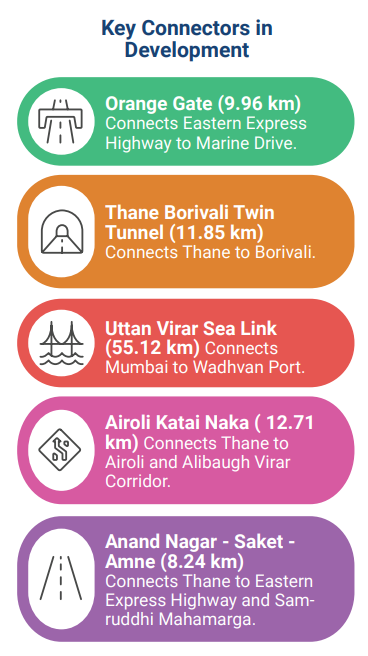
Several key connectors are already in various stages of development:
- The ongoing link from Orange Gate (Eastern Freeway) to the Coastal Road, including the widening of Marine Drive into a 12-lane corridor.
- The Worli–Sewri Connector linked to MTHL.
- The Worli–Bandra Sea Link, followed by the Bandra–Versova Sea Link, which is under execution by MSRDC and should be completed around 2029.
- The upcoming road from Versova to Dahisar.
- Another corridor from Dahisar to Bhayander.
Beyond Bhayander begins the project you mentioned — the Uttan–Virar Sea Link, which will run all the way up to Virar. At Virar, it will integrate with the Baroda and Ahmedabad highways, both of which are six-lane corridors. From there, a new linkage is being created further north into Palghar.
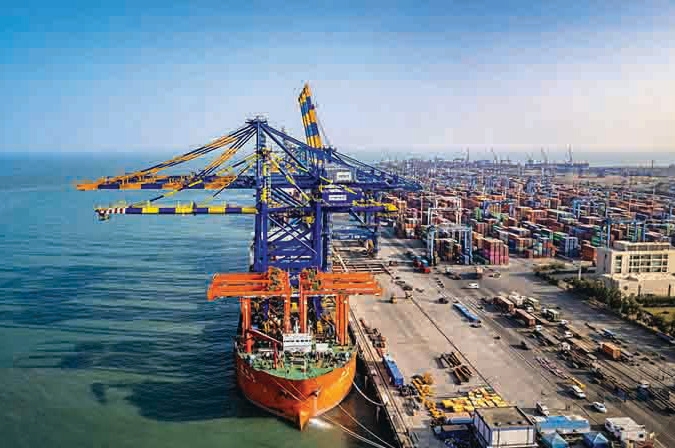
JNPT has already declared a 145-metre right of way, and land acquisition has begun. This will connect directly to Vadavan Port. So, in effect, the entire Mumbai–Vadavan connectivity is fully mapped.
Regarding the Versova–Virar Sea Link specifically, the project has been submitted to the Government of Maharashtra for administrative approval. Once the state approves it, it will move to the Government of India, and foreign funding will be sought. The Hon’ble Chief Minister has already made a statement in the Assembly confirming that the project will be foreign-funded. Following funding approval, the execution phase will begin.
All of this together — the sea links, the tunnels, the new highways, and the port connectivity — will fundamentally rewire the northern growth engine of MMR. These are the kinds of networks that enable a trillion-dollar metropolitan economy to take shape.
Q Let me end with a hypothetical but important question. When you imagine Mumbai in 2030, what does that city look like to you? Moreover,
what role do you see MMRDA playing in shaping that future? You also
spoke of a $400-billion economy. In that journey, how significant will the circular or recyclable economy be for MMR?
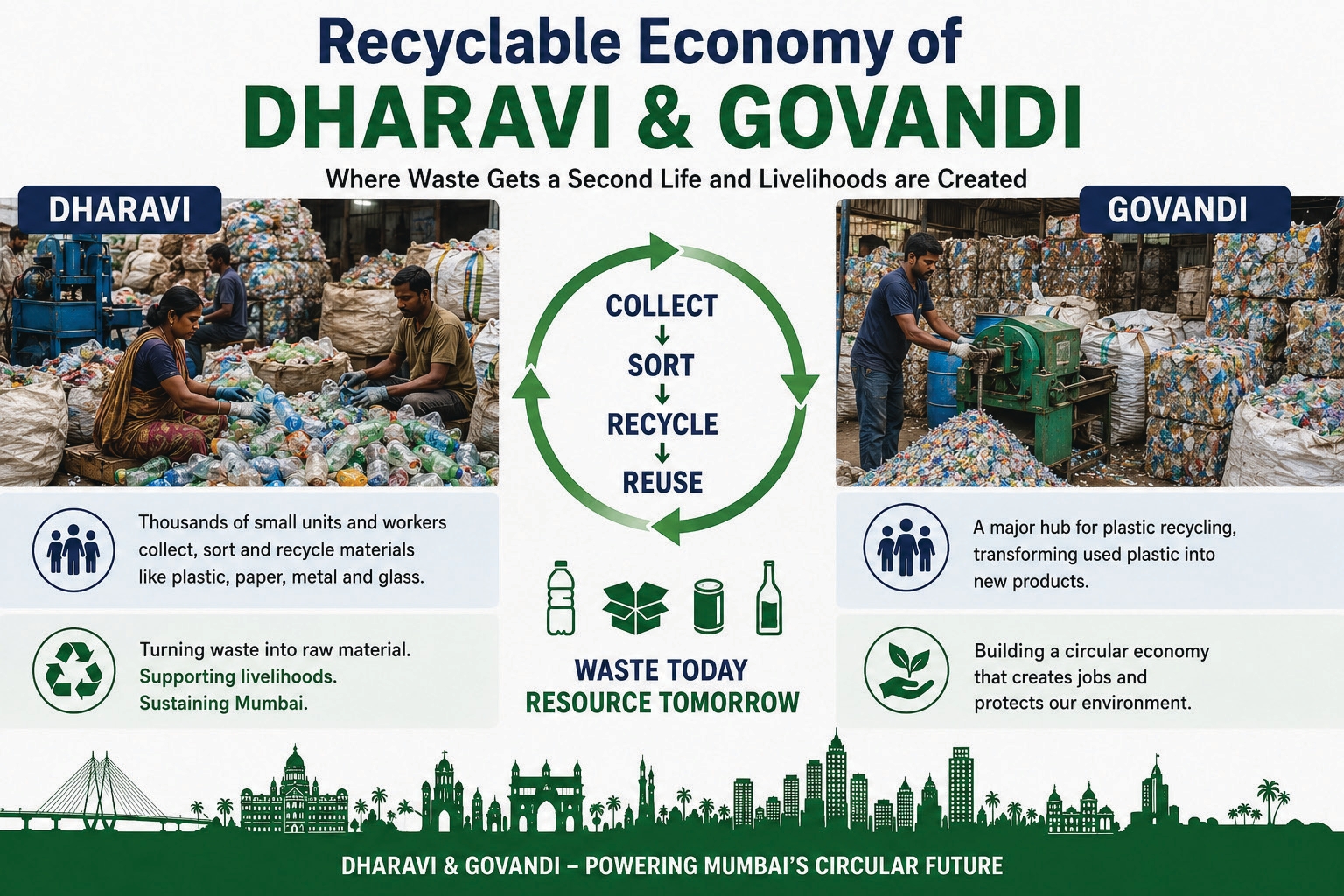
Our net-zero goals are very clear. As I said earlier, India is the only country in the world that has achieved the targets it committed to. We were expected to reduce emissions by 50% by 2030 — and we have already met that milestone. So, the circular, or recyclable, economy will play a very substantial role in the coming years.
But we must also recognise something unique about India: recycling is not new to us. It is part of everyday life here. Every Indian home practices recycling long before the term became fashionable globally. The neighbourhood kabadiwala is one of the most efficient recyclers in the world. He takes glass bottles, newspapers, broken household items, metal, plastic — and every bit of it goes back into a second life. It may not appear in corporate balance sheets, but it strengthens local families and keeps waste out of landfills. It is decentralised, natural and deeply sustainable.
The same is true in construction. Materials discarded at one site find a second use for levelling ground somewhere else. It is done quietly, without fanfare, and in a very responsible manner. Even animal waste is not wasted — it goes back into farming and the soil. So, the circular economy is already embedded in the Indian way of living. What will grow now is the formal circular economy, and I believe it will become very large.
As for Mumbai in 2030 — I like to look at it the way we look at old cinema. If you watch a film from the 1950s, then one from the 60s, 70s, 80s, 90s
and so on, you will see how the city
has changed each decade. The growth is exponential, not linear. And that exponential curve will only rise further.
Q Where does MMRDA fit into this?
MMRDA will continue to be at the heart of the region’s transformation — building the transport networks, the growth hubs, the new townships, the arterial roads, the mobility systems, and the urban backbone that holds a $400-billion economy together. Our job is to create the platforms on which the future city stands — sustainably, inclusively and ambitiously.
So I leave it to your imagination to visualise what exponential growth looks like. But I can assure you: the
direction is clear, the momentum is strong, and the future of Mumbai-MMR will be far bigger than anything we have seen before.