
THE STRUCTURAL DEFICIT IN INDIA’S URBAN PARKING ECOSYSTEM
India’s parking crisis is not a symptom of congestion—it is a manifestation of a deeper structural deficit within the country’s urban development model. The imbalance is rooted in three converging forces: accelerated motorisation, static regulatory frameworks, and inefficient land utilisation practices. Together, they have created a systemic gap between demand and provision—one that is widening with every cycle of urban growth. The scale of motorisation alone illustrates the pressure.
India currently has over 300 million registered vehicles, as per the Ministry of Road Transport and Highways, with passenger vehicle ownership in urban centres growing at an annual rate of approximately 8–10 percent. More significantly, the composition of this growth has shifted. Data from Autocar Professional indicates that SUVs now account for over 50 percent of new vehicle sales, compared to nearly 30 percent just a few years ago. This transition has increased the average spatial footprint per vehicle by an estimated 20–25 percent, placing additional strain on urban parking infrastructure.
However, urban planning frameworks have not evolved in parallel. Development Control Regulations across most Indian cities continue to prescribe parking requirements based on built-up area ratios—a model that assumes linear correlations between space and demand. These norms rarely incorporate variables such as multi-vehicle ownership per household, visitor parking demand, commercial turnover rates, or changing vehicle dimensions. The result is a regulatory system that ensures compliance, but not adequacy.
This inadequacy is empirically visible across major metropolitan regions. In Mumbai, where developable land is among the most constrained globally, industry assessments suggest that parking demand exceeds formal supply by 30–50 percent in several residential micro-markets. Bengaluru presents a comparable case, where research by the Indian Institute for Human Settlements indicates that over 40 percent of carriageway space in key commercial districts is encroached upon by parked vehicles, directly reducing road capacity. In Delhi NCR, the persistence of informal parking ecosystems reflects a structural inability of planned infrastructure to absorb demand, particularly in mixed-use developments.
These conditions point to a fundamental misclassification. Parking has historically been treated as a support function within real estate, rather than as a core component of urban infrastructure. This has resulted in underinvestment, fragmented planning, and limited integration with broader mobility systems.
“Parking is no longer a backend utility—it is becoming central to how urban infrastructure is planned, experienced, and monetised,” notes Rajesh Dogra, highlighting a critical shift in industry perception. His observation underscores the transition from parking as a regulatory obligation to parking as a strategic determinant of asset performance and urban efficiency.
This transition is being accelerated by the economics of land. In high-density urban environments, particularly in cities like Mumbai, the cost of constructing parking infrastructure is substantial. Industry estimates indicate that the construction cost per parking slot ranges between ₹4 lakh and ₹8 lakh, depending on factors such as excavation depth, soil conditions, and structural design. At the same time, conventional parking layouts—primarily ramp-based basement systems—exhibit low efficiency ratios.
Real estate design studies suggest that 30–40 percent of basement area is typically consumed by circulation spaces, including ramps, driveways, and turning radii. This results in a dual inefficiency: high capital expenditure combined with suboptimal space utilisation.
Ajay Raina contextualises this inefficiency within a broader engineering framework. “Traditional parking consumes horizontal space. Our systems unlock vertical potential. Whether it is stack systems that double capacity or tower systems that can accommodate over a hundred vehicles, the impact is not just on parking—it changes how developers utilise land and enhance the overall value of a project.”
His assessment reframes parking as a space optimisation problem, rather than a space allocation problem. The distinction is critical. While conventional systems distribute vehicles across horizontal surfaces, engineered systems concentrate them vertically, thereby improving land-use efficiency and project economics simultaneously.
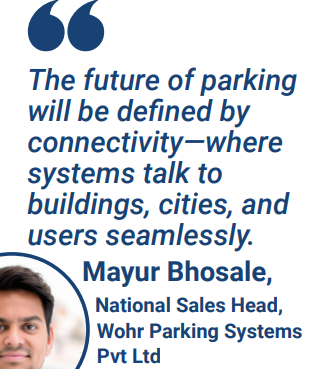
Yet, spatial inefficiency is only one dimension of the problem.The evolving nature of vehicles introduces additional complexity. “The passenger vehicle landscape in India has evolved significantly, with a clear shift toward larger formats like SUVs,” explains Mayur Bhosale. “This directly impacts parking design—requiring higher load capacities, larger dimensions, and more robust structural planning. At the same time, the rapid adoption of electric vehicles is reshaping parking infrastructure. EVs are heavier due to battery systems and require integrated charging provisions, making it essential for parking solutions to be structurally robust and future-ready.”
This dual shift—toward larger vehicles and electrification—has significant implications. Parking infrastructure must now accommodate increased load-bearing requirements, dimensional variability, and electrical integration, all within constrained urban footprints. Legacy systems, designed for smaller vehicles and static usage patterns, are increasingly misaligned with these demands. Operational inefficiency further compounds the issue.
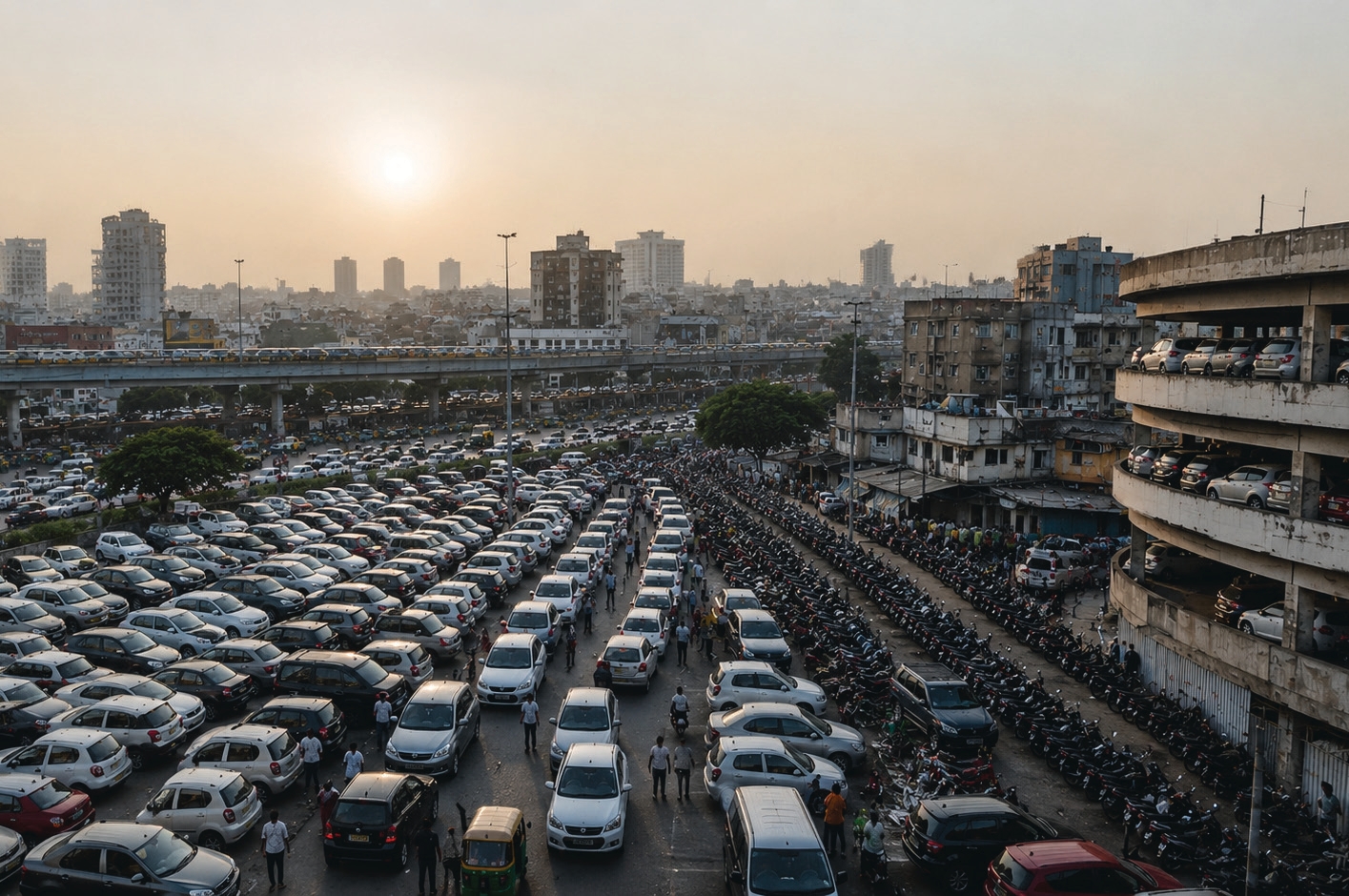
Urban mobility research indicates that drivers in Indian metros spend 15 to 20 minutes on average searching for parking during peak hours, a figure consistent with findings from multiple city-level traffic studies. This search time contributes directly to fuel consumption, emissions, and congestion, creating a feedback loop that exacerbates urban inefficiency.
 Ajay Raina highlights the scale of this impact, noting that even marginal fuel wastage per vehicle, when aggregated across millions of vehicles, results in a significant economic and environmental burden. This positions parking not merely as a spatial challenge, but as a contributor to urban productivity loss and environmental degradation.
Despite these implications, parking remains underrepresented in policy discourse. Urban regulations continue to focus on minimum provisioning rather than performance outcomes. Metrics such as utilisation efficiency, turnover rates, integration with mobility systems, and environmental impact are rarely incorporated into planning frameworks. This creates a structural lag between technological capability and regulatory adoption.
At the same time, emerging mobility trends are beginning to redefine the role of parking. “Parking can no longer be seen as a static provision,” states Rajashree Shetty. “With EVs and evolving mobility patterns, every parking slot has the potential to become part of a larger system—connected, energy-enabled, and future-ready. The decisions we take today must account not just for current demand, but for how mobility itself is evolving.”
Her perspective reflects a broader shift toward system integration. Parking is increasingly being viewed as a node within a larger urban ecosystem—interfacing with building management systems, energy networks, and digital platforms. This transformation moves parking from a passive function to an active infrastructure layer.
However, the transition is not uniform. India’s urban parking landscape currently operates across two parallel paradigms. The first is defined by manual, space-intensive, and regulation-driven systems, characterised by low efficiency and high friction. The second is emerging through engineering-led, automated, and technology-integrated solutions, offering higher efficiency and improved user experience.
The gap between these paradigms represents the core of the crisis. Bridging this gap will require a shift from incremental adjustments to systemic transformation—one that redefines how parking is planned, designed, and integrated within urban development.
Because the challenge is no longer about providing more parking. It is about restructuring how space is utilised within increasingly constrained urban environments. And in that restructuring lies one of the most critical, yet under-addressed, opportunities in India’s urban future.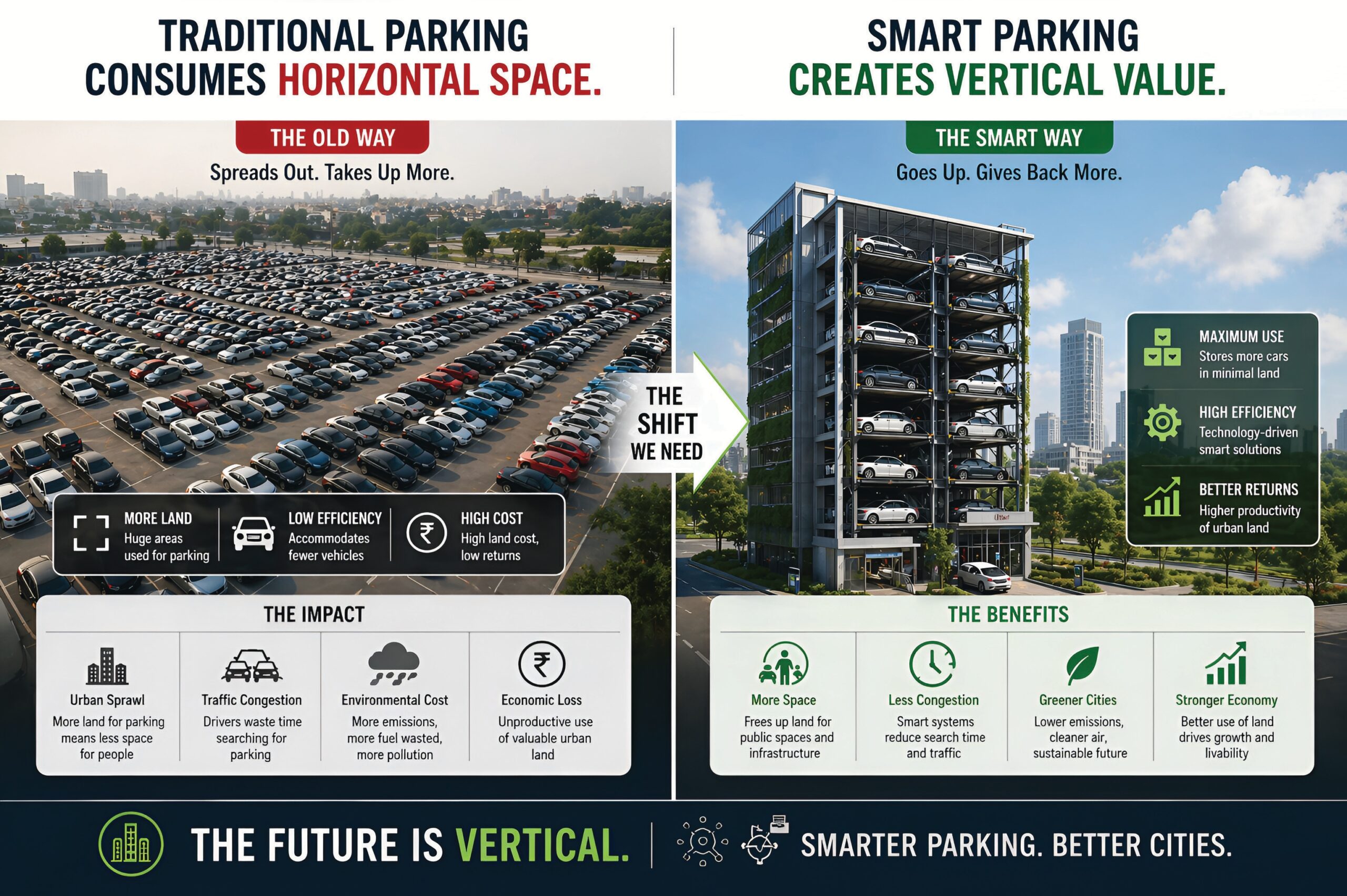
 FROM SPACE PROVISION TO SYSTEM ENGINEERING
If the first layer of India’s parking crisis is defined by structural deficit, the second is defined by the industry’s response—and that response is increasingly moving away from conventional construction toward engineered, system-driven infrastructure.
This transition is not cosmetic. It represents a fundamental shift in how parking is conceived—not as a physical allocation of space, but as an integrated system of movement, storage, and access.
Historically, parking design in India followed a linear logic: allocate basement area, design ramps, ensure turning radii, and distribute slots. The objective was compliance and basic usability. Efficiency was secondary. This model, while workable in low-density environments, begins to fail under conditions of high land cost and high vehicle density.
The limitations are now well understood.
Conventional parking systems operate with low space efficiency ratios, often utilising only 60–70 percent of available area for actual vehicle storage. The remaining space is consumed by circulation—ramps, drive aisles, and manoeuvring zones. In high-value urban markets, this inefficiency translates into a direct economic cost.
The industry’s response to this constraint has been to reframe parking as an engineering problem rather than a civil one.
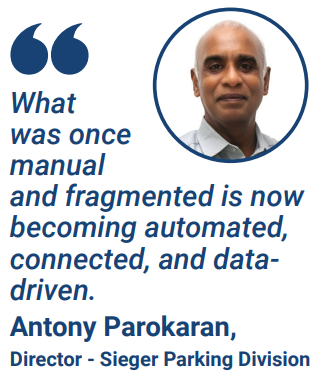
Antony Parokaran, Director – Sieger Parking Division articulates this transition through the lens of system design. “At the core, parking is an engineering product—but today, it is equally a digital system. Whether it is stack parking, tower systems, or robotic solutions, the objective is to maximise capacity within the same footprint while ensuring reliability, safety, and user convenience. This fundamentally changes how developers approach space utilisation and project viability.”
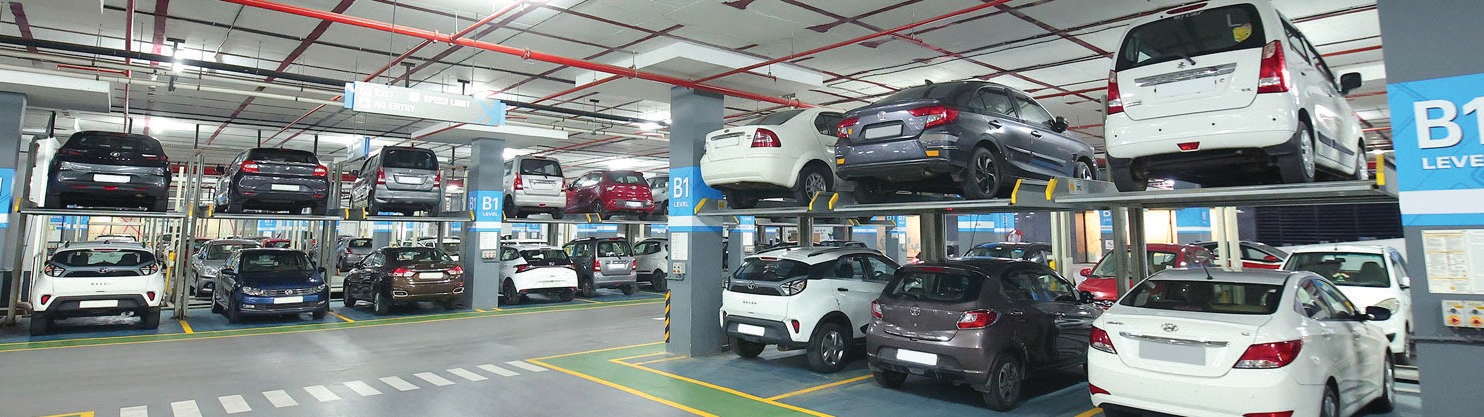
This shift toward engineered systems introduces a different set of design principles. Instead of horizontal distribution, these systems rely on vertical stacking, mechanical transfer, and automated positioning. Vehicles are no longer driven into individual slots; they are placed, moved, and retrieved through controlled systems. This eliminates the need for ramps and significantly reduces circulation space, thereby improving overall efficiency.
The impact is measurable. Stack parking systems can effectively double parking capacity within the same footprint, while tower-based solutions can accommodate 100 or more vehicles vertically, depending on configuration. Rotary and puzzle systems offer additional flexibility, allowing developers to adapt solutions based on site constraints and usage patterns.
However, capacity alone does not define the success of these systems. Reliability, safety, and lifecycle performance are critical—particularly in environments where parking is used continuously across residential and commercial applications.
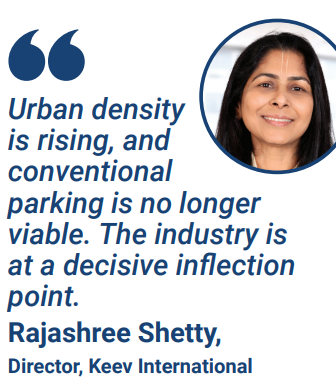 This is where engineering discipline becomes central. Rajashree Shetty positions this emphasis clearly. “At KEEV, execution is not just about delivery—it is about predictability, reliability, and engineering confidence. Every system is designed, tested, and validated before deployment. Our focus is on ensuring that performance is consistent not just at installation, but across the entire lifecycle of the system.”
Her statement reflects an important evolution in industry standards. Parking systems are no longer evaluated only on installation metrics; they are assessed on uptime, maintenance cycles, and long-term durability—parameters more commonly associated with critical infrastructure such as elevators or transit systems.
This convergence with infrastructure-grade standards is further reinforced by advancements in manufacturing and design.
Tedra Automotive Solutions, for instance, has invested in robotic welding, CNC laser cutting, and precision fabrication technologies, enabling higher levels of structural accuracy and consistency. These capabilities are not merely technical upgrades; they are essential for ensuring load-bearing stability, alignment, and safety in high-density parking systems.
Ajay Raina elaborates on this integration of engineering and intelligence. “Most of our automated systems are equipped with diagnostic interfaces that identify faults in real time—whether sensor-related, mechanical, or software-driven. This allows immediate intervention, often before the user even experiences a disruption. In large-scale systems, we are also embedding centralised monitoring architectures to enable remote diagnostics and faster response.”
This introduces a critical shift in operational philosophy—from reactive maintenance to predictive and preventive management.
The role of digital systems in enabling this shift is expanding rapidly.
Modern parking infrastructure is increasingly integrated with Building Management Systems (BMS), IoT platforms, and access control technologies. This integration allows parking to function as part of a larger ecosystem, rather than as an isolated component.
Mayur Bhosale highlights how this integration is shaping user expectations. “The current Indian scenario is changing the building structure. Building Management Systems are integrated from the entrance gate to access inside the office. Within this path, the user expects one seamless experience—from entry to parking to final access. Parking is a key link in this chain, and it is expected to align with the same level of automation and convenience.”
 This expectation of continuity is particularly relevant in commercial developments, where high volumes of vehicles must be managed within compressed timeframes.
In such environments, parking efficiency is not just about capacity—it is about throughput and flow management.
Large office complexes, malls, and mixed-use developments often experience peak-hour surges, where thousands of vehicles enter and exit within short intervals. Traditional systems struggle under such conditions, leading to congestion at entry points and delays within parking areas.
Engineered systems, combined with intelligent access control, address this challenge by reducing manual intervention and optimising movement.
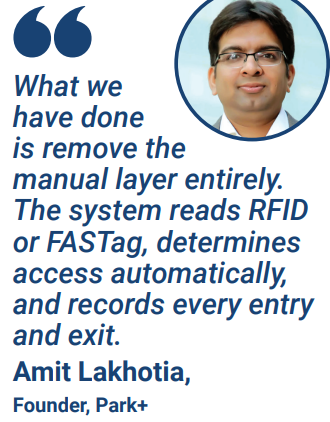
Amit Lakhotia describes this transformation from a platform perspective. “What we have done is remove the manual layer entirely. The system reads RFID or FASTag, determines access automatically, and records every entry and exit. The barrier opens without stopping the vehicle. This reduces friction, improves security, and ensures that the entire process is seamless for the user.”
The scale at which such systems operate is indicative of their impact. With millions of daily transactions, automated access control is no longer an experimental feature—it is becoming a baseline expectation in urban developments. Beyond access, digital integration is also enabling new forms of operational efficiency.
Parking systems can now provide real-time availability data, usage analytics, and performance metrics, allowing developers and operators to optimise utilisation. In commercial environments, this data can be used to manage peak demand, allocate spaces dynamically, and improve overall throughput.
This idea of parking as an ecosystem is central to the next phase of transformation. It extends beyond individual buildings to include city-level integration.
 Platforms such as Park+ are already enabling cross-location access, digital payments, and unified user interfaces, allowing parking to function across multiple environments—residential, commercial, and public. This creates a network effect, where the value of the system increases with scale.
At the same time, large-scale deployments are demonstrating the potential of engineered parking in real-world conditions. Projects such as high-density commercial hubs, airport-linked facilities, and mixed-use developments are increasingly adopting mechanised systems to address space constraints. Installations accommodating hundreds to thousands of vehicles within compact footprints are no longer exceptions—they are becoming reference models for future development.
Yet, despite these advancements, adoption remains uneven. Barriers persist—ranging from initial capital perception and user adaptability to regulatory ambiguity. While lifecycle economics often favour engineered systems, the upfront investment continues to influence decision-making, particularly in cost-sensitive segments.
However, as land costs rise and efficiency becomes critical, this equation is beginning to shift. Developers are increasingly evaluating parking not in terms of immediate cost, but in terms of long-term value creation—through increased saleable area, improved user experience, and enhanced project positioning.
This marks a transition from parking as a constraint to parking as a strategic asset. And it is within this transition that the industry’s response is taking shape—not as incremental improvement, but as systemic redesign.
Because the challenge is no longer to accommodate vehicles. It is to engineer space in a way that aligns with the realities of density, economics, and evolving urban mobility.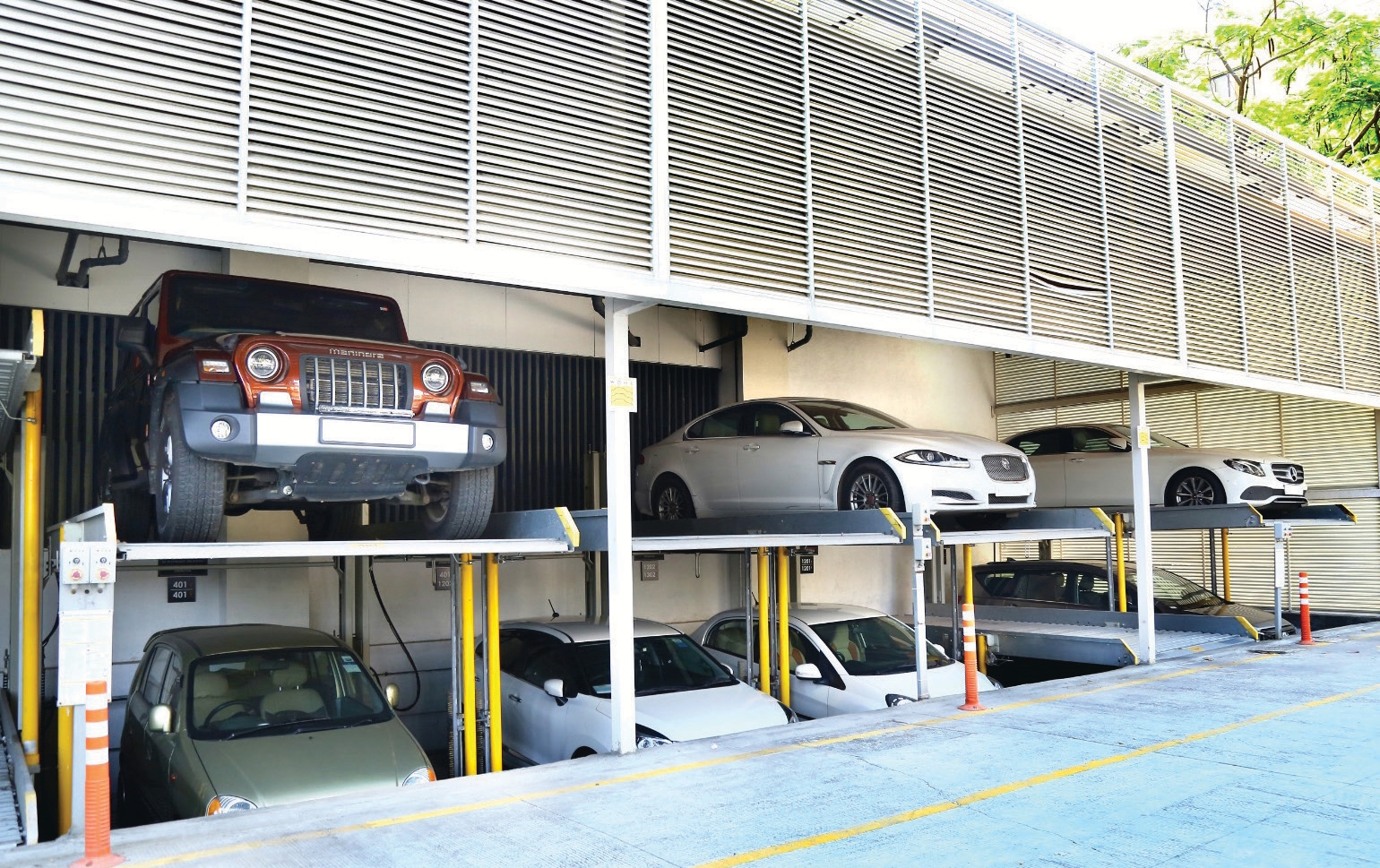
FROM INFRASTRUCTURE TO INTELLIGENCE: WHO OWNS THE FUTURE OF PARKING
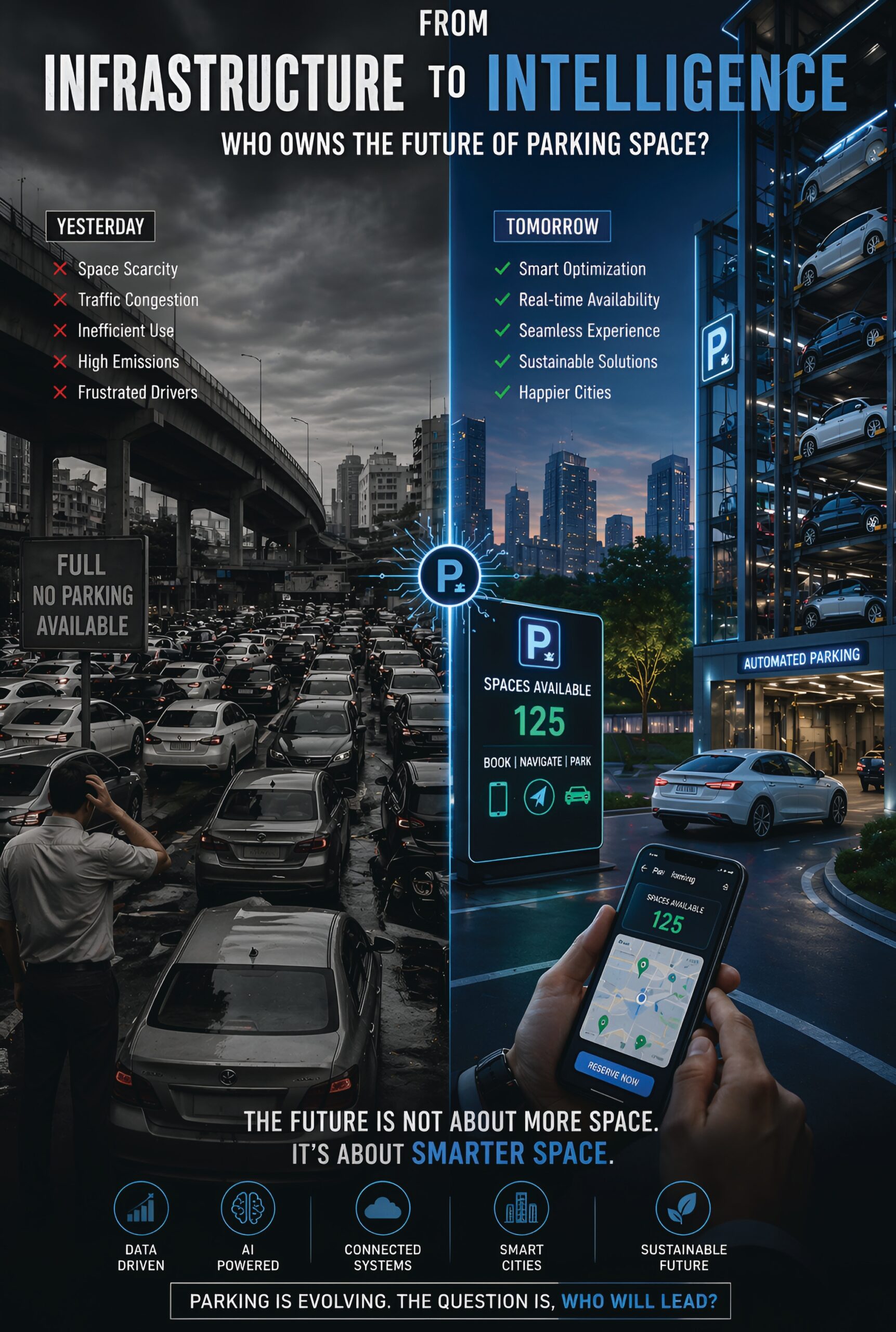
If the first phase of India’s parking evolution was defined by shortage, and the second by engineering response, the third is now unfolding as something more complex—and far more consequential. Parking is no longer just infrastructure. It is becoming data, energy, access, and control—all converging into a single layer that sits at the intersection of real estate, mobility, and urban governance.
The early signals of this transition are already visible across Indian cities, though often in fragmented forms. A commercial building integrates parking with building management systems. A residential complex introduces app-based access. A mall deploys FASTag-enabled payments. A large office park monitors real-time parking availability. Individually, these are upgrades. Collectively, they point to a redefinition.
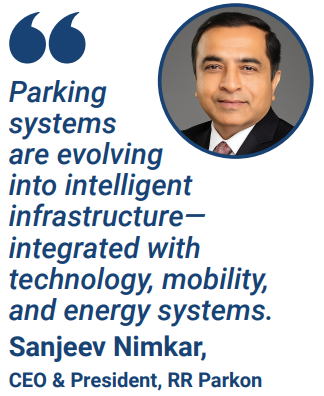
“Parking systems are evolving into intelligent infrastructure—integrated with IoT, real-time monitoring, and user interfaces that enhance both efficiency and experience,” says Sanjeev Nimkar. “This is no longer about mechanical systems alone; it is about creating connected ecosystems.”
What Nimkar describes is a shift from mechanisation to intelligence. The distinction is critical. Mechanised systems optimise space. Intelligent systems optimise time, movement, and decision-making. This shift is being accelerated by three converging forces—data, electrification, and platformisation.
The first is data. Every parking interaction—entry, exit, duration, occupancy—generates information. Until recently, this data remained largely unused. Today, it is becoming a central asset. Platforms are beginning to aggregate and interpret this data to create real-time visibility across locations. Users can identify available spaces before arrival. Operators can manage peak demand dynamically. Developers can analyse utilisation patterns to optimise design and pricing.
 Amit Lakhotia explains how this transformation is already altering user experience at scale. “What has happened is that access has become completely digital. The system reads RFID or FASTag automatically, determines whether the car is authorised, and records every movement. You don’t have to stop, you don’t have to interact, and yet the system is more secure than before. Every entry and exit is logged, and that data becomes usable at any point of time.”
The implication is profound. Parking is no longer just a physical interaction. It is a data-driven service layer.
The second force is electrification. Electric vehicles are not simply replacing internal combustion engines—they are redefining infrastructure requirements. Unlike conventional vehicles, EVs require time-bound charging, energy distribution, and load management.
This fundamentally changes the role of parking. It is no longer a passive storage space. It becomes an energy interface.
“The rapid adoption of electric vehicles is reshaping parking infrastructure,” notes Mayur Bhosale. “EVs are heavier due to battery systems and require integrated charging provisions. Parking systems must now be structurally robust, electrically enabled, and future-ready.”
What this introduces is a new layer of planning complexity. Charging infrastructure must be integrated without overloading systems. Electrical layouts must anticipate future demand. And perhaps most critically, energy consumption must be managed intelligently across multiple users and time cycles.
This is where parking begins to intersect not just with mobility, but with urban energy systems. The third force is platformisation.
Parking is increasingly moving from isolated systems to connected networks. Amit Lakhotia outlines this transition clearly. “The same tag can now work across multiple locations—society, office, mall, or hotel. You don’t need different systems for different places. A single platform integrates everything. This improves convenience, but more importantly, it creates a network where parking becomes part of a larger mobility ecosystem.”
This network effect is central to the future of parking. It shifts control from individual assets to integrated platforms. And that raises a more complex question—one that the industry has only begun to confront.
Who owns this ecosystem? Because as parking becomes connected, it begins to involve multiple stakeholders.
 Developers own the physical infrastructure. Technology platforms control the interface and data. City authorities regulate usage and policy. Users generate the demand that drives the system. Each of these stakeholders has a different objective. For developers, parking must enhance project viability and asset value.
For technology platforms, scale and data aggregation are key. For city authorities, parking is a lever to manage congestion and mobility. For users, the expectation is simple—speed, convenience, and reliability. The challenge lies in aligning these interests.
“Parking will increasingly be defined by how well engineering, technology, and governance come together,” observes Rajashree Shetty. “Each of these layers is evolving independently, but the real impact will be seen when they begin to function as a unified system.” This alignment is particularly critical in the context of policy.
India’s current parking regulations remain largely prescriptive. They define minimum requirements but rarely address efficiency, integration, or performance. There is limited guidance on how parking should interact with emerging technologies, how it should support EV infrastructure, or how it can be used as a tool for urban mobility management.
This creates a structural gap between what is possible and what is implemented. In contrast, global cities have begun to approach parking as a strategic instrument. Tokyo, for instance, links vehicle ownership directly to proof of parking availability, effectively aligning demand with infrastructure capacity. Singapore integrates parking with transit-oriented development, using pricing and regulation to manage usage. In both cases, parking is not treated as an isolated function, but as part of a broader urban system.
India’s context is more complex—larger, denser, and more diverse. But the direction is becoming clear. Parking will need to move from static provision to dynamic management. It will need to integrate with mobility platforms, energy systems, and urban policy frameworks.
And it will need to evolve from being a space problem to a system solution. At the same time, the implications for real estate are significant. Parking is emerging as one of the most critical determinants of project design and value. Efficient systems can unlock additional saleable area, improve user experience, and enhance long-term asset performance. Inefficient systems, by contrast, create friction, reduce usability, and erode value.
 Ajay Raina captures this relationship succinctly when he notes that parking decisions now directly influence how land is utilised and how projects are positioned in the market. This is perhaps the most important shift of all. Parking is no longer a constraint to be managed. It is a lever to be optimised.
And in that optimisation lies a broader transformation—one that extends beyond basements and buildings into the very structure of cities. Because ultimately, the future of urban India will not be defined only by what is built above ground.
It will be defined by how intelligently we organise, integrate, and manage the invisible systems that support it. Parking, once overlooked, is now at the centre of that conversation.
Not as an afterthought. But as infrastructure that determines whether cities merely grow—or actually function.