
HomeLatestDalmia Bharat Faces Cement Pricing Pressure

Dalmia Bharat Faces Cement Pricing Pressure

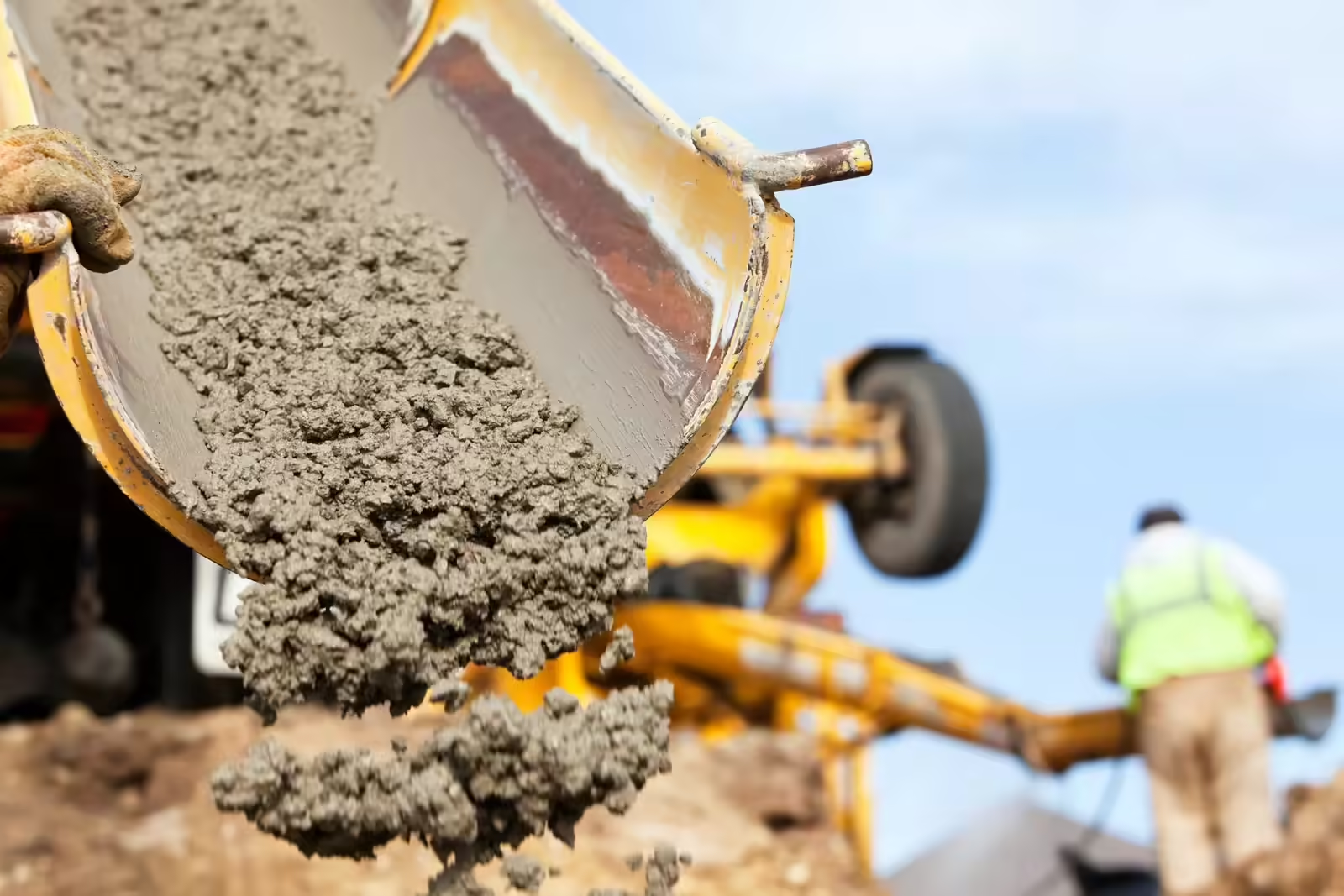
A temporary production disruption at a major cement facility in Odisha has exposed the fragile balance between supply, pricing, and demand recovery in India’s cement sector, with ripple effects likely across eastern construction markets.A kiln shutdown at a key plant operated by Dalmia Bharat in Rajgangpur during March led to a measurable drop in output, tightening supply in a region where the company has a significant operational footprint. The incident, though resolved within weeks, coincided with an early phase of demand recovery, amplifying its impact on regional availability and distribution.

The disruption comes at a time when the cement pricing pressure India landscape is already under strain. While infrastructure activity and construction demand are gradually improving after a subdued period, pricing power remains weak across several markets. This mismatch between recovering demand and constrained pricing is shaping how companies respond to short-term supply shocks.Eastern India, where a large share of capacity is concentrated, is particularly sensitive to such disruptions. Industry observers note that even short interruptions in production can influence supply chains, forcing developers and contractors to seek alternative sources, sometimes at higher logistical or procurement costs. For urban projects, especially those operating on tight budgets, such fluctuations can affect execution timelines.The broader context is a sector attempting to stabilise after a prolonged period of pricing softness. Cement producers have faced difficulty in maintaining realisations amid intense competition, even as input costs—particularly energy and transport—remain volatile. The current cement pricing pressure India dynamic suggests that companies may struggle to fully translate demand recovery into improved margins.

For cities, the implications extend beyond corporate performance. Cement is a critical input for housing, transport infrastructure, and commercial development. Any imbalance between supply availability and price stability can directly influence project viability, particularly in affordable housing and public infrastructure where cost sensitivity is high.At the same time, there are early indications of potential price corrections in select markets, supported by seasonal construction activity. If sustained, such adjustments could help restore equilibrium between supply and profitability. However, urban planners caution that uneven price movements across regions may create disparities in project costs, affecting smaller developers more acutely.Looking ahead, operational resilience will be key. Ensuring uninterrupted production across plants, particularly in high-demand regions, is critical not just for market share but for maintaining supply stability in rapidly urbanising corridors. Additionally, the sector faces a longer-term challenge of managing capacity expansion alongside demand growth, as new production lines come online across the country.

The recent disruption underscores how tightly linked industrial operations are with urban development outcomes. As India’s cities continue to expand, the ability of cement producers to navigate cement pricing pressure India while ensuring consistent supply will play a defining role in keeping construction pipelines on track and aligned with affordability and sustainability goals.

Also Read: UltraTech Cement Margins Face Input Cost Pressure

Dalmia Bharat Faces Cement Pricing Pressure
RELATED ARTICLES

LEAVE A REPLY

Please enter your comment!
Please enter your name here

- Advertisment -spot_img

Most Popular

Recent Comments

INDIA’S REAL ESTATE CAN’T AFFORD ANOTHER RAMP — HERE’S WHY : Mohan Kumar Soundararaj

In an exclusive interaction with Mohan Kumar Soundararaj, Managing Director of Parklayer Private Limited, he outlines how intelligent parking infrastructure is redefining urban real...
Antony Parokaran

The Engineering Race to Solve India’s Urban Space Crisis : Antony Parokaran

In this conversation, Antony Parokaran, Director – Parking Division at Sieger Global, discusses automation, engineering reliability, redevelopment challenges, EV integration, and the future of...
Ajay Raina

Engineering the Future of Urban Parking : Ajay Raina on How Tedra is Reimagining...

In rapidly densifying Indian cities, where land is scarce and vehicle ownership is rising exponentially, parking is no longer a backend utility—it is critical...

Right-Sized Thinking in an Overbuilt City : Cherag Ramkrishnan

Cherag Ramkrishnan, CMD—CR Realty on Mumbai’s Real Estate Economics, Design Discipline, and the Future of Urban Living. Q CR Realty emerged during Mumbai’s shift from...

Building for the Middle India : Shailesh Puranik

Shailesh Puranik on Scale, Cities and the Future of Affordable Aspirations, in an exclusive Interaction with Homes and Buildings Networks. Q Puranik Group has completed...
