
HomeLatestHaryana RERA Extends Project Timelines Amid Disruption

Haryana RERA Extends Project Timelines Amid Disruption

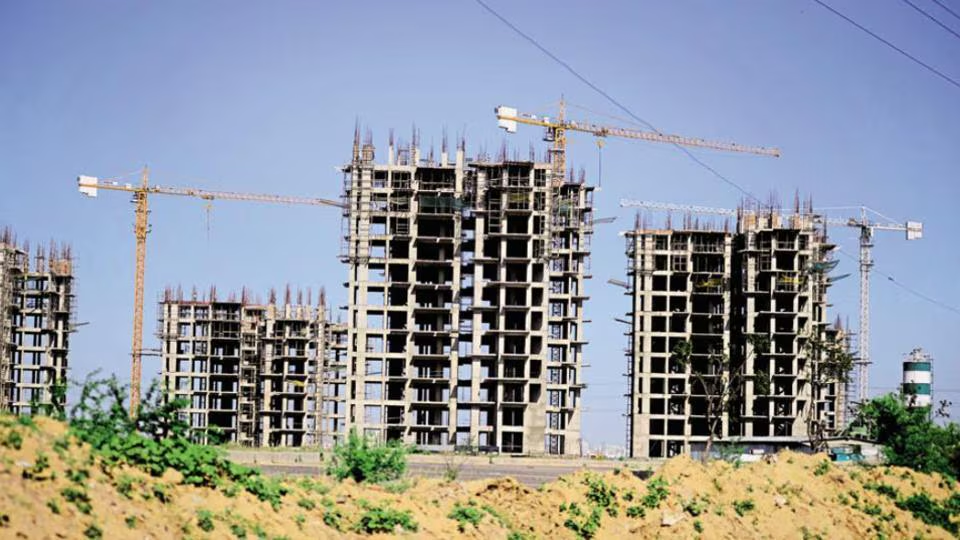
Haryana’s real estate regulator has granted a four month extension to eligible projects affected by disruption from the West Asia conflict, giving developers additional time to complete registered developments. The move, covering projects under the Gurugram authority, responds to construction-material shortages and wider supply-chain pressures. For homebuyers, however, the decision also raises a familiar concern: how regulatory relief can accommodate genuine external shocks without weakening certainty around possession dates.

The Haryana Real Estate Regulatory Authority, Gurugram, issued the order on August 11. It applies where a project’s original, revised or previously extended completion date falls on or after February 28, 2026. Projects must have been registered on or before July 31, 2026 to qualify. The additional period is automatic, meaning promoters do not need to submit separate applications to obtain the extension.The regulatory basis is the force majeure principle under the Real Estate (Regulation and Development) Act, 2016. In simple terms, force majeure allows contractual or regulatory timelines to be adjusted when exceptional events outside the parties’ control make performance difficult or impossible. The authority has treated the West Asia conflict as such an event because of its impact on international supply chains and the availability of construction materials.

The immediate objective is to prevent projects facing genuine external disruption from being treated in the same way as developments delayed by poor execution. Construction increasingly depends on interconnected supply networks covering metals, equipment, electrical components, fuels and other inputs. A geopolitical shock can therefore reach a housing site thousands of kilometres away through freight costs, delivery schedules or material availability.But the Haryana RERA extension also creates an important consumer-protection question. A project gaining four months can translate into additional rent, financing costs and uncertainty for households waiting to move. Urban planners and housing-sector experts generally distinguish between legitimate force majeure events and delays caused by weak project management. That distinction will matter if the measure is to preserve confidence in the regulatory framework.The decision is particularly relevant to Gurugram and the wider National Capital Region, where rapid residential and commercial development has already increased pressure on transport, drainage, water supply and other civic systems.

Project timelines are not only financial milestones; they influence when residents arrive, when infrastructure is required and how local authorities plan services.There is also a resilience lesson. Developers and public agencies cannot eliminate geopolitical risks, but they can reduce exposure through diversified sourcing, better inventory planning, local manufacturing links and more efficient construction systems. The Haryana RERA extension provides short-term breathing space; it does not solve those structural vulnerabilities.For buyers, the next priority should be clear disclosure of revised schedules and evidence that construction is progressing. For regulators, the challenge will be ensuring that exceptional relief remains targeted and does not become a substitute for accountability. Haryana’s housing market can absorb temporary disruption more effectively when regulatory flexibility is matched by transparent delivery commitments and resilient urban infrastructure.

Also Read : India Industrial Property Demand Broadens Across Cities
Haryana RERA Extends Project Timelines Amid Disruption
RELATED ARTICLES

LEAVE A REPLY

Please enter your comment!
Please enter your name here

- Advertisment -spot_img

Most Popular

Recent Comments

Mumbai Housing Boom Tests Urban Affordability

Mumbai Housing Boom Tests Urban Affordability

Mumbai’s residential market is becoming an increasingly important measure of how India’s housing economy is changing. The Mumbai Metropolitan Region accounted for 34% of...

India’s Tier 2 Cities Push Plotted Developments

India’s Tier 2 Cities Push Plotted Developments

India’s residential land market is moving beyond its traditional metropolitan centres, with Tier-2 cities becoming a major source of organised plotted housing supply. More...

Kolkata Real Estate Gains Focus In Bengal Revival

Kolkata Real Estate Gains Focus In Bengal Revival

Kolkata: West Bengal is looking to use real estate and urban redevelopment as a wider economic lever, with the state seeking changes to legacy...

India Infrastructure First Model Reshapes Urban Growth

India Infrastructure First Model Reshapes Urban Growth

India’s next phase of urban growth is putting infrastructure capacity at the centre of real estate planning, with industry leaders calling for transport, drainage,...

India Real Estate Enters A Technology Led Shift

India Real Estate Enters A Technology Led Shift

India’s real estate sector is entering a larger and more technology-driven growth cycle, with its market value projected to reach $1 trillion by 2030....