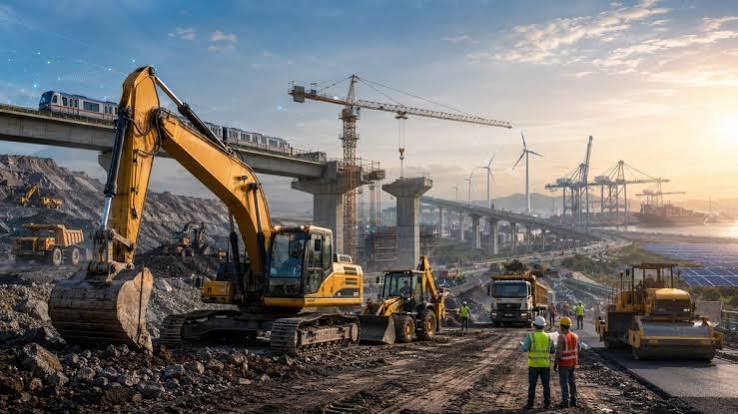
India’s construction industry is heading into a stronger investment cycle, with the Union Budget for 2026-27 allocating ₹12.22 lakh crore for capital expenditure, equivalent to 3.1% of GDP. The allocation is 11.5% higher than the previous year’s revised capital spending and is expected to support activity across infrastructure, energy and manufacturing.
The increase comes as public investment continues to shape India’s construction market. GlobalData forecasts that the sector will expand by 6.4% in real terms during 2026, supported by transport infrastructure, energy projects and budget-linked investment. It also expects Indian construction output to cross $1 trillion in nominal terms in 2027. For cities, the scale of spending matters because capital-intensive projects influence more than construction volumes. Roads, rail networks, energy systems and industrial facilities determine how efficiently people and goods move, where businesses locate and how quickly new urban areas develop. The quality and location of this investment will therefore have implications for housing access, commuting costs and the resilience of growing urban regions. The construction industry growth is also being supported by broader investment activity. Government data shows gross fixed capital formation increased 7.8% year-on-year in the fourth quarter of 2025, while the industrial production index for infrastructure and construction goods rose 9.1% during 2025. These indicators point to continued demand for construction materials, equipment and associated services.
Energy is likely to remain an important component of the pipeline. India has set a target of achieving 500GW of non-fossil fuel electricity generation capacity by 2030. That transition requires substantial investment in generation, transmission and supporting infrastructure, creating opportunities for construction while also increasing the importance of efficient land and resource use. Manufacturing investment adds another layer to the outlook. The 2026-27 Budget includes measures aimed at expanding domestic production capacity and strengthening capital-goods manufacturing. Such projects can generate demand for industrial buildings, logistics infrastructure and utility networks beyond major metropolitan centres.
However, faster construction industry growth does not automatically translate into better urban outcomes. Industry expansion will increasingly need to be assessed against project durability, resource consumption, carbon intensity and the ability of infrastructure to withstand heat, flooding and other climate pressures. The next phase of India’s building cycle will therefore be measured not simply by how much gets constructed, but by whether new infrastructure delivers lasting economic value while making cities more accessible, efficient and resilient.
Read More: Hyderabad TG RERA Freezes Two Flats in Dispute
India Infrastructure Spending Lifts Construction Outlook