
HomeLatestIndia RERA Flags Premium Housing Affordability Gap

India RERA Flags Premium Housing Affordability Gap

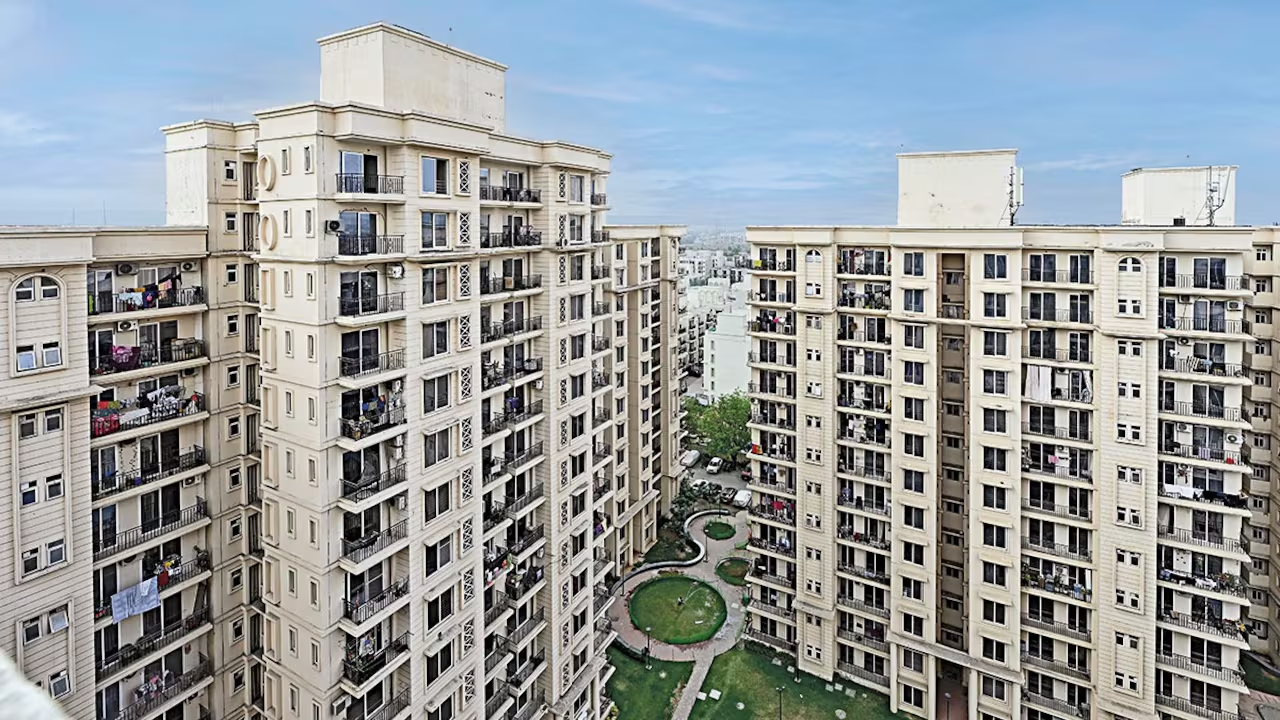
India’s housing market is moving further towards expensive homes, with new supply increasingly concentrated in premium and luxury segments across major cities. The shift, highlighted in fresh industry data, comes as developers strengthen their finances but lower- and middle-income buyers face rising prices. For urban India, the change raises a wider question: whether new housing supply is keeping pace with the needs of a broad population.

The clearest change is visible in launch patterns. Homes priced below ₹1.5 crore represented 85% of new launches across the top seven cities in Q1 2022. That proportion fell to 57% in Q1 2025 and 47% in Q1 2026. Meanwhile, homes in the ₹1.5–4 crore bracket increased from 14% to 44% over the same period, while properties above ₹4 crore rose from 1% to 9%. The numbers point to more than a luxury-market boom. They suggest a change in the economics of urban development. Higher land prices, construction expenses and regulatory compliance costs have made lower-priced projects harder to structure commercially. At the same time, affluent buyers and NRIs have continued to support larger homes and premium developments.

For buyers outside that segment, however, the consequences are more immediate. Rising property values combined with inflation and financing costs can push home ownership further out of reach. The premium housing India trend therefore has implications beyond developers’ sales strategies, affecting where households can afford to live and how cities accommodate workers, families and first-time buyers. Market performance is also becoming more uneven geographically. Housing sales in Q1 2026 fell 11% in Pune and Delhi-NCR and 7% in the Mumbai Metropolitan Region. Southern markets were comparatively stronger, with sales rising 9% in Chennai, 5% in Bengaluru and 1% in Hyderabad. Kolkata and Ahmedabad also recorded growth.

Developers, meanwhile, have entered this uncertain environment with stronger balance sheets. Their debt-to-collections ratio declined from 1.80 times in FY20 to 0.68 times in FY26, while bookings exceeded ₹1.5 lakh crore and collections crossed ₹90,000 crore. Smaller developers remain more exposed to higher input costs and weaker financial flexibility. For premium housing India, the next phase will depend not only on affluent demand but also on whether cities can maintain a balanced housing mix. RERA oversight, transparent project delivery and better land-use planning will remain important as urban expansion continues. A resilient housing market ultimately needs financial strength alongside homes that remain accessible to a wider range of citizens.

Also Read: NCR Housing Prices Rise as RERA Regulates Supply
India RERA Flags Premium Housing Affordability Gap
RELATED ARTICLES

LEAVE A REPLY

Please enter your comment!
Please enter your name here

- Advertisment -spot_img

Most Popular

Recent Comments

Bengaluru Office Lease Puts RERA Rules In Focus

Bengaluru Office Lease Puts RERA Rules In Focus

Bengaluru is set for another large corporate office commitment, with German semiconductor company Infineon Technologies taking about 6.3 lakh sq ft in Whitefield under...
Delhi NCR RERA Checks Commercial Real Estate Growth

Delhi NCR RERA Checks Commercial Real Estate Growth

India’s commercial property market is entering the second half of 2026 with occupiers and investors placing greater weight on connectivity, building quality, flexibility and...
Bengaluru Low Carbon Cement Gets Fresh Funding

Bengaluru Low Carbon Cement Gets Fresh Funding

A Bengaluru climate-tech company has raised ₹12.5 crore in seed funding to expand production of materials that can reduce cement use in concrete. The...
Odisha Aluminium Expansion Signals New Industrial Competition

Odisha Aluminium Expansion Signals New Industrial Competition

BHUBANESWAR: India’s aluminium sector could see a new competitive phase as Reliance Industries explores a possible move into aluminium, while a separate $11.5 billion...
India Steel Demand Signals Stronger Urban Buildout

India Steel Demand Signals Stronger Urban Buildout

India’s steel market is entering FY27 with demand growing faster than production, pointing to sustained activity across construction, infrastructure and manufacturing. Finished steel consumption...
