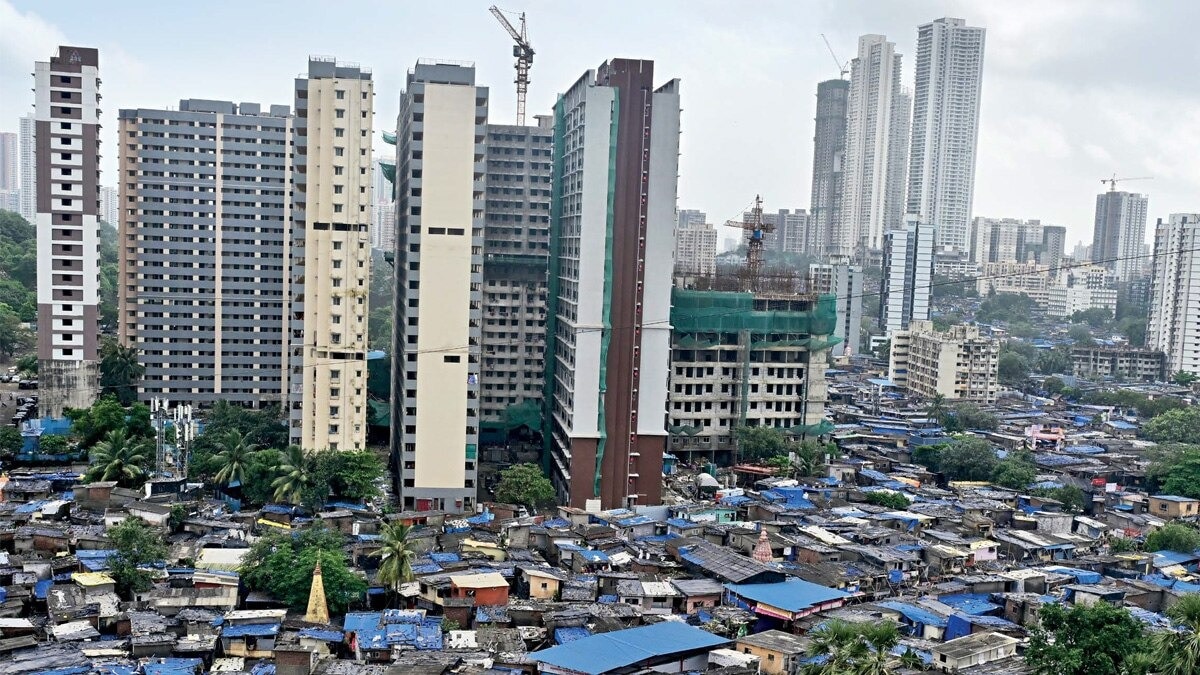
Mumbai’s long-awaited shift towards large-scale, integrated slum redevelopment moved a step closer this week as the Maharashtra government notified a new framework aimed at reorganising some of the city’s largest informal settlements into planned, serviced neighbourhoods. Officials said the policy could unlock significant land potential in a city struggling with constrained supply, ageing housing stock and widening inequality.
The framework replaces Mumbai’s earlier fragmented redevelopment model, which relied on individual plots and project-wise proposals. Under the new rules, clusters must measure at least 50 acres and contain a minimum slum occupation of 51 per cent. A senior housing department official said the intention is to “move from piecemeal redevelopment to coordinated transformation”, enabling consistent rehabilitation housing, shared amenities and improved infrastructure.
One of the most notable shifts is the inclusion of almost all land categories private, state-owned and municipal. Large slum belts frequently cut across different ownerships, making redevelopment difficult under past norms. While central government and PSU land will still require consent, the new mechanism removes a longstanding barrier that kept large parcels locked in administrative bottlenecks.Cluster identification will be undertaken by the Slum Rehabilitation Authority (SRA), which will also serve as the nodal agency. A high-powered committee comprising senior officials from the state housing department, SRA and the municipal corporation will evaluate each proposal.
This committee will determine cluster boundaries, infrastructure design, phasing, and the balance between rehabilitation and sale components before forwarding proposals for final approval under Section 3K of the Maharashtra Slum Areas Act.Consent from slum residents, previously a central requirement, has been waived. Officials argue that city-scale redevelopment requires predictable timelines and reduced procedural delays. However, urban planners warn that the state must ensure transparent communication and participatory mechanisms to safeguard community trust and long-term equity.
The framework also allows ongoing schemes approved under earlier development regulations to merge into new clusters. Non-slum structures including commercial units, cessed buildings, industrial premises and government offices may be retained or redeveloped depending on structural conditions. Their existing entitlement will be preserved even if layouts are reconfigured. Developers may be selected through competitive bidding, joint ventures with government bodies or priority allocation to an entity already controlling 40 per cent of land within the cluster. Each selected developer will be responsible for a comprehensive master plan detailing housing, internal mobility, community amenities, utilities and open spaces. Planning norms include a minimum 12 per cent open space within the slum area (with limited relaxations), community facilities proportional to the rehabilitation area, and integrated road and fire-safety systems.
Coastal Regulation Zone slums may also be redeveloped, provided residents are relocated within the same cluster.If private owners choose not to participate, they may accept developed land value or face acquisition under the 2013 land acquisition law. Compensation costs will be borne by the project proponent.
Industry experts believe the new framework could reshape Mumbai’s property pipeline by consolidating fragmented parcels and improving urban liveability through better infrastructure and planned layouts. However, they note that successful implementation will depend on coordination across agencies and the capacity to manage complex, multi-stakeholder redevelopment at scale. For residents, the long-term promise lies in safer homes, improved services and more equitable access to city infrastructure.
Mumbai Unveils Major Slum Cluster Redevelopment Framework To Unlock Urban Land Potential