
HomeMarket AnalysisBangaloreBengaluru Real Estate Shifts Towards Economic Corridors

Bengaluru Real Estate Shifts Towards Economic Corridors

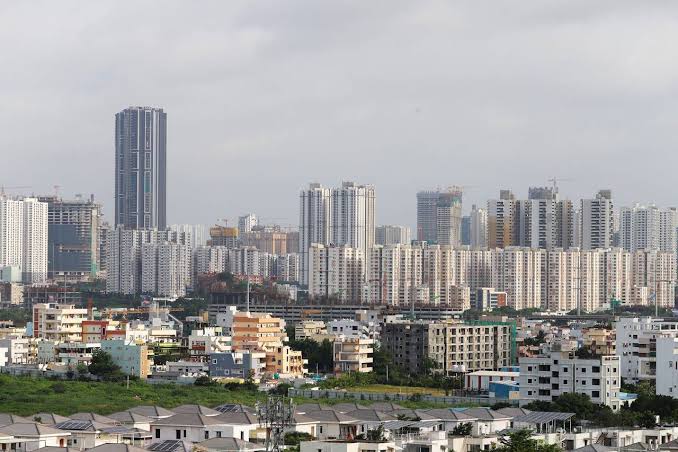
Bengaluru: Bengaluru’s next phase of real estate expansion is increasingly being shaped by where jobs, businesses and transport infrastructure converge. The city’s office market remains heavily supported by Global Capability Centres (GCCs), while new housing and commercial development is extending towards peripheral employment corridors. The shift is creating opportunities for new urban centres, but also raises questions about connectivity, affordability and infrastructure capacity.

The link between employment and property demand is becoming increasingly visible. In the first half of 2026, Bengaluru recorded 5.36 million sq ft of GCC leasing, the highest among Indian cities, according to Cushman & Wakefield. GCCs accounted for 52% of the city’s office leasing in the second quarter, while the Outer Ring Road and Peripheral East remained the strongest office demand locations. This concentration matters because employment clusters influence where people live, travel and spend. As companies establish offices, demand follows for housing, retail, schools, healthcare, hospitality and other services. A commercial corridor that attracts sustained employment can therefore evolve into a broader urban ecosystem rather than remaining an isolated office district. Bengaluru’s growth is already spreading beyond established central locations. Infrastructure projects such as the Satellite Town Ring Road are improving connections between peripheral areas including Hoskote, Anekal, Sarjapur, Doddaballapur, Devanahalli and Nelamangala. These links can shorten journeys between employment centres and residential markets, although their long-term impact will depend on how effectively they connect with public transport and local road networks.

The Bengaluru growth corridors are also developing against a more complicated housing market. The city recorded 27,968 housing sales during the first half of 2026, while developers launched 34,749 new homes, according to market data reported by Knight Frank. At the same time, rising land and construction costs are putting pressure on affordability, particularly for middle-income households. That creates a challenge for outward expansion. New housing can support economic decentralisation, but homes located far from employment and reliable public transport can increase commuting distances and dependence on private vehicles. Infrastructure therefore needs to develop alongside housing rather than after large residential clusters have already emerged.

The commercial market presents a similar lesson. Colliers expects GCCs to account for around half of India’s office demand in 2026 and 2027, while Bengaluru and Hyderabad have together accounted for more than 60% of GCC leasing since 2021. This suggests that employment-led development will remain an important factor in India’s urban real estate landscape. For Bengaluru, the priority is not simply to identify the next property hotspots. It is to build connected districts where jobs, homes, public transport and essential services can function together. The strongest Bengaluru growth corridors will ultimately be those that reduce travel burdens while supporting diverse housing and employment. As the city expands, coordinated planning will determine whether peripheral development becomes a collection of disconnected projects or a network of liveable urban centres. Aligning economic activity with mobility, housing and social infrastructure could allow Bengaluru to accommodate growth without deepening its existing pressures on congestion, affordability and everyday access.

Read More: Hyderabad Toopran Lands Cleared From Waqf Listing
Bengaluru Real Estate Shifts Towards Economic Corridors
RELATED ARTICLES

LEAVE A REPLY

Please enter your comment!
Please enter your name here

- Advertisment -spot_img

Most Popular

Recent Comments

Kolkata Residential Growth Gains Momentum Near EM Bypass

Kolkata Residential Growth Gains Momentum Near EM Bypass

Kolkata: A new 702-unit residential development in Jagaddal is adding to the housing supply along Kolkata's Southern EM Bypass corridor, where improving transport links...

Pune Karvenagar Roads Set To Boost Property Access

Pune Karvenagar Roads Set To Boost Property Access

Pune: The Pune Municipal Corporation (PMC) is accelerating land acquisition for two planned roads in Karvenagar as the city prepares for the opening of...

Maharashtra Housing Rules Draw Widespread Society Concerns

Maharashtra Housing Rules Draw Widespread Society Concerns

Mumbai: Maharashtra's proposed 2026 model bylaws for cooperative housing societies have drawn more than 5,000 objections and suggestions, putting parking, redevelopment, society charges and...

Mumbai MMR Housing Plan Targets 30 Lakh Homes

Mumbai MMR Housing Plan Targets 30 Lakh Homes

Mumbai: Maharashtra’s government has outlined a plan to develop 30 lakh homes across Mumbai and the Mumbai Metropolitan Region over the next 15 to...

Hyderabad Toopran Lands Cleared From Waqf Listing

Hyderabad Toopran Lands Cleared From Waqf Listing

Hyderabad: The Telangana High Court has set aside a 2001 Gazette notification that classified 5.8 acres of land in Toopran village, Medak district, as...