HomeLatestKalyani Steels Director Exit Signals Governance Transition

Kalyani Steels Director Exit Signals Governance Transition

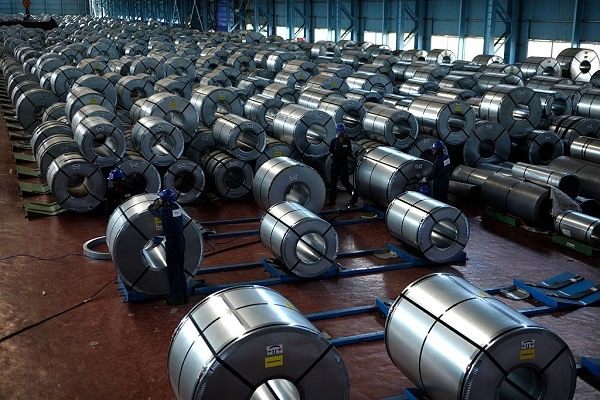
Kalyani Steels Board Transition Reflects Evolving Corporate Governance Standards.

Kalyani Steels has announced a change in its board composition following the cessation of an independent director’s tenure, marking another governance transition for an Indian steel producer operating in a sector that is increasingly shaped by investor scrutiny,regulatory compliance and sustainability expectations.While the development does not directly affect manufacturing operations, it highlights the growing significance of corporate oversight in industries supporting India’s infrastructure and industrial growth.The change comes as listed companies across India continue to strengthen governance frameworks in response to evolving regulatory standards and rising expectations from shareholders,lenders and institutional investors. Independent directors play a key role in ensuring balanced decision making, strengthening board accountability and providing oversight on matters relating to strategy,risk management and stakeholder interests.The Corporate Governance framework within heavy industries has gained greater prominence as steel manufacturers navigate rising capital requirements,energy transition challenges and increasing environmental obligations.Analysts note that governance practices are no longer viewed solely as compliance measures but as indicators of a company’s long-term resilience and operational credibility.India’s steel sector remains central to the country’s infrastructure ambitions,supplying materials for transport corridors,urban housing,renewable energy projects,industrial parks and public infrastructure.

As investment in these sectors expands, companies are expected to demonstrate not only production capability but also transparent governance that supports responsible capital allocation and sustainable business practices.Industry experts suggest that effective Corporate Governance contributes to stronger institutional confidence by ensuring independent oversight of strategic decisions,financial discipline and environmental risk management.This becomes particularly important as steel manufacturers invest in cleaner production technologies, digital manufacturing systems and decarbonisation initiatives that require significant long term capital commitments.Urban planners also emphasise that governance standards have wider implications for sustainable development. Responsible board oversight can influence decisions related to resource efficiency, workplace safety, community engagement and climate-related disclosures, all of which affect how industrial activity aligns with broader urban resilience goals. Transparent governance is increasingly recognised as an essential component of sustainable manufacturing rather than merely a regulatory requirement.Market specialists point out that periodic board changes are a normal aspect of listed company governance and often reflect statutory tenure limits or organisational restructuring. Such transitions generally provide an opportunity to refresh board expertise and ensure that companies remain equipped to address emerging business risks, technological shifts and evolving stakeholder expectations.

For investors, governance continuity remains an important consideration alongside financial performance.Strong boards are often viewed as better positioned to guide companies through market volatility,regulatory changes and the transition towards lower carbon industrial production without compromising operational stability.As India’s steel industry adapts to changing economic and environmental priorities,board effectiveness is likely to remain under close observation.Future competitiveness will increasingly depend not only on manufacturing efficiency but also on governance systems capable of supporting transparent decision making,responsible investment and sustainable industrial growth that benefits both cities and communities.

Also Read : Tata Steel Funding Move Reflects Expansion Priorities
Kalyani Steels Director Exit Signals Governance Transition
RELATED ARTICLES

LEAVE A REPLY

Please enter your comment!
Please enter your name here

- Advertisment -spot_img

Most Popular

Recent Comments

Odisha Steel Capacity Set to Reshape Industrial Growth

Odisha Steel Capacity Set to Reshape Industrial Growth

Odisha is preparing for a major expansion of its metals economy, with officials projecting installed steel capacity could reach 150–180 million tonnes within five...

SAIL Coking Coal Project Links West Bengal Blocks

SAIL Coking Coal Project Links West Bengal Blocks

Steel Authority of India Ltd (SAIL) and Bharat Coking Coal Ltd (BCCL) have agreed to jointly develop two adjoining coking coal blocks in West...
India Steel Output Gains As Global Production Slips

India Steel Output Gains As Global Production Slips

India’s steel industry continued to expand in August even as global crude steel production contracted, highlighting the country’s growing role in the international steel...
India Orders Captive Coal Plants to Boost Grid Supply

India Orders Captive Coal Plants to Boost Grid Supply

India is turning to its industrial captive power base as electricity demand remains unusually high for September, with 112 coal-based generating stations ordered to...
Andhra Pradesh Clears Land for Cement Expansion

Andhra Pradesh Clears Land for Cement Expansion

Andhra Pradesh has approved 250 acres for the expansion of an integrated cement facility in YSR Kadapa district, enabling planned production capacity to reach...