
HomeLatestMumbai FSI Deal Reshapes Khar Redevelopment Plans

Mumbai FSI Deal Reshapes Khar Redevelopment Plans

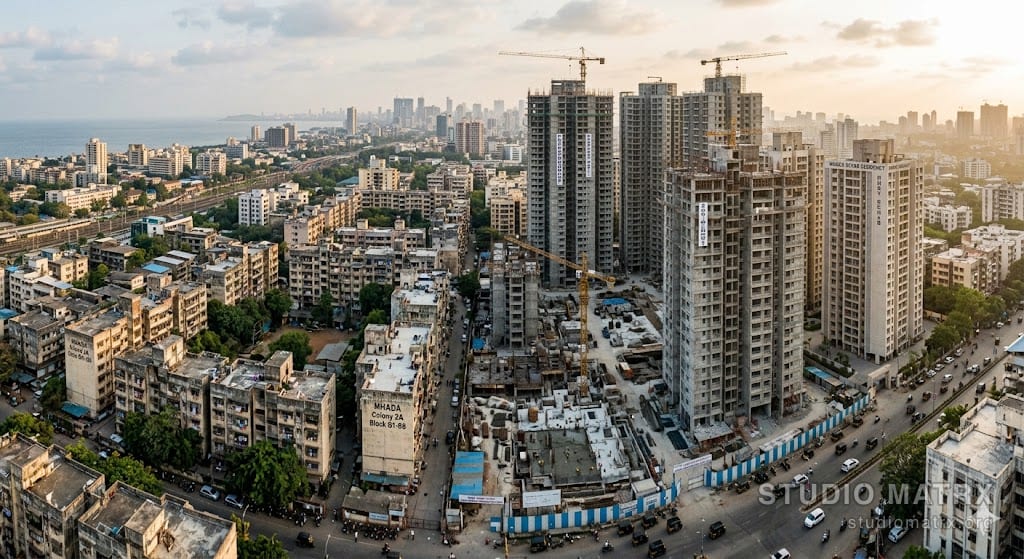
Mumbai’s redevelopment market is seeing a growing reliance on development rights rather than new land, with a Birla Estates subsidiary acquiring nearly 90,000 sq ft of floor space index for more than ₹159 crore. The rights, generated through a Slum Rehabilitation Authority scheme in Kandivali, will be transferred to a redevelopment project in Khar West. The transaction highlights how Mumbai is using transferable development capacity to unlock construction in land-constrained neighbourhoods.

The acquisition was completed by Unnatam Properties from two entities associated with the Parinee Group. Registration records show stamp duty of about ₹4.77 crore. The purchased FSI will not be used on the Kandivali site where it originated. Instead, it is intended for a larger property in Khar West, where two existing housing societies are being redeveloped. FSI, or floor space index, determines how much built-up floor area can be created on a plot relative to its size. In a city where developable land is scarce and property values are high, additional FSI can materially change the financial feasibility of redevelopment. The latest transaction therefore reflects a wider shift in Mumbai redevelopment towards assembling development rights alongside land and existing buildings.

The Khar project covers about 1.3 acres and marks the developer’s entry into Mumbai’s society-redevelopment segment. The project involves the reconstruction of two older housing societies through a joint arrangement with a local developer. The additional development potential acquired through the latest transaction could increase the amount of construction that can be accommodated within the eligible receiving site. For Mumbai, the significance extends beyond the ₹159 crore transaction. Transferable development rights allow construction potential created under one planning mechanism or location to support development elsewhere, subject to regulatory conditions. This can help make redevelopment financially viable without requiring developers to acquire large new land parcels.

But the model also places greater importance on how additional density is absorbed by neighbourhood infrastructure. More floor area can mean more residents, vehicles, water demand, sewage loads and pressure on public spaces. Mumbai redevelopment therefore needs to be assessed not only through the additional saleable area it creates, but also through the capacity of roads, drainage, public transport, open spaces and essential services around the receiving site. The transaction comes as Mumbai increasingly turns to redevelopment to renew ageing housing stock in established suburbs. That process can improve building safety and living conditions, but its long-term urban value will depend on whether higher development intensity is matched by stronger civic infrastructure and climate resilience. As land becomes increasingly scarce, development rights will remain an important part of Mumbai’s housing equation. The next test is ensuring that the additional construction capacity generated through such mechanisms translates into safer and more efficient neighbourhoods without allowing infrastructure deficits to grow alongside density.

Also Read: Mumbai Vile Parle Sees ₹12 Crore Home Deal
Mumbai FSI Deal Reshapes Khar Redevelopment Plans
RELATED ARTICLES

LEAVE A REPLY

Please enter your comment!
Please enter your name here

- Advertisment -spot_img

Most Popular

Recent Comments

Pune Karvenagar Roads Set To Boost Property Access

Pune Karvenagar Roads Set To Boost Property Access

Pune: The Pune Municipal Corporation (PMC) is accelerating land acquisition for two planned roads in Karvenagar as the city prepares for the opening of...

Maharashtra Housing Rules Draw Widespread Society Concerns

Maharashtra Housing Rules Draw Widespread Society Concerns

Mumbai: Maharashtra's proposed 2026 model bylaws for cooperative housing societies have drawn more than 5,000 objections and suggestions, putting parking, redevelopment, society charges and...

Mumbai MMR Housing Plan Targets 30 Lakh Homes

Mumbai MMR Housing Plan Targets 30 Lakh Homes

Mumbai: Maharashtra’s government has outlined a plan to develop 30 lakh homes across Mumbai and the Mumbai Metropolitan Region over the next 15 to...

Bengaluru Real Estate Shifts Towards Economic Corridors

Bengaluru Real Estate Shifts Towards Economic Corridors

Bengaluru: Bengaluru’s next phase of real estate expansion is increasingly being shaped by where jobs, businesses and transport infrastructure converge. The city’s office market...
Hyderabad Toopran Lands Cleared From Waqf Listing

Hyderabad Toopran Lands Cleared From Waqf Listing

Hyderabad: The Telangana High Court has set aside a 2001 Gazette notification that classified 5.8 acres of land in Toopran village, Medak district, as...